


01 Sep छत्तीसगढ़ ने क्रिटिकल मिनरल्स में बढ़ाई भूमिका, UPSC परीक्षा हेतु महत्वपूर्ण
✎ This phase included five mineral blocks from Chhattisgarh, underscoring the state’s pivotal role in India’s critical mineral ecosystem.
Subject Relevance — Where This Topic Fits
- GS Paper II — Government Policies and Interventions for Development | GS Paper III — Mineral and Energy Resources, Industrial Policy, and Sustainable Development
- Prelims: Critical Minerals, Mineral Auction Regime, National Mineral Exploration Policy (NMEP), Mines and Minerals (Development and Regulation) Act, 1957, State Mineral Policy, Mineral Security, Rare Earth Elements, Graphite, Vanadium, Titanium, Molybdenum, Tungsten
- Essay: India’s Quest for Self-Reliance in Strategic Resources: Balancing Growth and Sustainability, The Role of State Governments in India’s Mineral Economy: A Case Study of Chhattisgarh
Why is this in the news?
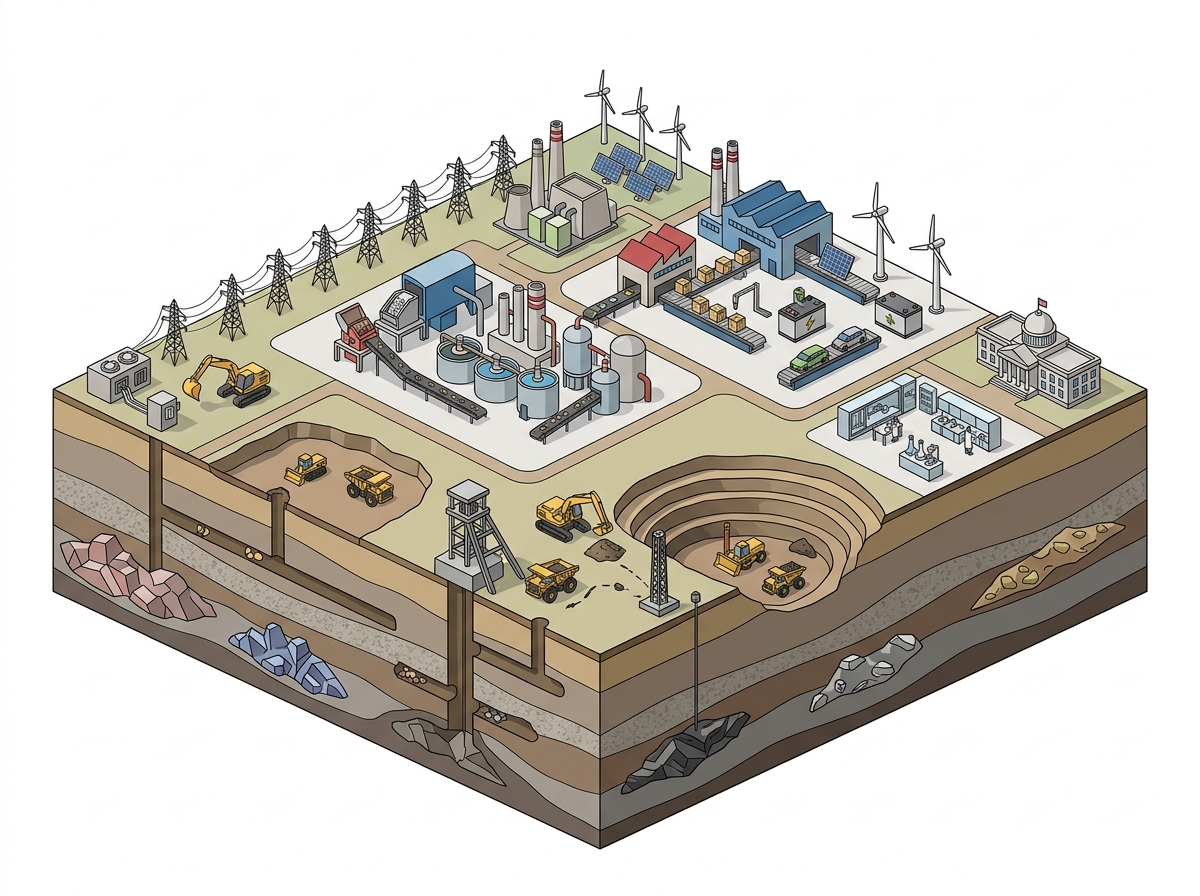
This phase included five mineral blocks from Chhattisgarh, underscoring the state’s pivotal role in India’s critical mineral ecosystem. The event, attended by the Chief Minister of Chhattisgarh, Union Minister of State for Coal and Mines, and senior officials, highlighted the state’s mineral potential, policy reforms, and the need for accelerated exploration, investment, and sustainable mineral development to support India’s industrial growth, energy transition, and strategic autonomy.
Background
- The global demand for critical minerals has surged due to their indispensable role in clean energy technologies, advanced manufacturing, and defence applications, necessitating robust domestic supply chains.
- India, with its vast mineral resources, has been progressively reforming its mineral governance framework to enhance transparency, efficiency, and investor confidence through auctions and policy liberalisation.
- The National Mineral Exploration Policy (NMEP), 2016, aims to bridge the gap between mineral potential and actual exploration by promoting public-private partnerships and leveraging advanced technologies.
- Chhattisgarh, a mineral-rich state in central India, contributes significantly to India’s coal, iron ore, and bauxite production, with emerging potential in critical minerals such as graphite, rare earth elements, and vanadium.
- The Union Government’s push for ‘Atmanirbhar Bharat’ in critical minerals aligns with global trends, including the US Inflation Reduction Act and the EU Critical Raw Materials Act, which prioritise domestic supply chains and strategic autonomy.
What are Critical and Strategic Minerals?
- Critical minerals are defined as non-fuel mineral resources essential for economic or national security, with supply chains vulnerable to disruption due to geopolitical, technological, or market factors.
- Strategic minerals are those critical to defence, aerospace, and high-technology industries, where domestic availability is crucial for national security and technological sovereignty.
- Key critical minerals in India’s context include graphite, rare earth elements (REEs), vanadium, titanium, molybdenum, tungsten, gallium, potash, phosphate, and glauconite, all of which are essential for clean energy, electronics, and industrial applications.
- Graphite is vital for battery anodes in electric vehicles, while REEs are indispensable for permanent magnets in wind turbines and electric motors.
- Vanadium is critical for energy storage systems, titanium for aerospace and medical implants, and tungsten for high-temperature applications in defence and manufacturing.
- The demand for critical minerals is projected to grow exponentially, with the International Energy Agency (IEA) estimating a fourfold increase in mineral requirements for clean energy technologies by 2040.
- Sustainable mineral development requires balancing economic exploitation with environmental protection, community welfare, and technological innovation to minimise ecological footprints and maximise value addition.
Key Features
| Feature | Significance |
|---|---|
| Inclusion of five mineral blocks in the 8th phase of Critical & Strategic Mineral Blocks auction | Expands Chhattisgarh’s role in India’s critical mineral supply chain, enhancing domestic production capacity for minerals like graphite, rare earth elements, and titanium. |
| Composite Licence and Mining Lease offerings | Facilitates both exploration and commercial mining, reducing entry barriers for investors and enabling end-to-end mineral value chain development. |
| State government’s commitment to transparent mining processes | Ensures equitable benefit-sharing, particularly for tribal communities, and aligns with national objectives of sustainable and ethical mineral extraction. |
| Focus on value addition beyond mining | Encourages downstream industries (processing, refining, manufacturing) to localise critical mineral supply chains, reducing import dependence. |
| Multi-stakeholder participation in roadshows | Bridges information gaps between policymakers, industry, and local stakeholders, fostering investment-friendly ecosystems. |
Why it Matters
Economic
- Enhances Chhattisgarh’s contribution to India’s GDP through increased mineral production and value addition, leveraging its rich mineral endowment.
- Attracts private investment in mining and allied industries, creating employment opportunities in mineral-rich districts.
- Strengthens domestic supply chains for critical minerals, reducing reliance on imports and improving trade balance.
Strategic
- Bolsters India’s mineral security by diversifying sources of critical minerals essential for clean energy, defence, and high-tech industries.
- Supports the transition to green technologies (e.g., rare earth elements for EVs, titanium for aerospace) through localised supply chains.
- Reduces geopolitical risks associated with import-dependent critical mineral sectors.
Environmental
- Promotes sustainable mining practices through transparent processes and technological interventions (e.g., mineral monitoring systems).
- Encourages responsible exploration to minimise ecological disruption, aligning with India’s climate commitments.
- Facilitates the development of eco-friendly mineral processing techniques to reduce pollution.
Social
- Ensures inclusive growth by involving tribal communities in mineral value chains, particularly through initiatives like the Tin Portal for transparent benefit-sharing.
- Enhances local infrastructure (transport, energy, skill development) through mineral-led industrialisation.
- Supports livelihoods of artisanal miners by integrating them into formal value chains.
Challenges
1. Regulatory and Policy Hurdles
- Complexity in obtaining environmental clearances and forest rights approvals for mining projects, delaying operationalisation.
- Need for harmonised state-centre policies to avoid regulatory overlaps and ensure seamless compliance.
- Ensuring adherence to the Forest Rights Act (FRA) while expediting mineral exploration in tribal areas.
UPSC Link: GS-II: Forest Rights Act 2006
2. Infrastructure Bottlenecks
- Limited transport connectivity in mineral-rich but remote districts, increasing logistical costs.
- Inadequate power supply for mineral processing units, necessitating dedicated energy solutions.
- Shortage of skilled labour for advanced mineral processing and value addition.
UPSC Link: GS-III: Infrastructure Development
3. Environmental and Ethical Concerns
- Risk of ecological degradation due to unregulated mining activities in biodiversity-rich regions.
- Need for strict enforcement of the Sustainable Development Framework for Mining (SDFM) guidelines.
- Addressing community resistance to mining projects due to perceived environmental and social costs.
UPSC Link: GS-III: Environmental Impact Assessment
4. Market and Technological Gaps
- Limited domestic capacity for processing and refining critical minerals, leading to export of raw materials.
- Dependence on imported technology for advanced mineral extraction and beneficiation.
- Fluctuating global prices of critical minerals affecting investor confidence.
UPSC Link: GS-III: Technology and Innovation
5. Land and Resource Conflicts
- Competing land uses (agriculture, forestry, mining) leading to disputes and delays in project approvals.
- Need for robust land acquisition and rehabilitation policies to mitigate conflicts.
- Ensuring fair compensation and resettlement for displaced communities.
UPSC Link: GS-II: Land Acquisition Act 2013
Challenges — UPSC Perspective
| Issue | Concern |
|---|---|
| Environmental Clearances | Delays in project approvals due to stringent EIA norms and public hearings. |
| Forest Rights Act Compliance | Challenges in securing consent from forest-dwelling communities for mining activities. |
| Logistics and Connectivity | High transportation costs due to poor road and rail infrastructure in mineral-rich regions. |
| Skill Gaps | Shortage of trained personnel for advanced mineral processing and value addition. |
| Market Volatility | Uncertainty in mineral prices affecting long-term investment planning. |
| Community Opposition | Resistance from local communities due to environmental and social concerns. |
Way Forward
- Establish a dedicated Mineral Development Corporation in Chhattisgarh to streamline exploration, mining, and value addition, leveraging state-level expertise.
- Accelerate the development of mineral-specific industrial clusters in districts like Dantewada and Bastar, focusing on downstream industries.
- Strengthen skill development programmes in collaboration with ITIs and polytechnics to build a local talent pool for mineral processing.
- Fast-track environmental and forest clearances for mineral blocks through a single-window clearance mechanism, ensuring compliance with FRA.
- Invest in critical mineral-specific infrastructure, including dedicated freight corridors and renewable energy-based processing units.
- Promote public-private partnerships (PPPs) for mineral exploration and mining, with transparent bidding processes to attract global investors.
- Develop a state-level mineral policy aligned with the National Mineral Policy 2019, incorporating sustainable and inclusive mining practices.
- Enhance technological adoption in mining through pilot projects for AI-driven mineral mapping and blockchain-based benefit-sharing systems.
UPSC Value Addition
Keywords for Mains Answer-Writing
Critical Minerals Mission · Mineral Security Partnership · National Mineral Policy 2019 · Commercial Mining of Coal · Auction of Mineral Blocks · Critical Mineral Supply Chain · Strategic Mineral Resources · Mineral Exploration Framework · Sustainable Mining Practices · Atmanirbhar Bharat in Minerals · State-Private Partnership in Mining · Mineral Value Addition · Graphite and Rare Earth Elements · Mineral Policy Reforms · Mineral-Based Industrialization
Constitutional & Policy Linkages
- Article 244: Administration of Scheduled Areas and Tribal Areas (FRA compliance).
- Article 299: Contracts entered by the State Government (mineral block auctions).
Concept Flow
Identification of Critical & Strategic Minerals → → Auction of Mineral Blocks (Composite Licence/Mining Lease) → → Exploration and Mining Operations → → Value Addition (Processing, Refining) → → Industrial Integration (Manufacturing, Green Energy) → → Economic Growth (GDP, Employment) → → Mineral Security (Reduced Import Dependence)
Prelims Practice Questions
Q1. Consider the following statements regarding the auction of critical and strategic mineral blocks in India:
1. The eighth phase of auction includes 20 mineral blocks across nine states.
2. The blocks include minerals such as graphite, rare earth elements, and vanadium.
3. The auction is conducted under the provisions of the Mines and Minerals (Development and Regulation) Act, 1957.
4. The auction is mandatory for all mineral blocks identified by the central government.
How many of the above statements are correct?
- Only one
- Only two
- Only three
- All
Answer: Only three — Statements 1, 2, and 3 are correct. The eighth phase includes 20 blocks across nine states, and these blocks cover minerals like graphite, rare earth elements, and vanadium. The auction is conducted under the MMDR Act, 1957. Statement 4 is incorrect as the auction is not mandatory for all blocks; it is based on the discretion of the central government and state policies.
Q2. Assertion (A): The National Mineral Policy 2019 emphasizes the need for sustainable mining practices and value addition in the mineral sector.
Reason (R): The policy aims to reduce India’s dependence on mineral imports and strengthen domestic supply chains.
Options:
A. Both A and R are true, and R is the correct explanation of A.
B. Both A and R are true, but R is not the correct explanation of A.
C. A is true, but R is false.
D. A is false, but R is true.
Answer: ? — Both Assertion (A) and Reason (R) are true. The National Mineral Policy 2019 indeed emphasizes sustainable mining practices and value addition to reduce import dependence. However, Reason (R) is not the only explanation for Assertion (A), as the policy also focuses on transparency, ease of doing business, and technological advancements in mining.
Q3. Match the following minerals with their respective categories as identified in India’s critical mineral framework:
Column I (Mineral) Column II (Category)
A. Graphite 1. Critical Mineral
B. Coal 2. Strategic Mineral
C. Rare Earth Elements 3. Fuel Mineral
D. Molybdenum 4. Minor Mineral
Options:
A. A-1, B-3, C-1, D-2
B. A-2, B-3, C-1, D-4
C. A-1, B-4, C-2, D-1
D. A-3, B-2, C-1, D-4
Answer: ? — Graphite and Rare Earth Elements are classified as Critical Minerals, Coal is a Fuel Mineral, and Molybdenum is a Strategic Mineral under India’s critical mineral framework. The correct match is A-1, B-3, C-1, D-2.
Mains Practice Question
✍ The auction of critical and strategic mineral blocks represents a pivotal shift in India’s mineral governance framework. Critically examine the significance of this initiative for India’s mineral security and industrialization, with reference to the National Mineral Policy 2019 and recent reforms. Also, discuss the challenges in achieving sustainable mineral development in the context of tribal communities and environmental concerns. (15 Marks)
Approach: MODEL-ANSWER SKELETON:
1. **Introduction** (2 marks): Define critical minerals and their strategic importance for India’s economy, energy transition, and self-reliance goals. Mention the National Mineral Policy 2019 and its objectives.
2. **Significance of Auction Mechanism** (4 marks):
– **Mineral Security**: Reduces import dependence (e.g., rare earth elements, graphite) by promoting domestic exploration and production.
– **Industrialization**: Supports sectors like electronics, renewable energy, and defence through assured supply of critical minerals.
– **Revenue Generation**: Auction proceeds contribute to state and central exchequers, enabling reinvestment in infrastructure and social development.
– **Transparency and Efficiency**: Aligns with MMDR Act reforms (2021) to ensure transparent allocation, ease of doing business, and technological adoption.
3. **Role of State Governments** (3 marks):
– Highlight the partnership model where states like Chhattisgarh leverage their mineral endowments (e.g., graphite, rare earth elements) to attract investment.
– Discuss the role of State Mineral Development Corporations (e.g., Chhattisgarh Mineral Development Corporation) in facilitating exploration and value addition.
– Mention the need for state-level policies to complement central initiatives, including land acquisition and regulatory clearances.
4. **Challenges in Sustainable Development** (4 marks):
– **Environmental Concerns**: Mining activities can lead to deforestation, water pollution, and biodiversity loss. Highlight the need for adherence to environmental impact assessment norms and the Forest Rights Act, 2006.
– **Tribal Communities**: Address displacement, loss of livelihoods, and cultural erosion. Discuss the importance of Free, Prior, and Informed Consent (FPIC) and benefit-sharing mechanisms.
– **Technological and Financial Constraints**: Limited domestic capacity for processing and refining critical minerals; dependence on foreign technology.
– **Regulatory Bottlenecks**: Delays in clearances, overlapping jurisdictions between central and state authorities, and lack of skilled workforce.
5. **Way Forward** (2 marks):
– Strengthen public-private partnerships for R&D in mineral processing and recycling.
– Promote skill development and technology transfer to build domestic capabilities.
– Ensure robust monitoring mechanisms for sustainable mining practices and community welfare.
Source: PIB (Press Information Bureau)
Chhattisgarh PCS (CGPSC) — State PCS Practice
Prelims: Which recent initiative by the Government of Chhattisgarh has strengthened the state’s role in India’s Critical Mineral Ecosystem?
- A. Launch of the ‘Chhattisgarh Mineral Development Mission’ to promote sustainable mining
- B. Signing of MoUs with global firms for lithium and graphite exploration
- C. Establishment of a dedicated ‘Critical Mineral Policy’ for the state
- D. Inclusion of Chhattisgarh in the Union Government’s ‘Critical Mineral Mission’ as a nodal state
Answer: A. Launch of the ‘Chhattisgarh Mineral Development Mission’ to promote sustainable mining — The ‘Chhattisgarh Mineral Development Mission’ was launched to enhance sustainable mineral extraction and processing, aligning with the state’s commitment to critical minerals.
Mains: Discuss the significance of Chhattisgarh’s emerging role in India’s Critical Mineral Ecosystem. How can the state leverage its mineral resources to boost its economy while ensuring environmental sustainability and tribal welfare? (200 words)
Generated by AanyaAi for educational purpose.
Related guides on our sites
- How to prepare for GS paper 1 for UPSC CSE mains exam
- Best UPSC coaching for IFOS exam
- Best mentorship programme for upsc
- UPSC+BA degree

- UPSC Alert: 40-Day ‘Khet Bachao Abhiyan’ Launch by Union Minister - October 22, 2026
- भारत ने बताया UN रिपोर्ट में दाऊद इब्राहिम को ‘भारत-आधारित’ बताना ‘गलत’ - October 22, 2026
- GRAP Stage I activated in Delhi-NCR amid rising AQI: Key actions for aspirants - October 22, 2026

No Comments