


01 Sep Bima Sakhi Scheme: UPSC Perspective on Women Empowerment in Insurance Sector
✎ The Bima Sakhi scheme is a flagship initiative to promote women-led entrepreneurship and financial inclusion by training and incentivising women to serve as life insurance agents in rural India, with structured stipends and…
Subject Relevance — Where This Topic Fits
- GS Paper III — Economy: Financial Inclusion, Insurance Sector Reforms, Rural Development | GS Paper III — Economy: Women Empowerment and Entrepreneurship | GS Paper II — Governance: Role of DRDA and District-Level Implementation Agencies
- Prelims: Bima Sakhi scheme, LIC Kadapa division, DRDA (District Rural Development Agency), Financial inclusion, Insurance penetration in rural India, Women entrepreneurship, Life insurance agents, Rural development schemes
- Essay: The role of women in India’s economic transformation: From inclusion to leadership, Financial inclusion as a tool for rural empowerment and sustainable development
Quick Revision: The Bima Sakhi scheme is a flagship initiative to promote women-led entrepreneurship and financial inclusion by training and incentivising women to serve as life insurance agents in rural India, with structured stipends and commission-based earnings.
Why is this in the news?
The Bima Sakhi scheme has been prominently featured in recent discussions following its recognition for significantly enhancing women’s entrepreneurship and expanding life insurance coverage in rural areas, particularly in Kadapa district, Andhra Pradesh. The scheme’s structured incentives and institutional support have demonstrated measurable impact on rural insurance penetration, making it a noteworthy model for replication across India’s hinterland.
Background
- The life insurance sector in India has historically faced challenges in rural penetration, with low awareness, limited access, and socio-economic barriers hindering coverage among marginalised populations.
- The Insurance Regulatory and Development Authority of India (IRDAI) has consistently emphasised financial inclusion as a national priority, encouraging innovative models to expand insurance reach, particularly in rural and semi-urban areas.
- District Rural Development Agencies (DRDAs), established under the Ministry of Rural Development, play a pivotal role in implementing rural development schemes and fostering grassroots entrepreneurship, including in the financial sector.
- The Life Insurance Corporation of India (LIC), a state-owned insurer, remains a dominant player in India’s life insurance market, with a mandate to extend social security through affordable and accessible insurance products.
- Women’s participation in the formal financial sector has been constrained by socio-cultural norms, limited mobility, and lack of awareness, despite their critical role in household financial decision-making.
What is the Bima Sakhi scheme?
- The Bima Sakhi scheme is designed to empower women by enabling them to work as life insurance agents, thereby fostering entrepreneurship and financial inclusion in rural areas.
- Under the scheme, women who have completed their Secondary School Certificate (SSC) examinations and are at least 18 years of age are eligible to enrol as ‘Bima Sakhis’ (insurance sisters), serving as intermediaries between insurers and potential policyholders.
- The scheme provides a structured incentive mechanism, including a monthly stipend during the first three years of service: ₹7,000 in the first year, ₹6,000 in the second year, and ₹5,000 in the third year, in addition to standard commission-based earnings.
- Bima Sakhis are tasked with promoting life insurance products, conducting awareness campaigns, and facilitating policy issuance, thereby bridging the gap between insurers and underserved communities.
- The scheme leverages the social capital of women in rural areas, who often enjoy greater trust and accessibility within their communities, thereby enhancing the credibility and uptake of insurance products.
- Institutional support is provided through partnerships with DRDAs, local self-government bodies, and insurers like LIC, ensuring training, monitoring, and access to resources for Bima Sakhis.
- Performance metrics indicate that Bima Sakhis have contributed significantly to insurance penetration in districts like Kadapa, where they account for nearly 18% of the division’s business, demonstrating the scheme’s scalability and impact.
Key Features
| Feature | Significance |
|---|---|
| Target demographic | Women aged 18+ with minimum SSC qualification, enabling inclusive entrepreneurship in rural and semi-urban areas. |
| Stipend structure | ₹7,000, ₹6,000, and ₹5,000 monthly for the first three years respectively, providing financial security during initial career establishment. |
| Commission-based remuneration | Primary income source for ‘Bima Sakhis’, incentivizing performance and sustainability of insurance distribution. |
| Rural outreach focus | Expands life insurance penetration in underserved regions, aligning with financial inclusion objectives. |
| Institutional integration | Collaboration between LIC, DRDA, and district administrations for implementation and monitoring. |
Why it Matters
Economic Empowerment
- Enhances women’s economic participation through formal sector employment in insurance distribution.
- Provides a structured career pathway for rural women with secondary education.
- Contributes to household income diversification, potentially reducing poverty in rural households.
Financial Inclusion
- Bridges the insurance coverage gap in rural and remote districts through localized agents.
- Facilitates access to life insurance for low-income and marginalized groups via community-based agents.
- Supports the achievement of Sustainable Development Goal 1 (No Poverty) and SDG 5 (Gender Equality).
Policy Implementation
- Demonstrates a targeted approach to skilling and employment generation under national schemes.
- Highlights the role of public sector insurance entities in executing government welfare initiatives.
- Showcases the efficacy of stipend-based incentives in fostering entrepreneurship among women.
Institutional Efficiency
- Leverages existing administrative structures (DRDA, LIC) for scalable implementation.
- Ensures accountability through local monitoring and performance tracking of ‘Bima Sakhis’.
- Promotes inter-departmental coordination for achieving socio-economic objectives.
Challenges
1. Sustainability of Income
- Dependence on commission-based earnings may expose agents to market fluctuations in insurance sales.
- Stipend phase-out after three years necessitates transition to self-sustaining income models.
UPSC Link: GS-III: Financial Inclusion
2. Geographical Disparities
- Uneven distribution of ‘Bima Sakhis’ across regions may leave certain areas underserved.
- Logistical challenges in remote and hilly terrains could hinder outreach and training.
UPSC Link: GS-II: Rural Development
3. Awareness and Trust Deficit
- Low financial literacy in rural areas may impede acceptance of insurance products.
- Distrust in formal financial institutions could reduce uptake despite agent availability.
UPSC Link: GS-III: Financial Literacy
4. Regulatory Compliance
- Ensuring adherence to IRDAI guidelines for agent licensing and conduct across diverse regions.
- Monitoring ethical practices to prevent mis-selling or coercion in policy acquisition.
UPSC Link: GS-III: Insurance Regulation
5. Scalability and Replicability
- Maintaining quality standards while scaling the model to other districts or states.
- Adapting the stipend structure to local economic conditions without diluting incentives.
UPSC Link: GS-II: Governance
6. Gender-Specific Barriers
- Cultural norms may restrict women’s mobility or participation in public roles as agents.
- Balancing domestic responsibilities with professional commitments for rural women.
UPSC Link: GS-I: Social Empowerment
Challenges — UPSC Perspective
| Issue | Concern |
|---|---|
| Income instability | Risk of agents discontinuing due to fluctuating commission-based earnings. |
| Regional imbalance | Concentration of ‘Bima Sakhis’ in high-revenue divisions like Kadapa. |
| Financial literacy | Low awareness of insurance products among target beneficiaries. |
| Regulatory oversight | Need for robust monitoring to prevent unethical practices in sales. |
| Cultural constraints | Social barriers to women’s participation in formal employment roles. |
| Scalability limits | Challenges in replicating the model in regions with weaker institutional support. |
Way Forward
- Conduct periodic financial literacy campaigns to enhance trust and understanding of insurance products among rural populations.
- Introduce a mentorship program pairing experienced ‘Bima Sakhis’ with new entrants to improve retention and performance.
- Expand the stipend phase-out period or introduce performance-linked extensions to ensure income stability post-incentive period.
- Strengthen last-mile delivery through mobile insurance units and digital onboarding tools to reduce logistical barriers.
- Establish a grievance redressal mechanism for policyholders and agents to address mis-selling or service issues.
- Integrate ‘Bima Sakhi’ agents with other government welfare schemes (e.g., PM-KISAN) for cross-sectoral benefits.
- Develop a standardized training curriculum with certification to enhance professional credibility and agent quality.
- Promote public-private partnerships to diversify income streams for agents beyond life insurance.
UPSC Value Addition
Keywords for Mains Answer-Writing
Bima Sakhi scheme · women entrepreneurship in insurance · rural insurance penetration · Life Insurance Corporation (LIC) · financial inclusion through women agents · insurance sector reforms · women empowerment in financial services · rural life insurance coverage · financial literacy and women · rural entrepreneurship development
Concept Flow
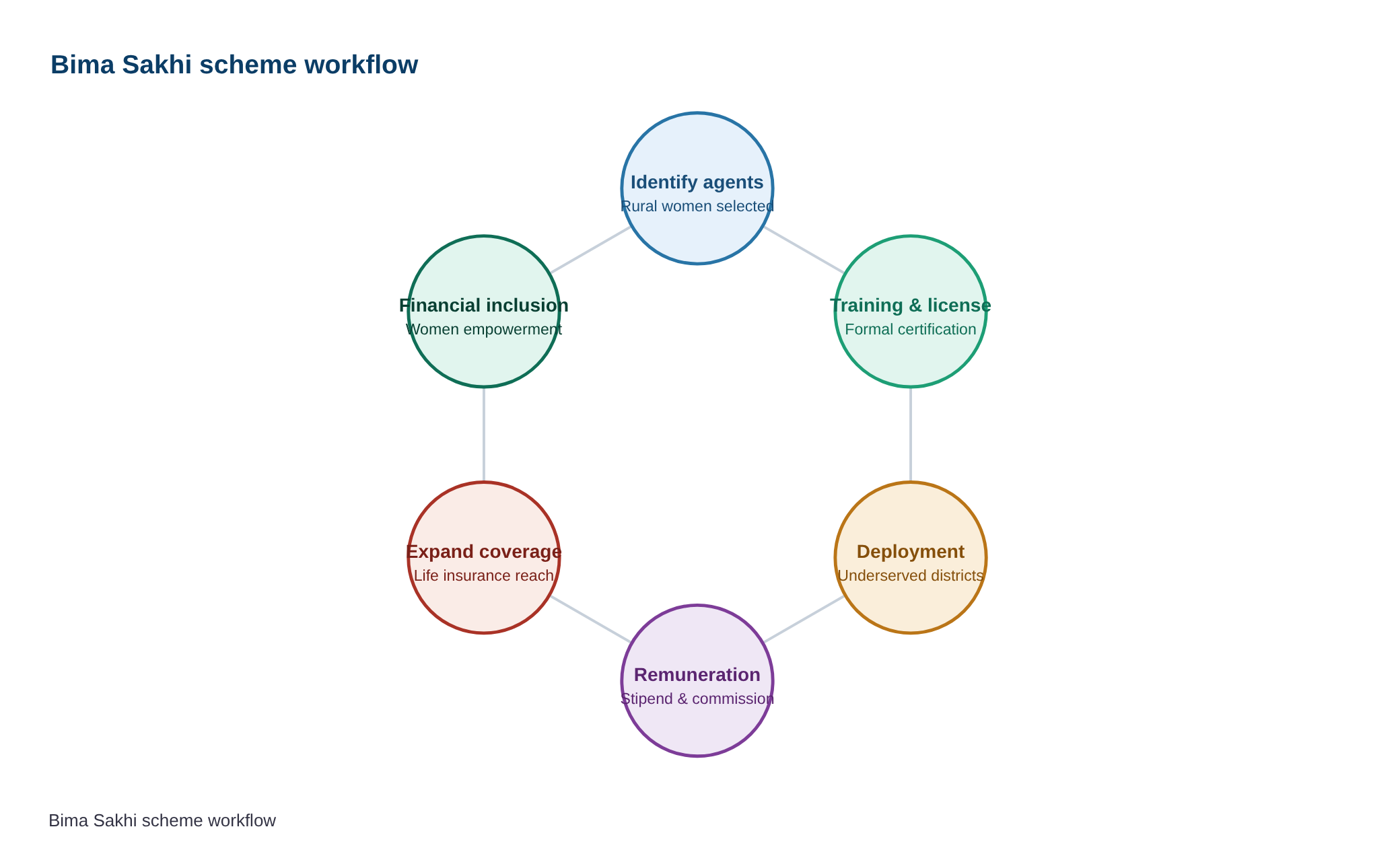
Identification of rural women as agents under ‘Bima Sakhi’ scheme → Completion of training and licensing → Deployment in underserved districts → Stipend and commission-based remuneration → Expansion of life insurance coverage → Financial inclusion and women’s economic empowerment → Monitoring and scaling for broader impact
Prelims Practice Questions
Q1. Consider the following statements regarding the ‘Bima Sakhi’ scheme:
1. It is a Central government initiative aimed at creating women entrepreneurs in the insurance sector.
2. The scheme provides a monthly stipend of ₹7,000 during the first year, ₹6,000 in the second year, and ₹5,000 in the third year.
3. The scheme is exclusively for women who have completed graduation and are above 25 years of age.
How many of the above statements are correct?
- Only one
- Only two
- All three
- None
Answer: Only two — Statements 1 and 2 are correct as per the scheme’s objectives and incentives. Statement 3 is incorrect because the scheme targets women who have completed SSC (Class 10) and are 18 years of age or older.
Q2. Assertion (A): The ‘Bima Sakhi’ scheme is designed to enhance rural insurance penetration by leveraging women entrepreneurs.
Reason (R): Women agents, being local to rural areas, can better connect with and understand the financial needs of rural communities.
In the context of the above statements, which of the following is correct?
- Both A and R are true, and R is the correct explanation of A.
- Both A and R are true, but R is not the correct explanation of A.
- A is true, but R is false.
- A is false, but R is true.
Answer: Both A and R are true, and R is the correct explanation of A. — Both the assertion and reason are true. The scheme’s design leverages local women agents to improve rural insurance coverage, making R a correct explanation of A.
Q3. Match the following columns related to the ‘Bima Sakhi’ scheme:
Column I (Scheme Feature) | Column II (Description)
————————–|—————————
A. Target Group | 1. Women who have completed SSC and are 18 years of age
B. Incentive Structure | 2. ₹7,000 (1st year), ₹6,000 (2nd year), ₹5,000 (3rd year)
C. Objective | 3. Enhance rural insurance penetration
D. Implementing Agency | 4. Life Insurance Corporation (LIC)
Select the correct match:
- A-1, B-2, C-3, D-4
- A-2, B-1, C-3, D-4
- A-1, B-2, C-4, D-3
- A-3, B-1, C-2, D-4
Answer: A-1, B-2, C-3, D-4 — The correct matches are: A-1 (Target Group), B-2 (Incentive Structure), C-3 (Objective), and D-4 (Implementing Agency).
Mains Practice Question
✍ The ‘Bima Sakhi’ scheme represents a significant initiative in leveraging women entrepreneurship to enhance financial inclusion in rural India. Critically examine the scheme’s design, objectives, and potential impact on rural insurance penetration. Also, discuss the broader implications for women’s empowerment and the challenges in scaling such initiatives. (15 Marks)
Approach: MODEL-ANSWER SKELETON:
1. **Introduction (2 marks)**: Define the ‘Bima Sakhi’ scheme, its origin (Central government initiative), and its primary objective of creating women entrepreneurs in the insurance sector to boost rural insurance penetration.
2. **Scheme Design and Key Features (4 marks)**:
– Target group: Women with SSC qualification and aged 18+.
– Incentive structure: Monthly stipend (₹7,000, ₹6,000, ₹5,000 over three years) alongside commission-based earnings.
– Role of LIC: Implementing agency, with local DRDA involvement for grassroots execution.
– Localised approach: Women agents as ‘Bima Sakhis’ act as intermediaries between LIC and rural households.
3. **Objectives and Expected Outcomes (3 marks)**:
– **Financial Inclusion**: Expand life insurance coverage in underserved rural areas.
– **Women Empowerment**: Provide livelihood opportunities, skill development, and financial independence to women.
– **Economic Impact**: Generate employment, stimulate local economies, and foster entrepreneurship among women.
4. **Potential Impact on Rural Insurance Penetration (3 marks)**:
– **Data from Kadapa Division**: 3,500 ‘Bima Sakhis’ contributing 18% of LIC’s business in the division, indicating scalability and revenue generation.
– **Trust and Accessibility**: Women agents, being part of the community, can bridge the trust deficit and accessibility barriers in rural insurance.
– **Sustainability**: Long-term viability depends on agent retention, training, and adaptability to market dynamics.
5. **Broader Implications for Women’s Empowerment (2 marks)**:
– **Agency and Autonomy**: Enhances women’s decision-making power within households and communities.
– **Skill Development**: Provides training in insurance products, financial literacy, and entrepreneurship.
– **Social Mobility**: Challenges traditional gender roles and promotes women’s participation in the formal economy.
6. **Challenges and Limitations (3 marks)**:
– **Scalability**: Replicating the model across diverse geographies with varying socio-economic conditions.
– **Agent Retention**: Ensuring long-term commitment amid fluctuating incomes and market competition.
– **Regulatory and Operational Hurdles**: Compliance with insurance regulations, agent licensing, and performance monitoring.
– **Awareness and Literacy**: Low financial literacy in rural areas may limit the scheme’s effectiveness without targeted awareness campaigns.
7. **Conclusion (2 marks)**: Summarise the scheme’s potential as a model for leveraging women’s entrepreneurship in financial inclusion, while acknowledging the need for supportive policies, infrastructure, and continuous evaluation to address challenges.
Source: The Hindu
Generated by AanyaAi for educational purpose.
Related guides on our sites
- Best PSIR optional coaching for upsc
- Best PSIR optional teacher for upsc
- Best teacher of PSIR optional for upsc
- Best PSIR optional coaching in delhi for UPSC


No Comments