


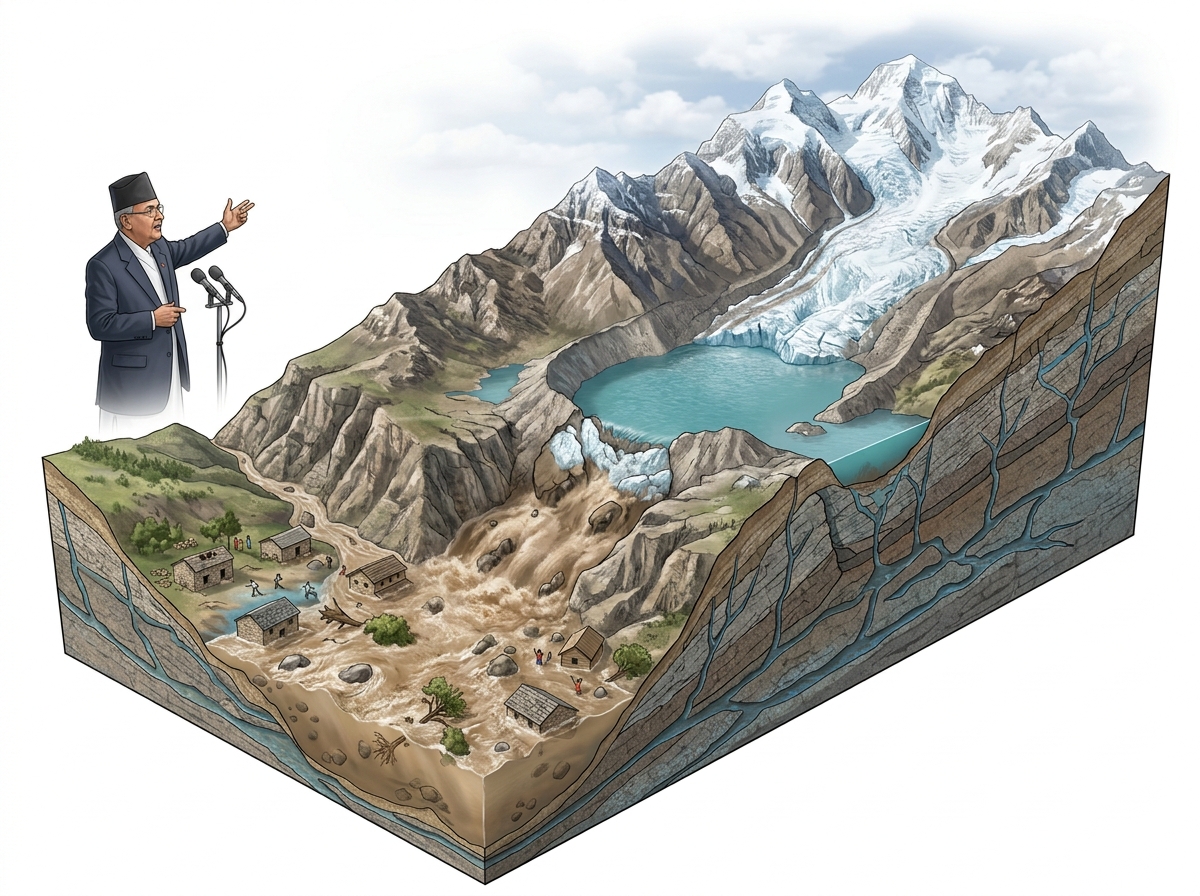
01 Sep Nepal PM Links Himalayan Floods to Climate Change: UPSC Relevance
✎ Glacial Lake Outburst Floods (GLOFs) in the Hindu Kush Himalayas are high-impact, climate-induced hydrological disasters requiring integrated transboundary governance, early warning systems, and community resilience measures to…
Subject Relevance — Where This Topic Fits
- GS Paper I — Geography of India and the World (Himalayan ecology, climate change impacts) | GS Paper III — Disaster Management (risk reduction, preparedness, and resilience) | GS Paper III — Environment and Ecology (climate change, glacial retreat, Himalayan ecosystem)
- Prelims: Glacial Lake Outburst Flood (GLOF), Hindu Kush Himalayan (HKH) Region, Himalayan glaciers, Disaster Risk Reduction (DRR), National Disaster Risk Reduction and Management Authority (NDRRMA), Flash floods, Permafrost degradation, Hydrological hazards
- Essay: The Himalayas: A Barometer of Climate Change and Human Vulnerability, Disaster Governance in the Age of Anthropocene: Lessons from the Hindu Kush Himalayas
Quick Revision: Glacial Lake Outburst Floods (GLOFs) in the Hindu Kush Himalayas are high-impact, climate-induced hydrological disasters requiring integrated transboundary governance, early warning systems, and community resilience measures to mitigate risks to lives and livelihoods.
Why is this in the news?
The devastating floods in Nepal’s Rasuwa district, triggered by a glacial lake outburst or rock-ice avalanche in the Bhotekoshi River basin, have resulted in 1,050 fatalities and displaced thousands, with the Nepalese Prime Minister explicitly attributing the disaster to climate-induced glacial retreat in the Himalayas. This incident underscores the escalating risks posed by climate change to the Hindu Kush Himalayan (HKH) region, a critical ecological and hydrological system, and highlights the urgent need for regional and global cooperation in disaster risk reduction and climate adaptation.
Background
- The Hindu Kush Himalayan (HKH) region, spanning eight countries including Nepal and India, is home to the world’s third-largest ice and snow reserves after the Arctic and Antarctic, often referred to as the ‘Third Pole’.
- Glacial retreat in the HKH has accelerated by approximately 0.3% per year since the 1970s, with projections indicating a potential loss of up to 80% of glacier volume by 2100 under high-emission scenarios (IPCC AR6).
- Glacial Lake Outburst Floods (GLOFs) are sudden releases of large volumes of water from glacial lakes, often triggered by the failure of natural dams composed of moraine or ice, leading to catastrophic downstream flooding.
- The Bhotekoshi River basin, a transboundary river system shared by Nepal and China (Tibet), is particularly vulnerable due to its steep topography, dense glacial coverage, and increasing frequency of extreme weather events.
- Nepal’s National Disaster Risk Reduction and Management Authority (NDRRMA) reported that the August 2026 floods in Rasuwa were the result of a rock-ice avalanche, which may have been induced by permafrost degradation and increased meltwater due to rising temperatures.
- The Intergovernmental Panel on Climate Change (IPCC) has repeatedly warned that the HKH region is warming at a rate significantly higher than the global average, with cascading impacts on hydrological systems, biodiversity, and human settlements.
What are Glacial Lake Outburst Floods (GLOFs)?
- GLOFs are catastrophic events wherein a glacial lake, typically dammed by unstable moraines or ice, breaches its natural barrier, releasing a sudden and voluminous discharge of water downstream.
- The primary triggers for GLOFs include: (a) rapid melting of glaciers leading to the expansion of glacial lakes; (b) seismic activity destabilising moraine dams; (c) rock-ice avalanches or landslides into glacial lakes, causing displacement waves; and (d) permafrost degradation reducing the structural integrity of natural dams.
- The Hindu Kush Himalayan (HKH) region is particularly susceptible to GLOFs dues to its high-altitude glacial lakes, steep terrain, and increasing frequency of extreme weather events linked to climate change.
- GLOFs can release volumes of water ranging from thousands to millions of cubic metres within minutes, generating flood waves that travel at high velocities downstream, often causing widespread destruction to infrastructure, agriculture, and human settlements.
- The impacts of GLOFs are exacerbated by the downstream concentration of populations and critical infrastructure in vulnerable valleys, as seen in the Bhotekoshi River basin.
- Historical GLOF events in the HKH include the 1981 Cirenmaco GLOF in China’s Tibet Autonomous Region and the 2013 Kedarnath disaster in India, both of which resulted in significant loss of life and economic damage.
- Early warning systems, such as real-time monitoring of glacial lakes and river gauges, are critical for mitigating GLOF risks, but their implementation remains challenging in remote and transboundary regions.
- Climate change is intensifying GLOF risks by accelerating glacial retreat, increasing meltwater volumes, and destabilising permafrost and moraine structures, thereby elevating the probability of dam failures.
Key Features
| Feature | Significance |
|---|---|
| Glacial Lake Outburst Floods (GLOFs) | Sudden release of water from glacial lakes due to ice or rock avalanches, leading to catastrophic downstream flooding; critical in Himalayan regions with high glacier density. |
| Himalayan Glacial Retreat | Accelerated melting of Himalayan glaciers due to anthropogenic climate change, increasing the frequency and intensity of GLOFs and flash floods. |
| Transboundary River Systems | Rivers like the Bhotekoshi, originating in the Himalayas and flowing into Nepal, highlight the shared hydrological risks between Nepal and China (Tibet), necessitating regional cooperation. |
| Disaster Risk Reduction (DRR) Mechanisms | Institutional frameworks for early warning, preparedness, and response, such as Nepal’s National Disaster Risk Reduction and Management Authority (NDRRMA), are essential for mitigating climate-induced disasters. |
| Global Climate Change Attribution | Scientific consensus links extreme weather events, including glacial outburst floods, to anthropogenic climate change, reinforcing the need for international climate action under frameworks like the Paris Agreement. |
Why it Matters
Environmental
- The Bhotekoshi flash flood exemplifies the cascading impacts of climate change on high-altitude ecosystems, particularly in the Hindu Kush Himalaya (HKH) region, which is warming at a rate higher than the global average.
- Glacial retreat and increased precipitation variability disrupt river regimes, altering sediment loads and water availability, with long-term implications for biodiversity and ecosystem services.
- The disaster underscores the vulnerability of mountain communities, whose livelihoods are intricately linked to glacial-fed rivers and fragile Himalayan ecosystems.
Geopolitical
- The transboundary nature of the Bhotekoshi River necessitates cooperation between Nepal and China (Tibet) for data sharing, early warning systems, and joint disaster management strategies.
- Climate-induced disasters in the Himalayas can strain bilateral relations if one nation perceives inadequate response or information-sharing by the other, highlighting the need for diplomatic frameworks.
Economic
- The economic cost of the flood includes direct damages to infrastructure (roads, bridges, hydropower projects), agricultural losses, and disruptions to tourism, which is a key sector in Nepal’s northern regions.
- Rehabilitation and reconstruction efforts require substantial financial resources, potentially diverting funds from other developmental priorities or necessitating international aid.
Humanitarian
- The high death toll (1,050) and missing persons (nearly 4,000) reflect the severe humanitarian impact of glacial outburst floods, compounded by the region’s remoteness and logistical challenges in rescue operations.
- Psychosocial support and trauma counselling are critical for affected communities, particularly in areas with high tourist footfall, where psychological resilience is essential for recovery.
Challenges
1. Limited Early Warning Systems
- Many Himalayan regions lack robust early warning systems for glacial lake outburst floods (GLOFs), delaying evacuation and response efforts.
- Integration of satellite-based monitoring, ground sensors, and community-based alert systems is urgently needed to reduce disaster risk.
UPSC Link: GS3: Disaster Management
2. Transboundary Data and Cooperation Gaps
- Scientific data on glacial dynamics and river flows is often siloed or inaccessible across national borders, hindering coordinated disaster preparedness.
- Political sensitivities in the Himalayan region can impede the sharing of critical hydrological and meteorological data between Nepal and China.
UPSC Link: GS2: International Relations
3. Climate Adaptation Financing
- Developing nations, including Nepal, face significant financing gaps for climate adaptation measures, such as glacial lake stabilization and resilient infrastructure.
- International climate funds (e.g., Green Climate Fund) often have bureaucratic hurdles, delaying disbursement for urgent adaptation projects.
UPSC Link: GS3: Climate Change
4. Community Awareness and Preparedness
- Local communities in high-risk zones often lack awareness of GLOF risks and evacuation protocols, exacerbating human casualties during disasters.
- Cultural and linguistic barriers in remote Himalayan regions can impede the dissemination of critical safety information.
UPSC Link: GS3: Disaster Management
5. Hydropower Vulnerability
- Himalayan hydropower projects, vital for Nepal’s energy security, are highly vulnerable to flash floods and sediment loads from glacial outbursts.
- Designing climate-resilient hydropower infrastructure requires advanced engineering solutions and regular risk assessments.
UPSC Link: GS3: Infrastructure
6. Psychosocial and Health Impacts
- The psychological trauma from sudden disasters, compounded by loss of livelihoods, poses long-term challenges for community recovery and resilience.
- Healthcare systems in affected regions are often ill-equipped to handle mass casualty events and post-disaster epidemics.
UPSC Link: GS2: Health
Challenges — UPSC Perspective
| Issue | Concern |
|---|---|
| Inadequate Infrastructure | Lack of climate-resilient roads, bridges, and evacuation routes in Himalayan regions increases vulnerability to flash floods. |
| Data Asymmetry | Limited real-time hydrological and meteorological data sharing between Nepal and China hampers early warning capabilities. |
| Financial Constraints | Nepal’s limited fiscal space for climate adaptation and disaster risk reduction constrains proactive measures. |
| Tourism Dependence | The economic reliance on tourism in northern Nepal amplifies the impact of disasters, as infrastructure and livelihoods are concentrated in high-risk zones. |
| Cross-Sectoral Coordination | Fragmented governance between disaster management agencies, local governments, and international partners delays effective response. |
| Climate Migration | Increased frequency of disasters may drive forced migration, straining urban infrastructure and social services in receiving areas. |
Way Forward
- Strengthen transboundary cooperation with China (Tibet) for joint monitoring of glacial dynamics, river flows, and early warning systems under existing bilateral frameworks like the China-Nepal Joint Mechanism on Disaster Risk Reduction.
- Enhance community-based disaster preparedness through awareness campaigns, mock drills, and the integration of indigenous knowledge in evacuation planning for high-risk Himalayan settlements.
- Invest in climate-resilient infrastructure, including retrofitting hydropower projects, constructing debris flow barriers, and designing flood-resistant road networks in vulnerable regions.
- Leverage international climate finance mechanisms, such as the Green Climate Fund and the Adaptation Fund, to mobilize resources for glacial lake stabilization and ecosystem-based adaptation projects.
- Develop a multi-hazard early warning system for the Hindu Kush Himalaya (HKH) region, integrating satellite data, ground sensors, and AI-driven predictive models to improve forecasting accuracy.
- Establish a regional disaster response fund for South Asia, pooling resources from member states to ensure rapid deployment of rescue and relief operations during climate-induced disasters.
- Promote research and development in glaciology and climate science to improve understanding of glacial retreat patterns and their linkages to extreme weather events in the Himalayas.
- Integrate climate adaptation into national development plans, ensuring that disaster risk reduction is mainstreamed in sectoral policies such as hydropower, agriculture, and tourism.
UPSC Value Addition
Keywords for Mains Answer-Writing
Climate change and Himalayan disasters · Glacial Lake Outburst Floods (GLOFs) · Disaster Risk Reduction and Management · South Asian transboundary water governance · Himalayan ecosystem vulnerability · International cooperation on climate adaptation · Flash floods and rock-ice avalanches · Disaster risk financing and insurance · Community-based disaster preparedness · Paris Agreement and climate finance · Himalayan glacier retreat · National Disaster Management Authority (NDMA) frameworks
Concept Flow
Anthropogenic climate change → Accelerated glacial retreat in the Himalayas → Formation and expansion of glacial lakes → Increased frequency of ice/rock avalanches → Sudden release of water (GLOF) → Flash flood in downstream regions (e.g., Bhotekoshi River) → Catastrophic impact on human settlements, infrastructure, and ecosystems → Humanitarian crisis and economic losses → Need for international cooperation, early warning systems, and climate adaptation measures.
Prelims Practice Questions
Q1. Consider the following statements regarding Glacial Lake Outburst Floods (GLOFs):
1. GLOFs occur when a glacial lake dammed by a glacier or moraine fails.
2. The Himalayas are particularly vulnerable to GLOFs due to rapid glacial retreat.
3. GLOFs are a phenomenon exclusive to the Himalayan region.
4. The 2026 Nepal floods were attributed to a rock-ice avalanche-induced GLOF.
How many of the above statements are correct?
- Only one
- Only two
- Only three
- All four
Answer: All four — Statements 1, 2, and 4 are correct. Statement 3 is incorrect as GLOFs are reported in other regions like the Andes and Alps, though the Himalayas are highly vulnerable.
Q2. Assertion (A): The Himalayan region has experienced a temperature rise of 1.8°C over the past century.
Reason (R): This temperature rise is attributed to anthropogenic climate change.
Options:
A. Both A and R are true, and R is the correct explanation of A.
B. Both A and R are true, but R is NOT the correct explanation of A.
C. A is true, but R is false.
D. A is false, but R is true.
Answer: ? — Both A and R are true, and R correctly explains A, as the 1.8°C rise in the Himalayas is widely documented as a consequence of climate change.
Q3. Match the following glacial hazards with their descriptions:
Column I | Column II
———————————-|———————————-
1. Glacial Lake Outburst Flood | A. Sudden release of water from a glacier-dammed lake
2. Rock-Ice Avalanche | B. Rapid downslope movement of ice, rock, and debris
3. Moraine-Dammed Lake Burst | C. Failure of a lake formed by glacial debris
4. Surge-Type Glacier Movement | D. Temporary advance of a glacier at unusually high velocity
Options:
A. 1-A, 2-B, 3-C, 4-D
B. 1-B, 2-A, 3-D, 4-C
C. 1-C, 2-D, 3-A, 4-B
D. 1-D, 2-C, 3-B, 4-A
Answer: ? — Correct matches: 1-A (GLOF), 2-B (Rock-Ice Avalanche), 3-C (Moraine-Dammed Lake Burst), 4-D (Surge-Type Glacier Movement).
Mains Practice Question
✍ ‘The Himalayas, often described as the ‘Third Pole’, are increasingly becoming a hotspot for climate-induced disasters.’ Critically examine this statement with reference to the 2026 Nepal floods and the broader implications for South Asia. (15 Marks)
Approach: MODEL-ANSWER SKELETON:
1. **Introduction (2 Marks)**:
– Briefly define the Himalayas as the ‘Third Pole’ and highlight their ecological and geopolitical significance.
– State the context: rising temperatures, glacial retreat, and increased frequency of climate-induced disasters (e.g., GLOFs, flash floods).
2. **Causes and Mechanisms (4 Marks)**:
– **Glacial Retreat and GLOFs**: Explain the process of glacial lake formation, moraine failure, and the resultant outburst floods (reference the 2026 Nepal floods as a case study).
– **Rock-Ice Avalanches**: Describe how warming temperatures destabilise permafrost and ice structures, leading to avalanches (link to the Bhotekoshi River incident).
– **Climate Change Drivers**: Cite IPCC reports on anthropogenic warming in the Himalayas (e.g., 1.8°C rise) and its cascading effects.
3. **Vulnerability and Impact (4 Marks)**:
– **Geographical Vulnerability**: Highlight the Himalayas’ young, fragile geology and steep topography, which amplify disaster risks.
– **Human and Economic Costs**: Discuss the 2026 Nepal floods (1,050+ deaths, 4,000+ missing) and broader South Asian risks (e.g., India’s Himalayan states like Uttarakhand, Himachal Pradesh).
– **Transboundary Implications**: Note the shared river systems (e.g., Ganga, Brahmaputra) and the need for regional cooperation.
4. **Governance and Adaptation (3 Marks)**:
– **National Frameworks**: Reference India’s National Disaster Management Authority (NDMA) guidelines for GLOF risk assessment and early warning systems.
– **Regional Mechanisms**: Discuss the role of SAARC Disaster Management Centre (SDMC) and the need for a South Asian climate adaptation fund.
– **International Commitments**: Link to the Paris Agreement (Article 2.2 on adaptation) and climate finance mechanisms (e.g., Green Climate Fund).
5. **Conclusion (2 Marks)**:
– Summarise the disproportionate vulnerability of the Himalayas to climate change.
– Emphasise the urgency of multi-scale governance (local to global) and the integration of traditional knowledge with modern science for resilience.
Source: orissapost.com
Generated by AanyaAi for educational purpose.
Related guides on our sites
- UPSC EPFO syllabus
- Gs Paper 1 Syllabus
- How to prepare for GS paper 1 for UPSC CSE mains exam
- Best UPSC coaching for IFOS exam

- UPSC Civil Services (Main) Examination 2026 — Sanskrit Literature Paper II: Question Paper | Plutus IAS - September 21, 2026
- चीनी राष्ट्रपति शी जिनपिंग अमेरिका दौरे पर, ट्रंप से मिलेंगे वार्ता हेतु - September 21, 2026
- Xi Jinping’s US Visit: Key Takeaways for UPSC & State PCS Aspirants - September 21, 2026

No Comments