


02 Sep Wayanad Monsoon Crisis: 37% Rainfall Deficit & El Niño Impact Explained
✎ The Wayanad monsoon deficit of 37% in 2026, driven by El Niño and climate change, underscores the vulnerability of India’s monsoon-dependent regions to altered precipitation patterns and rising temperatures, threatening water…
Subject Relevance — Where This Topic Fits
- GS Paper I — Geography (Climate, Monsoons, and Weather Patterns) | GS Paper III — Environment and Disaster Management (Climate Change, Water Scarcity, and Agricultural Impact)
- Prelims: Southwest Monsoon, El Niño-Southern Oscillation (ENSO), IMD, groundwater depletion, flash floods, drought, agro-climatic zones, Kerala topography, Western Ghats, rain shadow effect
- Essay: Climate change and its cascading impacts on human settlements, Water security: A critical challenge for India’s agrarian economy
Quick Revision: The Wayanad monsoon deficit of 37% in 2026, driven by El Niño and climate change, underscores the vulnerability of India’s monsoon-dependent regions to altered precipitation patterns and rising temperatures, threatening water security and agricultural stability.
Why is this in the news?
The Wayanad district in Kerala is experiencing a severe monsoon deficit of 37%, attributed to the lingering effects of the El Niño phenomenon and broader climate change patterns. This deficit, coupled with erratic rainfall distribution and rising temperatures, poses significant threats to drinking water availability, agricultural productivity, and ecological stability in the region, necessitating urgent policy and adaptive measures.
Background
- The Southwest Monsoon, critical for India’s agricultural cycle, is a seasonal wind system bringing 75% of the country’s annual rainfall, primarily between June and September.
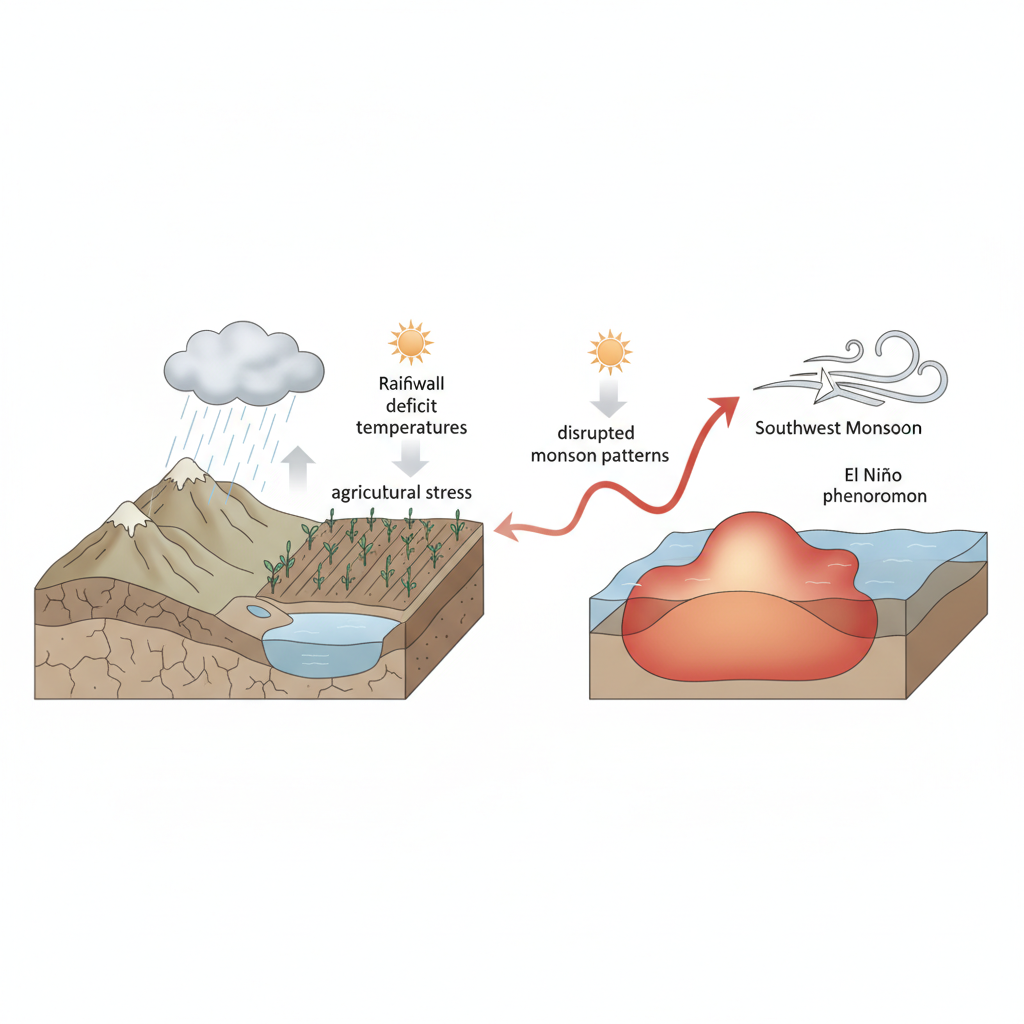
- El Niño, a phase of the El Niño-Southern Oscillation (ENSO) cycle, is characterised by anomalous warming of the central and eastern equatorial Pacific Ocean, which often disrupts monsoon patterns in India, leading to deficient rainfall in many regions.
- Kerala, a state in the southwest of India, receives significant monsoon rainfall due to its geographical location along the Western Ghats, which act as a barrier to moisture-laden winds from the Arabian Sea.
- Wayanad, a hill district in Kerala, is part of the Western Ghats biodiversity hotspot and is ecologically sensitive, with a mix of forests, plantations, and agricultural lands.
- The district has historically faced spatial variability in rainfall due to its topography, with eastern regions receiving less precipitation compared to the western slopes.
- The current crisis follows a pattern observed in recent years, where climate change has intensified the frequency and intensity of extreme weather events, including droughts and floods.
Understanding the Monsoon Deficit and El Niño Impact in Wayanad
- The Southwest Monsoon is the primary source of freshwater for agriculture, drinking water, and groundwater recharge in India, with Kerala receiving an average of 2,200 mm of rainfall during the monsoon season.
- El Niño events are associated with a weakening of the Indian Summer Monsoon, often resulting in reduced rainfall across central and peninsular India, including Kerala, due to altered atmospheric circulation patterns.
- The current deficit of 37% in Wayanad (June 1–August 31, 2026) indicates a significant departure from the normal seasonal average, with some eastern villages recording as little as 316 mm of rainfall.
- Spatial variability in rainfall within Wayanad highlights the role of topography, where western slopes receive higher precipitation due to orographic lift, while eastern regions lie in the rain shadow, receiving less rainfall.
- The shift from traditional prolonged, moderate rainfall to short-duration, high-intensity downpours reduces soil infiltration, leading to surface runoff, increased erosion, and diminished groundwater recharge.
- Rising temperatures, exacerbated by reduced cloud cover and dry spells, further strain water resources by increasing evapotranspiration rates and stressing local ecosystems.
- The combination of a rainfall deficit, erratic precipitation patterns, and rising temperatures threatens drinking water security, agricultural output, and ecological balance in Wayanad.
- Long-term climate projections suggest that such events may become more frequent and severe under global warming scenarios, necessitating adaptive strategies for water resource management and disaster preparedness.
Key Features
| Feature | Significance |
|---|---|
| Rainfall Deficit (37%) | Indicates severe shortfall in monsoon precipitation, threatening water security, agriculture, and groundwater recharge in Wayanad. |
| Spatial Imbalance in Rainfall | Eastern villages (e.g., Marakkadavu, Kallumukku) face acute deficits (383–404 mm), while western regions (e.g., Kunjom, Mattilayam) receive excess (3,435–3,986 mm), exacerbating localised droughts and floods. |
| Shift in Rainfall Pattern | Replacement of traditional prolonged moderate showers with high-intensity, short-duration downpours, reducing soil infiltration and groundwater replenishment. |
| Temperature Anomalies | Drier conditions elevate maximum temperatures (26°C in July vs. 27.9°C in June), increasing evapotranspiration and stressing water resources. |
| El Niño Influence | Global climate phenomenon linked to suppressed monsoon rainfall in India, compounding the natural variability of the Southwest Monsoon. |
Why it Matters
Economic
- Agricultural output in Wayanad, particularly cash crops like coffee, tea, and spices, is vulnerable to reduced soil moisture and erratic rainfall, impacting farmer livelihoods and rural incomes.
- Tourism-dependent sectors (e.g., eco-tourism, plantations) face disruptions due to water scarcity, affecting local economies reliant on monsoon-dependent activities.
- Increased reliance on groundwater for irrigation and drinking water may lead to over-extraction, raising long-term sustainability concerns for agricultural productivity.
Environmental
- Reduced groundwater recharge threatens the ecological balance of Wayanad’s forests and biodiversity hotspots, including the Western Ghats, a UNESCO World Heritage Site.
- High-intensity rainfall events increase soil erosion and landslide risks, particularly in hilly terrains, posing threats to human settlements and infrastructure.
- Prolonged dry spells and rising temperatures may alter local microclimates, affecting endemic flora and fauna adapted to specific moisture regimes.
Social
- Drinking water shortages in rural and tribal communities, especially in eastern Wayanad, may exacerbate health risks and displacement pressures.
- Agricultural laborers and marginal farmers, already vulnerable to climate variability, face heightened economic insecurity due to crop failures and reduced employment opportunities.
- Disproportionate impact on marginalised groups, including Scheduled Tribes and smallholder farmers, underscores the need for equitable climate adaptation strategies.
Governance
- The crisis tests the preparedness of district and state agencies in managing water scarcity, including the implementation of drought mitigation measures and early warning systems.
- Coordination between meteorological agencies (e.g., IMD), local bodies, and disaster management authorities is critical to address spatial imbalances in rainfall and their cascading effects.
- Long-term policy gaps in climate-resilient agriculture, water conservation, and sustainable land-use planning are highlighted by such extreme weather events.
Challenges
1. Water Scarcity and Agricultural Crisis
- 37% rainfall deficit threatens kharif sowing and standing crops, particularly in eastern Wayanad where deficits exceed 60% in some villages.
- Groundwater depletion risks escalate as farmers resort to deeper borewells, increasing energy costs and depleting aquifers.
- Livestock-dependent communities face fodder shortages, compounding food security challenges.
UPSC Link: GS3: Conservation, Environmental Pollution and Degradation, Environmental Impact Assessment
2. Climate Variability and Extreme Weather Events
- Shift from traditional rainfall patterns to high-intensity, short-duration showers reduces effective water storage and increases flood risks in low-lying areas.
- Rising temperatures exacerbate drought conditions, accelerating evapotranspiration and stressing water resources.
- El Niño-induced monsoon suppression adds a layer of unpredictability, complicating long-term agricultural and water resource planning.
UPSC Link: GS3: Disaster and Disaster Management
3. Spatial Disparities in Rainfall Distribution
- Western regions receive excessive rainfall, leading to localized flooding and soil erosion, while eastern regions face acute deficits.
- Poor connectivity and infrastructure gaps in drought-prone areas hinder the equitable distribution of water resources and relief measures.
- Agricultural practices in high-rainfall zones may not be adapted to flood risks, increasing vulnerability to crop loss.
UPSC Link: GS1: Salient Features of Indian Society, Diversity and Social Empowerment
4. Institutional and Policy Gaps
- Limited integration of climate projections into district-level agricultural and water resource management plans.
- Inadequate real-time monitoring and dissemination of rainfall data to farmers and local authorities for adaptive decision-making.
- Weak enforcement of water conservation measures, such as rainwater harvesting and watershed management, in high-rainfall zones.
UPSC Link: GS2: Government Policies and Interventions for Development in various sectors
5. Socio-Economic Vulnerabilities
- Marginal farmers and landless laborers lack financial resilience to cope with crop failures, increasing indebtedness and migration pressures.
- Tribal communities in Wayanad, dependent on forest resources, face heightened food insecurity due to reduced ecosystem services.
- Urban-rural disparities in access to piped water supply and irrigation infrastructure exacerbate inequities in water distribution.
UPSC Link: GS1: Poverty and Developmental Issues
Challenges — UPSC Perspective
| Issue | Concern |
|---|---|
| Rainfall Deficit (37%) | Threatens kharif sowing, groundwater recharge, and drinking water security in Wayanad. |
| Spatial Imbalance in Rainfall | Eastern villages face severe deficits (383–404 mm), while western regions receive excess (3,435–3,986 mm), leading to localized droughts and floods. |
| Shift in Rainfall Pattern | High-intensity, short-duration showers reduce soil infiltration, increasing runoff and groundwater depletion. |
| Rising Temperatures | Elevated maximum temperatures (27.9°C in June) exacerbate drought conditions and stress water resources. |
| El Niño Influence | Global climate phenomenon linked to suppressed monsoon rainfall, adding unpredictability to agricultural planning. |
| Institutional Preparedness | Gaps in real-time data dissemination, adaptive planning, and enforcement of conservation measures hinder effective crisis management. |
Way Forward
- Strengthen district-level climate resilience plans by integrating IMD rainfall forecasts and El Niño predictions into agricultural advisories.
- Promote water conservation techniques, such as farm ponds, contour bunding, and micro-irrigation, to enhance groundwater recharge and reduce runoff.
- Expand rainwater harvesting infrastructure in drought-prone eastern Wayanad, prioritizing tribal and marginalized communities.
- Enhance early warning systems for high-intensity rainfall events to mitigate flood risks in low-lying and hilly areas.
- Support farmers in transitioning to climate-resilient crops (e.g., drought-tolerant varieties) and diversifying livelihoods to reduce agricultural vulnerability.
- Improve real-time monitoring of groundwater levels and soil moisture through community-based participatory networks.
- Foster inter-departmental coordination between the Kerala State Disaster Management Authority, IMD, and local bodies for integrated drought and flood management.
- Conduct awareness campaigns on sustainable water use and conservation practices among urban and rural populations.
UPSC Value Addition
Keywords for Mains Answer-Writing
Southwest Monsoon variability · El Niño and Indian monsoon · rainfall deficit and water security · climate change and precipitation patterns · groundwater recharge mechanisms · agricultural drought and food security · Wayanad district geography · IMD rainfall monitoring · inter-state river basins · disaster risk reduction in hilly regions
Concept Flow
El Niño-induced suppression of Southwest Monsoon → Reduced rainfall (37% deficit) in Wayanad → Spatial imbalances in precipitation (eastern deficit, western excess) → Traditional moderate showers replaced by high-intensity, short-duration downpours → Reduced soil infiltration and groundwater recharge → Increased surface runoff and flood risks → Lower rainfall and higher temperatures (27.9°C) → Elevated evapotranspiration → Accelerated soil moisture depletion and drought conditions → Agricultural stress (kharif sowing failure) → Livelihood vulnerabilities (marginal farmers, tribal communities) → Economic insecurity and migration pressures → Groundwater over-extraction for irrigation and drinking → Long-term aquifer depletion → Escalating water scarcity in summer months → Inadequate institutional preparedness → Poor adaptive planning and enforcement → Prolonged crisis with cascading environmental and social impacts
Prelims Practice Questions
Q1. Consider the following statements regarding the Southwest Monsoon in India:
1. The Southwest Monsoon is the primary source of rainfall for the entire country.
2. El Niño events are generally associated with below-normal rainfall over India.
3. The India Meteorological Department (IMD) uses the Long Period Average (LPA) to calculate monsoon rainfall anomalies.
4. The Southwest Monsoon typically withdraws from India by the end of September.
How many of the above statements are correct?
- Only one
- Only two
- Only three
- All four
Answer: All four — Statements 1, 2, and 3 are correct. Statement 4 is incorrect as the Southwest Monsoon typically withdraws from India by mid-October, not the end of September.
Q2. Assertion (A): The El Niño-Southern Oscillation (ENSO) phenomenon significantly influences the Indian Southwest Monsoon.
Reason (R): El Niño events are characterized by warming of sea surface temperatures in the central and eastern equatorial Pacific Ocean, which disrupts the Walker circulation and reduces monsoon rainfall over India.
- Both A and R are true, and R is the correct explanation of A
- Both A and R are true, but R is not the correct explanation of A
- A is true, but R is false
- A is false, but R is true
Answer: Both A and R are true, but R is not the correct explanation of A — Both the assertion and reason are correct, and the reason accurately explains the assertion. El Niño disrupts atmospheric circulation patterns, leading to reduced monsoon rainfall over India.
Q3. Match the following districts with their respective rainfall deficits during the Southwest Monsoon season (June–August 2026) as reported in the article:
Column I (District) | Column II (Rainfall Deficit %)
———————————-|——————————-
1. Kunjom | A. 37%
2. Marakkadavu | B. 83%
3. Wayanad (District Average) | C. 90%
4. Muthanga | D. 37%
Options:
A. 1-A, 2-B, 3-C, 4-D
B. 1-C, 2-B, 3-A, 4-D
C. 1-D, 2-A, 3-B, 4-C
D. 1-B, 2-C, 3-A, 4-D
- A
- B
- C
- D
Answer: C — 1. Kunjom recorded the highest precipitation (3,986 mm), indicating a deficit below the district average but not the lowest. 2. Marakkadavu registered 383 mm, far below the seasonal average of 2,200 mm, resulting in an ~83% deficit. 3. Wayanad district average deficit is 37%. 4. Muthanga recorded 316 mm, the lowest, resulting in a ~90% deficit.
Mains Practice Question
✍ The Southwest Monsoon in India is exhibiting increasing variability, with districts like Wayanad facing severe rainfall deficits amid El Niño conditions. Critically analyse the implications of such variability on India’s water security, agricultural productivity, and disaster risk reduction strategies. (15 Marks)
Approach: MODEL-ANSWER SKELETON:
1. **Introduction (2 marks)**: Define the Southwest Monsoon and its significance for India’s agriculture and water resources. Briefly introduce the El Niño phenomenon and its impact on monsoon variability.
2. **Rainfall Deficit and Water Security (3 marks)**:
– Explain the concept of rainfall deficit and its measurement (e.g., Long Period Average by IMD).
– Discuss the implications of a 37% deficit in Wayanad: drinking water shortages, groundwater depletion, and surface water stress.
– Link to broader trends: declining groundwater levels in India (e.g., NITI Aayog’s Composite Water Management Index).
3. **Agricultural Productivity (3 marks)**:
– Analyse the impact of delayed or deficient monsoon on kharif crops (e.g., rice, pulses, coarse cereals).
– Discuss the shift from traditional light-to-moderate showers to intense, short-duration downpours: soil erosion, reduced infiltration, and crop damage.
– Reference the National Food Security Mission and its reliance on monsoon performance.
4. **Disaster Risk Reduction (3 marks)**:
– Examine the role of the National Disaster Management Authority (NDMA) and State Disaster Management Authorities (SDMAs) in mitigating monsoon-related risks.
– Discuss the need for climate-resilient infrastructure (e.g., check dams, rainwater harvesting) and early warning systems.
– Highlight the importance of inter-state coordination for transboundary river basins (e.g., Cauvery, Krishna).
5. **Policy and Institutional Responses (2 marks)**:
– Critically evaluate existing policies: Pradhan Mantri Krishi Sinchai Yojana (PMKSY), Jal Shakti Abhiyan, and the National Monsoon Mission.
– Suggest reforms: integration of climate science into agricultural planning, promotion of drought-resistant crop varieties, and decentralised water management.
6. **Conclusion (2 marks)**: Summarise the need for a multi-pronged approach combining scientific, policy, and community-based interventions to address monsoon variability.
Source: The Hindu
Kerala PCS (Kerala PSC (KAS)) — State PCS Practice
Prelims: As of the latest reports, Wayanad district in Kerala is experiencing a severe monsoon crisis with a rainfall deficit of 37%. Which of the following factors is NOT a primary contributor to this deficit?
- A. El Niño conditions in the Pacific Ocean
- B. Delayed onset of the southwest monsoon
- C. Increased frequency of cyclonic storms in the Arabian Sea
- D. Deforestation and land-use changes in the Western Ghats
Answer: C. Increased frequency of cyclonic storms in the Arabian Sea — While El Niño and delayed monsoon onset are linked to the deficit, increased cyclonic storms in the Arabian Sea typically enhance rainfall rather than reduce it.
Mains: Analyze the socio-economic and environmental impacts of the 37% rainfall deficit in Wayanad district. Suggest short-term and long-term measures to mitigate the crisis, with a focus on Kerala’s administrative and policy frameworks.
Generated by AanyaAi for educational purpose.
Related guides on our sites
- Current affairs for upsc 2026
- How to prepare for GS paper 1 for UPSC CSE mains exam
- Best UPSC coaching for IFOS exam
- Best geography optional coaching

- How India’s Rs 20,000 Cr CCUS Budget Can Drive Net-Zero Goals - October 23, 2026
- पंजाब-हरियाणा में पराली जलाने पर सीएक्यूएम की सख्त समीक्षा, तुरंत उठाये गये कदमों पर जोर - October 23, 2026
- UNEP Report 2026 Warns: Paris 1.5°C Target Slipping Away - October 23, 2026

No Comments