


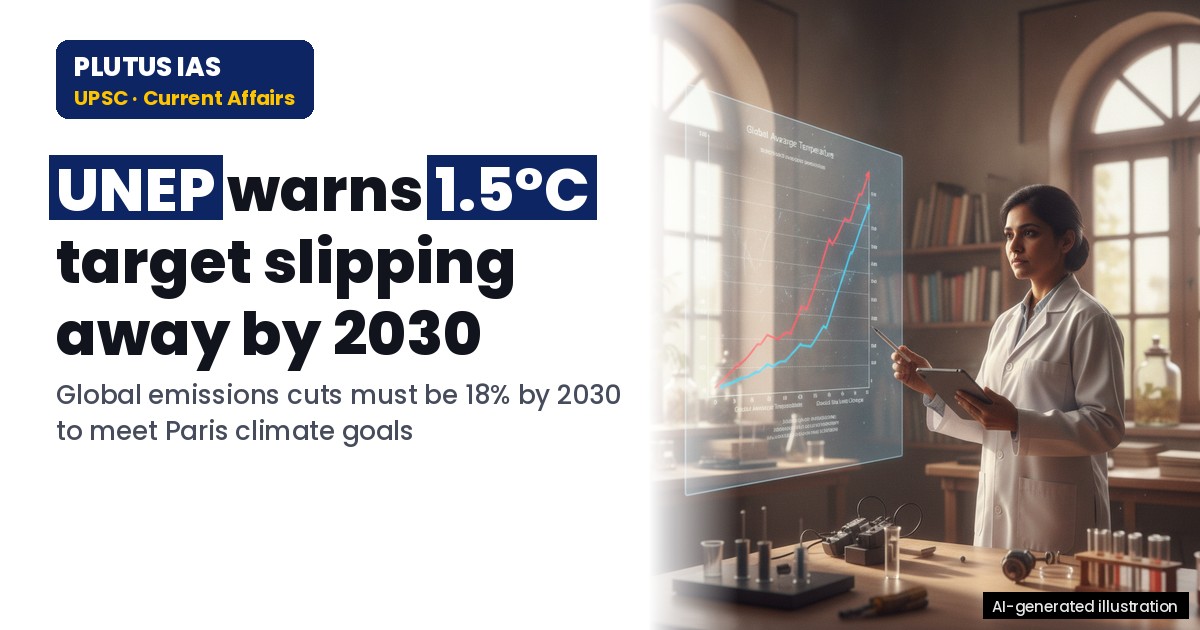
23 Oct UNEP Report 2026 Warns: Paris 1.5°C Target Slipping Away
✎ Current NDCs only achieve a 5–8% reduction, necessitating urgent and unprecedented action.
Subject Relevance — Where This Topic Fits
- GS Paper III — Environment, Conservation, Environmental Pollution and Degradation | GS Paper II — International Organisations, Reports, and Agreements
- Prelims: Paris Agreement, UNEP Emissions Gap Report, Nationally Determined Contributions (NDCs), Global Warming Potential (GWP), Loss and Damage Fund, 1.5°C vs 2°C targets, Carbon Capture and Storage (CCS), Renewable Energy Capacity
- Essay: Climate change as a global challenge: The role of international cooperation and national commitments, The dichotomy between aspirational climate targets and ground realities
Quick Revision: Current NDCs only achieve a 5–8% reduction, necessitating urgent and unprecedented action.
Why is this in the news?
The UNEP Emissions Gap Report 2026 highlights the widening disparity between the emission reduction commitments under the Paris Agreement and the actual trajectory required to limit global warming to 1.5°C. The report underscores the inadequacy of current Nationally Determined Contributions (NDCs) and the urgent need for accelerated action, technological innovation, and equitable climate finance ahead of the upcoming Conference of the Parties (CoP).
Background
- The Paris Agreement, adopted in 2015, aims to limit global temperature rise to well below 2°C, preferably to 1.5°C, compared to pre-industrial levels.
- Nationally Determined Contributions (NDCs) are national climate action plans submitted by countries under the Paris Agreement, outlining their emission reduction targets and adaptation strategies.
- The UNEP Emissions Gap Report is an annual assessment that evaluates the gap between projected greenhouse gas (GHG) emissions under current policies and the levels required to meet the Paris Agreement goals.
- The 1.5°C target is increasingly recognised as critical to avoiding the most severe impacts of climate change, including extreme weather events, sea-level rise, and ecosystem collapse.
- The report notes that full implementation of current NDCs would only reduce global emissions by 5–8% by 2030.
- The Loss and Damage Fund, established in 2023, aims to provide financial assistance to vulnerable countries facing climate-induced disasters, but its operationalisation remains a challenge.
What is the UNEP Emissions Gap Report?
- The UNEP Emissions Gap Report is an annual publication that assesses the difference between projected global GHG emissions under current policies and the levels required to meet the temperature goals of the Paris Agreement.
- The report provides a scientific basis for evaluating the adequacy of national climate commitments (NDCs) and highlights the urgency of scaling up mitigation efforts.
- It quantifies the emission reductions necessary to limit warming to 1.5°C, including pathways that allow for temporary overshoot followed by return to the target.
- The report evaluates the role of technological solutions, such as carbon capture and storage (CCS), and renewable energy deployment in bridging the emissions gap.
- It also examines the socio-economic and geopolitical barriers to rapid decarbonisation, including the need for equitable climate finance and technology transfer.
- The report serves as a critical input for climate negotiations, particularly during the Conference of the Parties (CoP) meetings.
- It underscores the importance of international cooperation, policy coherence, and accelerated action to address the climate crisis.
- The 2026 report specifically highlights the inadequacy of current NDCs and the need for transformative changes in energy systems, industrial processes, and land-use practices.
Key Features
| Feature | Significance |
|---|---|
| UNEP Emissions Gap Report 2026 | Quantifies the shortfall between current climate pledges and the 1.5°C Paris Agreement target, highlighting the urgency of accelerated mitigation. |
| 1.7-1.8°C Peak Warming Scenario | Demonstrates the feasibility of overshoot pathways, provided emissions decline sharply post-2050 to return to 1.5°C by 2055. |
| Renewable Energy Expansion | Solar and wind installations have tripled since 2015; further tripling required by 2035 to meet UNEP’s decarbonisation trajectory. |
| Carbon Storage Technologies | Identified as potential enablers for net-negative emissions post-2050, though cost-effectiveness and scalability remain uncertain. |
| Loss and Damage Fund (2023) | Aims to compensate vulnerable nations for irreversible climate impacts, yet operational gaps persist, as seen in Nepal’s flood relief delays. |
Why it Matters
Climate Governance
- Reaffirms the Paris Agreement’s legally binding framework for global climate action, despite non-compliance risks.
- Highlights the role of the UNFCCC and its subsidiary bodies (e.g., SBSTA) in tracking NDC progress and facilitating corrective measures.
- Underscores the necessity of multilateral cooperation to align national policies with collective mitigation goals.
Economic Implications
- Stranded assets in fossil fuel sectors could emerge if decarbonisation accelerates beyond current trajectories.
- Green industrial policies (e.g., subsidies for renewables) may redefine comparative advantages in global trade.
- Climate-induced migration and resource conflicts could strain fiscal capacities of developing nations.
Technological and Innovation
- Breakthroughs in battery storage and direct air capture are critical to balancing intermittent renewable supply and negative emissions.
- Public-private partnerships may accelerate R&D in carbon capture and utilisation (CCUS) to bridge technological gaps.
- Digitalisation (AI, IoT) can optimise energy grids and reduce system inefficiencies in decarbonisation pathways.
Geopolitical Dynamics
- Energy transition geopolitics may shift power balances, particularly for fossil fuel-dependent economies.
- Supply chain vulnerabilities in critical minerals (e.g., lithium, cobalt) necessitate diversified sourcing strategies.
- Climate finance flows (e.g., Green Climate Fund) become pivotal in reconciling equity concerns between Global North and South.
Socio-Ecological Impact
- Ecosystem collapse risks (e.g., coral reefs, Amazon) escalate beyond 1.5°C, threatening biodiversity and livelihoods.
- Extreme weather events (cyclones, heatwaves) disproportionately affect marginalised communities, exacerbating inequality.
- Agricultural productivity losses in tropical regions could trigger food security crises, necessitating adaptive agricultural practices.
Challenges
1. Implementation Gap in NDCs
- Current Nationally Determined Contributions (NDCs) under the Paris Agreement fall short of the 1.5°C trajectory by 61-64% by 2030.
- Non-binding nature of NDCs allows states to set unambitious targets without legal repercussions.
- Domestic political constraints (e.g., fossil fuel lobbies, electoral cycles) hinder rapid policy reforms.
UPSC Link: Paris Agreement (Article 4) and NDCs
2. Technological and Financial Constraints
- High upfront costs for large-scale renewable deployment and grid modernisation deter investments in developing nations.
- Uncertainty in carbon pricing mechanisms (e.g., carbon taxes, cap-and-trade) limits market-driven decarbonisation.
- Scalability challenges for carbon removal technologies (e.g., BECCS, DAC) pose risks to net-zero pathways.
UPSC Link: UNFCCC Technology Mechanism
3. Equity and Climate Justice
- Historical emitters (Global North) have yet to meet $100 billion/year climate finance commitments, undermining trust.
- Loss and Damage Fund’s operationalisation remains slow, with inadequate disbursement mechanisms for vulnerable states.
- Divergent national priorities (e.g., energy security vs. decarbonisation) complicate consensus-building in climate negotiations.
UPSC Link: Common but Differentiated Responsibilities (CBDR)
4. Geopolitical Fragmentation
- Trade wars over green subsidies (e.g., US Inflation Reduction Act) risk distorting global decarbonisation efforts.
- Sanctions and conflicts (e.g., Russia-Ukraine) disrupt critical mineral supply chains essential for clean energy transitions.
- Rising nationalism may lead to unilateral climate policies, fragmenting global cooperation.
UPSC Link: UNFCCC Article 2 (Objective)
5. Socio-Economic Disruptions
- Just transition policies must address job losses in coal-dependent regions to prevent social backlash.
- Climate-induced displacement (e.g., island nations) strains asylum systems and international law frameworks.
- Public resistance to carbon taxes or lifestyle changes (e.g., meat consumption) may delay behavioural shifts.
UPSC Link: UNFCCC Article 2 (Objective) and SDGs
Challenges — UPSC Perspective
| Issue | Concern |
|---|---|
| NDC Ambition Gaps | Current pledges are insufficient to meet 1.5°C; requires ratcheting mechanisms to enforce higher targets. |
| Carbon Pricing Gaps | Absence of uniform global carbon pricing undermines cost-effective emissions reductions. |
| Loss and Damage Fund Delays | Operational gaps limit disbursement to vulnerable nations despite formal establishment in 2023. |
| Renewable Energy Storage | Intermittency of solar/wind necessitates breakthroughs in grid-scale storage technologies. |
| Fossil Fuel Phase-Out | Lack of binding timelines for coal/oil/gas phase-outs delays systemic decarbonisation. |
| Climate Finance Shortfalls | Developed nations have not met $100 billion/year commitment, eroding trust in multilateralism. |
Way Forward
- Strengthen ratcheting mechanisms under the Paris Agreement to enforce periodic upward revisions of NDCs by 2030.
- Expand public and private investments in grid-scale renewable energy storage and carbon removal technologies.
- Accelerate operationalisation of the Loss and Damage Fund with transparent disbursement criteria and faster disbursal mechanisms.
- Harmonise global carbon pricing frameworks to create a level playing field for decarbonisation investments.
- Enhance technology transfer and climate finance flows to developing nations via mechanisms like the Green Climate Fund.
- Integrate climate resilience into national development plans (e.g., MGNREGA for drought-proofing) to address adaptation deficits.
- Promote international cooperation on critical mineral supply chains to mitigate geopolitical risks in clean energy transitions.
- Incorporate climate justice principles into domestic policies to ensure equitable burden-sharing across socio-economic groups.
UPSC Value Addition
Keywords for Mains Answer-Writing
Paris Agreement 2015 · Emissions Gap Report 2026 · 1.5°C temperature target · Nationally Determined Contributions (NDCs) · Loss and Damage Fund · UNFCCC · Climate change mitigation · Global Greenhouse Gas (GHG) emissions · Solar and wind energy transition · Climate geopolitics · Carbon capture technologies · Climate vulnerability and compensation
Concept Flow
Paris Agreement adoption (2015) → Nationally Determined Contributions (NDCs) submission → UNEP Emissions Gap Report (2026) identifies shortfall → Current NDCs fall short of 1.5°C target → Need for ratcheting mechanisms to enhance ambition → Accelerated renewable deployment and carbon removal technologies required → Geopolitical and financial barriers impede progress → Loss and Damage Fund operationalisation becomes critical → CoP negotiations must address equity and implementation gaps.
Prelims Practice Questions
Q1. Consider the following statements regarding the Paris Agreement and the Emissions Gap Report 2026:
1. The Paris Agreement aims to limit global temperature rise to 1.5°C above pre-industrial levels.
2. The Emissions Gap Report 2026 indicates that full implementation of current NDCs will reduce global emissions by 18% by 2030.
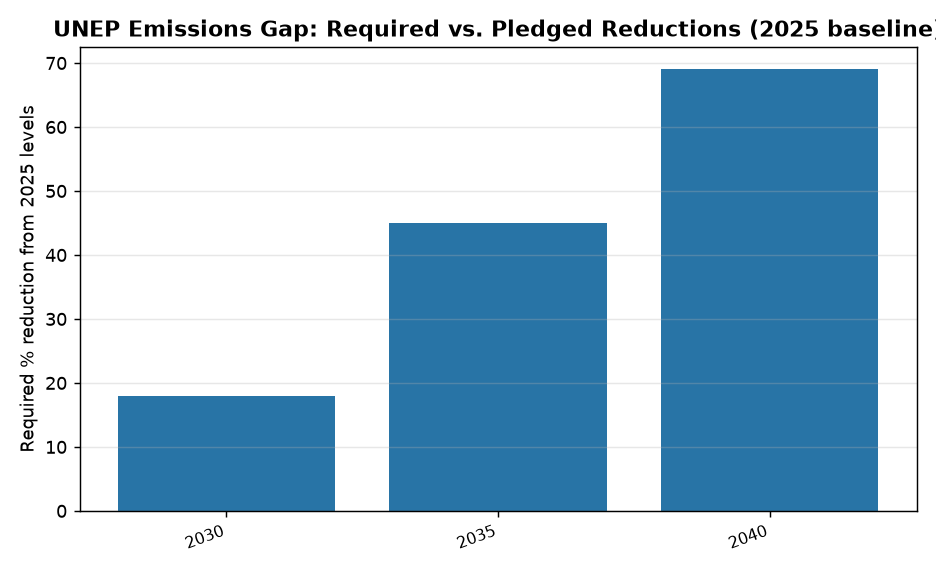
3. The report suggests that global GHG emissions must fall by 69% by 2040 to return to the 1.5°C pathway.
4. The Loss and Damage Fund was formalised in 2023 to compensate vulnerable nations for climate-related damages.
How many of the above statements are correct?
- Only one
- Only two
- Only three
- All
Answer: Only three — Statements 1 and 3 are correct. Statement 2 is incorrect as full implementation of NDCs would reduce emissions by only 5-8% by 2030. Statement 4 is correct as the Loss and Damage Fund was formalised in 2023.
Q2. Assertion (A): The Emissions Gap Report 2026 highlights that the 1.5°C target is unattainable in the near term without immediate and drastic reductions in global GHG emissions.
Reason (R): The report indicates that current NDCs, if fully implemented, would reduce global emissions by only 5-8% by 2030, far short of the required 18% reduction.
Options:
A. Both A and R are true, and R is the correct explanation of A.
B. Both A and R are true, but R is NOT the correct explanation of A.
C. A is true, but R is false.
D. A is false, but R is true.
- A
- B
- C
- D
Answer: A — Both A and R are true, and R correctly explains A, as the inadequacy of current NDCs directly underscores the assertion that the 1.5°C target is slipping.
Q3. Match the following columns related to climate governance:
Column I (Institution/Report)
Column II (Purpose)
1. UNFCCC
A. Formalised in 2023 to compensate vulnerable nations for climate-related damages
2. Paris Agreement
B. Aims to limit global temperature rise to well below 2°C, pursuing efforts to 1.5°C
3. Loss and Damage Fund
C. Aims to stabilise greenhouse gas concentrations to prevent dangerous anthropogenic interference with the climate system
4. Emissions Gap Report 2026
D. Assesses the gap between projected emissions and levels consistent with the Paris Agreement goals
Options:
1-B, 2-C, 3-A, 4-D
1-C, 2-B, 3-A, 4-D
1-D, 2-B, 3-C, 4-A
1-A, 2-D, 3-B, 4-C
- 1-B, 2-C, 3-A, 4-D
- 1-C, 2-B, 3-A, 4-D
- 1-D, 2-B, 3-C, 4-A
- 1-A, 2-D, 3-B, 4-C
Answer: 1-C, 2-B, 3-A, 4-D — Correct match: 1-C (UNFCCC aims to stabilise GHG concentrations), 2-B (Paris Agreement aims for 1.5°C), 3-A (Loss and Damage Fund compensates vulnerable nations), 4-D (Emissions Gap Report assesses emission reduction gaps).
Mains Practice Question
✍ The Emissions Gap Report 2026 underscores that the 1.5°C temperature target of the Paris Agreement is slipping beyond reach without immediate, unprecedented global action. Critically examine the institutional and technological challenges in bridging this gap, with reference to the role of Nationally Determined Contributions (NDCs), the Loss and Damage Fund, and the transition to renewable energy. (15 Marks)
Approach: MODEL-ANSWER SKELETON:
1. **Context & Report Insights**: Briefly summarise the Emissions Gap Report 2026 findings—required emission reductions (18% by 2030, 69% by 2040) vs. projected reductions under current NDCs (5-8% by 2030).
2. **Institutional Challenges**:
– **NDCs**: Explain their role under the Paris Agreement (Article 4) as non-binding national climate plans. Critically analyse their inadequacy due to voluntary nature, lack of enforcement, and geopolitical constraints (e.g., differing national priorities, carbon-intensive growth models).
– **Loss and Damage Fund**: Discuss its establishment (COP27, 2022) and operationalisation (COP28, 2023) under the UNFCCC. Critically examine its shortcomings—limited funding, bureaucratic delays, and failure to address immediate needs (e.g., Nepal floods, 2026). Reference the principle of ‘common but differentiated responsibilities’ (CBDR) and equity.
3. **Technological & Economic Challenges**:
– **Renewable Energy Transition**: Highlight the progress in solar/wind energy (2.5x increase since Paris Agreement) but stress the need for a 3x surge by 2035. Discuss barriers: storage solutions (battery tech, green hydrogen), grid integration, and geopolitical risks (e.g., critical mineral supply chains).
– **Carbon Capture Technologies (CCTs)**: Acknowledge their potential but highlight uncertainties—high costs, scalability, and environmental trade-offs (e.g., land use, energy penalties).
4. **Way Forward**:
– Strengthen NDCs with binding targets, enhanced transparency (Article 13 of Paris Agreement), and international cooperation (e.g., Just Energy Transition Partnerships).
– Reform the Loss and Damage Fund: expand donor base, simplify disbursement mechanisms, and integrate climate adaptation with mitigation.
– Accelerate R&D in CCTs and renewable storage, with public-private partnerships and technology transfer (Article 6.2 & 6.4 of Paris Agreement).
5. **Conclusion**: Reiterate the urgency of collective action, balancing equity with ambition, and the need for a multi-stakeholder approach involving governments, private sector, and civil society.
Source: The Indian Express
Generated by AanyaAi for educational purpose.
Related guides on our sites
- Best geography optional coaching
- Best geography optional coaching
- Best geography optional teacher
- Best geography optional teacher

- UNEP Report 2026 Warns: Paris 1.5°C Target Slipping Away - October 23, 2026
- पूर्व आईएएस अधिकारी हत्या मामले में आईएएस एसोसिएशन की मुख्यमंत्री से मुलाकात - October 23, 2026
- UPSC Exam: Rare Glimpse of Ritwik Ghatak’s Cinematic Legacy at 4-Day Festival - October 23, 2026

No Comments