


02 Sep Air Marshal Mishra Appointed CEO of Ram Temple Trust: Key UPSC Polity Insight
✎ The appointment of Air Marshal (retd) Jeetendra Mishra as the first Chief Executive Officer (CEO) of the Shri Ram Janmbhoomi Teerth Kshetra Trust has been necessitated by governance challenges, including allegations of financial…
Subject Relevance — Where This Topic Fits
- GS Paper II — Polity and Governance: Constitutional and Statutory Bodies | GS Paper III — Economic and Social Development: Transparency and Accountability in Institutions
- Prelims: Trusts Act, 1882, Public Trusts (Registration and Regulation) Act, 1950, Constitutional provisions on religious freedom (Article 25-28), Institutional integrity and accountability mechanisms, Corporate governance principles in non-profit organizations
- Essay: The role of institutional governance in preserving cultural heritage and ensuring transparency in religious trusts, Balancing faith, administration, and accountability in public institutions
Why is this in the news?
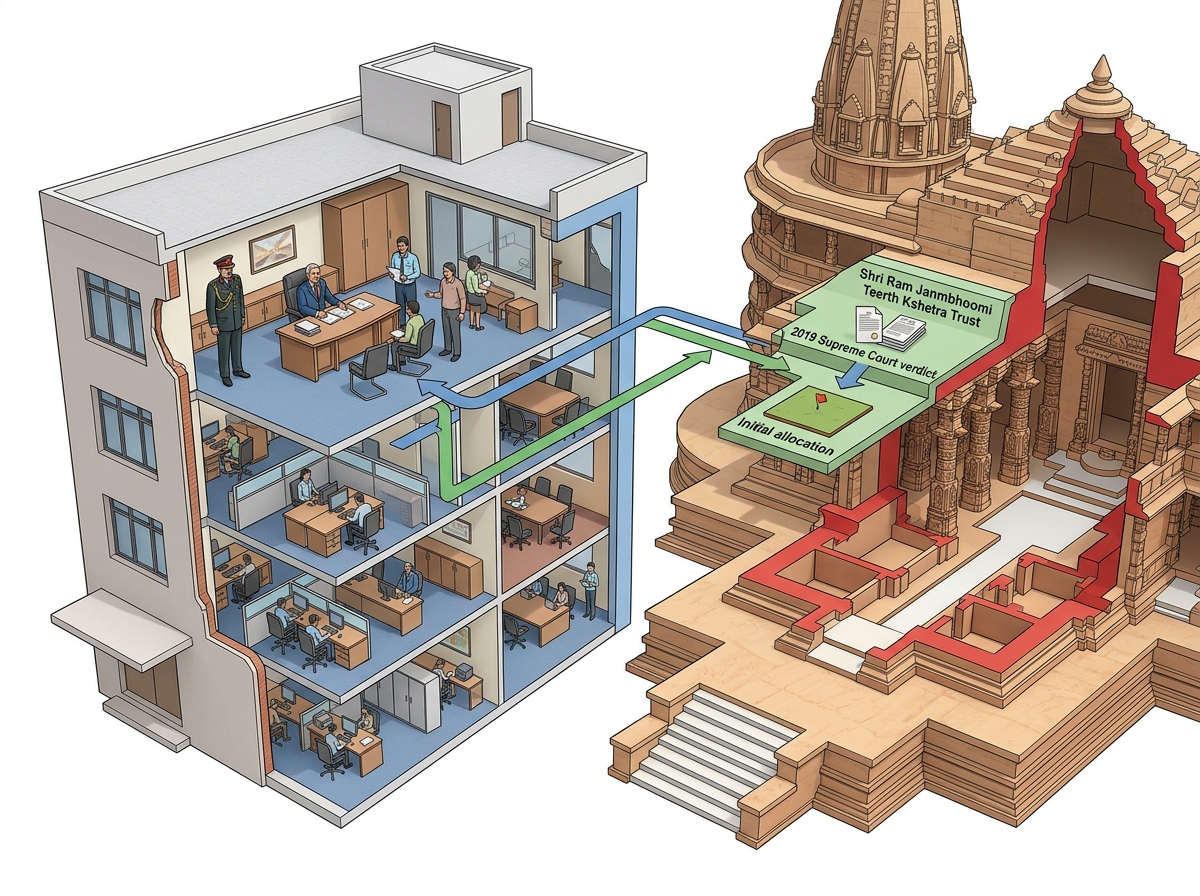
The appointment of Air Marshal (retd) Jeetendra Mishra as the first Chief Executive Officer (CEO) of the Shri Ram Janmbhoomi Teerth Kshetra Trust has been necessitated by governance challenges, including allegations of financial mismanagement and the resignation of key officials. This development underscores the evolving framework of institutional oversight for religious trusts in India, particularly those managing high-profile pilgrimage sites.
Background
- The Shri Ram Janmbhoomi Teerth Kshetra Trust was established following the Supreme Court’s 2019 verdict in the Ayodhya dispute, which allocated the disputed land for the construction of a temple and directed the formation of a trust to manage the site.
- Recent controversies involving alleged embezzlement of temple donations led to the resignation of the trust’s general secretary and the arrest of eight individuals, highlighting the need for robust institutional mechanisms.
- The search committee for the CEO position was constituted by the trust’s treasurer and included retired judicial and military officials, reflecting a multi-stakeholder approach to governance.
- Over 5,585 applications were received for the CEO position, indicating significant public and institutional interest in the trust’s management.
- The appointment follows a selection process designed to ensure leadership with expertise in governance, financial management, and institutional integrity.
What is the Shri Ram Janmbhoomi Teerth Kshetra Trust?
- The Shri Ram Janmbhoomi Teerth Kshetra Trust is a registered trust established to oversee the construction, maintenance, and administration of the Ram Temple in Ayodhya, Uttar Pradesh, as per the Supreme Court’s 2019 verdict.
- The trust is governed by a board of trustees, including representatives of religious, social, and administrative bodies, and is responsible for managing the temple’s operations, finances, and development activities.
- The trust’s governance framework includes mechanisms for financial transparency, audit, and accountability to prevent mismanagement and ensure public trust.
- The CEO’s role is to provide executive leadership, implement the trust’s strategic objectives, and ensure adherence to governance norms, including financial probity and regulatory compliance.
- The trust’s operations are subject to oversight by relevant state and central authorities, though its internal governance is guided by its founding deed and applicable laws.
- The appointment of a CEO with a background in military administration reflects the trust’s emphasis on structured leadership and operational discipline.
- The trust’s activities, including fund collection and expenditure, are governed by the principles of public trust and the constitutional guarantee of religious freedom (Articles 25-28).
Key Features
| Feature | Significance |
|---|---|
| Appointment of CEO | Institutionalises professional governance of the Shri Ram Janmbhoomi Teerth Kshetra Trust, ensuring transparency and accountability in temple management. |
| Selection Process | Demonstrates a meritocratic approach through a high-volume application process (5,585 applications) and a structured search committee with domain experts. |
| Leadership Profile | Air Marshal (retd) Jeetendra Mishra’s military background brings strategic planning, operational discipline, and crisis management skills to temple administration. |
| Trust Governance | Reinforces the trust’s administrative autonomy while addressing past controversies related to financial mismanagement and leadership vacancies. |
| Operational Efficiency | Aims to streamline temple operations, resource mobilisation, and visitor services, aligning with the trust’s socio-religious objectives. |
Why it Matters
Administrative Governance
- Establishes a precedent for professionalising the management of religious trusts, particularly those with significant public and financial dimensions.
- Highlights the role of retired military officers in civilian administrative roles, reflecting cross-sectoral leadership transfer.
Public Trust and Accountability
- Addressing past allegations of financial impropriety underscores the importance of transparency in managing religious endowments.
- Strengthens public confidence in the trust’s ability to utilise donations for intended purposes.
Strategic Human Resource Management
- The selection process exemplifies modern HR practices, including large-scale recruitment and structured evaluation criteria.
- Emphasises integrity, leadership, and domain expertise as critical attributes for high-stakes administrative roles.
Challenges
1. Financial Transparency and Donor Confidence
- Past incidents of alleged embezzlement necessitate robust financial auditing and real-time disclosure mechanisms.
- Ensuring donor trust requires proactive communication and third-party financial audits.
UPSC Link: GS Paper 2: Governance
2. Operational Scalability
- Managing large-scale temple operations, including pilgrim inflow, infrastructure, and security, demands scalable administrative systems.
- Balancing religious activities with modern management practices presents logistical challenges.
UPSC Link: GS Paper 2: Governance
3. Leadership Continuity
- The CEO’s role is critical; ensuring smooth transitions and institutional memory retention is essential for long-term stability.
- Mitigating risks associated with leadership attrition or sudden vacancies.
UPSC Link: GS Paper 2: Governance
4. Regulatory Compliance
- Adhering to legal frameworks governing religious trusts, including the Indian Trusts Act, 1882, and state-specific regulations.
- Ensuring compliance with tax exemptions and audit requirements for religious institutions.
UPSC Link: GS Paper 2: Governance
5. Stakeholder Coordination
- Coordinating with government agencies, local authorities, and religious bodies for seamless temple operations.
- Managing expectations of diverse stakeholders, including devotees, donors, and community groups.
UPSC Link: GS Paper 2: Governance
Challenges — UPSC Perspective
| Issue | Concern |
|---|---|
| Financial Mismanagement | Risk of recurrence of past allegations necessitates stringent internal controls and external audits. |
| Pilgrim Management | Handling large-scale footfall during festivals and events without compromising safety or sanctity. |
| Resource Mobilisation | Balancing donor expectations with optimal utilisation of funds for temple development and maintenance. |
| Legal Scrutiny | Ensuring compliance with all statutory and regulatory requirements to avoid legal disputes. |
| Public Perception | Maintaining transparency to counter scepticism and build trust among stakeholders. |
| Infrastructure Development | Addressing the need for modern amenities while preserving the temple’s cultural and religious heritage. |
Way Forward
- Formulate a comprehensive governance framework for the trust, outlining roles, responsibilities, and accountability mechanisms for the CEO and board members.
- Establish an independent financial audit committee to oversee all transactions and publish annual audit reports.
- Develop a pilgrim management plan to ensure crowd control, safety, and a seamless experience during peak seasons.
- Institute a donor engagement policy to maintain transparency in fund utilisation and periodic reporting to contributors.
- Strengthen inter-agency coordination with local authorities, police, and disaster management agencies for crisis preparedness.
- Implement a digital dashboard for real-time monitoring of temple operations, financial health, and visitor statistics.
- Conduct regular training programmes for trust employees on ethical governance, customer service, and crisis management.
- Engage with religious scholars and community leaders to align administrative practices with cultural sensitivities.
UPSC Value Addition
Keywords for Mains Answer-Writing
Shri Ram Janmbhoomi Teerth Kshetra Trust · CEO appointment process · Governance of religious trusts · Public Trusts Act · Constitutional provisions for religious institutions · Corporate governance in public bodies · Transparency in religious institutions · Appointment of public office holders · Checks and balances in trust governance · Accountability in religious trusts
Concept Flow
Appointment of CEO → Professionalisation of Trust Governance → Enhanced Transparency and Accountability → Restoration of Public Trust → Sustainable Resource Mobilisation → Long-term Temple Development and Maintenance
Prelims Practice Questions
Q1. Consider the following statements regarding the appointment of the CEO of the Shri Ram Janmbhoomi Teerth Kshetra Trust:
1. The appointment was made by a search committee headed by a retired judge.
2. The search committee received 5,585 applications for the position.
3. The CEO was selected from a shortlist of three candidates.
4. The appointment was made to address allegations of embezzlement of temple donations.
How many of the above statements are correct?
- Only one
- Only two
- Only three
- All four
Answer: All four — Statements 1, 2, and 3 are correct. Statement 4 is incorrect as the appointment was not made to address embezzlement allegations; rather, the controversy over donations preceded the appointment process.
Q2. Assertion (A): The Shri Ram Janmbhoomi Teerth Kshetra Trust operates under the provisions of the Societies Registration Act, 1860.
Reason (R): Religious trusts in India are governed by the Public Trusts Act of each state, which mandates transparency and accountability in their functioning.
Options:
A. Both A and R are true, and R is the correct explanation of A.
B. Both A and R are true, but R is not the correct explanation of A.
C. A is true, but R is false.
D. A is false, but R is true.
- A
- B
- C
- D
Answer: C — The assertion is true as the trust is registered under the Societies Registration Act, 1860. The reason is also true as religious trusts are governed by state-specific Public Trusts Acts, but the reason does not directly explain the assertion.
Mains Practice Question
✍ The appointment of a CEO for the Shri Ram Janmbhoomi Teerth Kshetra Trust highlights the evolving governance frameworks for religious trusts in India. In this context, critically examine the role of transparency and accountability in the management of religious trusts. Also, discuss the constitutional and legal provisions that govern such institutions. (15 Marks)
Approach: MODEL-ANSWER SKELETON:
1. **Introduction (2 marks)**
– Define religious trusts and their significance in Indian society.
– Briefly introduce the Shri Ram Janmbhoomi Teerth Kshetra Trust and the context of its CEO appointment.
2. **Transparency and Accountability in Religious Trusts (5 marks)**
– Explain the need for transparency and accountability in religious trusts, citing the controversy over alleged embezzlement of donations.
– Discuss the role of the CEO in ensuring governance standards.
– Highlight the importance of public trust in the functioning of such institutions.
3. **Constitutional and Legal Framework (5 marks)**
– **Constitutional Provisions**: Art. 25-28 (Right to Freedom of Religion), Art. 29-30 (Cultural and Educational Rights).
– **Legal Provisions**: Societies Registration Act, 1860; Public Trusts Acts of states (e.g., Maharashtra Public Trusts Act, 1950); Income Tax Act, 1961 (Section 12A/12AA for tax exemptions).
– **Judicial Precedents**: Refer to landmark judgments such as *S.R. Bommai v. Union of India* (1994) on secularism and *Commissioner of Police v. Acharya Jagadishwarananda Avadhuta* (2004) on religious institutions’ autonomy vs. regulation.
4. **Challenges and Way Forward (3 marks)**
– Discuss challenges such as lack of uniform legislation, political interference, and public scrutiny.
– Suggest measures like mandatory audits, digital transparency portals, and independent oversight bodies.
Balance of views: Present both the autonomy of religious institutions and the need for regulatory oversight to prevent misuse.
Source: orissapost.com
Generated by AanyaAi for educational purpose.
Related guides on our sites
- Current affairs for upsc 2026
- Best PSIR optional coaching for upsc
- Best PSIR optional teacher for upsc
- Best teacher of PSIR optional for upsc

- UNEP Report 2026 Warns: Paris 1.5°C Target Slipping Away - October 23, 2026
- पूर्व आईएएस अधिकारी हत्या मामले में आईएएस एसोसिएशन की मुख्यमंत्री से मुलाकात - October 23, 2026
- UPSC Exam: Rare Glimpse of Ritwik Ghatak’s Cinematic Legacy at 4-Day Festival - October 23, 2026

No Comments