


02 Sep Himachal Pradesh University Amendment Bill 2026: Transparent Recruitments in State Universities
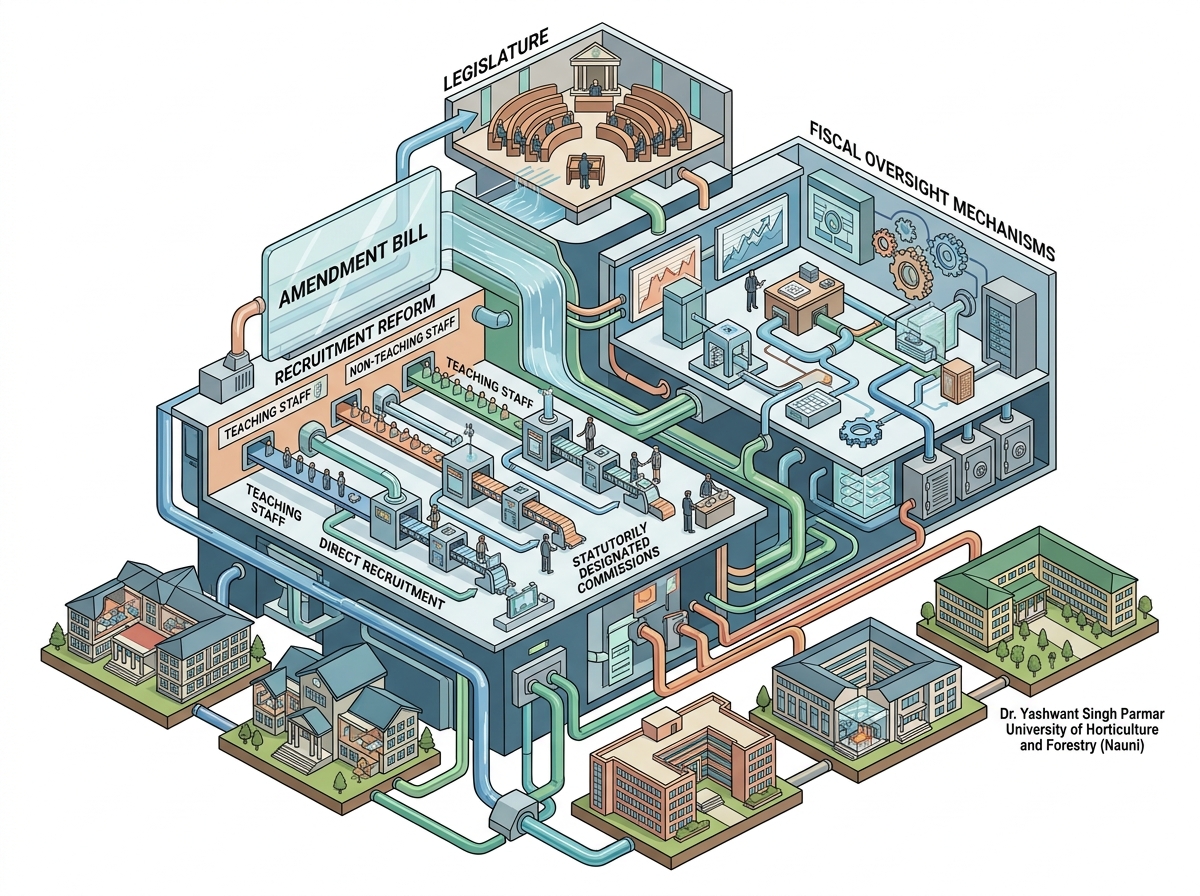
✎ The Himachal Pradesh State University (Amendment) Bill, 2026, institutionalises transparency in university appointments by mandating recruitment through statutorily designated commissions and integrates university finances with…
Subject Relevance — Where This Topic Fits
- GS Paper II — Governance, Transparency and Accountability | GS Paper III — Human Resource Development
- Prelims: University Grants Commission (UGC), Himachal Pradesh Public Service Commission (HPPSC), State Selection Commission, Academic Appointments, Fiscal Responsibility, University Governance
- Essay: Transparency in public institutions as a cornerstone of democratic governance, Balancing autonomy and accountability in higher education governance
Quick Revision: The Himachal Pradesh State University (Amendment) Bill, 2026, institutionalises transparency in university appointments by mandating recruitment through statutorily designated commissions and integrates university finances with state oversight to ensure fiscal discipline.
Why is this in the news?
The Himachal Pradesh State University (Amendment) Bill, 2026, was passed by the state legislature on 2 September 2026 to reform the recruitment and financial governance processes of six state-run universities. The Bill mandates direct recruitment of teaching and non-teaching staff through statutorily designated commissions, thereby enhancing transparency and reducing discretionary practices in appointments. It also introduces fiscal oversight mechanisms to ensure financial discipline in university administration.
Background
- The Bill amends the Himachal Pradesh State University Act, 1971, which governs the establishment, governance, and functioning of state universities.
- Six state universities—Himachal Pradesh University (Shimla), Himachal Pradesh Technical University (Hamirpur), Dr. Yashwant Singh Parmar University of Horticulture and Forestry (Solan), Chaudhary Sarwan Kumar Himachal Pradesh Krishi Vishvavidyalaya (Palampur), Himachal Pradesh University of Health Sciences (Kangra), and Himachal Pradesh National Law University (Shimla)—are covered under the amended provisions.
- Prior to the amendment, university appointments were often made through ad-hoc or departmental processes, leading to concerns about nepotism, lack of meritocracy, and financial mismanagement.
- The amendment aligns university governance with the constitutional principle of separation of powers and the doctrine of rule of law in public appointments.
- The Bill reflects a broader national trend towards institutionalising transparency in higher education governance, as seen in the UGC (Minimum Standards of Appointments and Conditions of Service of Teachers and other Academic Staff in Universities) Regulations, 2018.
What is the Himachal Pradesh State University (Amendment) Bill, 2026?
- The Bill amends the Himachal Pradesh State University Act, 1971, to introduce mandatory recruitment of teaching and non-teaching staff through statutorily designated commissions—Himachal Pradesh Public Service Commission (HPPSC) for teaching posts and Himachal Pradesh Rajya Chayan Aayog (HPRCA) or notified agencies for non-teaching posts.
- It restricts direct appointments in universities to the ranks of Professor and Associate Professor only, ensuring that all other appointments are made through competitive and transparent processes.
- The Bill mandates that the Finance Committee of each university shall be chaired by the State Finance Secretary, thereby integrating university finances with the state’s fiscal oversight framework.
- Recruitment processes must comply with the University Grants Commission (UGC) norms, ensuring adherence to national standards of academic excellence and meritocracy.
- The amendment aims to eliminate discretionary powers in appointments, reduce scope for favouritism, and enhance public trust in university governance.
- It introduces financial discipline by requiring universities to align their expenditure with approved budgets and subjecting financial decisions to state-level scrutiny.
- The Bill is part of a broader governance reform agenda to strengthen institutional autonomy while ensuring accountability to the state and society.
- It empowers the state legislature to hold universities accountable for their administrative and financial decisions through periodic reviews and audits.
Key Features
| Feature | Significance |
|---|---|
| Direct recruitment of faculty through HPSC | Ensures merit-based selection, reduces discretionary appointments, and aligns with UGC norms for higher education institutions. |
| Direct recruitment of non-teaching staff via HPRCA or notified agencies | Standardises recruitment processes, enhances transparency, and curtails irregularities in administrative appointments. |
| Restriction on university-level appointments to Professors and Associate Professors only | Prevents arbitrary appointments at lower levels, streamlines governance, and centralises control over key academic positions. |
| Financial oversight by Finance Secretary-led finance committee | Institutes fiscal discipline, prevents financial mismanagement, and ensures accountability in university expenditures. |
| Mandatory adherence to UGC recruitment guidelines | Bridges the gap between state legislation and national higher education standards, ensuring uniformity and quality in faculty appointments. |
Why it Matters
Governance and Institutional Reforms
- The amendment institutionalises a transparent and meritocratic recruitment framework for government universities, addressing long-standing concerns over nepotism and favouritism in appointments.
- Centralisation of key appointments (faculty and non-teaching staff) under statutory bodies (HPSC/HPRCA) reduces administrative discretion, thereby enhancing institutional autonomy within a regulated framework.
- The financial oversight mechanism ensures that university expenditures are subject to scrutiny, aligning with principles of fiscal federalism and public accountability.
Higher Education Policy
- The amendment reflects a shift towards standardising recruitment processes in line with UGC guidelines, ensuring consistency with national higher education policies.
- By limiting university-level appointments to Professors and Associate Professors, the amendment prevents dilution of academic standards and ensures that lower-level positions are filled through competitive processes.
- The reform underscores the role of state governments in regulating higher education institutions, complementing the UGC’s oversight while respecting federal structures.
Public Trust and Accountability
- The amendment addresses public perceptions of opacity in university recruitments, particularly in government-run institutions, by introducing structured and verifiable processes.
- The requirement for Finance Secretary-led oversight of university finances reinforces the principle of public trust in the utilisation of taxpayer funds allocated to higher education institutions.
Challenges
1. Implementation and Capacity Building
- The HPSC and HPRCA may face capacity constraints in processing a large volume of recruitments across six universities, necessitating adequate staffing and infrastructure.
- Ensuring seamless coordination between the state government, HPSC, HPRCA, and universities will be critical to avoid delays or procedural bottlenecks in the recruitment cycle.
UPSC Link: GS-II: Constitutional bodies
2. Balancing Autonomy and Regulation
- While centralisation enhances transparency, it may reduce the autonomy of universities in making localised academic or administrative appointments, potentially impacting institutional flexibility.
- The amendment’s restriction on university-level appointments to Professors and Associate Professors may limit the ability of universities to fill niche or specialised positions promptly.
UPSC Link: GS-II: Federalism
3. Financial Sustainability
- The financial oversight mechanism, while necessary, may face resistance from universities accustomed to greater financial autonomy, particularly in managing non-salary expenditures.
- Ensuring that the Finance Secretary-led committee does not overreach into academic or operational decisions of universities will require clear delineation of roles.
UPSC Link: GS-III: Public finance
4. Resistance to Change
- Stakeholders accustomed to existing recruitment practices may resist the new framework, leading to delays or pushback during the transition phase.
- Political and bureaucratic inertia could hinder the effective implementation of the amendment, particularly in addressing systemic inefficiencies.
UPSC Link: GS-II: Role of civil services
5. Monitoring and Evaluation
- The absence of a robust monitoring mechanism to evaluate the impact of the amendment on recruitment transparency and financial discipline could undermine its long-term effectiveness.
- Periodic audits and third-party assessments will be essential to identify gaps and ensure continuous improvement in the implementation process.
UPSC Link: GS-II: Government policies
Challenges — UPSC Perspective
| Issue | Concern |
|---|---|
| Capacity of HPSC/HPRCA | Risk of delays due to high volume of recruitments and limited staffing. |
| Coordination between agencies | Potential misalignment between state government, HPSC, HPRCA, and universities leading to procedural delays. |
| Autonomy vs. Regulation | Tension between centralised control and institutional flexibility in academic appointments. |
| Financial Oversight | Risk of overreach by the Finance Secretary-led committee into university operations. |
| Resistance to Change | Pushback from stakeholders accustomed to existing recruitment practices. |
| Monitoring Mechanism | Lack of structured evaluation to assess the amendment’s impact on transparency and accountability. |
Way Forward
- Conduct capacity-building workshops for HPSC and HPRCA officials to streamline recruitment processes under the new framework.
- Establish a dedicated inter-agency coordination cell to monitor the transition and address bottlenecks in real time.
- Develop clear guidelines for the Finance Secretary-led finance committee to delineate its role and prevent overreach into academic decisions.
- Introduce periodic audits and third-party evaluations to assess the amendment’s impact on recruitment transparency and financial discipline.
- Engage with university stakeholders, including faculty and administrative staff, to sensitise them about the benefits and requirements of the new framework.
- Publish annual reports on recruitment processes and financial expenditures of universities to enhance public transparency and accountability.
- Explore the use of digital platforms for end-to-end recruitment processes to minimise human intervention and reduce discretionary practices.
- Conduct mid-term reviews to identify challenges and propose corrective measures, ensuring the amendment’s objectives are met.
UPSC Value Addition
Keywords for Mains Answer-Writing
University governance reforms · Transparency in higher education appointments · Himachal Pradesh State University Amendment Bill 2026 · Recruitment through public service commissions · Financial discipline in state universities · UGC norms for faculty appointments · Role of Finance Secretary in university finance committees · Direct recruitment versus departmental promotions · Autonomy versus accountability in higher education · Public sector recruitment agencies in India
Constitutional & Policy Linkages
- Article 29 (Protection of interests of minorities) – Ensures that the amendment does not infringe upon the rights of minority institutions.
- Article 30 (Right of minorities to establish and administer educational institutions) – Balances state regulation with institutional autonomy.
Concept Flow
State government identifies opacity and financial mismanagement in university recruitments and expenditures. → Legislative proposal drafted to amend the Himachal Pradesh State University Act, 2026. → Bill introduced in the State Legislative Assembly and passed via voice vote. → Amendment mandates recruitment via HPSC/HPRCA and restricts university-level appointments to Professors and Associate Professors. → Financial oversight assigned to a Finance Secretary-led committee to ensure fiscal discipline. → Implementation phase begins, with stakeholders adapting to the new framework. → Monitoring and evaluation mechanisms are established to assess the amendment’s impact on transparency and accountability.
Prelims Practice Questions
Q1. Consider the following statements regarding the Himachal Pradesh State University Amendment Bill 2026:
1. The Bill mandates direct recruitment of teachers through the Himachal Pradesh Public Service Commission (HPPSC).
2. Non-teaching posts will be filled through the Himachal Pradesh State Selection Commission (HPRSC) or notified agencies.
3. The Bill requires the Finance Secretary of the state to chair the finance committee of each university.
4. The Bill empowers universities to appoint Professors and Associate Professors directly without involving any commission.
How many of the above statements are correct?
- Only one
- Only two
- Only three
- All four
Answer: All four — Statements 1, 2, and 3 are correct as per the Bill. Statement 4 is incorrect because the Bill restricts universities to appoint only Professors and Associate Professors directly; all other appointments must be made through HPPSC, HPRSC, or notified agencies.
Q2. Assertion (A): The Himachal Pradesh State University Amendment Bill 2026 aims to enhance transparency in university appointments.
Reason (R): The Bill requires all non-teaching posts to be filled through the Himachal Pradesh State Selection Commission (HPRSC) or notified agencies.
Options:
A. Both A and R are true, and R is the correct explanation of A.
B. Both A and R are true, but R is not the correct explanation of A.
C. A is true, but R is false.
D. A is false, but R is true.
Answer: ? — Both the Assertion (A) and Reason (R) are true. The Bill indeed aims to enhance transparency in appointments, and the requirement for non-teaching posts to be filled through HPRSC or notified agencies is a key provision contributing to this goal. Hence, R correctly explains A.
Q3. Which of the following is NOT a provision of the Himachal Pradesh State University Amendment Bill 2026?
A. Direct recruitment of teachers through HPPSC.
B. Mandatory UGC norms for faculty appointments.
C. Chairmanship of university finance committees by the Chief Minister.
D. Restriction on universities to appoint only Professors and Associate Professors directly.
- A
- B
- C
- D
Answer: C — Option C is incorrect. The Bill mandates that the Finance Secretary of the state will chair the finance committee of each university, not the Chief Minister.
Mains Practice Question
✍ The Himachal Pradesh State University Amendment Bill 2026 seeks to institutionalise transparency and financial discipline in state universities. Critically examine the provisions of the Bill in light of the constitutional and statutory framework governing higher education in India. Also, analyse the implications of these reforms for university autonomy and accountability. (15 Marks)
Approach: MODEL-ANSWER SKELETON:
1. **Constitutional and Statutory Framework**:
– Reference to Article 29 and 30 (cultural and educational rights), Article 14 (equality), and Article 21 (right to education).
– Role of the University Grants Commission (UGC) as a statutory body under the UGC Act, 1956, and its norms for faculty appointments and financial management.
2. **Provisions of the Bill**:
– **Transparency in Appointments**:
– Direct recruitment of teachers through HPPSC (as per UGC norms).
– Non-teaching posts to be filled through HPRSC or notified agencies.
– Restriction on universities to appoint only Professors and Associate Professors directly; other appointments via commissions.
– **Financial Discipline**:
– Finance committees chaired by the state Finance Secretary.
– Alignment with UGC norms for financial management and audits.
3. **University Autonomy vs. Accountability**:
– **Autonomy**:
– Universities traditionally enjoy autonomy in academic and administrative matters.
– Direct appointments of Professors and Associate Professors may preserve some academic freedom.
– **Accountability**:
– Public service commissions introduce merit-based, transparent processes.
– Financial oversight by the state Finance Secretary ensures compliance with fiscal norms.
– Potential tension between state control and institutional independence.
4. **Comparative Perspective**:
– Reference to similar reforms in other states (e.g., Uttar Pradesh Higher Education Services Commission).
– Judicial precedents on university autonomy (e.g., T.M.A. Pai Foundation v. State of Karnataka, 2002).
5. **Balanced View**:
– The reforms address long-standing concerns about nepotism and lack of transparency in university appointments.
– However, excessive state control may undermine institutional autonomy, affecting academic freedom and innovation.
6. **Conclusion**:
– The Bill strikes a balance between transparency and autonomy, but its success depends on effective implementation and safeguards against over-centralisation.
Source: amarujala.com
Himachal Pradesh PCS (HPPSC (HAS)) — State PCS Practice
Prelims: Which Himachal Pradesh State University Amendment Bill was recently passed in the state assembly to ensure transparency in appointments?
- Himachal Pradesh University (Amendment) Bill, 2024
- Himachal Pradesh State University (Amendment) Bill, 2024
- Himachal Pradesh Higher Education (Amendment) Bill, 2024
- Himachal Pradesh Technical University (Amendment) Bill, 2024
Answer: Himachal Pradesh State University (Amendment) Bill, 2024 — The Himachal Pradesh State University (Amendment) Bill, 2024 was passed to bring transparency in the appointment process of vice-chancellors and other key positions in state universities.
Mains: Discuss the significance of the Himachal Pradesh State University (Amendment) Bill, 2024, in the context of ensuring transparency and accountability in higher education governance in the state. Also, analyze its potential impact on the appointment process of vice-chancellors and other key positions in state universities.
Generated by AanyaAi for educational purpose.
Related guides on our sites
- Anthropology VS PSIR
- Best PSIR optional coaching
- Best PSIR optional coaching online
- Best PSIR optional teacher

- India-Australia AUSTRAHIND 2026 Exercise: Key Highlights for UPSC & State PCS - October 22, 2026
- एससीओ बैठक में भारत का आतंकवाद विरोध: क्षेत्रीय सहयोग पर जोर - October 22, 2026
- SEC Directs Strict SC Order Compliance for Andhra ULB Polls - October 22, 2026

No Comments