


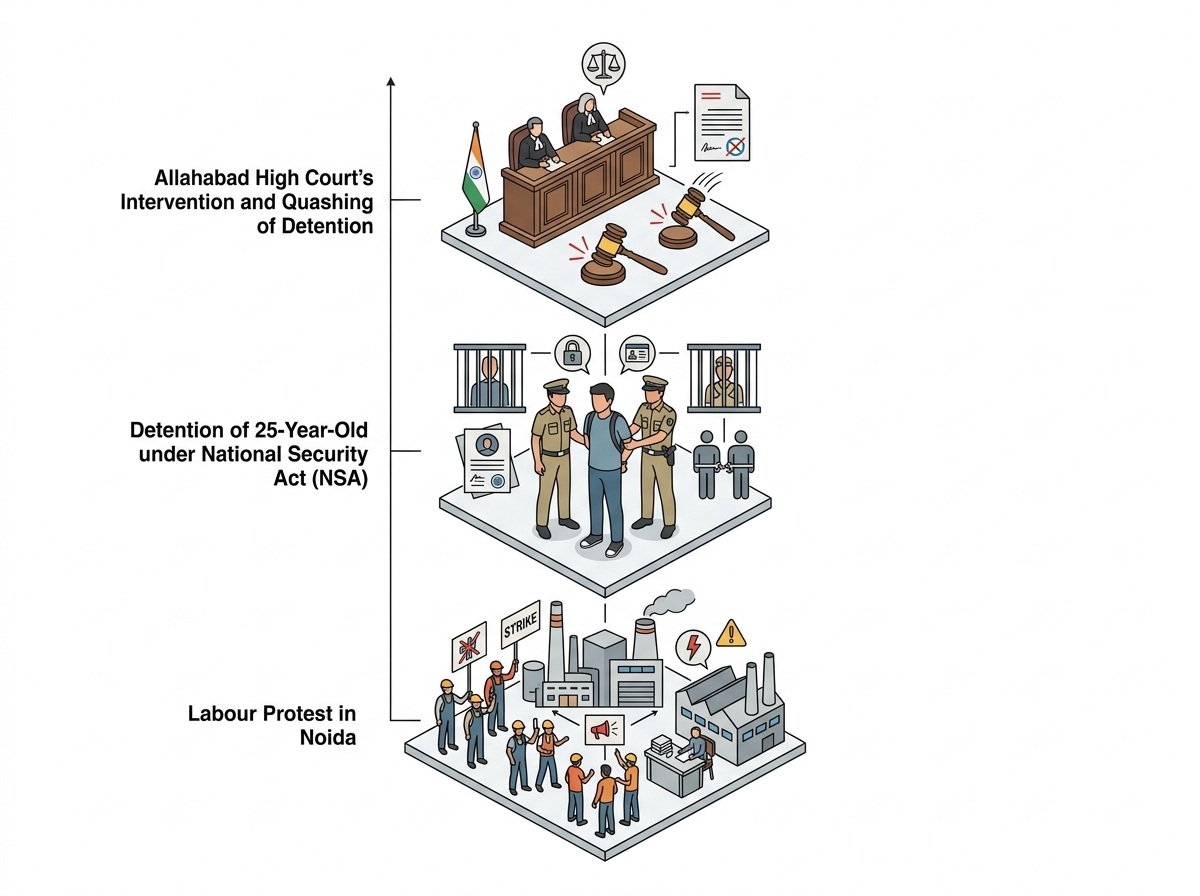
03 Sep Allahabad HC Strikes Down NSA Detention of Noida Protester: UPSC Analysis
✎ The National Security Act (NSA), 1980, is a preventive detention law that empowers the government to detain individuals without trial for up to 12 months if they are deemed likely to act in a manner prejudicial to national…
Subject Relevance — Where This Topic Fits
- GS Paper II — Judiciary and Constitutional Framework | GS Paper III — Issues relating to Poverty and Development
- Prelims: National Security Act (NSA), 1980, Preventive Detention, Habeas Corpus, Fundamental Rights under Articles 21, 22, and 32, Judicial Review of Executive Actions
- Essay: Judicial Activism and the Balance of Powers, Preventive Detention: Safeguards and Abuses
Quick Revision: The National Security Act (NSA), 1980, is a preventive detention law that empowers the government to detain individuals without trial for up to 12 months if they are deemed likely to act in a manner prejudicial to national security or public order; however, such detentions are subject to judicial review to ensure compliance with constitutional safeguards, including the right to liberty and due process.
Why is this in the news?
The Allahabad High Court’s quashing of a 25-year-old student’s detention under the National Security Act (NSA) in connection with the Noida labour protest has brought renewed attention to the legal and constitutional safeguards governing preventive detention in India. The Court’s intervention highlights the judiciary’s role in reviewing executive decisions that may infringe upon individual liberty, particularly in cases involving labour unrest and protest movements.
Background
- The National Security Act (NSA), 1980, empowers the government to detain individuals without trial for up to 12 months if it is deemed necessary to prevent them from acting in a manner prejudicial to national security or public order.
- The NSA is a preventive detention law, distinct from punitive detention, and does not require a formal trial or the presentation of evidence before a court.
- The invocation of the NSA in labour-related protests has been a subject of debate, with critics arguing that such measures may be used to suppress legitimate dissent or labour rights activism.
- The Allahabad High Court’s decision to quash the detention underscores the judiciary’s role in ensuring that executive actions comply with constitutional principles, including the right to liberty and due process.
- The case also raises questions about the balance between maintaining public order and protecting fundamental rights, particularly in the context of labour movements and social justice.
What is the National Security Act (NSA), 1980?
- The National Security Act (NSA), 1980, is a preventive detention law enacted to address threats to national security, public order, and communal harmony. It empowers the central and state governments to detain individuals without trial for up to 12 months if they are deemed likely to act in a manner prejudicial to national security or public order.
- The NSA is distinct from punitive detention laws, as it focuses on preventing potential harm rather than punishing past offences. Detention under the NSA does not require a formal trial or the presentation of evidence before a court.
- The law provides for detention on grounds such as acting in a manner prejudicial to the defence of India, the relations of India with foreign powers, or the security of India; or acting in a manner prejudicial to public order, maintenance of supplies and services essential to the community, or the maintenance of communal harmony.
- The NSA includes procedural safeguards, such as the requirement for the detaining authority to communicate the grounds of detention to the detainee within five days, though extensions may be granted. The detainee also has the right to make a representation against the detention, which must be considered by the government.
- The judiciary plays a critical role in reviewing the legality of detentions under the NSA through writ petitions, particularly habeas corpus petitions, which challenge the legality of detention.
- The Supreme Court has, in several judgments, emphasised the need for strict adherence to constitutional safeguards in preventive detention cases, including the principles of natural justice and proportionality.
- The NSA has been criticised for its potential misuse, particularly in cases involving political dissent, labour protests, or social activism, where authorities may invoke the law to suppress legitimate dissent under the guise of maintaining public order.
- The Allahabad High Court’s recent ruling in the Noida labour protest case reaffirms the judiciary’s role in ensuring that detentions under the NSA are not arbitrary or vague and comply with constitutional principles.
Key Features
| Feature | Significance |
|---|---|
| Quashing of NSA Detention | Demonstrates judicial oversight over executive actions under preventive detention laws, reinforcing constitutional safeguards against arbitrary detention. |
| Judicial Scrutiny of Executive Action | Highlights the role of the judiciary in reviewing the legality and proportionality of state actions, particularly under preventive detention statutes. |
| Compensation for Unlawful Detention | Reinforces the principle of state accountability for violations of personal liberty, as mandated under Article 21 of the Constitution. |
| FIRs and Charges | Underscores the procedural aspects of criminal investigations and the burden of proof in cases involving alleged violent intent or conspiracy. |
| Bail Proceedings | Illustrates the multi-layered judicial process in criminal cases, including bail applications and the interplay between lower courts and the High Court. |
Why it Matters
Constitutional and Legal
- The Allahabad High Court’s order reaffirms the principle that preventive detention under the National Security Act (NSA) must satisfy the test of reasonableness and non-arbitrariness, as enshrined in Article 21 of the Constitution.
- The imposition of a fine on the state for unlawful detention sets a precedent for judicial accountability in cases of executive overreach under preventive detention laws.
- The case underscores the importance of habeas corpus petitions as a safeguard against unlawful detention, ensuring judicial review of executive actions.
- The High Court’s scrutiny of the grounds for detention—such as the alleged recovery of a book and the formulation of a ‘strategy’—demonstrates the necessity of concrete, verifiable evidence in preventive detention cases.
Judicial Process and Governance
- The case highlights the role of the judiciary in balancing individual liberties with public order, particularly in cases involving protests or ideological affiliations.
- The High Court’s order reflects the principle that detention must be based on intelligible differentia and must not be vague or overly broad, as required under Article 14 of the Constitution.
- The case illustrates the procedural safeguards in place for individuals detained under preventive detention laws, including the right to legal representation and judicial review.
- The imposition of a fine on officials involved in sanctioning the detention underscores the accountability of executive authorities in upholding constitutional rights.
Social and Political Context
- The case raises questions about the intersection of protest movements, ideological affiliations, and state responses, particularly in the context of labour rights and social justice.
- The involvement of a student-activist in a labour protest highlights the role of youth and educational institutions in social movements and the potential for state intervention under preventive detention laws.
- The case underscores the need for clarity in the application of laws such as the NSA, particularly in cases where the alleged offenses are linked to ideological beliefs or protest activities.
Challenges
1. Preventive Detention Laws and Arbitrariness
- The invocation of the NSA in cases involving protest or ideological affiliations risks overreach, as preventive detention laws are often criticized for their potential to infringe upon personal liberty without sufficient safeguards.
- The vagueness of grounds for detention—such as the alleged formulation of a ‘strategy’ or the recovery of a book—raises concerns about the misuse of preventive detention laws to suppress dissent or protest movements.
- The lack of clear guidelines for the application of the NSA in cases involving social or labour protests creates ambiguity, leading to potential misuse by executive authorities.
UPSC Link: Fundamental Rights (Articles 12-35), Preventive Detention (Article 22)
2. Judicial Review and Executive Accountability
- The judiciary’s role in reviewing executive actions under preventive detention laws is critical, but the process can be delayed, leading to prolonged detention of individuals without trial.
- The imposition of fines on officials for unlawful detention is a step toward accountability, but the effectiveness of such measures in deterring future violations remains a challenge.
- The case highlights the need for stronger institutional mechanisms to ensure timely judicial review of preventive detention cases, particularly in cases involving vulnerable groups such as students or labour activists.
UPSC Link: Judicial Review (Article 13), Writs (Article 32)
3. Balancing Public Order and Individual Liberties
- The state’s responsibility to maintain public order must be balanced against the fundamental rights of individuals, particularly in cases involving protest or ideological affiliations.
- The case underscores the challenge of distinguishing between legitimate protest and alleged violent intent, particularly when ideological beliefs are involved.
- The application of laws such as the NSA in cases involving labour protests or social movements risks criminalizing dissent, thereby undermining democratic principles.
UPSC Link: Fundamental Rights (Articles 19, 21), Directive Principles (Article 51A)
4. Procedural Safeguards in Criminal Justice
- The case highlights the procedural challenges faced by individuals detained under multiple FIRs, including delays in bail proceedings and the burden of proof in cases involving alleged conspiracy.
- The involvement of multiple FIRs and charges in a single case complicates the judicial process, leading to prolonged detention and potential violations of the right to a speedy trial.
- The need for clear and consistent guidelines for the registration of FIRs and the filing of charges in cases involving protest or ideological affiliations remains a challenge.
UPSC Link: Criminal Procedure Code (CrPC), Right to Speedy Trial (Article 21)
Challenges — UPSC Perspective
| Issue | Concern |
|---|---|
| Vagueness in NSA Grounds | Risk of arbitrary detention due to broad or unclear grounds for invoking the NSA, particularly in cases involving protest or ideological affiliations. |
| Delay in Judicial Review | Prolonged detention without trial, as judicial review of preventive detention cases can be delayed, leading to potential violations of Article 21. |
| Multiple FIRs and Charges | Complicates the judicial process, leading to prolonged detention and potential misuse of the criminal justice system to suppress dissent. |
| Executive Overreach | Risk of misuse of preventive detention laws by executive authorities to suppress protest or ideological movements, undermining democratic principles. |
| Accountability of Officials | Challenges in ensuring accountability of officials involved in sanctioning unlawful detention, despite judicial orders imposing fines. |
Way Forward
- Strengthen judicial safeguards for individuals detained under preventive detention laws, including timelines for judicial review and clear guidelines for the invocation of the NSA.
- Enhance transparency in the registration of FIRs and the filing of charges, particularly in cases involving protest or ideological affiliations, to prevent misuse of the criminal justice system.
- Establish institutional mechanisms for the accountability of executive authorities involved in sanctioning preventive detention, including mandatory training on constitutional rights and due process.
- Promote dialogue between law enforcement agencies, judiciary, and civil society to clarify the application of laws such as the NSA in cases involving protest or social movements.
- Encourage the use of alternative dispute resolution mechanisms in cases involving labour protests or social movements to reduce reliance on preventive detention laws.
- Ensure that compensation for unlawful detention is disbursed promptly and that affected individuals receive adequate support to reintegrate into society.
- Conduct periodic reviews of the application of preventive detention laws to identify patterns of misuse and recommend corrective measures.
UPSC Value Addition
Keywords for Mains Answer-Writing
National Security Act (NSA) 1980 · Preventive detention · Fundamental Rights under Part III of the Constitution · Judicial review of executive actions · Habeas corpus · Procedural safeguards in detention laws · Allahabad High Court · Right to liberty (Article 21) · Due process of law · Executive discretion vs judicial oversight · Protest rights and public order · Detention without trial · Constitutional remedies · Rule of law
Constitutional & Policy Linkages
- [‘Article 21: Right to Personal Liberty’, ‘Ensures protection against arbitrary detention and the right to a speedy trial.’]
- [‘Article 22: Protection against Preventive Detention’, ‘Lays down safeguards for individuals detained under preventive detention laws.’]
- [‘Article 14: Right to Equality’, ‘Prohibits arbitrary or discriminatory application of laws, including preventive detention.’]
- [‘Article 32: Writs for Enforcement of Rights’, ‘Empowers the judiciary to issue writs for the protection of fundamental rights, including habeas corpus.’]
Concept Flow
Protest by labour activists → Registration of FIRs with charges including attempt to murder and conspiracy → State invokes NSA for preventive detention → Judicial scrutiny via habeas corpus petition → High Court quashes detention as arbitrary and vague → Imposition of fine on state for unlawful detention → Reinforcement of constitutional safeguards against arbitrary detention.
Prelims Practice Questions
Q1. Consider the following statements regarding the National Security Act (NSA), 1980:
1. The NSA empowers the Central Government to detain a person for up to 12 months without charge.
2. The detaining authority must communicate the grounds of detention to the detainee within 5 days of detention.
3. The detainee has the right to make a representation against the detention order.
4. The detention order can be reviewed by a judicial magistrate within 30 days of its issuance.
How many of the above statements are correct?
- Only one
- Only two
- Only three
- All four
Answer: Only three — Statement 1 is correct: The NSA allows detention for up to 12 months. Statement 2 is incorrect: The grounds must be communicated within 10 days, not 5. Statement 3 is correct: The detainee has the right to make a representation. Statement 4 is incorrect: There is no mandatory review by a judicial magistrate within 30 days; the detainee may approach the High Court via habeas corpus.
Q2. Assertion (A): The Allahabad High Court quashed the detention of Akriti Chaudhary under the NSA, 1980, terming it ‘arbitrary and vague’.
Reason (R): The NSA, 1980, empowers the executive to detain individuals without trial to prevent actions prejudicial to national security, but such detention must satisfy the test of reasonableness under Article 21 of the Constitution.
Options:
A. Both A and R are true, and R is the correct explanation of A.
B. Both A and R are true, but R is not the correct explanation of A.
C. A is true, but R is false.
D. A is false, but R is true.
- A
- B
- C
- D
Answer: B — Assertion (A) is true: The Allahabad High Court quashed the detention as arbitrary and vague. Reason (R) is true and correctly explains A: The NSA must comply with the reasonableness test under Article 21, as held in multiple Supreme Court judgments such as *A.K. Roy v. Union of India* (1982).
Q3. Match the following provisions of the Constitution of India with their corresponding Articles:
Column I (Provision)
1. Protection against arbitrary arrest and detention
2. Right to life and personal liberty
3. Right to move the Supreme Court for enforcement of fundamental rights
4. Protection against conviction for offences with retrospective effect
Column II (Article)
A. Article 20
B. Article 21
C. Article 22
D. Article 32
Options:
1. 1-A, 2-B, 3-D, 4-C
2. 1-C, 2-B, 3-D, 4-A
3. 1-B, 2-C, 3-A, 4-D
4. 1-D, 2-A, 3-C, 4-B
- 1
- 2
- 3
- 4
Answer: 3 — Correct matching: 1-Protection against arbitrary arrest and detention → Article 22; 2-Right to life and personal liberty → Article 21; 3-Right to move the Supreme Court for enforcement of fundamental rights → Article 32; 4-Protection against conviction for offences with retrospective effect → Article 20.
Mains Practice Question
✍ The invocation of the National Security Act (NSA), 1980, against individuals in the context of public protests raises critical questions about the balance between national security and fundamental rights. Critically examine the constitutional validity of preventive detention laws like the NSA in India, with reference to recent judicial pronouncements. Also, analyse the role of the judiciary in ensuring that executive discretion does not degenerate into arbitrariness. (15 Marks)
Approach: MODEL-ANSWER SKELETON:
1. **Introduction (2 marks)**
– Define preventive detention and the NSA, 1980: Detention without trial to prevent actions prejudicial to national security or public order.
– Contextualise with the Allahabad High Court’s quashing of Akriti Chaudhary’s detention as ‘arbitrary and vague’.
2. **Constitutional Framework (3 marks)**
– Article 21: Right to life and personal liberty; ‘procedure established by law’ must be fair, just, and reasonable (Maneka Gandhi v. Union of India, 1978).
– Article 22: Safeguards against arbitrary detention (right to be informed of grounds, right to legal representation, right to make a representation).
– Article 20(1): Protection against conviction for offences with retrospective effect (not directly applicable to preventive detention but relevant for proportionality).
3. **Judicial Review and Standards (4 marks)**
– Supreme Court’s stance on preventive detention: *A.K. Roy v. Union of India* (1982) upheld the NSA but emphasised the need for ‘live and proximate link’ between the detention order and the purpose of detention.
– *Kanwaljit Singh v. State of Punjab* (2021): Reiterated that detention must not be ‘vague or arbitrary’; executive discretion is subject to judicial review.
– *Re-Detention of A. K. Gopalan* (1950): Held that preventive detention is an exception to the rule of law and must be strictly construed.
4. **Executive Discretion vs. Judicial Oversight (3 marks)**
– Executive’s role: Detention orders are passed by the executive (District Magistrate/State Government) based on subjective satisfaction.
– Judicial oversight: High Courts and Supreme Court can review detention orders via habeas corpus (Article 226/32). Courts examine the ‘satisfaction’ of the detaining authority to ensure it is not mala fide or based on irrelevant considerations.
– Recent trend: Courts have increasingly intervened to quash detention orders deemed arbitrary (e.g., Allahabad HC in the present case).
5. **Critique and Way Forward (3 marks)**
– Critique: NSA is often criticised for its potential misuse, lack of transparency, and inadequate safeguards against executive overreach.
– Way forward: Strengthen procedural safeguards (e.g., mandatory time-bound judicial review, access to case files, independent oversight body).
– Balance: Emphasise that national security is paramount but must not be used to stifle legitimate dissent or protest rights.
**Key Cases to Cite:**
– *A.K. Roy v. Union of India* (1982)
– *Maneka Gandhi v. Union of India* (1978)
– *Kanwaljit Singh v. State of Punjab* (2021)
– *Re-Detention of A. K. Gopalan* (1950)
**Balance of Views:**
– Pro-executive: Argues that preventive detention is necessary to maintain public order and national security.
– Pro-judicial: Argues that unchecked executive discretion undermines the rule of law and fundamental rights.
Source: The Indian Express
Uttar Pradesh PCS (UPPSC) — State PCS Practice
Prelims: Regarding the recent Allahabad High Court order quashing the detention of a 25-year-old under the National Security Act (NSA) in the Noida labour protest case, which of the following statements is correct?
- The High Court ruled that the detention was arbitrary as the protest did not pose a threat to national security or public order.
- The NSA detention was upheld by the High Court as the protest involved industrial unrest in a key economic hub of Uttar Pradesh.
- The High Court directed the Uttar Pradesh government to compensate the detainee for wrongful detention under the NSA.
- The order was passed by the Supreme Court, not the Allahabad High Court, in the Noida labour protest case.
Answer: The High Court ruled that the detention was arbitrary as the protest did not pose a threat to national security or public order. — The Allahabad High Court quashed the NSA detention, citing lack of sufficient grounds to justify the detention under the Act, emphasizing the protest’s localized nature and absence of national security concerns.
Mains: Critically analyze the role of the National Security Act (NSA) in handling labour protests in Uttar Pradesh, with special reference to the Noida labour protest case. Discuss the administrative and legal challenges faced by the state government in balancing law and order with workers’ rights, and suggest measures to prevent misuse of such stringent laws in future.
Generated by AanyaAi for educational purpose.
Related guides on our sites
- Best PSIR optional coaching for upsc
- Best PSIR optional teacher for upsc
- Best teacher of PSIR optional for upsc
- Best PSIR optional coaching in delhi for UPSC


No Comments