


03 Sep Ahmedabad Joins Hub-and-Spoke Model: UPSC’s Aviation Strategy Explained
✎ The Hub-and-Spoke model in aviation reduces transit dependency on foreign hubs by enabling pre-clearance formalities at regional ‘spoke’ airports, thereby enhancing passenger convenience and operational efficiency for airlines.
Subject Relevance — Where This Topic Fits
- GS Paper II — International Relations (Regional and Global Connectivity, Infrastructure Diplomacy) | GS Paper III — Infrastructure (Transportation: Aviation Sector, Logistics Efficiency)
- Prelims: Hub-and-Spoke Model, International Civil Aviation Organization (ICAO), UDAN Scheme, Airport Authority of India (AAI), Open Skies Policy, Aviation Safety, Gaganyaan Mission (Space-Aviation Linkage), Regional Connectivity Scheme (RCS), National Civil Aviation Policy (NCAP) 2016, Bilateral Air Service Agreements
- Essay: Globalisation and Regional Connectivity: The Role of Infrastructure in National Development, India’s Strategic Position in the Global Aviation Landscape: Opportunities and Challenges
Quick Revision: The Hub-and-Spoke model in aviation reduces transit dependency on foreign hubs by enabling pre-clearance formalities at regional ‘spoke’ airports, thereby enhancing passenger convenience and operational efficiency for airlines.
Why is this in the news?
The Ministry of Civil Aviation has operationalised the ‘Hub-and-Spoke’ international flight model from Ahmedabad, Gujarat, marking the third airport in India—after Varanasi and Amritsar—to be integrated into this framework. This initiative aligns with India’s ‘International Aviation Hub Strategy’ aimed at enhancing global connectivity, improving passenger experience, and positioning India as a preferred aviation hub by 2030 and a global hub by 2047. The model enables seamless international transit with pre-clearance formalities at spoke airports, reducing transit dependency on foreign hubs and streamlining logistics for passengers and airlines.
Background
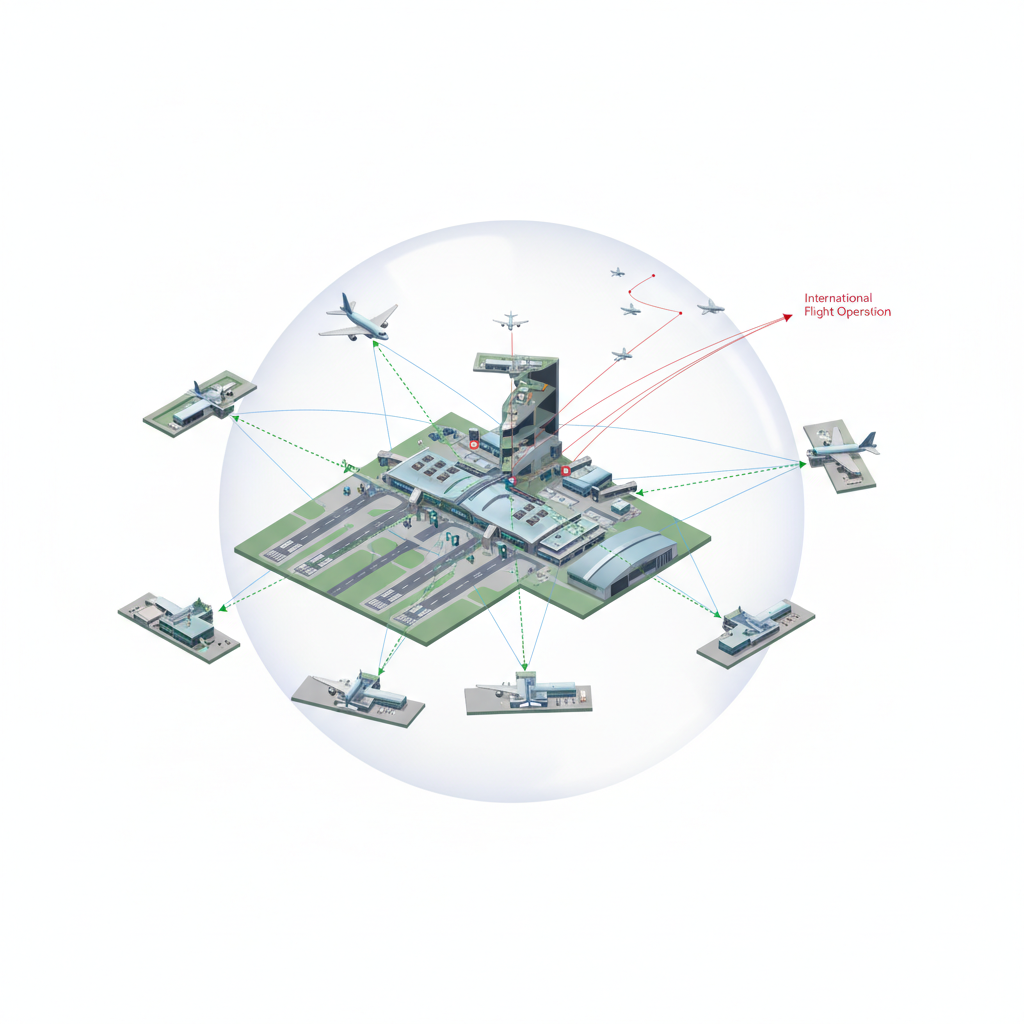
- The ‘Hub-and-Spoke’ model is a cornerstone of modern aviation network design, where a central ‘hub’ airport connects multiple ‘spoke’ airports via direct flights, optimising route efficiency and passenger convenience.
- India’s aviation sector has witnessed exponential growth post-liberalisation (1991), with passenger traffic increasing from 15 million in 1995 to over 300 million in 2023, necessitating infrastructure and operational reforms.
- India’s strategic geographic location—bridging East Asia, South-East Asia, the Middle East, and Europe—positions it as a natural transit point for international travel and cargo.
What is the Hub-and-Spoke Model in International Aviation?
- A network design where a central ‘hub’ airport (e.g., Delhi) connects multiple ‘spoke’ airports (e.g., Ahmedabad, Varanasi, Amritsar) via direct flights, enabling efficient passenger and cargo movement.
- Under this model, international passengers departing from spoke airports complete pre-clearance formalities (check-in, immigration, customs) at the spoke itself, eliminating the need for re-processing at the hub.
- Baggage is tagged directly to the final international destination, reducing transit risks, delays, and passenger inconvenience associated with multiple check-ins and immigration queues.
- The model enhances operational efficiency for airlines by consolidating traffic at hubs, optimising aircraft utilisation, and reducing operational costs per passenger.
- It strengthens India’s ‘International Aviation Hub Strategy’ by reducing dependence on foreign transit hubs (e.g., Dubai, Singapore, Doha) and increasing direct connectivity from regional airports.
- Passenger experience improves significantly due to reduced travel time, simplified logistics, and lower risk of missed connections, particularly for those originating from Tier-II/III cities.
- Economic spillovers include boosted tourism, trade facilitation, and growth in allied sectors such as hospitality, logistics, and manufacturing in spoke regions.
Key Features
| Feature | Significance |
|---|---|
| Direct international connectivity from Ahmedabad | Eliminates the need for passengers to travel via Delhi for international transfers, reducing travel time and complexity. |
| Hub-and-Spoke model integration | Integrates Ahmedabad as a ‘spoke’ airport under the Delhi hub, enabling seamless passenger and baggage transfer. |
| Single-window check-in, immigration, and customs at Ahmedabad | Allows passengers to complete formalities at the origin airport, avoiding re-processing at Delhi. |
| Through baggage handling | Ensures luggage is transferred directly to the final international destination, reducing risk of loss or misrouting. |
| Enhanced global connectivity | Connects Ahmedabad to 22 European, South-East Asian, and Middle Eastern destinations via morning flights and 17 North American, East Asian, Australian, and European destinations via evening flights. |
Why it Matters
Economic Impact
- Boosts Ahmedabad’s textile, pharmaceutical, diamond, gem, and engineering sectors by increasing footfall from international tourists and business travelers.
- Reduces operational costs for airlines by optimizing route networks and passenger transfers through a centralized hub.
Strategic Aviation Policy
- Advances India’s goal of becoming a preferred aviation hub by 2030 and a global aviation hub by 2047 under the International Aviation Hub Strategy.
- Reduces reliance on foreign transit airports, enhancing India’s self-sufficiency in international air connectivity.
Infrastructure Utilization
- Optimizes the use of Ahmedabad’s existing airport infrastructure by integrating it into a larger, multi-modal aviation network.
- Facilitates the development of ancillary services such as hotels, logistics, and tourism in tier-II and tier-III cities.
Passenger Experience
- Simplifies international travel by eliminating multi-booking, re-check-in, and immigration queues at transit hubs.
- Reduces travel fatigue and risk of missed connections, improving overall satisfaction for international passengers.
Challenges
1. Airport Infrastructure Constraints
- Limited capacity at Ahmedabad International Airport to handle increased international traffic without upgrades in runways, terminals, or parking bays.
- Need for additional ground handling staff and equipment to manage higher passenger volumes efficiently.
UPSC Link: GS3: Infrastructure
2. Customs and Immigration Efficiency
- Risk of bottlenecks at Ahmedabad’s customs and immigration counters if processing systems are not scaled proportionally to demand.
- Potential delays in baggage handling if infrastructure for through baggage transfer is not robustly implemented.
UPSC Link: GS2: Governance
3. Regulatory and Compliance Hurdles
- Ensuring adherence to international aviation safety and security standards (e.g., ICAO, DGCA) for seamless hub-and-spoke operations.
- Coordinating between central and state authorities for land acquisition, environmental clearances, and airspace management.
UPSC Link: GS2: Governance
4. Competition with Established Hubs
- Ahmedabad’s new connectivity may face competition from established international hubs like Dubai or Singapore, which already offer extensive global networks.
- Need for aggressive marketing and airline partnerships to attract passengers to Ahmedabad as a preferred transit point.
UPSC Link: GS3: Economy
5. Cost Implications for Airlines
- High operational costs for airlines due to fuel, maintenance, and crew expenses for long-haul international routes from Ahmedabad.
- Potential resistance from airlines if profitability is not ensured, especially for less popular destinations.
UPSC Link: GS3: Economy
6. Environmental and Sustainability Concerns
- Increased carbon emissions from additional flights may raise environmental compliance issues under national and international frameworks.
- Need for sustainable aviation fuel (SAF) adoption and noise pollution mitigation in surrounding areas.
UPSC Link: GS3: Environment
Challenges — UPSC Perspective
| Issue | Concern |
|---|---|
| Capacity constraints | Limited infrastructure at Ahmedabad may lead to congestion and delays. |
| Regulatory compliance | Ensuring adherence to international aviation safety and security standards. |
| Airline profitability | High operational costs may deter airlines from expanding routes. |
| Competition with global hubs | Established hubs may divert traffic away from Ahmedabad. |
| Environmental impact | Increased emissions and noise pollution require mitigation measures. |
| Passenger awareness | Lack of awareness about the new system may lead to underutilization. |
Way Forward
- Strengthen Ahmedabad International Airport’s infrastructure through phased upgrades in runways, terminals, and baggage handling systems.
- Enhance customs and immigration processing capacity with automated systems and additional staff deployment.
- Foster partnerships with international airlines to expand route networks and ensure profitability.
- Launch targeted awareness campaigns to educate passengers on the benefits of the hub-and-spoke model.
- Develop ancillary infrastructure such as hotels, logistics, and tourism services to capitalize on increased footfall.
- Implement sustainable aviation practices, including adoption of SAF and noise reduction technologies.
- Monitor and evaluate the operational and economic impact of the new system to identify areas for improvement.
- Coordinate with state and central agencies to streamline regulatory clearances and airspace management.
UPSC Value Addition
Keywords for Mains Answer-Writing
Hub-and-Spoke Model in Aviation · International Aviation Hub Strategy · Regional Connectivity Scheme (RCS) – UDAN · Airport Infrastructure Development · Civil Aviation Policy 2016 · Multi-modal Connectivity · Global Aviation Connectivity · Tier-II and Tier-III City Integration · Aviation Sector Liberalisation · Sagarmala and Bharatmala Synergies · National Civil Aviation Policy · Air Traffic Rights and Bilateral Agreements
Concept Flow
India’s International Aviation Hub Strategy (2030–2047) → Identification of tier-II/tier-III cities for integration → Selection of Ahmedabad as a ‘spoke’ airport → Integration into Delhi hub under hub-and-spoke model → Implementation of single-window check-in, immigration, and customs at Ahmedabad → Direct through-baggage handling to final destinations → Enhanced global connectivity and passenger experience → Economic and strategic benefits for Ahmedabad and India
Prelims Practice Questions
Q1. Consider the following statements regarding the ‘Hub-and-Spoke’ model in aviation:
1. It aims to centralise international passenger movement through a primary hub airport.
2. The model reduces the need for passengers to undergo immigration and customs checks at multiple airports.
3. Ahmedabad, Varanasi, and Amritsar are designated as hub airports under this model.
How many of the above statements are correct?
- Only one
- Only two
- All
- None
Answer: Only two — Statement 1 and 2 are correct as the model centralises international passenger movement through a primary hub (Delhi) and reduces multi-point immigration checks. Statement 3 is incorrect because Ahmedabad, Varanasi, and Amritsar are designated as ‘spoke’ airports, not hubs.
Q2. Assertion (A): The ‘Hub-and-Spoke’ model in aviation is designed to enhance operational efficiency for airlines.
Reason (R): It allows for seamless baggage transfer and reduces turnaround time at spoke airports.
In the context of the above two statements, which one of the following is correct?
- Both A and R are true, and R is the correct explanation of A
- Both A and R are true, but R is not the correct explanation of A
- A is true, but R is false
- A is false, but R is true
Answer: Both A and R are true, and R is the correct explanation of A — Both the assertion and reason are true. The ‘Hub-and-Spoke’ model enhances operational efficiency by enabling seamless baggage transfer and reducing turnaround time, as R correctly explains A.
Q3. Which of the following is NOT a primary objective of India’s International Aviation Hub Strategy?
A. To position India as a preferred aviation hub for Indian passengers by 2030
B. To reduce dependence on foreign transit airports for Indian passengers
C. To mandate the use of a single airline for all international operations
D. To leverage India’s strategic geographical location for global connectivity
- A
- B
- C
- D
Answer: C — The International Aviation Hub Strategy does not mandate the use of a single airline. Objectives include positioning India as a preferred hub by 2030, reducing dependence on foreign transit airports, and leveraging geographical advantages for connectivity.
Mains Practice Question
✍ The ‘Hub-and-Spoke’ model in aviation, as recently operationalised at Ahmedabad, Varanasi, and Amritsar, represents a paradigm shift in India’s international connectivity strategy. Critically examine the potential benefits and challenges of this model for India’s aviation sector and economy. Also, outline the institutional and policy frameworks that enable its implementation. (15 Marks)
Approach: MODEL-ANSWER SKELETON:
1. **Introduction (2 marks)**
– Define the ‘Hub-and-Spoke’ model: Centralised hub (Delhi) connected to regional spoke airports (Ahmedabad, Varanasi, Amritsar) for seamless international connectivity.
– Context: Part of India’s International Aviation Hub Strategy under the National Civil Aviation Policy (2016) and subsequent amendments.
2. **Benefits of the Model (5 marks)**
– **For Passengers**: Reduced travel time, seamless baggage transfer, elimination of multi-point immigration checks, and improved convenience (cite the example of Ahmedabad passengers avoiding Delhi transfers).
– **For Airlines**: Enhanced operational efficiency through centralised hub management, better load factor utilisation, and reduced turnaround time.
– **For Economy**: Boost to tourism (e.g., Commonwealth Games 2030), enhanced trade connectivity (textiles, pharmaceuticals, gems in Ahmedabad), and integration of Tier-II/Tier-III cities with global markets.
– **For Infrastructure**: Optimal utilisation of airport capacity, reduced congestion at major hubs, and alignment with Sagarmala and Bharatmala initiatives.
3. **Challenges and Criticisms (5 marks)**
– **Infrastructure Bottlenecks**: Limited capacity at spoke airports (e.g., runway length, terminal facilities) may constrain growth.
– **Regulatory Hurdles**: Complexity in air traffic rights negotiations under bilateral agreements (e.g., traffic rights for European/US routes).
– **Economic Viability**: High operational costs for airlines due to smaller spoke airports; risk of underutilisation without sufficient demand.
– **Geopolitical Dependencies**: Over-reliance on Delhi as the sole hub may create vulnerabilities in case of disruptions (e.g., natural disasters, strikes).
– **Equity Concerns**: Potential neglect of non-spoke airports, exacerbating regional disparities in connectivity.
4. **Institutional and Policy Frameworks (3 marks)**
– **National Civil Aviation Policy (2016)**: Framework for regional connectivity, airport infrastructure development, and liberalisation of air traffic rights.
– **UDAN (RCS) Scheme**: Subsidies and viability gap funding to support regional airports as spoke hubs.
– **Air Services Agreement (ASA) Framework**: Bilateral/multilateral agreements to secure traffic rights for international routes.
– **Role of AAI and DGCA**: Regulatory oversight, airport management, and safety compliance.
– **Digital Infrastructure**: Integration of passenger processing systems (e.g., e-visa, immigration automation) to streamline operations.
5. **Conclusion (2 marks)**
– Balanced assessment: The model holds significant promise for transforming India’s aviation sector and economy but requires robust infrastructure, regulatory reforms, and equitable policy implementation to address challenges.
– Forward-looking: Emphasise the need for phased expansion, public-private partnerships, and alignment with India’s broader connectivity goals (e.g., PM Gati Shakti).
Source: PIB (Press Information Bureau)
Gujarat PCS (GPSC) — State PCS Practice
Prelims: Which of the following airports in Gujarat has been designated as a ‘Hub and Spoke’ model for international flight operations by the Ministry of Civil Aviation, as announced in 2024?
- A. Sardar Vallabhbhai Patel International Airport, Ahmedabad
- B. Surat International Airport
- C. Vadodara Airport
- D. Rajkot Airport
Answer: A. Sardar Vallabhbhai Patel International Airport, Ahmedabad — The Ministry of Civil Aviation designated Sardar Vallabhbhai Patel International Airport, Ahmedabad, as a ‘Hub and Spoke’ model for international flight operations to enhance connectivity and efficiency.
Mains: Explain the significance of Ahmedabad’s designation as a ‘Hub and Spoke’ model for international flight operations in the context of Gujarat’s economic growth and tourism. Discuss the potential challenges and policy measures required to maximize its benefits for the state.
Generated by AanyaAi for educational purpose.
Related guides on our sites
- Current affairs for upsc 2026
- How to prepare for GS paper 1 for UPSC CSE mains exam
- Best UPSC coaching for IFOS exam
- Best mentorship programme for upsc

- एससीओ बैठक में भारत का आतंकवाद विरोध: क्षेत्रीय सहयोग पर जोर - October 22, 2026
- SEC Directs Strict SC Order Compliance for Andhra ULB Polls - October 22, 2026
- आंध्र प्रदेश: 100 नगर निकाय चुनाव प्रक्रिया पर रोक, सर्वोच्च न्यायालय के आदेश के बाद SEC ने रोकी प्रक्रिया - October 22, 2026

No Comments