


03 Sep AI’s Productivity Paradox: Will Automation Boost or Reduce Output?
✎ The productivity paradox in AI adoption arises from the gap between technological potential and measurable economic gains, necessitating a focus on complementary innovations in workforce skills, organisational structures, and…
Subject Relevance — Where This Topic Fits
- GS Paper III — Science and Technology, Economic Development, Inclusive Growth and Issues Arising from Them | GS Paper III — Indian Economy and Issues Relating to Planning, Mobilisation of Resources, Growth, Development and Employment
- Prelims: Artificial Intelligence, Labour Productivity, Total Factor Productivity, Technological Adoption, Productivity Paradox, Human-Computer Interaction, Statistical Modelling, Large Language Models, Productivity Enhancement, Digital Divide
- Essay: The Role of Technology in Shaping Human Productivity: Promise and Peril, Balancing Innovation and Equity: The Socio-Economic Implications of AI Adoption
Quick Revision: The productivity paradox in AI adoption arises from the gap between technological potential and measurable economic gains, necessitating a focus on complementary innovations in workforce skills, organisational structures, and regulatory frameworks to realise sustained productivity improvements.
Why is this in the news?
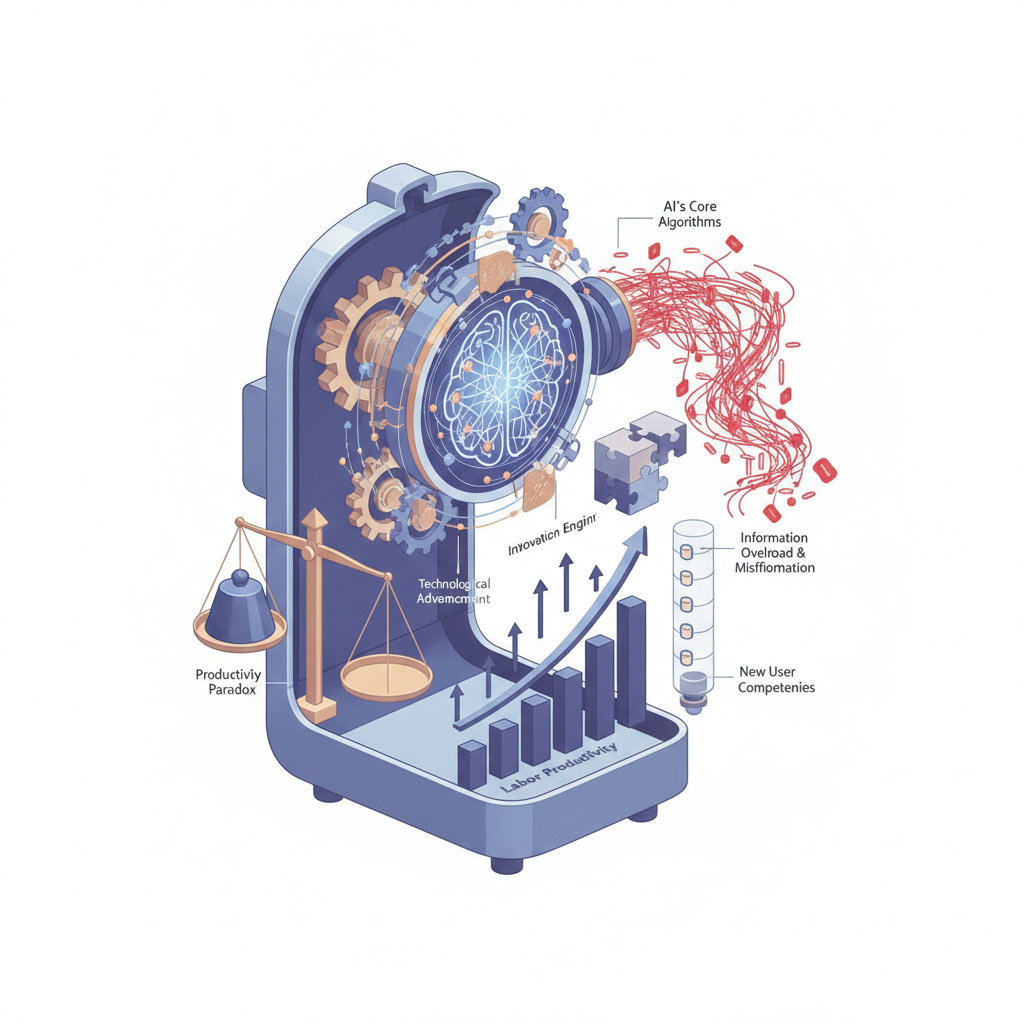
The article highlights the divergent perspectives on the impact of Artificial Intelligence (AI) on labour productivity, citing scepticism from economists regarding the uncritical adoption of AI models. It draws parallels with historical technological transitions, such as the internet and search engines, to illustrate how initial productivity gains from new technologies can be offset by unintended consequences like information overload, misinformation, and the need for new user competencies. The discussion underscores the importance of rigorous evaluation frameworks for assessing the net economic benefits of AI integration in workplaces.
Background
- The relationship between technological innovation and labour productivity has been a subject of scholarly debate since the Industrial Revolution, with the ‘productivity paradox’ (Solow Paradox) highlighting instances where technological advancements did not immediately translate into measurable productivity gains.
- The advent of the internet in the 1990s revolutionised information access, with tools like Gopher and later the World Wide Web enabling rapid document exchange, but early systems required specialised technical skills, limiting widespread adoption.
- The emergence of user-friendly interfaces such as Mosaic, Netscape Navigator, and later Google’s search engine democratised internet access, leading to exponential growth in information retrieval but also introducing challenges like information overload and the rise of clickbait.
- The transition from traditional statistical models to Large Language Models (LLMs) represents a paradigm shift in computational linguistics, with LLMs leveraging trillions of parameters to contextualise language, though their reliance on statistical extrapolation introduces risks of inaccuracies and biases.
- The economic literature distinguishes between ‘labour productivity’ (output per worker) and ‘total factor productivity’ (efficiency gains from all inputs), with AI’s impact often debated in terms of its contribution to the latter rather than the former.
- Historical precedents, such as the adoption of electricity in the early 20th century, demonstrate that the full productivity benefits of new technologies may only materialise after complementary innovations in organisational structures and workforce skills.
What is the Productivity Paradox in the Context of Artificial Intelligence?
- The **Productivity Paradox** refers to the observed phenomenon where the adoption of advanced technologies, including AI, does not always result in immediate or proportional increases in labour productivity, despite significant investments in innovation.
- AI systems, particularly **Large Language Models (LLMs)**, utilise deep learning techniques to process and generate human-like text, enabling applications such as chatbots, automated content generation, and decision-support tools in workplaces.
- The core mechanism of AI-driven productivity enhancement is rooted in **automation of routine tasks**, **augmentation of human capabilities**, and **optimisation of resource allocation**, which can reduce operational inefficiencies and accelerate decision-making processes.
- However, the **statistical nature of LLMs**—which rely on pattern recognition rather than causal reasoning—introduces risks of **hallucinations** (fabricated outputs), **bias amplification**, and **contextual inaccuracies**, potentially undermining productivity gains by requiring additional human oversight and validation.
- The **interface design** of AI tools plays a critical role in their adoption; user-friendly designs (e.g., plain-language queries in chatbots) can lower barriers to entry but may also mask underlying complexities, leading to overreliance on AI outputs without critical assessment.
- Historical cases, such as the **dot-com bubble** and the **rise of search engines**, illustrate how initial productivity gains from technological adoption can be eroded by **monopolistic practices**, **information asymmetry**, and **adverse behavioural adaptations** (e.g., clickbait-driven content strategies).
- The **digital divide** exacerbates the productivity paradox, as disparities in access to AI tools and digital literacy can widen economic inequalities, particularly in sectors or regions where technological integration is uneven.
- Policy frameworks must address **skill gaps**, **regulatory oversight**, and **ethical considerations** to ensure that AI adoption translates into sustainable productivity improvements without compromising job quality or exacerbating structural unemployment.
UPSC Value Addition
Keywords for Mains Answer-Writing
Artificial Intelligence · Labour Productivity · Technological Adoption · Economic Dynamism · Large Language Models · Productivity Paradox · Technological Unemployment · Digital Public Infrastructure · Innovation Policy · Regulatory Governance of AI · Economic Growth Models · Human-Computer Interaction
Prelims Practice Questions
Q1. Consider the following statements regarding the impact of Artificial Intelligence (AI) on labour productivity:
1. AI adoption is universally recognised to enhance labour productivity across all sectors.
2. The productivity paradox refers to the lag between technological investment and measurable productivity gains.
3. Historical precedents like the World Wide Web demonstrate that user-friendly interfaces alone guarantee sustained productivity improvements.
4. Large Language Models (LLMs) rely on statistical extrapolation and may produce unreliable outputs, potentially reducing productivity.
How many of the above statements are correct?
- Only one
- Only two
- Only three
- All four
Answer: Only three — Statements 2 and 4 are correct. Statement 1 is incorrect as AI’s impact on productivity is debated and not universally recognised. Statement 3 is incorrect because user-friendly interfaces alone do not guarantee productivity improvements, as seen in the degradation of search-engine results due to optimisation and clickbait.
Q2. Assertion (A): The adoption of Large Language Models (LLMs) in workplaces is expected to uniformly increase labour productivity.
Reason (R): LLMs utilise trillions of parameters to incorporate contextual factors, enabling them to outperform traditional statistical models in all tasks.
In the context of the above assertions, which of the following is correct?
- Both A and R are true, and R is the correct explanation of A
- Both A and R are true, but R is NOT the correct explanation of A
- A is true, but R is false
- A is false, but R is true
Answer: A is false, but R is true — Assertion (A) is false because the impact of LLMs on labour productivity is contested and not uniformly positive. Reason (R) is true in describing LLMs’ technical capability, but it does not explain why productivity gains are uncertain, as LLMs may produce unreliable outputs or require additional time for verification.
Q3. Match the following technological advancements with their corresponding eras of adoption:
Column I (Technological Advancement)
A. Gopher
B. World Wide Web
C. Google Search Engine
D. Large Language Models (LLMs)
Column II (Era of Adoption)
1. Early 1990s
2. Mid-1990s
3. Late 1990s
4. 2020s
Select the correct match:
- A-1, B-2, C-3, D-4
- A-2, B-1, C-3, D-4
- A-1, B-3, C-2, D-4
- A-4, B-2, C-1, D-3
Answer: A-1, B-2, C-3, D-4 — Gopher was used in the early internet era (pre-1990s), the World Wide Web emerged in the early 1990s, Google’s search engine was launched in the late 1990s, and Large Language Models gained prominence in the 2020s.
Mains Practice Question
✍ Critically examine the claim that Artificial Intelligence (AI) will meaningfully increase labour productivity in contemporary economies. Substantiate your analysis with reference to historical precedents in technological adoption and the potential productivity paradox. (15 Marks)
Approach: MODEL-ANSWER SKELETON:
1. **Introduction**: Define AI and labour productivity; state the claim and its contested nature.
2. **Historical Precedents**:
– **World Wide Web (WWW)**: Transition from Gopher to WWW; role of user-friendly interfaces (browsers like Mosaic, Netscape) in enabling productivity gains.
– **Google Search Engine**: Initial efficiency, followed by degradation due to optimisation, clickbait, and sponsored results; user adaptation required (Boolean operators, keyword selection).
– **Productivity Paradox**: Lag between technological investment and measurable output gains (e.g., Solow Paradox).
3. **AI and Productivity**:
– **Potential Advantages**: LLMs’ contextual incorporation via trillions of parameters; natural language interfaces reducing cognitive load.
– **Challenges**: Unreliability of outputs (hallucinations), time costs in verification, and degradation of user experience (e.g., AI overviews replacing curated search results).
4. **Productivity Paradox in AI**:
– **Empirical Evidence**: Mixed results from studies on AI adoption and productivity; sectors like customer service may see gains, while others face inefficiencies.
– **Human Factors**: Need for upskilling (e.g., prompt engineering, output validation) to harness AI effectively.
5. **Regulatory and Policy Considerations**:
– **Digital Public Infrastructure**: Role of frameworks like India’s National AI Strategy in ensuring equitable and efficient AI adoption.
– **Ethical Governance**: Need for transparency, accountability, and safeguards against misuse to prevent productivity losses.
6. **Conclusion**: Balance of views—AI holds transformative potential but requires robust institutional and human capital support to realise productivity gains. Acknowledge uncertainty and the need for empirical validation.
Source: orissapost.com
Generated by AanyaAi for educational purpose.
Related guides on our sites
- Current affairs for upsc 2026
- Best economics optional coaching for upsc
- Best economics optional teacher for upsc
- How to prepare for GS paper 1 for UPSC CSE mains exam

- AI’s Productivity Paradox: Will Automation Boost or Reduce Output? - September 3, 2026
- असम के विकास में केंद्र की भूमिका: विधानसभा अध्यक्ष और डॉ. जितेंद्र सिंह की बैठक - September 3, 2026
- Assam Speaker Meets Union Minister Dr. Jitendra Singh: Key Discussions on State’s Rapid Development - September 3, 2026

No Comments