


04 Sep El Nino to Persist Till Feb 2027: Impact on India’s Monsoon & Climate
✎ El Niño’s persistence through February 2027 is likely to reduce monsoon rainfall in India, elevate temperatures during winter and early summer, and increase the risk of terminal heat stress in Rabi crops, necessitating adaptive…
Subject Relevance — Where This Topic Fits
- GS Paper I — Geography (Climate and Weather Systems) | GS Paper III — Environment, Ecology, Biodiversity and Climate Change
- Prelims: El Niño-Southern Oscillation (ENSO), Indian Monsoon, La Niña, IMD, WMO, Long Period Average (LPA), Rabi Crops, Terminal Heat Stress, Climate Change
- Essay: Climate Change and Its Impact on Global Weather Patterns, Sustainable Agriculture and Food Security in the Context of Climate Variability
Quick Revision: El Niño’s persistence through February 2027 is likely to reduce monsoon rainfall in India, elevate temperatures during winter and early summer, and increase the risk of terminal heat stress in Rabi crops, necessitating adaptive agricultural and water resource management strategies.
Why is this in the news?
The World Meteorological Organization (WMO) has projected that El Niño conditions are likely to intensify into a very strong event and persist through February 2027, with significant implications for global and regional climate patterns. This projection, corroborated by the India Meteorological Department (IMD), raises concerns for India’s monsoon rainfall, agricultural productivity, and overall climate resilience, particularly during the upcoming winter and early summer seasons.
Background
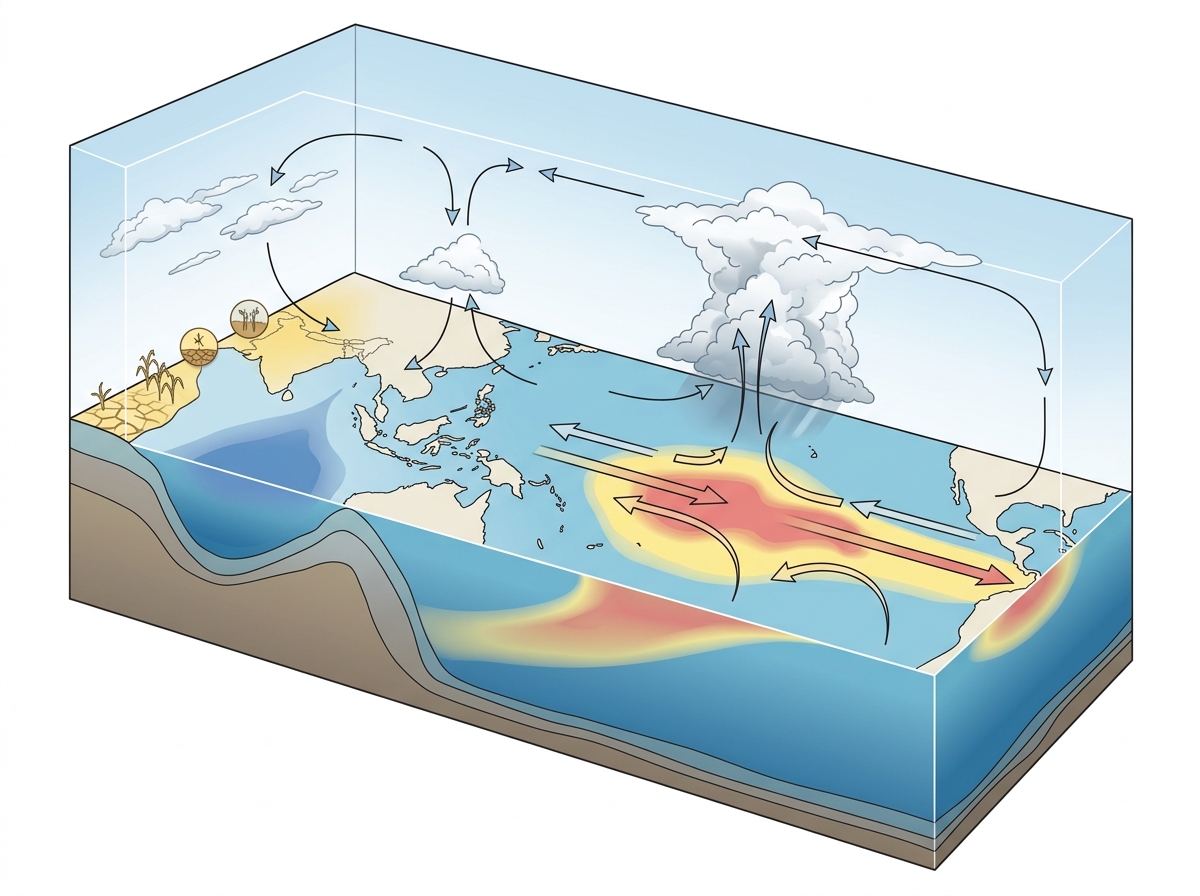
- El Niño-Southern Oscillation (ENSO) is a naturally occurring climate phenomenon characterized by fluctuations in sea surface temperatures and atmospheric pressure in the tropical Pacific Ocean, with three distinct phases: El Niño, La Niña, and neutral.
- El Niño events are associated with the warming of central and eastern equatorial Pacific waters, which disrupts global weather patterns, including the Indian monsoon, leading to reduced rainfall over the Indian subcontinent.
What is El Niño-Southern Oscillation (ENSO)?
- ENSO is a coupled ocean-atmosphere phenomenon that occurs in the tropical Pacific Ocean, influencing global weather and climate patterns through sea surface temperature anomalies and atmospheric pressure fluctuations.
- The three phases of ENSO are: El Niño (warming phase), La Niña (cooling phase), and neutral (average conditions), each with distinct impacts on global climate systems.
- El Niño is characterized by the abnormal warming of sea surface temperatures in the central and eastern equatorial Pacific, which weakens the trade winds and disrupts the Walker Circulation, a key atmospheric circulation pattern over the Pacific.
- The impacts of El Niño are not limited to the Pacific; they extend globally, affecting monsoon systems, temperature regimes, and the frequency of extreme weather events such as droughts, floods, and heatwaves.
- La Niña, the opposite phase of ENSO, is associated with cooler-than-average sea surface temperatures in the central and eastern Pacific, leading to enhanced monsoon rainfall over India and other regions.
- ENSO is a natural climate variability phenomenon, but anthropogenic climate change is altering its behavior, with studies suggesting an increase in the frequency of extreme El Niño events.
Key Features
| Feature | Significance |
|---|---|
| El Niño Southern Oscillation (ENSO) | A naturally occurring climate phenomenon involving fluctuations in sea surface temperatures and atmospheric pressure in the tropical Pacific Ocean, influencing global weather patterns. |
| WMO Projection (Sept 2026) | Indicates a very strong El Niño event persisting through February 2027, with heightened risks of extreme weather events globally. |
| IMD Rainfall Forecast (Sept 2026) | Projects below-normal rainfall (91% of LPA) for India in September, exacerbating existing monsoon deficits. |
| Temperature Anomalies (Aug 2026) | August 2026 recorded India’s hottest August since 1901, with a 16% rainfall deficit attributed to El Niño conditions. |
| Rabi Crop Heat Stress | Shortened winters and rising February-March temperatures increase terminal heat stress on wheat and other rabi crops, affecting productivity. |
Why it Matters
Agricultural Impact
- Reduced monsoon rainfall during El Niño years typically lowers kharif crop yields, particularly rice, pulses, and coarse cereals.
- Prolonged dry spells and heat stress during rabi season threaten wheat production in northern India, a critical food security crop.
- Increased reliance on irrigation and groundwater, exacerbating water scarcity in already stressed regions.
- Potential for localized crop failures, leading to food price volatility and inflationary pressures.
Hydrological and Water Security
- Diminished reservoir inflows and groundwater recharge due to deficient rainfall, impacting drinking water supply and irrigation.
- Heightened drought risks in central and southern India, with cascading effects on hydroelectric power generation.
- Increased competition for water resources between agriculture, industry, and domestic sectors, necessitating demand-side management.
Economic and Livelihoods
- Adverse impact on rural incomes, particularly for small and marginal farmers dependent on rainfed agriculture.
- Higher input costs (e.g., diesel for irrigation pumps) due to energy price fluctuations linked to climate anomalies.
- Potential strain on government finances through increased expenditure on drought relief, food subsidies, and crop insurance payouts.
Public Health and Disaster Management
- Elevated risks of heatwaves, vector-borne diseases (e.g., malaria, dengue), and waterborne illnesses during prolonged dry periods.
- Increased frequency of extreme weather events (e.g., cyclones, floods) during El Niño transitions, requiring robust early warning systems.
- Strain on healthcare infrastructure due to climate-sensitive diseases and heat-related morbidity.
Climate Policy and Global Context
- Underscores the urgency of integrating climate resilience into India’s agricultural and water policies, aligning with SDG 13 (Climate Action).
- Highlights the need for international cooperation on climate adaptation, given the transboundary nature of ENSO impacts.
- Reinforces the importance of India’s Nationally Determined Contributions (NDCs) under the Paris Agreement for mitigation and adaptation.
Challenges
1. Agricultural Productivity Decline
- Risk of significant yield losses in kharif and rabi crops due to deficient rainfall and heat stress.
- Increased vulnerability of smallholder farmers, who lack resources to adapt to climate variability.
- Potential disruption in food supply chains, affecting food security and nutritional outcomes.
UPSC Link: GS-III: Agriculture, Food Security
2. Water Scarcity and Drought
- Depletion of groundwater reserves in overexploited regions (e.g., Punjab, Haryana, Rajasthan).
- Reduced hydropower generation, exacerbating energy deficits during peak demand periods.
- Competing demands for water between agriculture, industry, and urban areas, leading to social tensions.
UPSC Link: GS-III: Water Resources, Drought Management
3. Extreme Weather Events
- Increased frequency of heatwaves, particularly in northern and central India, with severe health impacts.
- Higher likelihood of cyclones and heavy rainfall events during El Niño transitions, causing infrastructure damage.
- Disruption of transportation, power supply, and communication networks during extreme events.
UPSC Link: GS-III: Disaster Management
4. Economic and Fiscal Strain
- Rise in food inflation due to supply-side shocks, affecting vulnerable populations.
- Increased expenditure on drought relief, crop insurance, and subsidies, straining public finances.
- Potential decline in rural demand, impacting industrial growth and employment.
UPSC Link: GS-III: Indian Economy, Inflation
5. Policy Implementation Gaps
- Limited integration of climate projections into long-term agricultural and water planning.
- Inadequate adoption of climate-resilient technologies (e.g., drought-resistant crop varieties, micro-irrigation).
- Weak coordination between central and state agencies on drought preparedness and response.
UPSC Link: GS-II: Governance, GS-III: Environment
Challenges — UPSC Perspective
| Issue | Concern |
|---|---|
| Kharif Crop Failure | Reduced rainfall during monsoon season leads to lower yields of rice, pulses, and coarse cereals. |
| Rabi Crop Heat Stress | Shortened winters and rising temperatures during February-March threaten wheat productivity. |
| Groundwater Depletion | Over-extraction for irrigation in Punjab, Haryana, and Rajasthan accelerates during droughts. |
| Heatwave Mortality | Prolonged high temperatures increase risks of heatstroke, particularly among agricultural workers. |
| Food Price Inflation | Supply-side shocks from crop failures contribute to higher food prices and reduced affordability. |
| Climate Migration | Prolonged droughts and crop failures may drive rural-to-urban migration, straining urban infrastructure. |
Way Forward
- Enhance integration of seasonal climate forecasts (e.g., IMD, WMO) into agricultural advisory services for farmers.
- Promote climate-resilient crop varieties and agronomic practices (e.g., short-duration varieties, mulching) to mitigate heat stress.
- Expand micro-irrigation (e.g., drip, sprinkler) to improve water-use efficiency in drought-prone regions.
- Strengthen groundwater regulation through participatory aquifer management and recharge programs.
- Develop heatwave action plans for vulnerable regions, including early warning systems and public health interventions.
- Invest in drought-resilient infrastructure (e.g., rural water storage, rural roads for relief operations).
- Foster public-private partnerships for climate-smart agriculture, including insurance schemes and financial literacy.
- Integrate climate adaptation into national and state-level policies (e.g., National Mission for Sustainable Agriculture).
UPSC Value Addition
Keywords for Mains Answer-Writing
El Niño Southern Oscillation (ENSO) · El Niño and its impacts on India · World Meteorological Organization (WMO) projections · India Meteorological Department (IMD) forecasts · Monsoon variability and climate change · Rabi crop vulnerability to temperature anomalies · Long Period Average (LPA) rainfall · ENSO-neutral phase and its significance · Climate resilience and agricultural adaptation · Extreme weather events and policy responses
Concept Flow
El Niño conditions develop in the equatorial Pacific → Disruption of Walker Circulation → Reduced monsoon rainfall over India → Deficient kharif crop yields → Prolonged El Niño → Persistent dry spells and heatwaves → Shortened winter season in northern India → Terminal heat stress on rabi crops (e.g., wheat) → Reduced rainfall → Lower groundwater recharge and reservoir inflows → Water scarcity in agriculture and domestic sectors → Heat stress and drought → Lower agricultural productivity → Increased food prices and inflationary pressures → Extreme weather events → Infrastructure damage and displacement → Strain on disaster management systems → Policy response → Integration of climate forecasts into agricultural planning → Promotion of climate-resilient practices
Prelims Practice Questions
Q1. Consider the following statements regarding El Niño Southern Oscillation (ENSO):
1. El Niño is associated with the warming of sea surface temperatures in the central and eastern tropical Pacific Ocean.
2. La Niña typically results in a cooling effect on global temperatures.
3. ENSO has only two phases: El Niño and La Niña.
4. The neutral phase of ENSO is characterised by average sea surface temperatures in the Pacific.
How many of the above statements are correct?
- Only one
- Only two
- Only three
- All
Answer: All — Statements 1, 2, and 4 are correct. Statement 3 is incorrect because ENSO has three phases: El Niño, La Niña, and the neutral phase.
Q2. Assertion (A): The India Meteorological Department (IMD) has forecasted below-normal rainfall for September 2026 due to prevailing El Niño conditions.
Reason (R): El Niño conditions typically lead to reduced rainfall in India by altering atmospheric circulation patterns.
Options:
A. Both A and R are true, and R is the correct explanation of A.
B. Both A and R are true, but R is not the correct explanation of A.
C. A is true, but R is false.
D. A is false, but R is true.
Answer: ? — Both Assertion (A) and Reason (R) are true, and Reason (R) correctly explains Assertion (A). El Niño conditions are known to suppress monsoon rainfall in India.
Q3. Match the following climate phenomena with their characteristic effects on India’s monsoon:
Column I
1. El Niño
2. La Niña
3. Neutral ENSO phase
Column II
A. Above-normal rainfall
B. Below-normal rainfall
C. Normal rainfall
Select the correct match:
- 1-B, 2-A, 3-C
- 1-A, 2-B, 3-C
- 1-C, 2-A, 3-B
- 1-B, 2-C, 3-A
Answer: 1-B, 2-A, 3-C — El Niño (1) is associated with below-normal rainfall (B), La Niña (2) with above-normal rainfall (A), and the neutral ENSO phase (3) with normal rainfall (C).
Mains Practice Question
✍ El Niño conditions are projected to persist through February 2027, with significant implications for India’s climate and agricultural productivity. Critically examine the linkages between El Niño, monsoon variability, and the vulnerability of Rabi crops to temperature anomalies. Also assess the policy measures required to enhance climate resilience in Indian agriculture. (15 Marks)
Approach: MODEL-ANSWER SKELETON:
1. **Introduction (2 marks)**: Define ENSO and El Niño; state WMO and IMD projections for 2026–27.
2. **Mechanism of El Niño and Monsoon Variability (4 marks)**:
– Explain the atmospheric-oceanic coupling (Walker Circulation, Trade Winds).
– Link El Niño to suppressed monsoon rainfall (reduced moisture transport, delayed onset).
– Cite IMD data: August 2026 rainfall deficit (16%) and record August temperatures since 1901.
3. **Impact on Rabi Crops (4 marks)**:
– Temperature anomalies during reproductive/grain-filling stages of wheat (February–March warming trends: 0.69°C/decade in February).
– Terminal heat stress and yield reduction in major wheat-growing regions (Punjab, Haryana, Uttar Pradesh).
– Reference Climate Trends study on shortening winters.
4. **Policy Measures for Climate Resilience (3 marks)**:
– **Short-term**: Crop diversification, early sowing, heat-resistant varieties, irrigation scheduling.
– **Long-term**: National Mission for Sustainable Agriculture (NMSA), Pradhan Mantri Krishi Sinchayee Yojana (PMKSY), climate-smart agriculture (CSA) integration.
– Institutional frameworks: IMD’s seasonal forecasts, WMO’s Early Warning Systems.
5. **Conclusion (2 marks)**: Emphasise the need for adaptive governance, inter-ministerial coordination (MoA&FW, MoES, NITI Aayog), and global climate commitments (Paris Agreement).
Source: orissapost.com
Generated by AanyaAi for educational purpose.
Related guides on our sites
- Current affairs for upsc 2026
- How to prepare for GS paper 1 for UPSC CSE mains exam
- Best UPSC coaching for IFOS exam
- Best geography optional coaching

- Kerala HC Refuses Stay on Waqf Board Reconstitution: Key Facts - October 23, 2026
- तेलंगाना पेंशनरों के PAN और आधार विवरण होंगे सत्यापित, जानिए पूरा मामला - October 23, 2026
- Marathwada Turns Hotter; Konkan Wetter in 70 Years: IMD-IITM Study - October 23, 2026

No Comments