


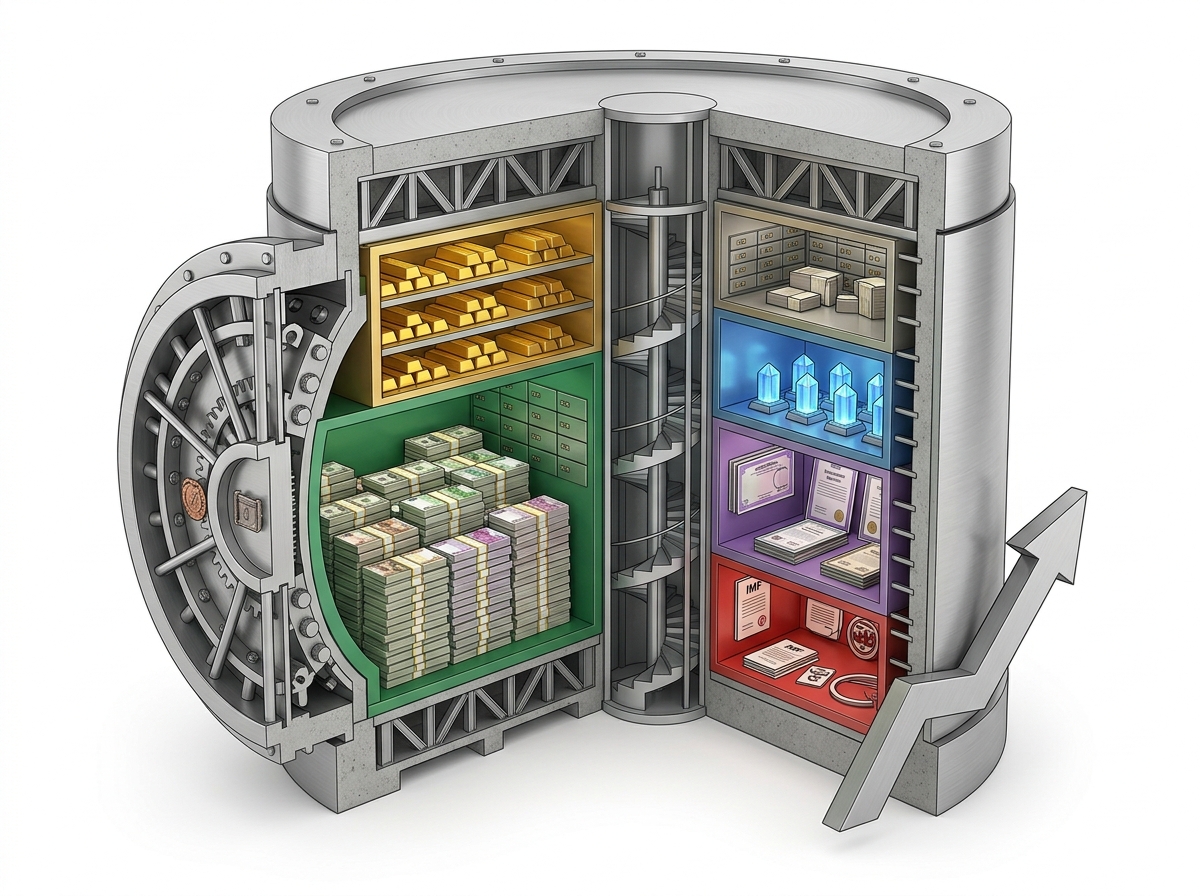
04 Sep India’s Forex Reserves Hit Record $740.8bn: RBI Data for UPSC 2026
✎ Foreign Exchange Reserves are a critical buffer against external shocks, with India’s reserves now exceeding USD 740 billion, supported by RBI’s forex swap mechanism and structural capital inflows.
Subject Relevance — Where This Topic Fits
- GS Paper III — Indian Economy and Issues relating to Planning, Mobilisation of Resources, Growth, Development and Employment | GS Paper III — Effects of Liberalisation on the Economy, Changes in Industrial Policy and their Effects on Industrial Growth | GS Paper III — Indian Economy and issues relating to Planning, Mobilisation of Resources, Growth, Development and Employment — Balance of Payments
- Prelims: Foreign Exchange Reserves (FER), RBI, Foreign Currency Assets (FCA), Special Drawing Rights (SDR), Reserve Position with IMF, Currency Appreciation/Depreciation, Forex Swap Mechanism, Balance of Payments, Current Account Deficit, Capital Account Surplus
- Essay: The Role of Central Banks in Managing Macroeconomic Stability: A Case Study of India’s Foreign Exchange Reserves, Globalisation and National Economic Sovereignty: The Imperative of Robust Forex Management
Quick Revision: Foreign Exchange Reserves are a critical buffer against external shocks, with India’s reserves now exceeding USD 740 billion, supported by RBI’s forex swap mechanism and structural capital inflows.
Why is this in the news?
The Reserve Bank of India (RBI) reported a record surge of USD 11.475 billion in India’s foreign exchange reserves, reaching an unprecedented high of USD 740.803 billion for the week ended August 28, 2026. This marks the second consecutive weekly increase exceeding USD 10 billion, following a prior record of USD 729.328 billion. The upward trajectory reflects structural interventions, including the RBI’s concessional forex swap initiatives, and underscores India’s growing external sector resilience amid global geopolitical volatility.
Background
- Foreign exchange reserves are held by central banks to ensure external sector stability, facilitate international trade, and provide confidence in the domestic currency during external shocks.
- India’s foreign exchange reserves have historically fluctuated in response to global commodity price movements, capital flows, and geopolitical tensions, with notable peaks during periods of strong capital inflows or trade surpluses.
- The onset of the Middle East conflict in early 2026 led to a temporary decline in reserves as the RBI intervened in forex markets to stabilise the rupee through dollar sales, highlighting the counter-cyclical role of reserves.
- The RBI’s forex swap mechanism, introduced in June 2026, was designed to attract foreign currency liquidity while managing currency volatility, yielding over USD 132 billion in new flows since its implementation.
- Foreign currency assets (FCA), comprising the largest component of reserves, are denominated in non-US currencies such as the euro, pound, and yen, whose valuation is affected by exchange rate movements against the US dollar.
- Special Drawing Rights (SDRs) and the reserve position with the IMF are smaller components of reserves, reflecting India’s quota-based contributions and allocations from the IMF.
What are Foreign Exchange Reserves and their Components?
- Foreign Exchange Reserves (FER) are external assets held by a central bank, primarily in the form of foreign currencies, gold, SDRs, and reserve positions with the IMF, to meet balance-of-payments obligations and stabilise the national currency.
- Foreign Currency Assets (FCA) constitute the largest share of FER (approximately 81.08% as of August 2026), including deposits, securities, and other foreign-denominated assets held by the RBI.
- Gold reserves, the second-largest component, serve as a hedge against currency volatility and geopolitical risks, with their valuation influenced by global gold prices and exchange rate movements.
- Special Drawing Rights (SDRs) are international reserve assets created by the IMF, allocated to member countries based on their IMF quotas, and can be exchanged for freely usable currencies.
- Reserve Position with the IMF represents India’s quota subscription and lending to the IMF, reflecting the country’s financial commitment and access to IMF resources in times of balance-of-payments stress.
- The valuation of FER is subject to exchange rate fluctuations, particularly for non-US currencies, which can lead to valuation gains or losses without corresponding changes in actual reserve holdings.
- India’s forex reserves are managed under the provisions of the Reserve Bank of India Act, 1934, which empowers the RBI to maintain reserves to ensure monetary stability and external sector viability.
- The accumulation of reserves is influenced by current account dynamics (trade balance, remittances) and capital account flows (FDI, portfolio investments, external borrowings), with surpluses in either account contributing to reserve growth.
Key Features
| Feature | Significance |
|---|---|
| Forex Reserves Level (USD 740.803 billion) | Demonstrates robust external sector strength and buffers against global financial volatility. |
| Foreign Currency Assets (USD 600.67 billion) | Primary driver of reserve growth; reflects currency composition and valuation effects of non-US currencies. |
| Gold Reserves (USD 116.409 billion) | Provides hedge against USD depreciation and geopolitical risks; diversifies reserve composition. |
| Special Drawing Rights (SDRs) (USD 18.81 billion) | Contingent liquidity instrument under IMF framework; supplements foreign exchange reserves. |
| Reserve Position with IMF (USD 4.914 billion) | Represents India’s quota-based lending capacity to the IMF; enhances multilateral financial credibility. |
Why it Matters
Macroeconomic Stability
- Enhances India’s resilience to external shocks such as capital flow reversals or sudden currency depreciation.
- Reduces vulnerability to global financial crises by maintaining high liquidity buffers.
- Strengthens the rupee’s stability through increased market intervention capacity of the RBI.
Monetary Policy Autonomy
- Provides the Reserve Bank of India (RBI) with greater flexibility in managing liquidity and interest rates.
- Enables sterilisation operations to offset inflationary pressures from capital inflows.
- Supports independent monetary policy in the face of global monetary tightening cycles.
External Sector Credibility
- Signals strong investor confidence in India’s economic fundamentals to foreign portfolio investors (FPIs).
- Facilitates smoother external debt servicing and reduces sovereign risk premiums.
- Enhances India’s negotiating power in international financial forums and trade agreements.
Geopolitical Buffer
- Acts as a strategic cushion during periods of heightened geopolitical tensions, such as the Middle East conflict referenced in the source.
- Mitigates the impact of supply chain disruptions or commodity price shocks on the current account.
Challenges
1. Volatility in Capital Flows
- Sudden reversals in foreign portfolio investments (FPI) can erode reserves rapidly, as seen during geopolitical conflicts.
- Dependence on volatile components like foreign currency assets increases exposure to exchange rate risks.
UPSC Link: GS-III: External Sector
2. Cost of Reserve Accumulation
- Opportunity cost of holding excessive reserves, as idle forex reserves could be deployed for developmental expenditures.
- Interest income foregone on RBI’s foreign asset holdings compared to domestic investments.
UPSC Link: GS-III: Monetary Policy
3. Exchange Rate Management
- Excessive reserve accumulation may lead to currency appreciation, harming export competitiveness.
- Balancing intervention to stabilise the rupee without triggering currency manipulation allegations.
UPSC Link: GS-III: Foreign Exchange
4. Compositional Risks
- Over-reliance on USD-denominated assets exposes reserves to USD depreciation risks.
- Gold reserves, while a hedge, are subject to price volatility and storage costs.
UPSC Link: GS-III: Reserve Management
5. Global Spillovers
- Reserve accumulation may invite scrutiny from global financial institutions or trade partners regarding currency practices.
- Impact of US Federal Reserve policy shifts on India’s reserve dynamics and capital flows.
UPSC Link: GS-III: Global Financial Architecture
Challenges — UPSC Perspective
| Issue | Concern |
|---|---|
| Liquidity Mismatch | Risk of sudden outflows exceeding reserve coverage, especially during global risk-off episodes. |
| Valuation Effects | Fluctuations in non-US currencies (euro, yen) can distort reserve growth metrics without actual inflow. |
| Sovereign Ratings | Excessive reserve accumulation may not proportionally improve credit ratings due to structural fiscal concerns. |
| Regulatory Arbitrage | Potential misuse of forex reserves for quasi-fiscal activities, undermining transparency. |
| Climate Risks | Reserves invested in fossil-fuel-dependent economies face transition risks from global decarbonisation efforts. |
| Data Asymmetry | Lack of granular disclosure on reserve composition and counterparty risks in global custodian holdings. |
Way Forward
- Rationalise reserve accumulation targets based on empirical assessment of external sector risks and trade-offs with developmental spending.
- Diversify reserve composition further by increasing allocations to gold, SDRs, and other non-USD assets to mitigate currency risks.
- Enhance transparency in reserve management by publishing detailed breakdowns of currency composition, counterparty exposure, and valuation methodologies.
- Strengthen coordination between the RBI and the Ministry of Finance to align reserve accumulation with broader macroeconomic objectives, including export competitiveness.
- Develop contingency plans for rapid reserve depletion scenarios, including pre-negotiated swap lines with major central banks.
- Leverage forex reserves to support India’s green transition financing through targeted investments in sustainable assets.
- Monitor and mitigate spillover effects of reserve accumulation on domestic liquidity conditions to avoid inflationary pressures.
UPSC Value Addition
Keywords for Mains Answer-Writing
Foreign Exchange Reserves (Forex) · Foreign Currency Assets (FCA) · Gold Reserves · Special Drawing Rights (SDR) · Reserve Position with IMF · RBI’s Forex Management · Concessional Forex Swap Initiative · Rupee Depreciation · Geopolitical Risks and Forex Reserves · Macroeconomic Stability · Balance of Payments (BoP) · Exchange Rate Management · Capital Inflows · Monetary Policy and Forex Reserves
Concept Flow
Geopolitical tensions → Capital outflows → Rupee depreciation → RBI intervention (forex sales) → Decline in reserves → Shift to concessional forex swap initiatives → Inflow of USD 132 billion → Accumulation of reserves to USD 740.803 billion → Strengthened external sector buffers → Enhanced monetary policy autonomy → Improved investor confidence → Sustained capital inflows
Prelims Practice Questions
Q1. Consider the following statements regarding India’s Foreign Exchange Reserves:
1. Foreign Exchange Reserves are composed of Foreign Currency Assets (FCA), Gold Reserves, Special Drawing Rights (SDR), and Reserve Position with the IMF.
2. The value of FCA is expressed in dollar terms and includes the effects of appreciation or depreciation of non-US currencies like the euro, pound, and yen.
3. The Special Drawing Rights (SDR) are a currency basket managed by the World Bank for international transactions.
How many of the above statements are correct?
- Only one
- Only two
- All three
- None
Answer: Only two — Statement 1 is correct as FCA, Gold Reserves, SDR, and Reserve Position with the IMF are the four components of Forex Reserves. Statement 2 is correct as FCA values are expressed in dollar terms and adjusted for currency fluctuations. Statement 3 is incorrect as SDRs are managed by the IMF, not the World Bank.
Q2. Assertion (A): The Reserve Bank of India (RBI) intervenes in the forex market by selling dollars to stabilize the rupee during periods of depreciation.
Reason (R): Intervention by the RBI in the forex market is aimed at maintaining macroeconomic stability and managing exchange rate volatility.
Options:
A. Both A and R are true, and R is the correct explanation of A.
B. Both A and R are true, but R is NOT the correct explanation of A.
C. A is true, but R is false.
D. A is false, but R is true.
Answer: ? — Assertion (A) is true as the RBI often sells dollars to prevent excessive rupee depreciation. Reason (R) is also true and correctly explains A, as RBI’s forex interventions are designed to maintain macroeconomic stability and exchange rate stability.
Q3. Match the following components of India’s Foreign Exchange Reserves with their respective values as of the week ended August 28, 2026:
Column I (Component) | Column II (Value in USD Billion)
————————————|———————————–
A. Foreign Currency Assets (FCA) | 1. 116.409
B. Gold Reserves | 2. 600.67
C. Special Drawing Rights (SDR) | 3. 18.81
D. Reserve Position with IMF | 4. 4.914
Options:
A. A-2, B-1, C-3, D-4
B. A-1, B-2, C-3, D-4
C. A-2, B-1, C-4, D-3
D. A-4, B-2, C-1, D-3
Answer: ? — The correct match is: Foreign Currency Assets (FCA) – 600.67 billion, Gold Reserves – 116.409 billion, Special Drawing Rights (SDR) – 18.81 billion, and Reserve Position with IMF – 4.914 billion.
Mains Practice Question
✍ Critically examine the significance of India’s record-high Foreign Exchange Reserves of USD 740.8 billion as of August 28, 2026, for macroeconomic stability and external sector management. (15 Marks)
Approach: MODEL-ANSWER SKELETON:
1. **Definition and Composition** (2 Marks):
– Define Foreign Exchange Reserves and list their components: Foreign Currency Assets (FCA), Gold Reserves, Special Drawing Rights (SDR), and Reserve Position with the IMF.
– Highlight the dominant component (FCA) and its volatility due to exchange rate fluctuations.
2. **Macroeconomic Stability** (4 Marks):
– **Buffer against External Shocks**: Discuss how high forex reserves act as a cushion against global financial volatility, geopolitical risks, and sudden capital outflows.
– **Exchange Rate Stability**: Explain the RBI’s role in managing the rupee’s volatility through forex interventions (dollar sales/purchases) and the impact on inflation and trade competitiveness.
– **Import Cover**: Calculate or state the import cover provided by the reserves (e.g., 15+ months) and its significance for import-dependent economies.
– **Credit Rating and Investor Confidence**: Link high reserves to improved sovereign credit ratings and foreign investor confidence.
3. **External Sector Management** (4 Marks):
– **Balance of Payments (BoP)**: Discuss how forex reserves mitigate BoP pressures, especially during current account deficits or capital flight.
– **Debt Servicing**: Explain the role of reserves in meeting external debt obligations and maintaining debt sustainability.
– **Trade Facilitation**: Highlight how reserves enable smooth import of critical goods (oil, machinery) and support export competitiveness.
– **Concessional Forex Swap Initiative**: Briefly describe the RBI’s 2026 swap initiative, its objectives (e.g., USD 132 billion inflows), and its impact on reserves.
4. **Critique and Challenges** (3 Marks):
– **Cost of Holding Reserves**: Discuss the opportunity cost of holding idle reserves (e.g., returns foregone on alternative investments).
– **Moral Hazard**: Argue whether large reserves encourage reckless fiscal or monetary policies.
– **Overvaluation Risk**: Explain how excessive forex accumulation can lead to rupee overvaluation, hurting export competitiveness.
5. **Conclusion** (2 Marks):
– Summarize the dual role of forex reserves as both a shield and a potential liability.
– Emphasize the need for a balanced approach: maintaining adequate reserves while ensuring efficient utilization for growth and development.
Source: orissapost.com
Generated by AanyaAi for educational purpose.
Related guides on our sites
- Current affairs for upsc 2026
- Best economics optional coaching for upsc
- Best economics optional teacher for upsc
- How to prepare for GS paper 1 for UPSC CSE mains exam

- आरबीआई द्वारा 91, 182 और 364 दिनीय ट्रेजरी बिलों की नीलामी: प्रमुख तथ्य - October 24, 2026
- Inflation’s Second-Round Effects: RBI Policy & Economic Impact Analysis - October 24, 2026
- ISRO का NVS-03 उपग्रह: NavIC को पुनः सक्रिय करेगा, जानिए कैसे? - October 24, 2026

No Comments