


04 Sep IAF Chief’s UAE Visit: India-UAE Defence Ties Set to Strengthen Significantly
✎ The India-UAE Strategic Defence Partnership is a formal framework to enhance military interoperability, joint exercises, and defence industry collaboration, aligned with their Comprehensive Strategic Partnership and regional…
Subject Relevance — Where This Topic Fits
- GS Paper II — International Relations: Bilateral, Regional and Global Groupings and Agreements involving India and/or affecting India’s interests | GS Paper III — Security Challenges and their Management in Border Areas
- Prelims: Comprehensive Strategic Partnership (CSP), Strategic Defence Partnership, India-UAE Joint Military Exercises, Gulf Cooperation Council (GCC), Indian Ocean Region (IOR) security
- Essay: India’s Strategic Autonomy in a Multipolar World, The Role of Middle East in India’s Foreign Policy
Quick Revision: The India-UAE Strategic Defence Partnership is a formal framework to enhance military interoperability, joint exercises, and defence industry collaboration, aligned with their Comprehensive Strategic Partnership and regional security objectives.
Why is this in the news?
The visit of the Indian Air Force Chief to the United Arab Emirates (UAE) in September 2026 underscores the deepening defence ties between India and the UAE, as both nations explore avenues to enhance military cooperation, joint exercises, and institutional exchanges. This engagement follows a series of high-level interactions, including visits by service chiefs and the signing of a Letter of Intent for a Strategic Defence Partnership, highlighting the evolving nature of their bilateral relationship within the broader framework of the Comprehensive Strategic Partnership.
Background
- India and the UAE established the Comprehensive Strategic Partnership (CSP) in 2017, elevating bilateral relations to a higher trajectory.
- The UAE is a key partner in the Gulf region, and its strategic location in the Indian Ocean Region (IOR) makes it significant for India’s maritime security and trade interests.
- Defence cooperation has been a focal point of the CSP, with regular high-level exchanges, joint military exercises, and defence industry collaborations.
- The Indian Ocean Region (IOR) faces evolving security challenges, including piracy, terrorism, and geopolitical rivalries, necessitating collaborative approaches.
- India’s Act East Policy and the UAE’s proactive foreign policy underpin their shared commitment to regional stability and economic integration.
What is the Strategic Defence Partnership between India and the UAE?
- The Strategic Defence Partnership is a formal framework agreed upon by India and the UAE to deepen defence cooperation, including joint exercises, defence industry collaboration, and technology transfer.
- It builds on the Comprehensive Strategic Partnership (CSP) signed in 2017, which encompasses political, economic, and security dimensions.
- The partnership aims to enhance interoperability between the armed forces of both countries through regular joint military exercises, such as ‘Desert Eagle’ for the air forces.
- Defence industry collaboration includes co-development and co-production of defence equipment, with a focus on indigenisation and technology sharing.
- Institutional ties are strengthened through high-level visits, joint working groups, and exchanges of defence personnel for training and capacity-building.
- Both countries have reaffirmed their commitment to a rules-based international order and the peaceful resolution of disputes, reflecting their shared strategic outlook.
- The partnership also facilitates logistics and operational cooperation, including access to each other’s military facilities under mutual agreements.
Key Features
| Feature | Significance |
|---|---|
| Bilateral Air Force Exchange | Demonstrates institutionalised defence diplomacy, enhancing interoperability and trust-building between the Indian Air Force (IAF) and UAE Air Force and Air Defence. |
| Strategic Defence Partnership Framework | Signals a formalised commitment to long-term defence cooperation, aligning with the Comprehensive Strategic Partnership between India and the UAE. |
| Joint Military Exercises | Facilitates operational coordination, tactical learning, and standardisation of procedures, thereby improving regional security architecture. |
| High-Level Visits by Service Chiefs | Underscores the depth of institutional engagement, with reciprocal visits by the Army, Navy, and Air Force chiefs in 2026, reinforcing defence ties. |
| Letter of Intent for Strategic Defence Partnership | Provides a roadmap for future collaboration, including technology transfer, joint R&D, and defence industrial cooperation. |
Why it Matters
Strategic Security
- Enhances maritime domain awareness in the Arabian Sea and Gulf of Oman, critical for countering piracy, terrorism, and illegal maritime activities.
- Strengthens regional deterrence against non-state actors and state-sponsored threats, contributing to stability in West Asia.
- Aligns with India’s ‘Act East’ and ‘SAGAR’ (Security and Growth for All in the Region) policies, fostering a rules-based maritime order.
Defence Industrial Cooperation
- Opens avenues for joint defence manufacturing, technology transfer, and co-development of platforms, reducing import dependence.
- Potential for UAE investment in India’s defence corridors (e.g., Tamil Nadu and Uttar Pradesh) and participation in ‘Make in India’ initiatives.
- Facilitates access to UAE’s advanced aerospace and cyber security capabilities, complementing India’s indigenous defence production.
Geopolitical Alignment
- Reinforces India’s strategic partnerships with Gulf states, balancing China’s influence in the region.
- Supports the UAE’s diversification of defence partnerships beyond traditional allies, enhancing its strategic autonomy.
- Contributes to a multi-polar security architecture in West Asia, reducing over-reliance on any single external power.
Operational Synergy
- Improves interoperability between air forces, enabling seamless joint operations during humanitarian assistance, disaster relief, or conflict scenarios.
- Enhances intelligence-sharing mechanisms, including early warning systems for aerial threats.
- Facilitates exchange of best practices in air domain management, including air traffic control and airspace management.
Challenges
1. Regulatory and Bureaucratic Hurdles
- Differences in defence procurement policies, export controls, and offset obligations may delay project execution.
- Need for harmonised legal frameworks to facilitate technology transfer and joint ventures under the Strategic Defence Partnership.
UPSC Link: Mains GS II: Bilateral Groupings
2. Asymmetric Capability Gaps
- UAE’s advanced aerospace capabilities (e.g., F-16, Rafale) may outpace India’s indigenous systems, requiring focused R&D collaboration.
- Ensuring equitable technology sharing without compromising India’s strategic autonomy in critical sectors.
UPSC Link: Mains GS III: Defence Technology
3. Geopolitical Constraints
- Balancing defence ties with the UAE while maintaining strategic partnerships with other Gulf states (e.g., Saudi Arabia, Qatar).
- Navigating regional tensions (e.g., Yemen conflict, Iran’s nuclear programme) that may impact defence cooperation.
UPSC Link: Mains GS II: Regional Groupings
4. Human Resource Development
- Limited institutional capacity for joint training programmes, requiring expansion of defence academies and exchange programmes.
- Ensuring language and cultural compatibility for seamless integration of personnel in joint exercises.
UPSC Link: Mains GS III: Human Resource Development
Challenges — UPSC Perspective
| Issue | Concern |
|---|---|
| Export Controls | UAE’s adherence to Wassenaar Arrangement and India’s Defence Procurement Procedure (DPP) may create compliance challenges. |
| Offset Obligations | High offset percentages (e.g., 30-50%) under Indian DPP could deter UAE firms from investing in joint ventures. |
| Intellectual Property Rights | Protecting proprietary technologies while enabling joint R&D remains a contentious issue. |
| Cybersecurity Standards | Divergent cybersecurity protocols may hinder seamless data-sharing and joint cyber operations. |
| Logistics Support | Limited pre-positioning of defence assets and infrastructure in each other’s territories could delay rapid deployment. |
Way Forward
- Establish a Joint Defence Working Group (JDWG) with sub-committees for technology, training, and logistics to streamline implementation.
- Accelerate the signing of a Defence Technology and Industrial Cooperation (DTIC) agreement to formalise R&D and manufacturing partnerships.
- Expand the scope of bilateral military exercises (e.g., ‘Desert Eagle’ for air forces, ‘Zayed Talwar’ for navies) to include hybrid warfare scenarios.
- Develop a joint maritime security framework, including coordinated patrols and information-sharing mechanisms in the Arabian Sea.
- Facilitate UAE investment in India’s defence corridors through liberalised FDI norms and single-window clearance mechanisms.
- Enhance cybersecurity collaboration by establishing a joint cyber defence centre and conducting regular red-team exercises.
- Institutionalise defence attachés’ exchanges and language training programmes to improve interoperability and cultural understanding.
UPSC Value Addition
Keywords for Mains Answer-Writing
India-UAE strategic partnership · Comprehensive Strategic Partnership · defence diplomacy · bilateral military exercises · Letter of Intent for Strategic Defence Partnership · regional security architecture · institutional ties in defence · Air Force Chiefs’ interactions · defence cooperation mechanisms · joint security initiatives
Concept Flow
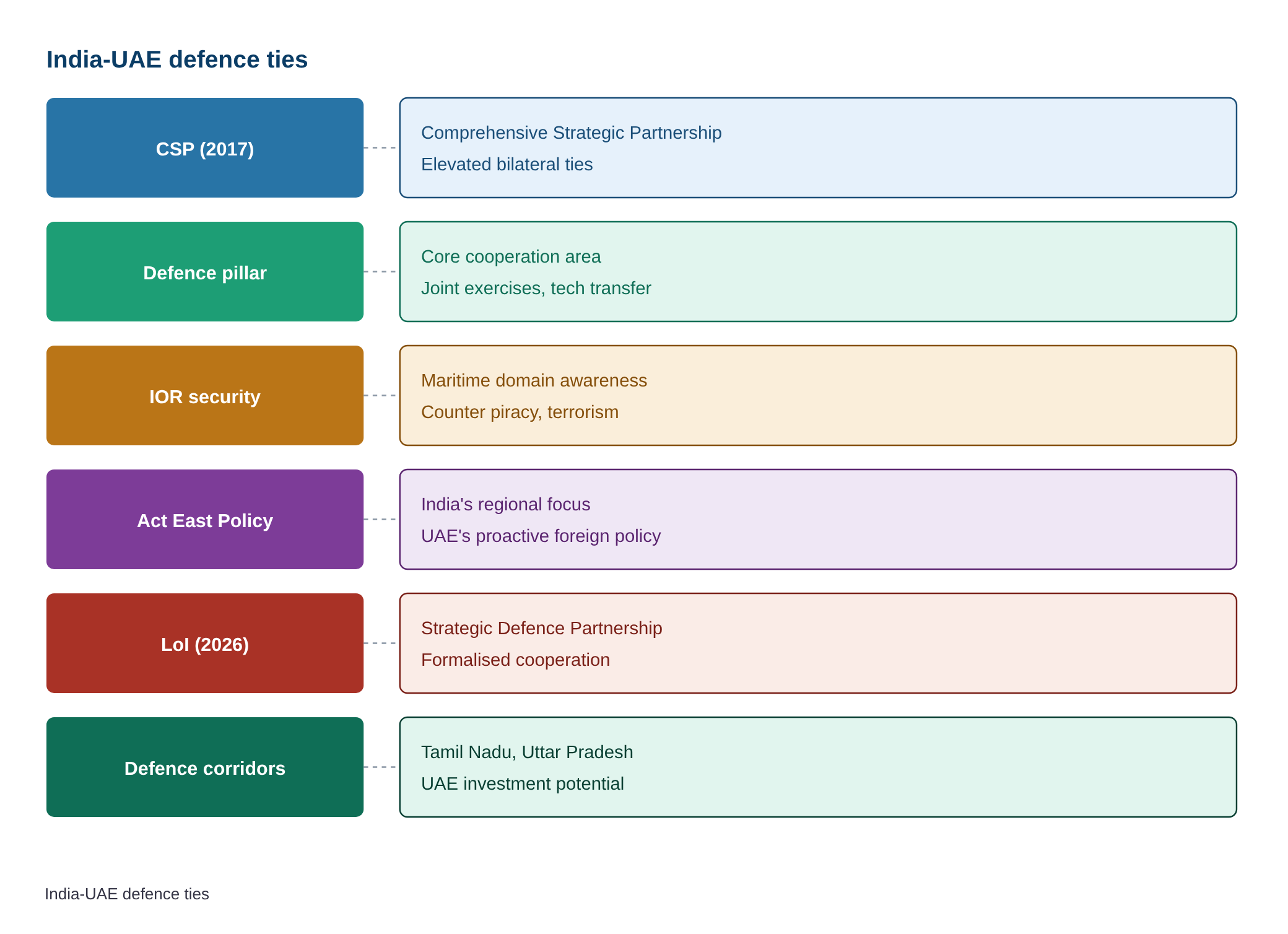
India-UAE Comprehensive Strategic Partnership (2017) → Defence and security cooperation identified as a core pillar. → Reciprocal high-level visits by Service Chiefs (2026) → Institutionalisation of defence diplomacy. → Letter of Intent for Strategic Defence Partnership (2026) → Formalisation of long-term cooperation mechanisms. → Joint military exercises and technology transfer agreements → Operational and industrial synergy. → Enhanced maritime domain awareness and cybersecurity collaboration → Regional security stabilisation. → Defence industrial cooperation and offset obligations → Economic and strategic interdependence.
Prelims Practice Questions
Q1. Consider the following statements regarding India-UAE defence cooperation:
1. The Chief of the Air Staff of the Indian Air Force recently visited the UAE to explore avenues for strengthening bilateral defence ties.
2. The UAE President’s visit to India in January 2026 led to the signing of a Letter of Intent for a Strategic Defence Partnership.
3. The India-UAE defence cooperation is solely focused on naval exercises and does not include air or land forces.
How many of the above statements are correct?
- Only one
- Only two
- All three
- None
Answer: Only two — Statements 1 and 2 are correct as per the report. Statement 3 is incorrect because the cooperation includes air, land, and naval forces, as evidenced by the interactions between respective Service Chiefs.
Q2. Assertion (A): The India-UAE Comprehensive Strategic Partnership includes a core pillar of defence and security cooperation.
Reason (R): The joint statement issued after the UAE President’s visit to India in January 2026 acknowledged steady and strong bilateral defence and security cooperation as a core pillar of the partnership.
In the context of the above two statements, which of the following is correct?
- Both A and R are true, and R is the correct explanation of A.
- Both A and R are true, but R is not the correct explanation of A.
- A is true, but R is false.
- A is false, but R is true.
Answer: Both A and R are true, and R is the correct explanation of A. — Both the Assertion (A) and Reason (R) are true, and R correctly explains A as it directly cites the joint statement that highlights defence and security cooperation as a core pillar.
Q3. Match the following pairs related to India-UAE defence cooperation:
Column I (Visiting Official) Column II (Country Represented)
a. Air Chief Marshal AP Singh 1. UAE
b. Brigadier General Staff Mohamed Khamees Mohamed Al-Hassani 2. India
c. General Upendra Dwivedi 3. UAE
Select the correct match:
- a-1, b-3, c-2
- a-2, b-1, c-3
- a-1, b-2, c-3
- a-3, b-1, c-2
Answer: a-1, b-3, c-2 — Air Chief Marshal AP Singh (India) visited the UAE, Brigadier General Staff Mohamed Khamees Mohamed Al-Hassani (UAE) visited India, and General Upendra Dwivedi (India) interacted with UAE officials.
Mains Practice Question
✍ The India-UAE Comprehensive Strategic Partnership has evolved into a robust framework for defence and security cooperation. Critically examine the institutional mechanisms, recent engagements, and the strategic significance of this partnership for regional security architecture. (15 Marks)
Approach: MODEL-ANSWER SKELETON:
1. **Institutional Mechanisms**:
– Define the Comprehensive Strategic Partnership and its pillars (political, economic, defence, security).
– Highlight the role of the Letter of Intent for a Strategic Defence Partnership signed during the UAE President’s visit (January 2026).
– Discuss the institutionalised exchanges: Service Chiefs’ interactions (Air Force, Army, Navy), joint military exercises, and professional exchanges.
2. **Recent Engagements**:
– Cite the Air Chief Marshal AP Singh’s visit to the UAE (September 2026) and the UAE Air Force Commander’s visit to India (June 2026).
– Mention the Army Chief’s interaction with UAE Land Forces Deputy Commander (June 2026) and the reaffirmation of mutual trust and institutional ties.
– Reference the joint statement’s emphasis on regional security and stability.
3. **Strategic Significance**:
– Analyse the partnership’s role in enhancing maritime security in the Indian Ocean Region (IOR) and the Gulf.
– Discuss how defence cooperation contributes to counter-terrorism, counter-piracy, and humanitarian assistance.
– Evaluate the partnership’s impact on India’s Act East Policy and the UAE’s role in the Gulf Cooperation Council (GCC).
4. **Challenges and Opportunities**:
– Briefly outline potential challenges (geopolitical tensions, differing strategic priorities).
– Conclude with the partnership’s potential to foster a rules-based regional order and its implications for India’s broader foreign policy objectives.
KEYWORDS TO USE: Comprehensive Strategic Partnership, Strategic Defence Partnership, institutionalised exchanges, regional security architecture, maritime security, Act East Policy, Gulf Cooperation Council.
Source: orissapost.com
Generated by AanyaAi for educational purpose.
Related guides on our sites
- Current affairs for upsc 2026
- How to prepare for GS paper 1 for UPSC CSE mains exam
- Best UPSC coaching for IFOS exam
- Best mentorship programme for upsc

- Odisha vs Andhra Pradesh: Supreme Court Contempt Over Kotia Polls - October 24, 2026
- आरबीआई द्वारा 91, 182 और 364 दिनीय ट्रेजरी बिलों की नीलामी: प्रमुख तथ्य - October 24, 2026
- Inflation’s Second-Round Effects: RBI Policy & Economic Impact Analysis - October 24, 2026

No Comments