


04 Sep Supreme Court Extends Aravalli Panel Deadline: Key Facts for UPSC & PCS
✎ The Aravalli Ecosystem Landscape (AEL) framework is a multi-dimensional, evidence-based approach proposed by the Supreme Court-appointed Aravalli High-Powered Committee to assess the Aravalli Range holistically, integrating…
Subject Relevance — Where This Topic Fits
- GS Paper II — Polity and Governance (Judicial Review, Environmental Governance) | GS Paper III — Environment and Ecology (Biodiversity Conservation, Ecosystem Services, Environmental Impact Assessment)
- Prelims: Aravalli Range, Aravalli High-Powered Committee (HPC), Ecosystem Landscape Framework, Judicial Review in Environmental Governance, Geospatial Assessment, Biodiversity Hotspots, Mineral Resource Governance, Public Consultation in Environmental Decision-Making
- Essay: Environmental Governance: Balancing Development and Conservation, Judicial Activism in Environmental Protection: A Case Study of the Aravalli Range
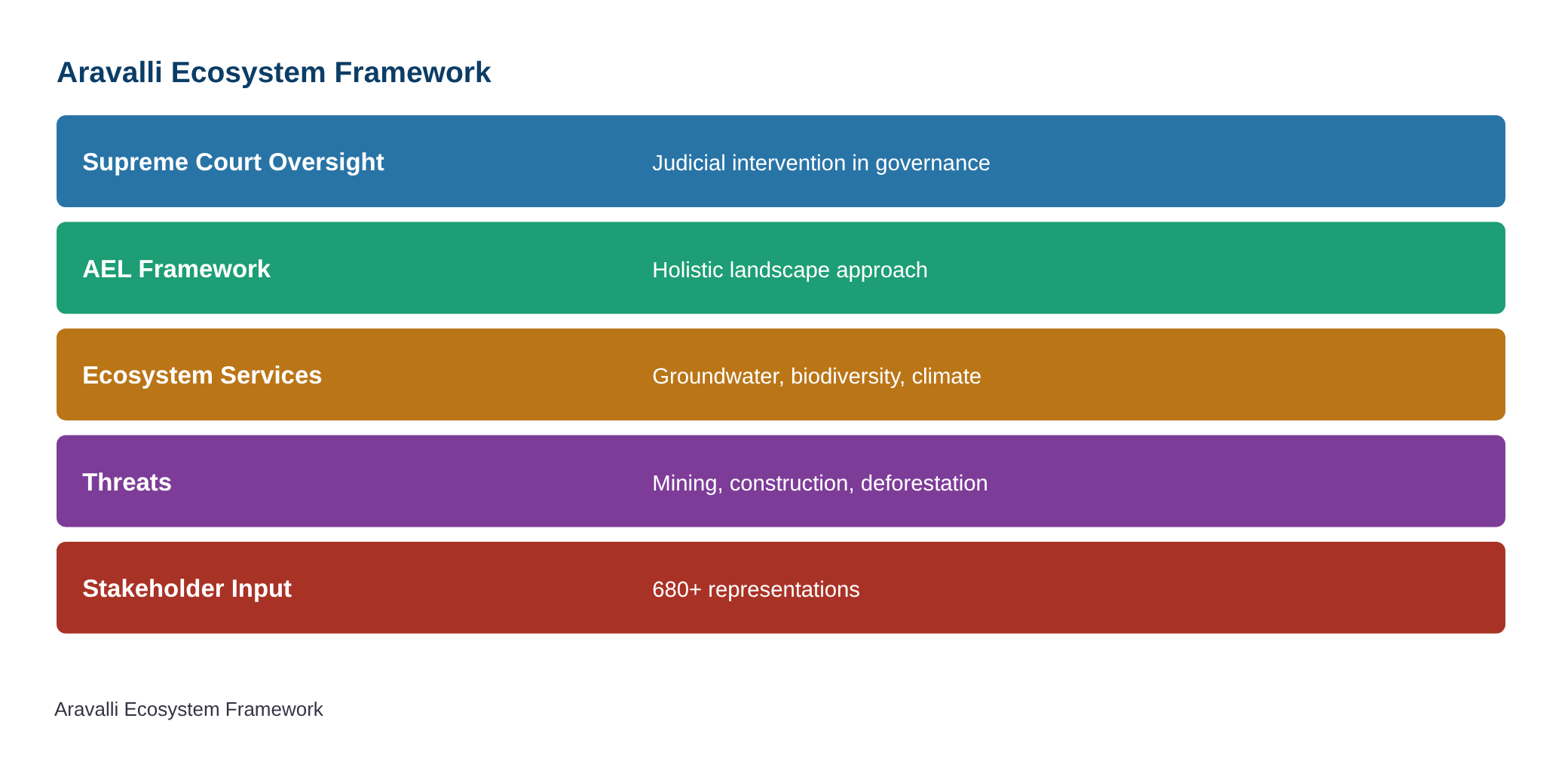
Quick Revision: The Aravalli Ecosystem Landscape (AEL) framework is a multi-dimensional, evidence-based approach proposed by the Supreme Court-appointed Aravalli High-Powered Committee to assess the Aravalli Range holistically, integrating geological, ecological, hydrological, and socio-economic dimensions for sustainable conservation and governance.
Why is this in the news?
The Supreme Court-appointed Aravalli High-Powered Committee (HPC) has requested a six-month extension to submit its final report, citing the need for a comprehensive, multi-dimensional assessment of the Aravalli Range. This development underscores the complexity of ecosystem governance, the necessity of integrating scientific, ecological, and socio-economic evidence, and the judiciary’s role in ensuring evidence-based environmental policy. The proposed Aravalli Ecosystem Landscape (AEL) framework reflects a paradigm shift from traditional terrain-based delineation to a holistic, landscape-level approach for conservation and sustainable management.
Background
- The Aravalli Range, spanning across Rajasthan, Haryana, and parts of Gujarat and Delhi, is one of India’s oldest mountain systems and a critical biodiversity hotspot, providing vital ecosystem services such as groundwater recharge, soil conservation, and climate regulation.
- The Supreme Court, in a series of judgments (e.g., *T.N. Godavarman Thirumulpad v. Union of India* and *Almitra H. Patel v. Union of India*), has repeatedly intervened in environmental governance to address ecological degradation and illegal encroachments in ecologically sensitive zones, including the Aravallis.
- The original deadline for the HPC’s final report was August 31, 2026, but the committee has sought an extension to February 28, 2027, to conduct a rigorous, multi-disciplinary assessment.
- The Aravalli Range faces threats from mining, illegal construction, deforestation, and urban expansion, necessitating a robust, evidence-based framework for conservation and sustainable development.
- Public consultations and stakeholder engagement have been integral to the HPC’s process, with over 680 representations received from diverse stakeholders, including local communities, environmentalists, and industry representatives.
What is the Aravalli Ecosystem Landscape (AEL) Framework?
- The AEL framework is a holistic, multi-dimensional approach proposed by the Aravalli HPC to assess the Aravalli Range not merely as a terrain but as an interconnected ecosystem with geological, hydrological, ecological, and socio-economic dimensions.
- Unlike traditional delineation methods that rely on a single criterion (e.g., altitude or vegetation), the AEL framework integrates spatial, ecological, geological, hydrological, biogeographical, and socio-economic data to identify areas with distinct socio-ecological characteristics.
- The framework aims to inform differentiated conservation and management strategies tailored to the unique ecological and socio-economic contexts of different zones within the Aravalli landscape.
- It includes a critical assessment of the adequacy of existing regulatory frameworks (e.g., the Forest Conservation Act, 1980; the Environment Protection Act, 1986; and state-level environmental laws) in addressing the conservation needs of the Aravallis.
- The AEL framework emphasizes the importance of geospatial assessment, sensitivity analysis, expert examination, field validation, and stakeholder feedback to ensure a comprehensive and defensible report.
- The framework is designed to be dynamic, allowing for periodic review and adaptation based on emerging scientific evidence and socio-economic changes.
- The HPC’s field visits and public hearings (conducted in August 2026) were pivotal in gathering on-ground data, local knowledge, and community perspectives to enrich the AEL framework.
- The proposed framework aligns with global best practices in ecosystem-based management, such as the United Nations Sustainable Development Goals (SDG 15: Life on Land) and the Convention on Biological Diversity (CBD).
Key Features
| Feature | Significance |
|---|---|
| Supreme Court-appointed Aravalli High-Powered Committee (HPC) | A judicial body constituted to conduct an independent, scientific, and multi-dimensional assessment of the Aravalli range, ensuring evidence-based governance and conservation. |
| Aravalli Ecosystem Landscape (AEL) framework | A proposed method for evaluating the Aravalli range that integrates geological, hydrological, ecological, socio-economic, and biodiversity dimensions, enabling differentiated conservation strategies. |
| Comprehensive geospatial and stakeholder validation | Ensures the final report is defensible by incorporating spatial data, sensitivity analysis, expert reviews, field assessments, and public consultations. |
| Extension of deadline to February 28, 2027 | Recognises the complexity of the task and the need for thorough, multi-layered analysis to address the multidimensional challenges of the Aravalli ecosystem. |
| Public hearings and representations (680+ submissions) | Demonstrates participatory governance, allowing diverse stakeholders to contribute to the assessment process and ensuring transparency. |
Why it Matters
Ecological and Environmental
- The Aravalli range is one of the oldest mountain systems in the world and a critical ecological hotspot, providing essential ecosystem services such as groundwater recharge, biodiversity conservation, and climate regulation.
- The AEL framework aims to address the inadequacies of existing regulatory mechanisms by evaluating the ecological integrity and socio-economic dependencies of the region.
- Conservation of the Aravallis is vital for mitigating desertification in Rajasthan and Haryana, as well as for maintaining regional hydrological cycles.
Scientific and Methodological
- The committee’s approach integrates multi-disciplinary evidence, including geospatial data, ecological surveys, and socio-economic assessments, to develop a robust and defensible framework.
- The proposed AEL framework could serve as a model for ecosystem-based management in other biodiverse and ecologically sensitive regions across India.
- The emphasis on sensitivity analysis and expert validation ensures that the findings are scientifically rigorous and policy-relevant.
Governance and Institutional
- The Supreme Court’s intervention underscores the role of the judiciary in environmental governance, particularly in cases where executive or legislative actions are perceived as inadequate.
- The committee’s multi-stakeholder engagement process enhances the legitimacy and effectiveness of conservation policies by incorporating diverse perspectives.
- The extension request highlights the challenges of balancing judicial timelines with the complexities of ecological assessments, necessitating adaptive governance mechanisms.
Legal and Regulatory
- The case exemplifies the intersection of environmental law, judicial activism, and administrative governance in addressing ecological degradation.
- The AEL framework could inform future amendments to the Environment Protection Act, 1986, or the Forest Conservation Act, 1980, by providing a scientific basis for delineation and conservation.
Challenges
1. Multi-dimensional complexity of ecosystem assessment
- The Aravalli range spans multiple states (Rajasthan, Haryana, Gujarat, Delhi) with diverse ecological, geological, and socio-economic characteristics, complicating uniform conservation strategies.
- Integrating disparate data sources (geospatial, hydrological, ecological) into a cohesive framework requires advanced technical and analytical capabilities.
- Balancing conservation imperatives with developmental pressures (mining, urbanisation, agriculture) poses significant governance challenges.
UPSC Link: Environmental Governance (GS-III)
2. Data gaps and scientific uncertainties
- Incomplete or outdated spatial and ecological data may hinder accurate assessment of the Aravalli ecosystem’s health and resilience.
- Climate change-induced alterations in hydrological and ecological patterns introduce additional layers of uncertainty in long-term conservation planning.
- The need for sensitivity analysis and expert validation prolongs the assessment process, delaying policy implementation.
UPSC Link: Environmental Impact Assessment (GS-III)
3. Stakeholder conflicts and participatory governance
- Divergent interests among local communities, industries (mining, real estate), and conservationists may lead to resistance or non-compliance with proposed regulations.
- Ensuring meaningful participation of marginalised groups (indigenous communities, farmers) in public hearings and decision-making processes is a persistent challenge.
- The sheer volume of representations (680+) necessitates efficient mechanisms for synthesis and incorporation into the final report.
UPSC Link: Environmental Ethics and Governance (GS-IV)
4. Judicial timelines vs. ecological realities
- The Supreme Court’s deadline extension request reflects the tension between judicial efficiency and the time-intensive nature of ecological assessments.
- Delays in finalising the report may exacerbate ongoing environmental degradation in the Aravallis, particularly from illegal mining and encroachments.
- The need for iterative feedback from domain experts and stakeholders further extends the timeline, requiring adaptive judicial oversight.
UPSC Link: Judicial Activism and Environmental Law (GS-II)
5. Regulatory inadequacies and enforcement gaps
- Existing environmental laws (e.g., Forest Conservation Act, 1980) may not adequately address the multi-dimensional challenges of the Aravalli ecosystem.
- Weak enforcement mechanisms, corruption, and lack of inter-state coordination hinder effective implementation of conservation policies.
- The AEL framework’s proposed assessment of regulatory adequacy could identify systemic gaps and inform legislative or policy reforms.
UPSC Link: Environmental Law and Policy (GS-II)
Challenges — UPSC Perspective
| Issue | Concern |
|---|---|
| Geological and ecological diversity | Diverse terrain and ecosystems complicate uniform conservation strategies and require differentiated approaches. |
| Data paucity and scientific uncertainty | Incomplete or outdated data may undermine the accuracy and defensibility of the final report. |
| Stakeholder conflicts | Divergent interests among communities, industries, and conservationists may hinder consensus on conservation measures. |
| Judicial timelines vs. ecological timeframes | The need for thorough assessment may conflict with judicial deadlines, delaying policy action. |
| Regulatory and enforcement gaps | Existing laws may not adequately address the multi-dimensional challenges of the Aravalli ecosystem. |
| Climate change impacts | Alterations in hydrological and ecological patterns introduce additional layers of uncertainty in conservation planning. |
Way Forward
- Finalise the Aravalli Ecosystem Landscape (AEL) framework by incorporating expert feedback, stakeholder inputs, and field validations to ensure scientific rigour and policy relevance.
- Develop a phased implementation plan for conservation measures, prioritising areas based on ecological sensitivity, biodiversity value, and socio-economic dependencies.
- Strengthen inter-state coordination mechanisms to address the transboundary nature of the Aravalli range and ensure uniform enforcement of conservation policies.
- Enhance data collection and monitoring systems, leveraging geospatial technologies (GIS, remote sensing) and citizen science initiatives for real-time ecological assessments.
- Formulate a robust enforcement strategy, including stricter penalties for illegal mining, encroachments, and violations of environmental norms.
- Integrate climate change projections into conservation planning to build resilience against future environmental stresses.
- Establish a multi-stakeholder oversight committee to periodically review the implementation of conservation measures and address emerging challenges.
- Leverage the AEL framework as a model for ecosystem-based management in other biodiverse and ecologically sensitive regions across India.
UPSC Value Addition
Keywords for Mains Answer-Writing
Aravalli Range · Supreme Court-appointed committees · Ecosystem-based conservation frameworks · Geospatial assessment · Regulatory framework for ecological protection · Judicial activism in environmental governance · Multi-dimensional ecological assessment · Stakeholder consultations in environmental policy · Aravalli Ecosystem Landscape (AEL) framework · Judicial oversight of executive action
Constitutional & Policy Linkages
- [‘Article 21 (Right to Life)’, ‘Protection of ecological balance as part of the right to a healthy environment.’]
- [‘Article 48A (DPSP)’, ‘Directive to protect and improve the environment and safeguard forests and wildlife.’]
- [‘Article 51A(g) (Fundamental Duty)’, ‘Duty of citizens to protect and improve the natural environment.’]
Concept Flow
Supreme Court orders independent assessment of Aravalli range due to ecological degradation concerns -> → Constitution of Aravalli High-Powered Committee (HPC) for multi-dimensional evaluation -> → Development of Aravalli Ecosystem Landscape (AEL) framework integrating geological, ecological, and socio-economic dimensions -> → Field visits, public hearings, and expert consultations to gather evidence and stakeholder inputs -> → Synthesis of data and formulation of differentiated conservation strategies -> → Assessment of regulatory adequacy and identification of enforcement gaps -> → Final report submission to Supreme Court with recommendations for policy and legislative reforms.
Prelims Practice Questions
Q1. Consider the following statements regarding the Aravalli High-Powered Committee (HPC):
1. The HPC was constituted by the Supreme Court of India.
2. The HPC is tasked with reviewing the Centre’s report on the definition and delineation of the Aravalli range.
3. The HPC’s final report was due on August 31, 2026, but it has sought an extension.
4. The HPC’s framework for assessment is termed the ‘Aravalli Ecosystem Landscape (AEL)’.
How many of the above statements are correct?
- Only one
- Only two
- Only three
- All four
Answer: All four — Statements 1, 2, 3, and 4 are all correct. The HPC was indeed constituted by the Supreme Court, tasked with reviewing the Centre’s report, sought an extension for its final report, and proposed the AEL framework.
Q2. Assertion (A): The Aravalli High-Powered Committee (HPC) seeks to assess the adequacy of the existing regulatory framework for the Aravalli range.
Reason (R): The HPC aims to adopt a multi-dimensional approach, including geological, hydrological, and socio-economic dimensions, to inform conservation strategies.
Options:
A. Both A and R are true, and R is the correct explanation of A.
B. Both A and R are true, but R is not the correct explanation of A.
C. A is true, but R is false.
D. A is false, but R is true.
Answer: ? — Both the assertion and reason are true. The HPC’s multi-dimensional assessment (R) directly informs its evaluation of the adequacy of existing regulatory frameworks (A), making R the correct explanation of A.
Q3. Match the following dimensions of the Aravalli Ecosystem Landscape (AEL) framework with their respective descriptions:
Column I (Dimension)
1. Geological
2. Hydrological
3. Socio-economic
4. Biodiversity
Column II (Description)
A. Assessment of water resource distribution and management
B. Evaluation of mineral resources and terrain characteristics
C. Analysis of species distribution and ecological balance
D. Examination of human settlements, livelihoods, and cultural practices
Options:
A. 1-B, 2-A, 3-D, 4-C
B. 1-A, 2-B, 3-C, 4-D
C. 1-C, 2-D, 3-A, 4-B
D. 1-D, 2-C, 3-B, 4-A
- A
- B
- C
- D
Answer: A — The correct matches are: 1-B (Geological → mineral resources and terrain), 2-A (Hydrological → water resources), 3-D (Socio-economic → human settlements and livelihoods), and 4-C (Biodiversity → species distribution).
Mains Practice Question
✍ The Supreme Court-appointed Aravalli High-Powered Committee (HPC) has proposed the Aravalli Ecosystem Landscape (AEL) framework to assess the ecological and socio-economic dimensions of the Aravalli range. Critically examine the significance of this framework in the context of environmental governance and judicial oversight in India. (15 Marks)
Approach: MODEL-ANSWER SKELETON:
1. **Context and Background**: Briefly introduce the Aravalli range, its ecological significance, and the role of the Supreme Court in constituting the HPC. Mention the need for a multi-dimensional assessment framework.
2. **AEL Framework**: Explain the AEL framework as proposed by the HPC, detailing its key dimensions—geological, hydrological, biogeographical, ecological, biodiversity, mineral-resource, and socio-economic. Highlight its departure from single terrain-based criteria.
3. **Judicial Oversight**: Discuss the role of the judiciary in environmental governance, citing relevant cases such as the T.N. Godavarman Thirumulpad v. Union of India (1997) and the concept of judicial activism in environmental protection.
4. **Advantages of AEL Framework**:
– **Comprehensive Assessment**: Emphasise the need for a holistic approach to ecological conservation, integrating multiple dimensions.
– **Differentiated Conservation Strategies**: Explain how the framework can identify areas with differing socio-ecological characteristics and tailor conservation efforts accordingly.
– **Regulatory Adequacy**: Discuss how the framework assesses the effectiveness of existing regulatory mechanisms (e.g., Forest Conservation Act, 1980; Environmental Protection Act, 1986).
5. **Challenges and Criticisms**:
– **Complexity and Time-Consuming**: Acknowledge the challenges of integrating diverse data sets and the time required for field validation.
– **Stakeholder Engagement**: Highlight the importance of stakeholder consultations and the potential for conflicts among diverse interest groups.
– **Implementation Bottlenecks**: Discuss the challenges of translating the framework into actionable policy, including coordination between central and state authorities.
6. **Conclusion**: Summarise the significance of the AEL framework in advancing environmental governance, while acknowledging the need for robust implementation mechanisms and stakeholder collaboration.
Source: orissapost.com
Generated by AanyaAi for educational purpose.
Related guides on our sites
- Current affairs for upsc 2026
- Best PSIR optional coaching for upsc
- Best economics optional coaching for upsc
- Best PSIR optional teacher for upsc

- UPSC Alert: 40-Day ‘Khet Bachao Abhiyan’ Launch by Union Minister - October 22, 2026
- भारत ने बताया UN रिपोर्ट में दाऊद इब्राहिम को ‘भारत-आधारित’ बताना ‘गलत’ - October 22, 2026
- GRAP Stage I activated in Delhi-NCR amid rising AQI: Key actions for aspirants - October 22, 2026

No Comments