


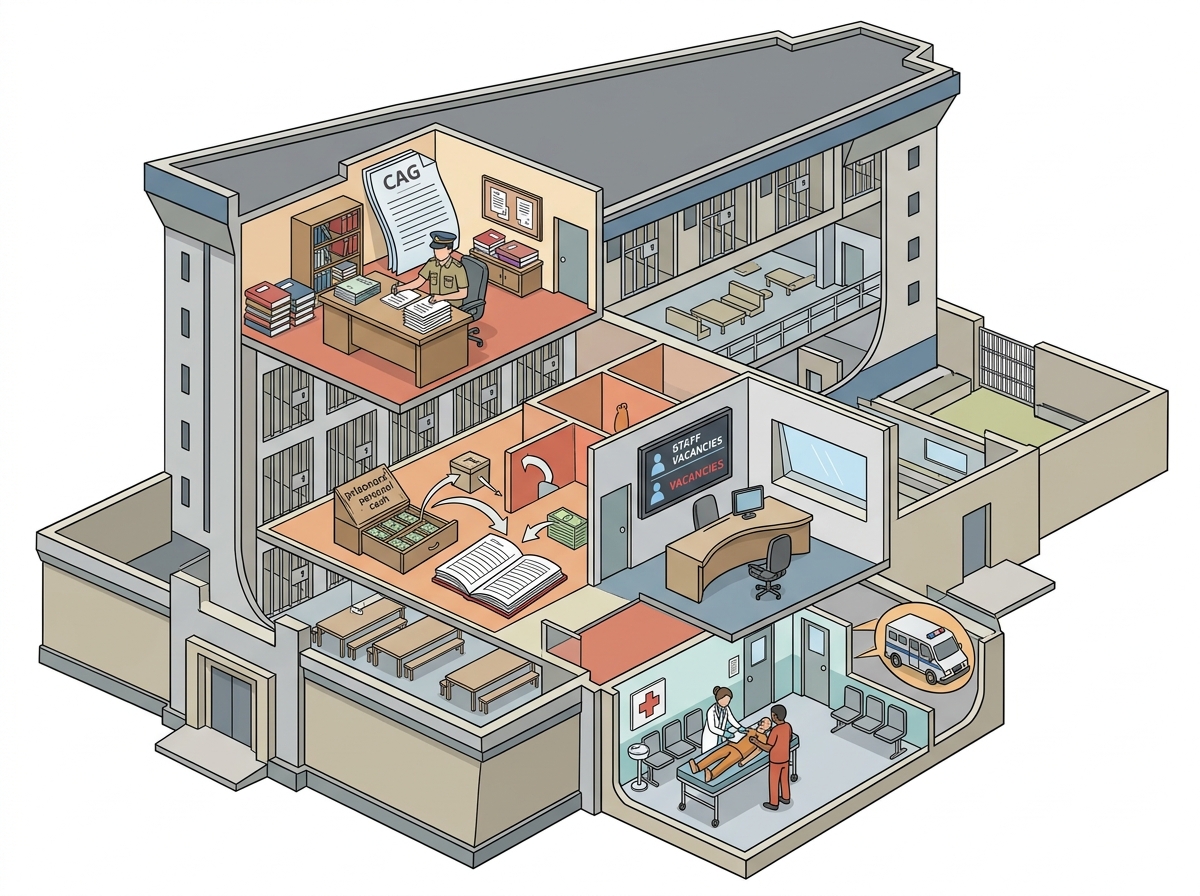
05 Sep CAG Exposes Financial & Healthcare Failures in Himachal Pradesh Prisons
✎ The CAG report on Himachal Pradesh’s prisons highlights three critical areas of failure: unauthorised utilisation of prisoners’ funds, acute shortage of security staff, and systemic neglect of inmates’ right to timely medical…
Subject Relevance — Where This Topic Fits
- GS Paper II — Governance, Transparency and Accountability | GS Paper III — Human Resource Development and Public Services
- Prelims: CAG, Prison Reforms, Prisoners’ Funds, Prisons Act, 1894, Model Prison Manual, 2016, Judicial Custody, Prison Administration, Prisoners’ Rights, Right to Health, Right to Speedy Trial
- Essay: The Role of Institutions in Upholding Constitutional Rights: A Case Study of Prison Administration, Ethics in Governance: Balancing Fiscal Constraints with Constitutional Obligations
Quick Revision: The CAG report on Himachal Pradesh’s prisons highlights three critical areas of failure: unauthorised utilisation of prisoners’ funds, acute shortage of security staff, and systemic neglect of inmates’ right to timely medical care, all of which violate constitutional and statutory provisions.
Why is this in the news?
The Comptroller and Auditor General (CAG) of India’s performance audit report on Himachal Pradesh’s prison administration (up to 2024) has exposed critical lapses in financial management, security infrastructure, and medical care within the state’s prison system. The report highlights the unauthorised utilisation of prisoners’ personal funds for departmental expenditures, severe shortages in security staff, and systemic failures in providing timely medical treatment to inmates due to inadequate escort arrangements. These revelations underscore the need for institutional reforms to ensure compliance with constitutional and statutory provisions governing prison administration.
Background
- Prison administration in India is governed by the Prisons Act, 1894, and the Model Prison Manual, 2016, which prescribe standards for security, healthcare, and welfare of inmates.
- The Supreme Court of India, in *Ramamurthy v. State of Karnataka* (1997), emphasised that prison reforms must align with constitutional principles of dignity, equality, and fundamental rights.
- The CAG’s role, as enshrined in Article 148 of the Constitution, includes auditing the accounts of the Union and States to ensure fiscal prudence and adherence to rules.
- Prisoners’ personal funds (e.g., ‘prisoners’ property accounts’) are held in trust and are not to be utilised for departmental expenses, as per the Himachal Pradesh Prison Manual, 2021.
- The Right to Health, recognised as part of the Right to Life under Article 21 of the Constitution, imposes an obligation on the state to ensure medical care for prisoners.
- Security staff shortages in prisons have been a recurring issue across India, impacting both internal security and the timely transportation of inmates for medical treatment.
What are the key findings of the CAG report on Himachal Pradesh’s prisons?
- Unauthorised utilisation of prisoners’ personal funds: The report found that ₹65.89 lakh was withdrawn from prisoners’ property accounts for departmental expenditures (e.g., police allowances, medical tests) across Kanda, Solan, and Dharamshala jails. As of March 2024, ₹6.56 lakh remained unreimbursed to inmates, violating the Himachal Pradesh Prison Manual, 2021.
- Systemic breach of trust: Prisoners’ funds are held in trust and are not to be used for administrative purposes. The CAG termed this practice as a violation of financial discipline and fiduciary responsibility.
- Severe shortage of security staff: Against the requirement of 1,281 warders and head warders, only 466 posts (36%) were filled as of April 2024. Additionally, 68% of dispenser posts and 57% of assistant superintendent positions were vacant, exacerbating operational inefficiencies.
- Failure to provide medical treatment: Between 2021 and 2024, 16,723 inmates were referred to external hospitals. However, 40.25% (6,731 inmates) could not access treatment due to the unavailability of police escorts. In 2022, 54% of medical referrals were stalled for the same reason.
- Deficient medical infrastructure: The report highlighted the non-functional state of medical equipment (e.g., hematology analysers) in Kanda and Dharamshala jails due to a lack of trained operators, further delaying critical healthcare.
Key Features
| Feature | Significance |
|---|---|
| Misuse of Prisoners’ Property Accounts for Departmental Expenditure | Violates the Himachal Pradesh Prison Manual 2021, which classifies prisoners’ property accounts as private deposits, rendering their use for departmental expenses illegal and undermining financial governance in prisons. |
| Unavailability of Police Escort for Hospital Referrals | Leads to 40.25% of referred prisoners failing to reach hospitals due to lack of security, directly impacting healthcare access and potentially violating constitutional guarantees under Article 21 (Right to Life and Personal Liberty). |
| Severe Shortage of Security Staff (Warders and Head Warders) | Only 36% of sanctioned posts filled, impeding prison security, inmate management, and escort services, thereby exacerbating risks to both inmates and public safety. |
| Deficiencies in Medical Infrastructure and Staffing | Includes non-functional medical equipment (e.g., hematology analyzers) and vacant posts for dispensers and medical officers, compromising healthcare delivery within prisons. |
| Lack of Inter-Departmental Coordination | Gaps between prison, health, and police departments result in delayed medical referrals, inadequate escort arrangements, and systemic inefficiencies in prison governance. |
Why it Matters
Prison Governance and Rule of Law
- The misuse of prisoners’ funds exemplifies systemic failures in financial probity within prison administrations, violating statutory provisions and eroding public trust in institutional accountability.
- Inadequate security staffing and escort services undermine the state’s constitutional obligation to ensure humane treatment of prisoners and protect their right to healthcare, as interpreted under Article 21 of the Constitution.
- Deficiencies in medical infrastructure and staffing reflect broader governance challenges in public healthcare delivery, particularly in correctional facilities where vulnerable populations require specialized care.
Human Rights and Constitutional Safeguards
- The inability to provide police escort for medical referrals raises concerns about the violation of prisoners’ fundamental rights, including the right to health and dignity, as guaranteed under Articles 21 and 22 of the Constitution.
- Prolonged delays in medical treatment due to systemic inefficiencies may constitute a form of ‘custodial neglect,’ violating international human rights standards such as the Nelson Mandela Rules.
Fiscal Management and Public Expenditure
- The diversion of prisoners’ funds for departmental expenses indicates a breakdown in financial discipline, risking misappropriation and undermining transparent budgetary practices in prison administrations.
- Unfilled staff positions and underutilized medical equipment represent inefficient public expenditure, as resources remain unutilized despite pressing needs, leading to avoidable costs.
Challenges
1. Financial Governance in Prisons
- Misuse of prisoners’ property accounts violates statutory provisions (Himachal Pradesh Prison Manual 2021) and undermines financial transparency and accountability in prison administrations.
- Lack of dedicated budgetary allocations for prison operations forces reliance on irregular sources, such as prisoners’ funds, to meet essential expenses like security and medical care.
- Unrecovered funds (₹6.56 lakh) from prisoners’ accounts highlight systemic failures in financial reconciliation and audit processes within prison departments.
UPSC Link: GS2: Governance, Transparency & Accountability
2. Healthcare Access for Prisoners
- Only 59.75% of referred prisoners receive medical treatment due to unavailability of police escort, leading to delayed or denied healthcare, which may constitute a violation of Article 21.
- Deficiencies in medical infrastructure, such as non-functional hematology analyzers, and vacant posts for dispensers and medical officers, exacerbate healthcare disparities within prisons.
- Lack of coordination between prison, health, and police departments results in systemic inefficiencies, such as unutilized tele-consultation services (e-Sanjeevani) and delayed referrals.
UPSC Link: GS2: Health, Human Rights
3. Security Staffing and Prison Management
- Only 36% of sanctioned posts for warders and head warders are filled, leading to severe shortages in security staff, which impedes inmate supervision, escort services, and overall prison safety.
- Vacant posts for dispensers (68% unfilled) and assistant superintendents (57% unfilled) further strain prison administration, affecting both security and healthcare delivery.
- Inadequate staffing compromises the implementation of the Model Prison Manual, which prescribes staffing norms to ensure humane and secure prison conditions.
UPSC Link: GS3: Internal Security, Disaster Management
4. Inter-Departmental Coordination and Governance
- Gaps between prison, health, and police departments result in delayed medical referrals, inadequate escort arrangements, and systemic inefficiencies in prison governance.
- Lack of integrated planning and shared resources (e.g., police escort pools) exacerbates operational challenges, particularly in remote or high-security prisons.
UPSC Link: GS2: Centre-State Relations, Governance
Challenges — UPSC Perspective
| Issue | Concern |
|---|---|
| Misuse of Prisoners’ Funds | Violates statutory provisions and undermines financial transparency; ₹6.56 lakh remains unrecovered, indicating weak audit and reconciliation mechanisms. |
| Unavailability of Police Escort for Medical Referrals | 40.25% of referred prisoners fail to reach hospitals, leading to delayed or denied healthcare and potential violations of Article 21. |
| Severe Shortage of Security Staff | Only 36% of sanctioned posts filled, compromising prison security, inmate management, and escort services, thereby risking both inmate and public safety. |
| Deficiencies in Medical Infrastructure and Staffing | Non-functional medical equipment and vacant posts for dispensers and medical officers lead to inadequate healthcare delivery within prisons. |
| Lack of Inter-Departmental Coordination | Gaps between prison, health, and police departments result in systemic inefficiencies, such as delayed referrals and unutilized tele-consultation services. |
| Non-Compliance with Prison Manual Norms | Failure to adhere to the Himachal Pradesh Prison Manual 2021 and Model Prison Manual, leading to systemic governance failures in prisons. |
Way Forward
- Strengthen financial governance by enforcing strict adherence to the Himachal Pradesh Prison Manual 2021, prohibiting the use of prisoners’ property accounts for departmental expenses except in extreme emergencies.
- Augment security staffing by expediting recruitments for warders, head warders, dispensers, and assistant superintendents to meet sanctioned norms, with a focus on remote and high-security prisons.
- Enhance inter-departmental coordination by establishing a shared police escort pool for medical referrals, integrating prison, health, and police departments through regular joint reviews and real-time tracking systems.
- Upgrade medical infrastructure by repairing or replacing non-functional equipment (e.g., hematology analyzers) and filling vacant posts for medical officers and dispensers to ensure round-the-clock healthcare in prisons.
- Leverage tele-medicine platforms (e.g., e-Sanjeevani) to provide regular medical consultations and reduce dependency on physical referrals, while ensuring adequate internet connectivity and staff training.
- Conduct periodic audits of prisoners’ property accounts to ensure transparency, timely reconciliation, and recovery of any misused funds, with strict penalties for non-compliance.
- Implement a grievance redressal mechanism for prisoners to report delays in medical referrals or security lapses, with independent oversight by the State Human Rights Commission or a designated authority.
- Develop a state-specific prison reform plan aligned with the Model Prison Manual, including budgetary allocations for staffing, infrastructure, and training, with annual progress reviews by the State Legislature.
UPSC Value Addition
Keywords for Mains Answer-Writing
Prisoners’ welfare · CAG audit report · Prison administration · Prisoners’ Property Account · Prison security staff · Prison health infrastructure · Prisoners’ medical treatment · Prisoners’ rights · Prison reforms · Judicial accountability · Model Prison Manual 2016 · Prisoners’ constitutional rights
Constitutional & Policy Linkages
- Article 21: Right to Life and Personal Liberty (healthcare access for prisoners)
- Article 22: Protection against arrest and detention in certain cases (safeguards for prisoners)
- Article 39A: Equal justice and free legal aid (ensuring humane treatment of prisoners)
- Article 226: Writ jurisdiction of High Courts (judicial oversight of prison conditions)
Concept Flow
Inadequate budgetary allocations for prison operations → Misuse of prisoners’ property accounts for departmental expenses → Violation of Himachal Pradesh Prison Manual 2021 → Financial governance failures → Severe shortage of security staff (warders, head warders) → Inadequate prison security and escort services → Delayed or denied medical referrals for prisoners → Potential violation of Article 21 → Deficiencies in medical infrastructure and staffing → Non-functional equipment and vacant posts → Compromised healthcare delivery in prisons → Systemic inefficiencies in prison governance → Lack of inter-departmental coordination between prison, health, and police departments → Delayed referrals and unutilized tele-medicine services → Prolonged healthcare delays for prisoners → Custodial neglect concerns → Non-compliance with Model Prison Manual norms → Systemic governance failures → Erosion of public trust in prison administration → Need for structural reforms and accountability mechanisms
Prelims Practice Questions
Q1. Consider the following statements regarding the Model Prison Manual 2016:
1. It mandates the establishment of a Prisoners’ Property Account for depositing prisoners’ personal funds.
2. It stipulates the minimum ratio of security staff to prisoners as 1:3.
3. It requires regular medical check-ups for prisoners by external medical professionals.
How many of the above statements are correct?
- Only one
- Only two
- All
- None
Answer: All — Statement 1 is correct as the Manual explicitly provides for a Prisoners’ Property Account. Statement 2 is incorrect as the Manual does not prescribe a fixed ratio of security staff to prisoners. Statement 3 is correct as the Manual emphasizes regular medical examinations for prisoners.
Q2. Assertion (A): The utilisation of prisoners’ personal funds for departmental expenses violates the provisions of the Model Prison Manual 2016.
Reason (R): The Model Prison Manual 2016 explicitly prohibits the use of prisoners’ Property Account for any administrative or operational expenses of the prison department.
- Both A and R are true, and R is the correct explanation of A
- Both A and R are true, but R is not the correct explanation of A
- A is true but R is false
- A is false but R is true
Answer: Both A and R are true, and R is the correct explanation of A — Both the Assertion and Reason are correct. The Model Prison Manual 2016 clearly states that the Prisoners’ Property Account is a personal deposit and cannot be used for departmental expenses, making R the correct explanation of A.
Q3. Match the following columns related to prison administration in India:
Column I (Provision) | Column II (Relevant Statute/Manual)
———————|—————————
A. Prisoners’ Property Account | 1. Prisoners Act, 1894
B. Minimum security staff norms | 2. Model Prison Manual, 2016
C. Medical treatment of prisoners | 3. Directive Principles of State Policy (Article 38, 39, 41)
D. Rehabilitation of prisoners | 4. National Policy on Prison Reforms and Correctional Administration, 2007
- A-2, B-4, C-1, D-3
- A-2, B-1, C-3, D-4
- A-1, B-2, C-4, D-3
- A-4, B-2, C-1, D-3
Answer: A-2, B-4, C-1, D-3 — A matches with 2 (Model Prison Manual, 2016) as it pertains to the Prisoners’ Property Account. B matches with 4 (National Policy on Prison Reforms and Correctional Administration, 2007) which provides norms for staffing. C matches with 1 (Prisoners Act, 1894) which mandates medical treatment. D matches with 3 (Directive Principles of State Policy) which emphasize rehabilitation.
Mains Practice Question
✍ The utilisation of prisoners’ personal funds for departmental expenses and the unavailability of security staff for medical referrals in prisons reflect systemic failures in prison governance. Critically examine the constitutional and statutory framework governing prisoners’ rights and prison administration in India. Also, outline the measures required to ensure compliance with the Model Prison Manual, 2016 and the National Policy on Prison Reforms and Correctional Administration, 2007. (15 Marks)
Approach: MODEL-ANSWER SKELETON:
1. **Constitutional and Statutory Framework**:
– Article 21 (Right to Life and Personal Liberty) and Article 22 (Protection against arrest and detention) of the Constitution.
– Prisoners Act, 1894: Sections 3, 4, and 24 (powers and duties of prison authorities).
– Prisoners’ Property Account: Provisions under the Model Prison Manual, 2016 (Chapter 7) and state-specific prison rules.
– Directive Principles of State Policy (Articles 38, 39, 41) emphasizing rehabilitation and humane treatment.
2. **Systemic Failures Highlighted in the CAG Report**:
– Violation of the Prisoners’ Property Account norms (Model Prison Manual, 2016).
– Shortage of security staff (Model Prison Manual, 2016 mandates 1:3 staff-to-prisoner ratio; actual ratio in Himachal Pradesh was 1:10).
– Lack of medical infrastructure and trained personnel (National Policy on Prison Reforms and Correctional Administration, 2007).
3. **Judicial Precedents**:
– Sunil Batra v. Delhi Administration (1978): Right to dignified life and medical care.
– Hussainara Khatoon v. State of Bihar (1979): Right to speedy trial and humane conditions.
– Inhuman Conditions in 1382 Prisons v. Union of India (2016): Directions for prison reforms and compliance with Model Prison Manual.
4. **Measures for Compliance**:
– Strict adherence to the Model Prison Manual, 2016: Regular audits of Prisoners’ Property Accounts, staff recruitment drives, and training programs.
– Implementation of the National Policy on Prison Reforms and Correctional Administration, 2007: Upgradation of medical facilities, tele-medicine (e-Sanjeevani), and shared police escort systems.
– Strengthening of judicial oversight: Regular inspections by District Magistrates and High Court committees.
– Capacity building: Training of prison staff in human rights and medical emergency protocols.
5. **Conclusion**:
– Balancing security imperatives with prisoners’ rights requires multi-stakeholder coordination (state governments, judiciary, and civil society).
– Compliance with statutory and policy frameworks is essential to uphold constitutional guarantees and prevent systemic failures.
Source: amarujala.com
Generated by AanyaAi for educational purpose.
Related guides on our sites
- Current affairs for upsc 2026
- Best PSIR optional coaching for upsc
- Best economics optional coaching for upsc
- Best PSIR optional teacher for upsc

- पेरियार टाइगर रिजर्व में 6 नई प्रजातियाँ खोजी गईं, जानिए क्या हैं विशेषताएँ - September 22, 2026
- Six New Species Discovered in Periyar Tiger Reserve: UPSC & PCS Key Biodiversity Insights - September 22, 2026
- तमिलनाडु में बस किराए में संशोधन: सरकार को चार सप्ताह और समय मिला, उच्च न्यायालय का फैसला - September 22, 2026

No Comments