


06 Sep India Backs UN Resolution to End Child Marriage by 2030
✎ The International Day for the Elimination of Child, Early and Forced Marriage, observed on 27 November, is a UNGA-recognised observance aimed at eliminating a human rights violation that undermines gender equality, education, and…
Subject Relevance — Where This Topic Fits
- GS Paper II — International Relations | GS Paper II — Human Rights
- Prelims: UNGA resolution, child marriage, Bal Vivah Mukt Bharat campaign, Sierra Leone, Organization of African First Ladies for Development (OAFLAD), human rights violations, multisectoral strategies, empowerment of women and girls, sustainable development goals
- Essay: The intersection of human rights, gender equality, and global governance: A case study of child marriage eradication, Sustainable Development Goals and the urgency of collective action: Lessons from the elimination of child marriage
Quick Revision: The International Day for the Elimination of Child, Early and Forced Marriage, observed on 27 November, is a UNGA-recognised observance aimed at eliminating a human rights violation that undermines gender equality, education, and sustainable development.
Why is this in the news?
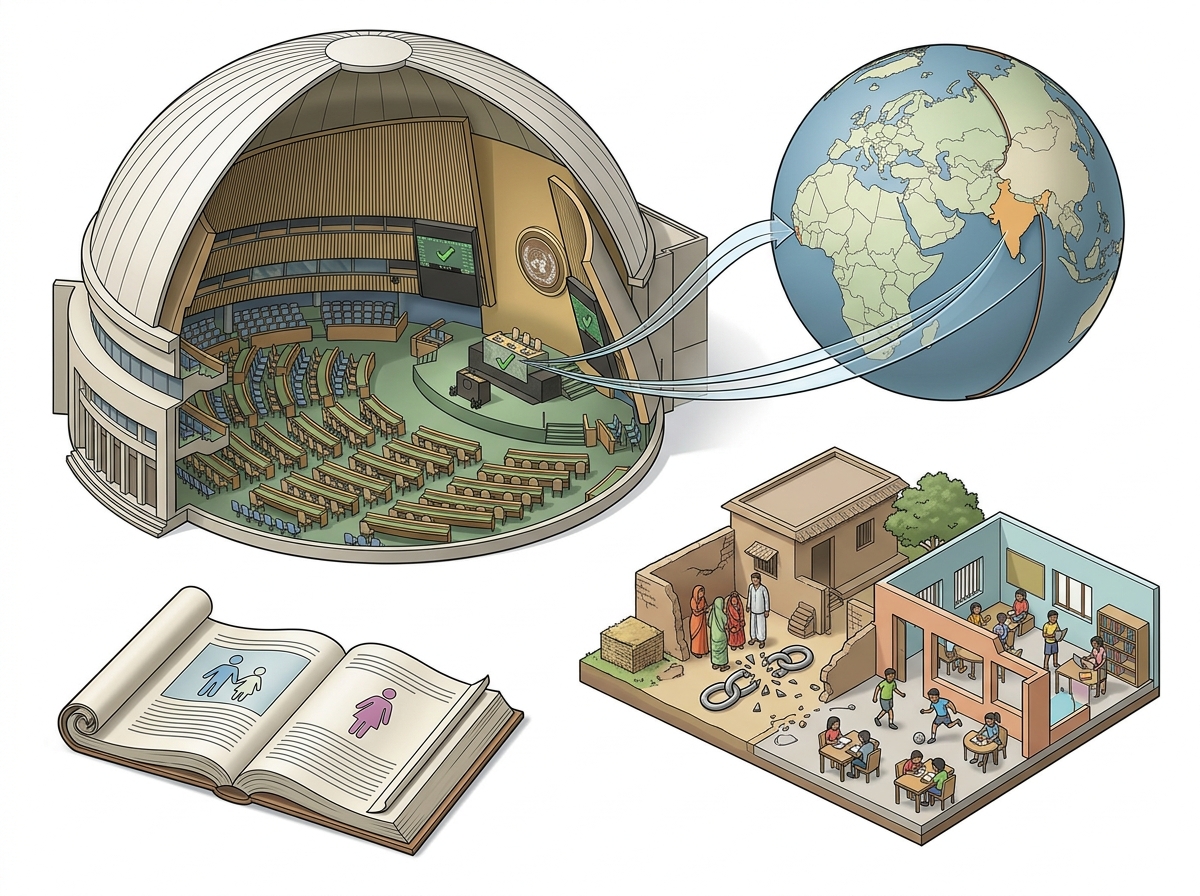
India co-sponsored a resolution adopted by consensus in the United Nations General Assembly (UNGA) to proclaim 27 November as the International Day for the Elimination of Child, Early and Forced Marriage. The resolution, led by Sierra Leone and supported by 70 nations, including India, aims to galvanise global action against a harmful practice that violates human rights, disproportionately affects girls, and undermines sustainable development. The adoption follows India’s domestic initiative, the ‘Bal Vivah Mukt Bharat’ campaign, launched on 27 November 2024, which aligns with the resolution’s objectives.
Background
- Child marriage is a global human rights violation recognised under the Convention on the Rights of the Child (1989) and the Convention on the Elimination of All Forms of Discrimination against Women (1979), with India being a signatory to both.
- The United Nations Sustainable Development Goals (SDGs), particularly SDG 5 (Gender Equality) and SDG 16 (Peace, Justice and Strong Institutions), explicitly call for the elimination of child marriage by 2030.
- Globally, an estimated 12 million girls are married before the age of 18 each year, with South Asia accounting for nearly half of all child marriages, according to UNICEF data.
- India has historically been among the countries with the highest prevalence of child marriage, though recent data indicates a declining trend due to legislative and social interventions.
- The ‘Bal Vivah Mukt Bharat’ campaign, launched in 2024, is a national initiative aimed at reducing child marriage prevalence by 10% by 2026 and achieving a child marriage-free India by 2030.
- The resolution’s adoption is part of a broader global movement led by civil society organisations, including the Organization of African First Ladies for Development (OAFLAD) and initiatives such as ‘Just Rights for Children’.
What is the International Day for the Elimination of Child, Early and Forced Marriage?
- The International Day for the Elimination of Child, Early and Forced Marriage, designated as 27 November, is a UN-recognised observance aimed at raising global awareness of the harmful consequences of child marriage and mobilising action to end the practice.
- The day serves as a platform for Member States, civil society, faith leaders, educational institutions, and communities to reaffirm their commitment to eliminating child marriage through policy, education, and empowerment initiatives.
- The resolution adopted by the UNGA encourages Member States to develop and implement holistic, multisectoral national strategies, including legal reforms, budgetary allocations, and institutional mechanisms to address child marriage.
- Key actions highlighted in the resolution include ensuring quality education for all girls, supporting married girls and young women to continue or return to education, and promoting the empowerment of women and girls as a preventive measure.
- The resolution recognises child, early, and forced marriage as a violation of human rights, disproportionately affecting girls and women, particularly those in vulnerable situations such as conflict zones, rural areas, and marginalised communities.
- The observance of the day is intended to foster accountability among governments, civil society, and international actors, ensuring that progress towards eliminating child marriage is measurable and transparent.
- The initiative aligns with global frameworks such as the SDGs, the Beijing Platform for Action, and the African Union’s Campaign to End Child Marriage, reinforcing the interconnectedness of gender equality and human rights agendas.
- The day also provides an opportunity to highlight the role of children and young people in advocacy and decision-making processes related to their own rights and well-being.
Key Features
| Feature | Significance |
|---|---|
| UNGA Resolution 2026 | Formalises 27 November as International Day for the Elimination of Child, Early and Forced Marriage, elevating the issue to a global policy calendar. |
| Co-sponsorship by India | Demonstrates India’s commitment to SDG Target 5.3 and aligns with domestic campaigns like ‘Bal Vivah Mukt Bharat’. |
| Multisectoral Approach | Encourages Member States to adopt holistic strategies integrating education, law enforcement, civil society, and faith leaders. |
| Human Rights Framework | Reaffirms that child marriage violates fundamental rights, particularly of girls, and constitutes a harmful practice under international law. |
| Youth and Community Participation | Mandates inclusion of children and local stakeholders in designing and implementing prevention measures. |
Why it Matters
Human Rights & Gender Justice
- Reinforces the indivisibility of civil, political, economic, social, and cultural rights by addressing a structural violation of girls’ rights.
- Aligns with the Convention on the Elimination of All Forms of Discrimination against Women (CEDAW), 1979, which India ratified in 1993.
- Provides a global platform to challenge patriarchal norms that normalise early marriage as a social practice.
Sustainable Development Goals (SDGs)
- Directly advances SDG Target 5.3: Eliminate all harmful practices, such as child, early and forced marriage and female genital mutilation.
- Contributes to SDG 4 (Quality Education) by promoting retention of married girls in school systems.
- Supports SDG 1 (No Poverty) and SDG 8 (Decent Work) by delaying marriage to enhance human capital formation.
Institutional & Policy Coherence
- Creates a synchronised global observance to catalyse national policy alignment, including legal reforms and budgetary commitments.
- Enhances inter-agency coordination under the UN system, particularly between UNICEF, UNFPA, and OHCHR.
Global South Leadership
- Demonstrates leadership by Sierra Leone and co-sponsorship by India, reflecting South-South solidarity in addressing a shared developmental challenge.
- Highlights the role of First Ladies and civil society networks in driving normative change at the international level.
Challenges
1. Legal and Enforcement Gaps
- Despite progressive legislation (e.g., Prohibition of Child Marriage Act, 2006), enforcement remains weak due to social acceptance and systemic corruption.
- Lack of uniform age-of-marriage laws across states creates jurisdictional inconsistencies in implementation.
UPSC Link: GS-II: Social Justice – Vulnerable Sections
2. Socio-Cultural Barriers
- Deep-rooted patriarchal norms and economic dependencies perpetuate child marriage, particularly in rural and tribal communities.
- Misinterpretation of religious and customary practices often used to justify early unions.
UPSC Link: GS-I: Indian Society – Role of Women
3. Economic Vulnerability
- Poverty and lack of alternative livelihoods for girls’ families increase the perceived benefits of early marriage as a coping mechanism.
- Limited access to financial services and insurance for girls and women exacerbates dependency on marital households.
UPSC Link: GS-III: Inclusive Growth – Poverty Alleviation
4. Data Deficiencies and Monitoring
- Incomplete and delayed reporting of child marriages due to under-registration and social stigma surrounding the practice.
- Absence of disaggregated data by caste, tribe, and region hinders targeted policy design.
UPSC Link: GS-II: Governance – Transparency & Accountability
5. Intersectional Vulnerabilities
- Girls from marginalised communities (SC/ST/OBC), disabled girls, and those in conflict zones face heightened risks of early marriage.
- Climate-induced displacement and food insecurity further increase vulnerability to exploitative marital arrangements.
UPSC Link: GS-I: Social Empowerment – Vulnerable Groups
Challenges — UPSC Perspective
| Issue | Concern |
|---|---|
| Enforcement of PCMA, 2006 | Weak implementation due to social acceptance and lack of awareness among stakeholders. |
| Poverty and Dowry System | Economic pressures incentivise families to marry daughters early to reduce financial burdens. |
| Lack of Birth Registration | Undocumented age of children complicates age verification and legal protection. |
| School Dropout Rates | Early marriage correlates with discontinuation of education, perpetuating cycles of poverty. |
| Community Resistance | Local leaders and religious figures often oppose interventions, citing tradition and cultural autonomy. |
| Digital Divide | Limited access to information on rights and legal recourse in remote areas exacerbates vulnerability. |
Way Forward
- Strengthen enforcement of the Prohibition of Child Marriage Act, 2006, through periodic audits and fast-track courts for violations.
- Expand targeted social protection programmes (e.g., conditional cash transfers) for adolescent girls in high-prevalence districts.
- Integrate child marriage prevention into school curricula and teacher training to foster peer-led awareness campaigns.
- Leverage Ayushman Bharat and Poshan Abhiyaan to improve health outcomes for married adolescents and their children.
- Enhance inter-ministerial coordination between Women and Child Development, Education, and Rural Development departments.
- Promote digital literacy and mobile-based reporting mechanisms to enable girls to seek help discreetly.
- Establish a national monitoring framework with disaggregated data to track progress against SDG 5.3.
- Engage faith leaders and local governance bodies (e.g., Gram Panchayats) through structured dialogues to challenge harmful norms.
UPSC Value Addition
Keywords for Mains Answer-Writing
International Day for the Elimination of Child, Early and Forced Marriage · UNGA Resolution 2026 · Sustainable Development Goal 5.3 · Prohibition of Child Marriage Act, 2006 · Child Marriage Free India Campaign (2024) · National Plan of Action to End Child Marriage · Article 21 of the Constitution of India · Protection of Children from Sexual Offences Act, 2012 · United Nations Convention on the Rights of the Child (UNCRC) · Sustainable Development Goals (SDGs) · Gender-based violence and child marriage · Multi-stakeholder governance for child rights
Constitutional & Policy Linkages
- Article 15(3) – Empowers the State to make special provisions for women and children.
- Article 21 – Right to life and personal liberty, interpreted to include protection from early marriage.
- Article 24 – Prohibits employment of children below 14 years in hazardous occupations, indirectly reinforcing age thresholds.
- Directive Principles of State Policy (Articles 39(f), 45, 46) – Mandate protection of children and promotion of their welfare.
Concept Flow
Prevalence of child marriage → Violation of fundamental rights → Recognition as a harmful practice → Global advocacy (e.g., UNGA resolution) → National policy alignment (e.g., ‘Bal Vivah Mukt Bharat’) → Legal enforcement and social change → Reduction in prevalence → Achievement of SDG 5.3.
Prelims Practice Questions
Q1. Consider the following statements regarding the International Day for the Elimination of Child, Early and Forced Marriage:
1. The day is observed on November 27 every year.
2. The resolution was adopted by the UN General Assembly in 2026.
3. The day was first proposed by Sierra Leone in collaboration with India.
4. The resolution calls for investment in quality education for all girls as a key strategy.
How many of the above statements are correct?
- Only one
- Only two
- Only three
- All four
Answer: All four — Statements 1, 2, and 4 are correct. Statement 3 is incorrect as the resolution was led by Sierra Leone but co-sponsored by India and others, not first proposed by Sierra Leone alone.
Q2. Assertion (A): The Prohibition of Child Marriage Act, 2006, criminalizes child marriage in India.
Reason (R): The Act provides for the annulment of child marriages and penalizes parents and solemnizers involved.
Options:
A. Both A and R are true, and R is the correct explanation of A.
B. Both A and R are true, but R is not the correct explanation of A.
C. A is true, but R is false.
D. A is false, but R is true.
Answer: ? — Both the Assertion (A) and Reason (R) are true, and R correctly explains A. The Act criminalizes child marriage and provides for penalties and annulment mechanisms.
Q3. Match the following initiatives with their respective years of launch:
Column I (Initiative) | Column II (Year)
— | —
A. Child Marriage Free India Campaign | 1. 2012
B. Protection of Children from Sexual Offences Act | 2. 2024
C. United Nations Convention on the Rights of the Child | 3. 1989
D. Prohibition of Child Marriage Act | 4. 2006
Options:
A. A-2, B-1, C-3, D-4
B. A-1, B-2, C-3, D-4
C. A-4, B-3, C-2, D-1
D. A-3, B-4, C-1, D-2
Answer: ? — A-2 (Child Marriage Free India Campaign launched in 2024), B-1 (POCSO Act enacted in 2012), C-3 (UNCRC adopted in 1989), D-4 (Prohibition of Child Marriage Act enacted in 2006).
Mains Practice Question
✍ Critically analyse the significance of the United Nations General Assembly’s adoption of the International Day for the Elimination of Child, Early and Forced Marriage on November 27. How far does India’s co-sponsorship of the resolution reflect its commitment to addressing child marriage within the framework of constitutional and statutory provisions? (15 Marks)
Approach: MODEL-ANSWER SKELETON:
1. **Context and Significance of the Resolution**:
– Brief on the UNGA resolution (2026) designating November 27 as the International Day for the Elimination of Child, Early and Forced Marriage.
– Link to Sustainable Development Goal 5.3 (eliminate all harmful practices, including child marriage).
– Emphasize the global consensus and multi-stakeholder approach.
2. **India’s Commitment and Domestic Framework**:
– India’s co-sponsorship of the resolution and its alignment with domestic initiatives like the ‘Child Marriage Free India Campaign’ (2024).
– Constitutional provisions: Article 21 (Right to Life and Personal Liberty), Article 14 (Right to Equality), and Article 15 (Prohibition of Discrimination).
– Statutory framework: Prohibition of Child Marriage Act, 2006; Protection of Children from Sexual Offences Act, 2012; and the Juvenile Justice (Care and Protection of Children) Act, 2015.
3. **Challenges and Gaps in Implementation**:
– Persistence of child marriage in certain regions (e.g., Rajasthan, Bihar, Uttar Pradesh) despite legal prohibitions.
– Socio-cultural factors: poverty, illiteracy, and gender inequality.
– Weak enforcement mechanisms and lack of awareness.
4. **Multi-sectoral Strategies for Elimination**:
– Role of education (Right to Education Act, 2009) and skill development programs.
– Empowerment of girls through self-help groups and awareness campaigns.
– Involvement of local governance (Panchayati Raj Institutions) and civil society organizations.
5. **Conclusion**:
– India’s co-sponsorship reflects a positive step toward global commitments, but sustained action at the grassroots level is essential.
– Balance between legal provisions and socio-economic reforms is critical for long-term impact.
Source: orissapost.com
Generated by AanyaAi for educational purpose.
Related guides on our sites
- Anthropology VS PSIR
- Best PSIR optional coaching
- Best PSIR optional coaching online
- Best sociology optional coaching

- India Backs UN Resolution to End Child Marriage by 2030 - September 6, 2026
- उपराष्ट्रपति ने ‘दिनामलार’ के 75 वर्ष पूरे होने पर स्मारक डाक टिकट जारी किया - September 6, 2026
- UPSC Alert: Vice President Releases Dinamalar 75th Anniversary Stamp - September 6, 2026

No Comments