


06 Sep ISRO Staff Warns Against Privatisation Risks in Space Sector Policy
✎ The privatisation of ISRO’s manufacturing and operational functions, if pursued, must ensure that strategic autonomy, employment security, and institutional continuity are not compromised, with clear legal, administrative, and…
Subject Relevance — Where This Topic Fits
- GS Paper III — Science and Technology (S&T) — Developments and their Applications and Effects in Everyday Life | GS Paper III — Economy — Liberalisation, Privatisation and Globalisation (LPG) — Issues Relating to Privatisation
- Prelims: IN-SPACe, Department of Space, PSLV, LVM3, SSLV, Space Activities Bill 2017, Atomic Energy Act 1962 (applicable to space sector via DoS), Public Sector Undertaking (PSU), Technology Transfer, Strategic Autonomous Systems
- Essay: The Role of Public Institutions in National Development: Balancing Innovation and Privatisation, Ethics in Governance: Transparency and Accountability in Public Sector Reforms
Quick Revision: The privatisation of ISRO’s manufacturing and operational functions, if pursued, must ensure that strategic autonomy, employment security, and institutional continuity are not compromised, with clear legal, administrative, and phasing mechanisms in place.
Why is this in the news?
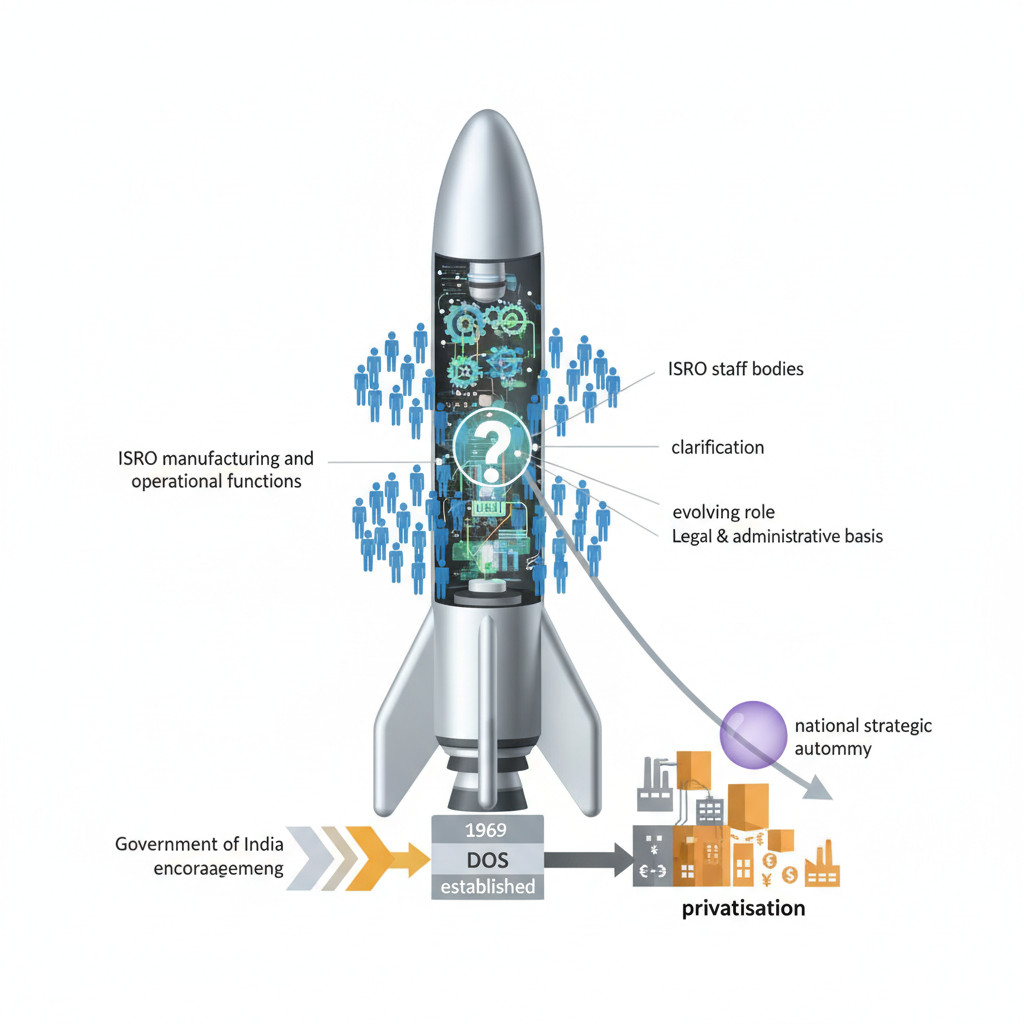
The Indian Space Research Organisation (ISRO) has faced queries from its employee associations regarding the proposed transfer of its manufacturing and operational functions to private entities. These concerns stem from public remarks by the Chairperson of IN-SPACe, which suggest a future where ISRO may no longer manufacture launch vehicles, raising questions about the agency’s evolving role, the legal and administrative basis of such a shift, and its implications for the workforce and national strategic autonomy.
Background
- ISRO, established in 1969 under the Department of Space (DoS), operates as the primary agency for India’s space programme, encompassing research, development, and operational activities in satellite launch, remote sensing, and space exploration.
- The Government of India has progressively encouraged private sector participation in the space sector, formalised through the establishment of IN-SPACe in 2020 as a single-window nodal agency to promote, authorise, and supervise space activities by non-governmental entities.
- The Space Activities Bill, 2017, introduced provisions for regulating private sector participation, including licensing, liability, and technology transfer, though it remains pending in Parliament.
- India’s space programme has achieved global recognition through missions such as Chandrayaan, Mangalyaan, and the PSLV, LVM3, and SSLV launch vehicles, which are critical to national security, disaster management, and socio-economic development.
- Concerns over privatisation in strategic sectors are not unique to ISRO; similar debates have emerged in defence, atomic energy, and other high-technology domains, where public ownership is often justified by considerations of national security and long-term technological sovereignty.
What is the proposed privatisation of ISRO’s functions?
- The proposal, as articulated by IN-SPACe, suggests a future where ISRO’s role may transition from direct manufacturing and operational responsibilities to a focus on research and development (R&D), policy formulation, and strategic oversight.
- Private sector entities, including startups and Public Sector Undertakings (PSUs), are expected to assume responsibility for the design, development, realisation, integration, testing, and launch of launch vehicles such as PSLV, LVM3, and SSLV, as well as their successors.
- The shift is framed within the broader policy of ‘space commercialisation,’ aimed at enhancing India’s global competitiveness, reducing the financial burden on the exchequer, and accelerating innovation through private sector participation.
- The proposed model envisages a collaborative ecosystem where ISRO retains control over critical R&D, strategic missions, and regulatory functions, while private entities handle scalable manufacturing and routine operational tasks.
- The transition is expected to be phased, with pilot projects and gradual transfer of responsibilities to private entities, though the exact timeline and modalities remain unspecified in public domain communications.
- Concerns raised by ISRO employee associations highlight potential risks to national security, loss of institutional knowledge, and adverse impacts on the existing workforce, including recruitment freezes and career stagnation.
- The legal and administrative framework for such a transition is not yet publicly detailed, raising questions about compliance with constitutional provisions, service conditions of ISRO employees, and the preservation of public assets developed over decades.
Key Features
| Feature | Significance |
|---|---|
| Proposed transfer of ISRO’s manufacturing and operational functions to private entities | Raises questions about the future role of ISRO, workforce implications, and strategic autonomy in space technology |
| Employee associations’ letter to ISRO Chairperson | Highlights concerns over lack of official communication and transparency in policy formulation |
| IN-SPACe’s role in promoting private sector participation | Central to enabling non-governmental entities in space activities, including launch vehicle manufacturing and operations |
| ISRO’s future as a residual R&D entity | Potential shift from end-to-end space missions to a research-focused role, with commercial and operational functions outsourced |
| Concerns over workforce and recruitment | Questions about sanctioned strength, vacancies, and future recruitment in ISRO centres post-privatisation |
Why it Matters
Strategic and Security Implications
- ISRO’s indigenous capability in launch vehicles (PSLV, LVM3, SSLV) underpins India’s strategic autonomy in space, including satellite launches, national security, and disaster management.
- Transfer of operational and manufacturing functions to private entities may dilute direct government control over critical space infrastructure, raising concerns about supply chain security and sovereign access.
- Technology developed by ISRO is a national asset; its transfer must align with strategic, safety, and employment considerations to prevent over-reliance on foreign or private entities for mission-critical systems.
Economic and Industrial Impact
- Privatisation of ISRO’s functions could catalyse the growth of India’s space industry, fostering innovation, competition, and job creation in the private sector.
- However, the transition must ensure that ISRO’s core competencies in R&D and high-risk missions are not compromised by a shift in focus to commercial activities.
- The move aligns with the government’s broader goal of ‘Atmanirbhar Bharat’ in space, but requires careful phasing to avoid disruptions in ongoing projects and workforce morale.
Institutional and Governance Challenges
- The lack of official communication from the Department of Space regarding the privatisation policy creates ambiguity, risking misinterpretation and resistance from stakeholders.
- ISRO’s transition to a residual R&D role necessitates clear delineation of responsibilities between ISRO, IN-SPACe, and private entities to avoid duplication or gaps in governance.
- Employee concerns about job security, recruitment, and career progression highlight the need for a structured transition plan with social safety nets and retraining programmes.
Legal and Regulatory Framework
- The privatisation policy must comply with existing laws governing space activities, including the Space Activities Act, 2019, and guidelines issued by IN-SPACe to ensure accountability and transparency.
- Intellectual property rights (IPR) and technology transfer agreements with private entities must safeguard national interests while fostering innovation and commercialisation.
- Regulatory oversight must extend to safety, environmental, and ethical standards for private space missions to mitigate risks associated with commercialisation.
Challenges
1. Ambiguity in Policy Communication
- The absence of an official policy document or white paper from the Department of Space creates uncertainty among ISRO employees, scientists, and stakeholders.
- Public remarks by IN-SPACe Chairperson without corresponding official clarification risk misinterpretation and erode trust in the transition process.
- Addressing this requires a transparent, multi-stakeholder consultation process to outline the policy’s objectives, timelines, and implications.
UPSC Link: GS3: Science and Technology – Space Technology
2. Workforce Transition and Job Security
- ISRO’s existing workforce may face uncertainty regarding job roles, career progression, and future recruitment, particularly in manufacturing and operational domains.
- The shift from a government-run to a privatised model necessitates reskilling programmes and social security measures for affected employees.
- Balancing the need for efficiency with workforce stability is critical to prevent brain drain and maintain institutional knowledge.
UPSC Link: GS3: Employment and Human Resource Development
3. Strategic Autonomy vs. Commercialisation
- ISRO’s role as a national space agency underpins India’s strategic autonomy, including access to space for defence, communication, and remote sensing.
- Over-reliance on private entities for launch vehicles and operations may expose critical missions to commercial risks or delays, impacting national priorities.
- A hybrid model, where ISRO retains control over high-priority missions while enabling private participation in commercial activities, may offer a balanced approach.
UPSC Link: GS3: Defence and Security – Space Technology
4. Regulatory and Oversight Gaps
- The transition to privatisation requires robust regulatory frameworks to ensure safety, accountability, and compliance with national and international standards.
- IN-SPACe’s role in authorising and supervising private entities must be complemented by clear guidelines on technology transfer, IPR, and mission assurance.
- Lack of a unified regulatory body could lead to fragmentation, duplication of efforts, or gaps in oversight, particularly for dual-use technologies.
UPSC Link: GS2: Governance – Regulatory Mechanisms
5. Technology Transfer and IPR Management
- ISRO’s indigenous technologies, developed over decades, are a national asset. Their transfer to private entities must ensure that strategic capabilities are not compromised.
- IPR agreements must balance innovation incentives with national security concerns, particularly for dual-use technologies with defence applications.
- Clear protocols for technology transfer, including licensing terms and export controls, are essential to prevent unauthorised proliferation.
UPSC Link: GS3: Science and Technology – IPR and Technology Transfer
Challenges — UPSC Perspective
| Issue | Concern |
|---|---|
| Lack of official policy communication | Creates ambiguity and resistance among stakeholders |
| Workforce transition and job security | Risk of job losses, demotivation, and loss of institutional knowledge |
| Strategic autonomy in space missions | Potential dilution of government control over critical infrastructure |
| Regulatory and oversight gaps | Risk of fragmentation, duplication, or gaps in governance |
| Technology transfer and IPR management | Need to balance innovation with national security and strategic interests |
Way Forward
- Constitute a high-level task force comprising ISRO, IN-SPACe, Department of Space, and representatives from employee associations to draft a detailed transition plan.
- Release an official white paper or policy document outlining the objectives, timelines, phasing, and governance structure for ISRO’s privatisation, including workforce and recruitment implications.
- Establish a transparent consultation process with stakeholders, including scientists, employees, industry representatives, and academia, to address concerns and incorporate feedback.
- Develop reskilling and retraining programmes for ISRO employees to align with the new roles, focusing on R&D, technology transfer, and regulatory oversight.
- Formulate clear guidelines for technology transfer, IPR management, and export controls to safeguard national interests while fostering innovation in the private sector.
- Strengthen IN-SPACe’s regulatory framework to ensure accountability, safety, and compliance for private entities, including regular audits and performance reviews.
- Create a dedicated grievance redressal mechanism for employees and stakeholders to address concerns related to job security, career progression, and policy implementation.
UPSC Value Addition
Keywords for Mains Answer-Writing
ISRO privatisation policy · Indian National Space Promotion and Authorisation Centre (IN-SPACe) · Department of Space governance · public sector vs private sector in space technology · strategic autonomy in space sector · ISRO workforce implications · space sector liberalisation · public-private partnership in aerospace · ISRO institutional role · space sector policy framework · ISRO human resource management · strategic technology transfer · space sector governance · ISRO future trajectory
Concept Flow
ISRO’s existing role as a national space agency (end-to-end missions: R&D, manufacturing, operations) → Government’s push for privatisation to enhance efficiency, innovation, and industry participation (IN-SPACe’s mandate) → Public remarks by IN-SPACe Chairperson suggesting ISRO’s shift to a residual R&D role (triggering concerns) → Employee associations’ letter seeking official clarification on policy, workforce, and strategic implications → Potential transition to a hybrid model (ISRO retains R&D and high-priority missions; private sector handles commercial activities) → Need for regulatory oversight, technology transfer protocols, and workforce transition plans to mitigate risks → Long-term impact on India’s strategic autonomy, economic growth, and institutional governance in space technology
Prelims Practice Questions
Q1. Consider the following statements regarding the Indian Space Research Organisation (ISRO) and its privatisation trajectory:
1. ISRO is governed by the Department of Space under the Ministry of Science and Technology.
2. The Indian National Space Promotion and Authorisation Centre (IN-SPACe) is mandated to promote, enable, authorise, and supervise space activities of non-governmental entities.
3. The Government of India has approved a policy to transfer all launch vehicle manufacturing and operational functions of ISRO to private entities without any public sector role.
How many of the above statements are correct?
- Only one
- Only two
- All
- None
Answer: Only two — Statement 1 is correct: ISRO operates under the administrative control of the Department of Space, which is under the Ministry of Science and Technology. Statement 2 is correct: IN-SPACe is tasked with facilitating private sector participation in space activities. Statement 3 is incorrect: No official policy has been approved to transfer all launch vehicle functions entirely to the private sector; public-private partnership models are under consideration.
Q2. Assertion (A): The Indian National Space Promotion and Authorisation Centre (IN-SPACe) was established to promote and regulate private sector participation in the space sector.
Reason (R): The Department of Space aims to enhance India’s global competitiveness in space technology by leveraging private sector capabilities while retaining strategic control over core technologies.
- Both A and R are true, and R is the correct explanation of A.
- Both A and R are true, but R is not the correct explanation of A.
- A is true, but R is false.
- A is false, but R is true.
Answer: Both A and R are true, but R is not the correct explanation of A. — Assertion (A) is true: IN-SPACe was established under the Department of Space to promote, authorise, and supervise space activities of non-governmental entities. Reason (R) is also true and correctly explains the rationale behind IN-SPACe’s creation, which is to balance private sector efficiency with strategic oversight.
Q3. Match the following institutions with their respective roles in India’s space sector governance:
Column I (Institution) | Column II (Role)
— | —
A. ISRO | 1. Autonomous body to promote and authorise private space activities
B. IN-SPACe | 2. Primary agency for space research, development, and launch operations
C. Department of Space | 3. Administrative authority overseeing ISRO and space sector policies
D. Antrix Corporation | 4. Commercial arm of ISRO for marketing space products and services
- {‘A-2, B-1, C-3, D-4’: True}
- {‘A-1, B-2, C-3, D-4’: False}
- {‘A-3, B-1, C-2, D-4’: False}
- {‘A-4, B-3, C-2, D-1’: False}
Answer: {‘A-2, B-1, C-3, D-4’: True} — Correct matches: A-2 (ISRO is the primary agency for space research and operations), B-1 (IN-SPACe promotes and authorises private space activities), C-3 (Department of Space is the administrative authority), D-4 (Antrix Corporation is ISRO’s commercial arm).
Mains Practice Question
✍ The Department of Space is contemplating a phased transfer of certain manufacturing and operational functions of ISRO to private entities. Critically examine the implications of this policy shift for India’s strategic autonomy, technological sovereignty, and workforce sustainability. Also, analyse the constitutional and administrative framework governing the space sector in India. (15 Marks)
Approach: MODEL-ANSWER SKELETON:
1. **Strategic Autonomy and Technological Sovereignty**
– Define strategic autonomy in the context of space technology: control over critical technologies, self-reliance, and national security.
– Discuss India’s achievements (e.g., PSLV, GSLV, Chandrayaan, Gaganyaan) and their role in establishing strategic autonomy.
– Analyse risks: over-reliance on private sector for core technologies (launch vehicles, propulsion systems), potential loss of indigenous capability, and foreign dependency.
– Reference the Draft Space Activities (Promotion and Facilitation) Bill, 2019, and the Space Activities Act, 2022, to highlight regulatory safeguards.
2. **Workforce Implications**
– Examine the concerns raised by ISRO employees: job security, future recruitment, and skill retention.
– Discuss the role of ISRO as a training ground for India’s space workforce and its contribution to human resource development in STEM.
– Highlight the need for a transition plan: reskilling, redeployment, and social security for affected employees.
3. **Constitutional and Administrative Framework**
– Article 51A(h) of the Constitution: Fundamental Duty to develop scientific temper and spirit of inquiry.
– Article 300A: Right to livelihood and property, which may be implicated in workforce transitions.
– Role of the Department of Space: administrative control over ISRO, policy formulation, and oversight of public-private partnerships.
– IN-SPACe’s mandate: regulatory and promotional role; clarify its distinction from ISRO’s core functions.
4. **Balancing Public and Private Roles**
– Compare models: ISRO’s integrated approach (R&D + manufacturing + operations) vs. NASA’s model (NASA focuses on R&D; private sector handles manufacturing/operations).
– Discuss the middle path: public sector retains critical R&D and strategic projects, while private sector handles commercial and scalable activities.
– Reference global examples: SpaceX (USA), Arianespace (France), and their public-private models.
5. **Way Forward**
– Emphasise the need for a transparent, time-bound policy roadmap with stakeholder consultations.
– Suggest mechanisms for safeguarding national interests: technology transfer protocols, export controls, and indigenous content requirements.
– Highlight the role of academia and research institutions in sustaining innovation.
**Key Terms to Include:**
– Strategic autonomy, technological sovereignty, public-private partnership (PPP), indigenous capability, Draft Space Activities Bill, Space Activities Act, IN-SPACe, Department of Space, Article 51A(h), Article 300A.
Source: orissapost.com
Generated by AanyaAi for educational purpose.

- आंध्र प्रदेश सरकार ने पुलिस कर्मियों को अतिरिक्त त्याग पत्र अवकाश, बढ़ी पेंशन स्वीकृत की - September 6, 2026
- Andhra Pradesh approves extra leave, higher pensions for police & staff - September 6, 2026
- इसरो कर्मचारियों ने निजीकरण की दिशा पर स्पष्टीकरण मांगा, जानिए पूरा मामला - September 6, 2026

No Comments