


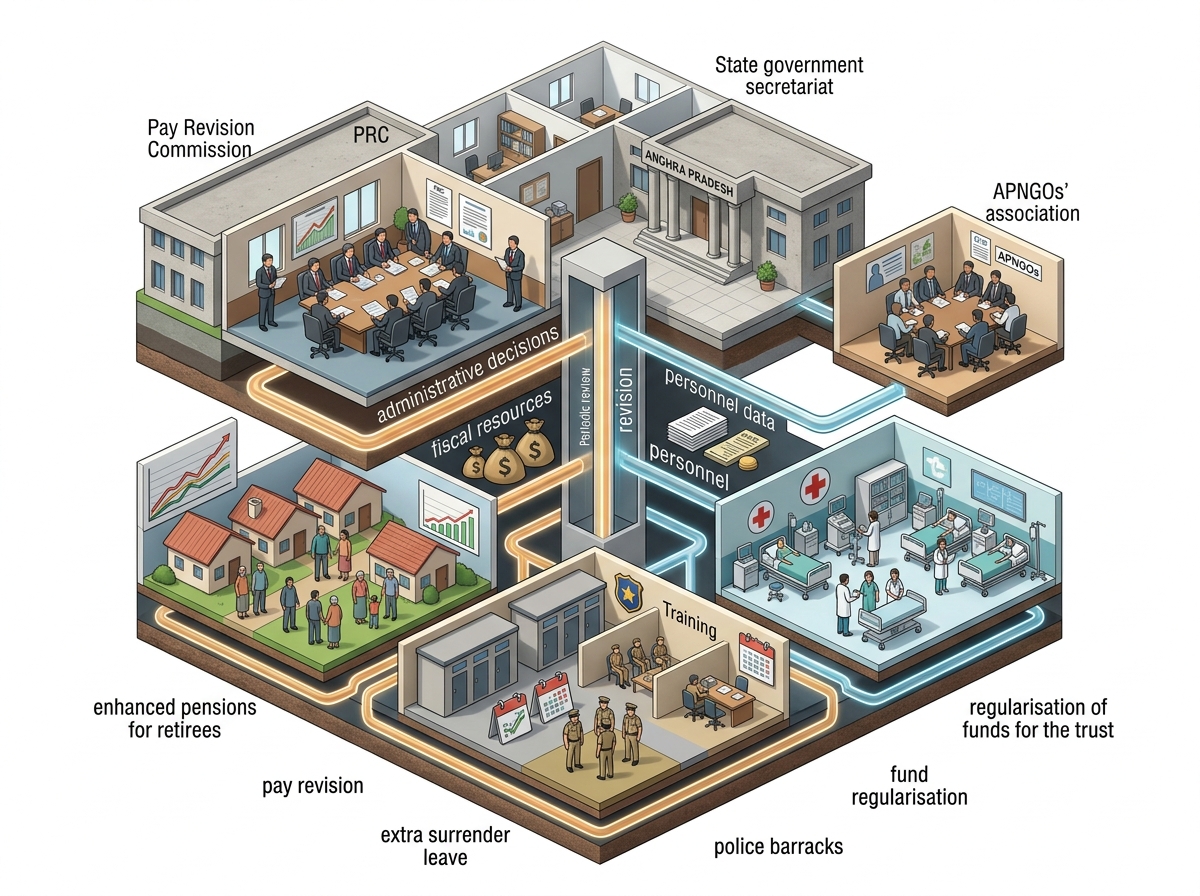
06 Sep Andhra Pradesh approves extra leave, higher pensions for police & staff
✎ Pay Revision Commissions (PRCs) are institutional mechanisms to periodically review and revise pay scales, allowances, and service conditions of government employees, ensuring equitable remuneration while balancing fiscal…
Subject Relevance — Where This Topic Fits
- GS Paper II — Constitutional and Non-Constitutional Bodies (Pay Commissions) | GS Paper III — Issues Relating to Development and Management of Social Sector/Services (Pensions, Leave Policies)
- Prelims: Pay Revision Commission (PRC), Dearness Allowance (DA), NTR Vaidya Seva Trust, surrender leave, notional increments
- Essay: Public administration reforms and employee welfare: Balancing fiscal prudence with social justice
Quick Revision: Pay Revision Commissions (PRCs) are institutional mechanisms to periodically review and revise pay scales, allowances, and service conditions of government employees, ensuring equitable remuneration while balancing fiscal prudence.
Why is this in the news?
The Andhra Pradesh government’s decision to appoint the 12th Pay Revision Commission (PRC) and address pending employee grievances, including enhanced pensions for retirees, additional surrender leave for police personnel, and regularisation of funds for the NTR Vaidya Seva Trust, has drawn attention to the governance mechanisms for public sector employee welfare. This development underscores the role of Pay Commissions in ensuring equitable remuneration and service conditions, while also highlighting the fiscal and administrative challenges in implementing such reforms.
Background
- Pay Revision Commissions (PRCs) are constituted periodically by state governments to review and revise the pay scales, allowances, and service conditions of government employees, including police personnel.
- Dearness Allowance (DA) is an adjustment mechanism to offset inflation, typically paid in instalments based on the Consumer Price Index (CPI).
- Surrender leave is a provision allowing government employees to waive a portion of their earned leave in exchange for cash compensation, aimed at addressing staff shortages during exigencies.
- The NTR Vaidya Seva Trust is a health scheme in Andhra Pradesh providing cashless treatment to government employees and their families in empanelled hospitals.
- State governments often face fiscal constraints in balancing employee welfare demands with budgetary allocations, necessitating structured review mechanisms like PRCs.
What is the Pay Revision Commission (PRC)?
- A Pay Revision Commission is a statutory or non-statutory body constituted by state governments to review and recommend revisions in the pay scales, allowances, and service conditions of government employees, including police and civil services.
- The recommendations of a PRC are typically implemented after approval by the state government, often with a time-bound action plan to address pending grievances.
- PRCs also examine issues such as pension revisions, leave policies (including surrender leave), and welfare schemes for outsourcing staff and contractual employees.
- The 12th PRC in Andhra Pradesh is expected to address long-standing demands such as notional increments for ward and village secretariat staff, which are critical for service parity.
- The appointment of a PRC is a governance tool to institutionalise periodic reviews, reducing ad-hocism in employee welfare measures.
Key Features
| Feature | Significance |
|---|---|
| Appointment of 12th Pay Revision Commission (PRC) | Institutionalises periodic review of emoluments and service conditions, ensuring alignment with inflation and cost-of-living indices for government employees. |
| Release of two pending Dearness Allowance (DA) instalments | Provides immediate fiscal relief to employees by compensating for inflation-induced erosion of real wages. |
| Additional surrender leave for police staff | Enhances operational flexibility and morale by allowing officers to utilise accumulated leave for exigencies or personal needs. |
| Enhanced pension quantum for retirees | Strengthens social security for former employees, addressing post-retirement income vulnerability. |
| Regular funding for NTR Vaidya Seva Trust | Ensures uninterrupted access to cashless healthcare for employees and dependents, reducing out-of-pocket expenditure. |
Why it Matters
Governance and Public Administration
- Demonstrates the role of employee associations in policy advocacy, highlighting the interplay between organised labour and administrative efficiency.
- Illustrates the State’s commitment to institutional mechanisms (e.g., PRC) for equitable and transparent remuneration adjustments.
- Shows the integration of welfare schemes (e.g., health coverage) into the broader framework of employee benefits, reducing administrative fragmentation.
Economic Implications
- Direct fiscal impact through DA releases and pension enhancements, influencing State expenditure patterns and fiscal deficit management.
- Indirect stimulus to local economies via increased disposable income of government employees and retirees.
- Potential long-term effects on State’s creditworthiness and borrowing costs if wage revisions are not matched by productivity gains.
Human Resource Management in Civil Services
- Highlights the need for calibrated leave policies to balance operational exigencies with employee well-being in high-stress roles (e.g., police).
- Underscores the importance of actuarial soundness in pension systems to ensure sustainability amid demographic shifts.
- Reinforces the principle of ‘equal pay for equal work’ across diverse cadres within the State’s administrative machinery.
Social Security and Labour Rights
- Affirms the State’s obligation to provide dignified post-retirement income, aligning with constitutional directives on welfare.
- Expands healthcare access through structured schemes, reducing inequities in medical service utilisation.
- Sets a precedent for addressing grievances of outsourced staff, a segment often excluded from standardised benefits.
Challenges
1. Fiscal Sustainability of Wage Revisions
- Risk of unsustainable expenditure growth if wage revisions outpace revenue mobilisation or productivity improvements.
- Pressure on State’s fiscal space, particularly in revenue-deficit scenarios or during economic downturns.
- Need for robust fiscal consolidation measures to prevent crowding out of developmental expenditures.
UPSC Link: GS-III: Fiscal Policy and Budgetary Management
2. Pension System Viability
- Demographic challenges such as ageing workforce and increasing life expectancy strain defined-benefit pension models.
- Actuarial mismatches may arise if contribution rates and investment returns fail to cover liabilities.
- Requirement for periodic reforms (e.g., shifting to contributory schemes) to ensure long-term solvency.
UPSC Link: GS-II: Social Sector Services
3. Operational Efficiency vs. Employee Welfare
- Balancing additional leave provisions with critical service delivery, especially in essential sectors like policing.
- Potential for absenteeism or reduced productivity if leave policies are not calibrated with workforce requirements.
- Need for performance-linked incentives to offset any perceived trade-offs between welfare and efficiency.
UPSC Link: GS-IV: Ethics and Human Interface
4. Inclusivity in Welfare Schemes
- Ensuring parity in benefits for outsourced staff, who often lack formal employment security or standardised remuneration.
- Risk of exclusion if welfare schemes are not universally accessible or are subject to administrative delays.
- Requirement for clear eligibility criteria and grievance redressal mechanisms to prevent exclusion errors.
UPSC Link: GS-II: Welfare Schemes for Vulnerable Sections
Challenges — UPSC Perspective
| Issue | Concern |
|---|---|
| Revenue Constraints | State’s ability to fund wage revisions without compromising developmental spending or incurring unsustainable debt. |
| Pension Liabilities | Long-term financial sustainability of defined-benefit pension schemes amid demographic shifts. |
| Leave Policy Implementation | Operational feasibility of additional surrender leave without disrupting critical services. |
| Healthcare Scheme Funding | Ensuring consistent cashless treatment access without interruptions due to fund shortages. |
| Outsourcing Staff Inclusion | Extending welfare benefits to non-permanent staff while maintaining fiscal prudence. |
Government Initiatives — Must-Memorise for Prelims
- NTR Vaidya Seva Trust (Andhra Pradesh)
Way Forward
- Constitute an expert committee to assess the fiscal impact of the 12th PRC recommendations and propose mitigative measures.
- Introduce performance-linked bonuses or productivity incentives to offset additional leave provisions in critical departments.
- Expand the scope of the NTR Vaidya Seva Trust to include preventive healthcare services, reducing long-term treatment costs.
- Develop a phased roadmap for pension reforms, including transitioning to contributory models where feasible.
- Strengthen grievance redressal mechanisms for outsourced staff to ensure equitable benefit distribution.
- Conduct periodic audits of welfare schemes to identify gaps and streamline administrative processes.
- Promote financial literacy programmes for employees to optimise utilisation of leave and pension benefits.
- Collaborate with State-owned financial institutions to offer low-interest loans to employees for housing and education.
UPSC Value Addition
Keywords for Mains Answer-Writing
Pay Revision Commission · Dearness Allowance · Surrender Leave · Pension Reforms · Welfare Schemes for Government Employees · NTR Vaidya Seva Trust · Public Sector Undertakings · State Government Employees · Service Conditions of Police Personnel · Fiscal Implications of Wage Revisions
Constitutional & Policy Linkages
- Article 39(d): Equal pay for equal work
- Article 41: Right to public assistance in cases of unemployment, old age, sickness, etc.
Concept Flow
Employee associations (APNGOs) articulate grievances → Government appoints 12th PRC → PRC reviews emoluments and service conditions → Recommendations include DA releases and welfare enhancements → State implements changes → Fiscal impact assessed → Long-term sustainability evaluated.
Prelims Practice Questions
Q1. Consider the following statements regarding the Pay Revision Commission (PRC) in India:
1. The PRC is a constitutional body mandated to revise salaries of government employees every five years.
2. The PRC recommendations are binding on the government and must be implemented without any modifications.
3. The PRC may also address service-related grievances of employees, including pension and leave entitlements.
How many of the above statements are correct?
- Only one
- Only two
- Only three
- None
Answer: Only three — Statement 1 is incorrect as the PRC is not a constitutional body but a statutory or executive body constituted by the government. Statement 2 is incorrect because PRC recommendations are generally advisory and subject to government approval. Statement 3 is correct as PRC terms of reference often include service-related grievances.
Q2. Assertion (A): The Dearness Allowance (DA) is a component of salary that is linked to the cost of living index to neutralise the impact of inflation.
Reason (R): The DA is revised periodically based on the Consumer Price Index for Industrial Workers (CPI-IW) and is applicable to all government employees in India.
Options:
A. Both A and R are true, and R is the correct explanation of A.
B. Both A and R are true, but R is NOT the correct explanation of A.
C. A is true, but R is false.
D. A is false, but R is true.
Answer: ? — Both Assertion (A) and Reason (R) are correct. The DA is indeed a salary component linked to inflation, and its revision is based on CPI-IW. However, the DA is not applicable to all government employees uniformly; its applicability varies by service conditions and government notifications.
Q3. Match the following welfare schemes with their respective states where they have been recently implemented or expanded:
Column I (Scheme) | Column II (State)
——————————————–|——————-
1. NTR Vaidya Seva Trust | A. Andhra Pradesh
2. One Rank One Pension (OROP) | B. Uttar Pradesh
3. Mukhyamantri Swasthya Bima Yojana | C. Rajasthan
4. Ayushman Bharat Pradhan Mantri Jan Arogya Yojana | D. Tamil Nadu
Options:
A. 1-A, 2-B, 3-C, 4-D
B. 1-A, 2-D, 3-B, 4-C
C. 1-A, 2-B, 3-D, 4-C
D. 1-B, 2-A, 3-C, 4-D
- A
- B
- C
- D
Answer: B — 1. NTR Vaidya Seva Trust is a health scheme specific to Andhra Pradesh. 2. One Rank One Pension (OROP) is a central scheme but has been a key demand in Uttar Pradesh. 3. Mukhyamantri Swasthya Bima Yojana is a state-specific health insurance scheme launched in Rajasthan. 4. Ayushman Bharat PM-JAY is a central government scheme implemented across states, including Tamil Nadu.
Mains Practice Question
✍ The Pay Revision Commission (PRC) serves as a mechanism for addressing wage disparities and service-related grievances of government employees. Critically examine the role of the PRC in ensuring equity and efficiency in public sector employment, with reference to recent developments such as the appointment of the 12th PRC in Andhra Pradesh and the revision of Dearness Allowance (DA). Also, analyse the fiscal and administrative implications of such revisions for state exchequers. (15 Marks)
Approach: MODEL-ANSWER SKELETON:
1. **Introduction (2 Marks)**
– Define Pay Revision Commission (PRC) as an advisory body constituted by state governments to revise salaries, allowances, and service conditions of government employees.
– Mention its periodic nature (e.g., every 5-10 years) and terms of reference, which may include DA revisions, pension reforms, and leave entitlements.
– Contextualise with the recent appointment of the 12th PRC in Andhra Pradesh (2026) and the revision of DA instalments.
2. **Role of PRC in Ensuring Equity and Efficiency (5 Marks)**
– **Equity**: Discuss how PRC recommendations aim to reduce wage disparities by aligning salaries with inflation (DA), cost of living, and parity across similar cadres. Reference the demand for notional increments for ward and village secretariats in Andhra Pradesh.
– **Efficiency**: Highlight how timely wage revisions can enhance employee motivation, reduce attrition, and improve service delivery. Cite examples like the NTR Vaidya Seva Trust funding assurance for health scheme continuity.
– **Grievance Redressal**: Explain how PRC addresses service-related issues (e.g., surrender leave for police, pension enhancements) to improve employee satisfaction and productivity.
3. **Fiscal Implications for State Exchequers (4 Marks)**
– **Revenue Impact**: Analyse the financial burden on state budgets due to wage revisions, DA hikes, and pension enhancements. Reference the need for fiscal prudence and potential revenue mobilisation measures (e.g., tax reforms, disinvestment).
– **Long-term Sustainability**: Discuss the trade-off between employee welfare and fiscal sustainability, citing examples of states facing fiscal stress due to high pension liabilities (e.g., Kerala, Punjab).
– **Debt Management**: Mention the role of the 15th Finance Commission recommendations in incentivising states to manage their fiscal deficits while meeting welfare commitments.
4. **Administrative Implications (3 Marks)**
– **Implementation Challenges**: Highlight delays in PRC recommendations due to bureaucratic processes, political considerations, or resource constraints. Reference the two pending DA instalments in Andhra Pradesh.
– **Monitoring and Accountability**: Discuss the need for transparent monitoring mechanisms to ensure timely implementation of PRC recommendations and prevent misuse of funds (e.g., NTR Vaidya Seva Trust).
– **Inter-state Comparisons**: Briefly compare Andhra Pradesh’s approach with other states (e.g., Tamil Nadu’s 7th PRC, Maharashtra’s wage revision for teachers) to highlight best practices or pitfalls.
5. **Conclusion (1 Mark)**
– Summarise the dual role of PRC in balancing employee welfare with fiscal responsibility.
– Emphasise the need for a holistic approach that integrates wage revisions with structural reforms in public sector employment (e.g., rationalisation of posts, performance-linked incentives).
Source: The Hindu
Andhra Pradesh PCS (APPSC) — State PCS Practice
Prelims: As per recent reports, which Andhra Pradesh government department has agreed to provide extra surrender leave for police personnel and higher pensions, as stated by APNGOs’ Venu Gopal?
- Department of Home Affairs
- Department of Finance
- Department of Personnel and Training
- Department of Revenue
Answer: Department of Home Affairs — The Department of Home Affairs is responsible for police administration in Andhra Pradesh, making it the likely department involved in granting extra surrender leave for police personnel.
Mains: Discuss the significance of the Andhra Pradesh government’s recent decision to provide extra surrender leave and higher pensions for police personnel, in the context of police reforms and welfare measures in the state.
Generated by AanyaAi for educational purpose.
Related guides on our sites
- Best economics services coaching
- Best economics optional coaching
- Best economics optional coaching for upsc
- best teacher of economics optional

- मद्रास उच्च न्यायालय ने तमिलनाडु धर्मार्थ विभाग की लापरवाही पर कड़ी टिप्पणी की - October 23, 2026
- PM Modi’s Vision: Capacity Building Commission & Mission Karmayogi for Civil Services - October 23, 2026
- रक्षा मंत्री का सेना प्रमुखों को महत्वपूर्ण निर्देश: सुरक्षा चुनौतियों का सामना करने की तैयारी - October 23, 2026

No Comments