


06 Sep Rajnath Singh’s 3-Day Sri Lanka Visit: Key Agenda & Bilateral Significance for UPSC

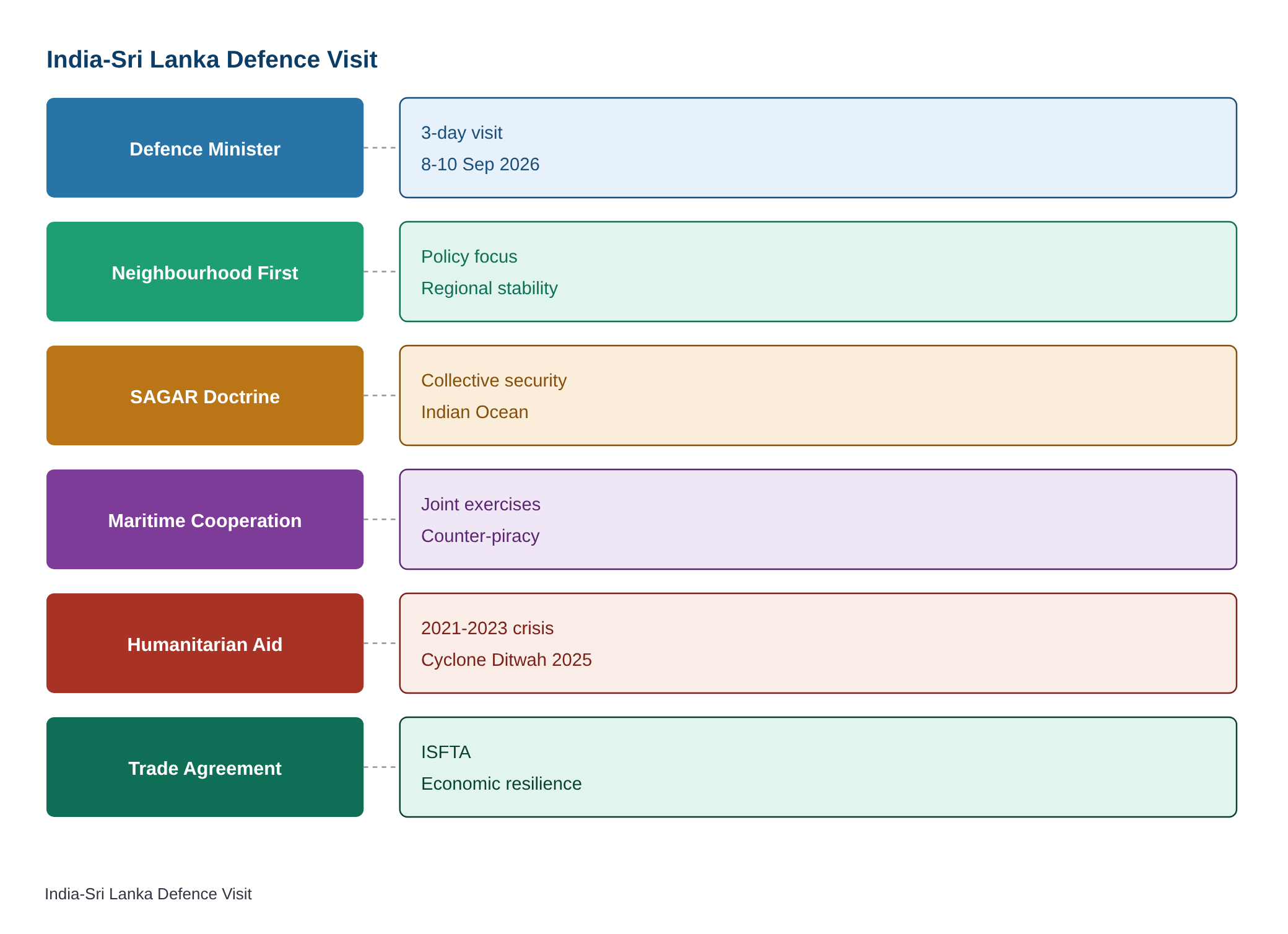
✎ The Defence Minister’s visit to Sri Lanka (8–10 September 2026) will reinforce India’s commitment to maritime security, disaster resilience, and defence cooperation in the Indian Ocean Region under the ‘Neighbourhood First’ and…
Subject Relevance — Where This Topic Fits
- GS Paper II — International Relations: India and its Neighbourhood | GS Paper III — Security Challenges and their Management
- Prelims: Neighbourhood First Policy, SAGAR Doctrine, India-Sri Lanka maritime cooperation, Indian Ocean Region (IOR) security, Defence cooperation agreements
- Essay: India’s role in regional stability and crisis response in South Asia, Maritime security and the Indo-Pacific: India’s strategic partnerships
Quick Revision: The Defence Minister’s visit to Sri Lanka (8–10 September 2026) will reinforce India’s commitment to maritime security, disaster resilience, and defence cooperation in the Indian Ocean Region under the ‘Neighbourhood First’ and SAGAR doctrines.
Why is this in the news?
The official three-day visit of India’s Defence Minister to Sri Lanka from 8 to 10 September 2026 underscores the strategic importance of bilateral defence and maritime cooperation between the two nations. This visit follows India’s sustained support to Sri Lanka during its economic crisis and subsequent natural disasters, reinforcing the principles of the ‘Neighbourhood First’ policy and the SAGAR (Security and Growth for All in the Region) doctrine, both of which prioritise mutual security and development in the Indian Ocean Region.
Background
- India and Sri Lanka share deep civilisational ties, historical linkages, and a maritime boundary across the Palk Strait and Gulf of Mannar.
- The two countries have maintained a robust and multifaceted partnership spanning defence cooperation, economic collaboration, trade, and people-to-people ties.
- India’s assistance to Sri Lanka during its severe economic crisis (2021–2023) included financial aid, fuel supply, and essential commodities, demonstrating solidarity in times of distress.
- In May 2025, Cyclone Ditwah struck Sri Lanka, causing widespread devastation; India was among the first responders, providing immediate humanitarian relief and long-term rehabilitation support.
- The bilateral relationship is anchored in the ‘Neighbourhood First’ policy, articulated by Prime Minister Narendra Modi, which prioritises India’s engagement with its immediate neighbours.
- The SAGAR doctrine, articulated by Prime Minister Narendra Modi, emphasises collective security, sustainable development, and mutual trust in the Indian Ocean Region, aligning with India’s strategic interests in Sri Lanka.
What constitutes India-Sri Lanka Defence and Maritime Cooperation?
- **Maritime Security Partnership**: India and Sri Lanka conduct joint naval exercises such as SLINEX, focusing on anti-piracy, search and rescue, and maritime domain awareness.
- **Defence Procurement and Training**: Sri Lanka has historically procured defence equipment from India, including Dornier aircraft, offshore patrol vessels, and training support for its armed forces.
- **Humanitarian Assistance and Disaster Relief (HADR)**: Both nations collaborate closely in disaster response, including during cyclones, floods, and maritime incidents, as demonstrated during Cyclone Ditwah in 2025.
- **Counter-Terrorism and Coastal Security**: India provides intelligence-sharing, capacity-building, and technical assistance to enhance Sri Lanka’s counter-terrorism capabilities and coastal surveillance.
- **Exclusive Economic Zone (EEZ) Management**: Joint patrolling and information-sharing mechanisms are in place to safeguard maritime resources and prevent illegal fishing and smuggling.
- **Defence Industrial Cooperation**: Initiatives such as the establishment of a joint working group on defence industries aim to promote co-development and co-production of defence equipment.
- **Strategic Dialogues**: Regular high-level defence consultations, including the India-Sri Lanka Defence Ministers’ Dialogue, ensure alignment on regional security challenges.
Key Features
| Feature | Significance |
|---|---|
| High-Level Delegation | Demonstrates India’s prioritisation of bilateral engagement with Sri Lanka, involving key ministries (Defence and External Affairs) to ensure coordinated policy execution. |
| Focus on Regional Security | Reinforces maritime and defence cooperation, aligning with India’s ‘SAGAR’ doctrine for collective security and stability in the Indian Ocean Region (IOR). |
| People-to-People Connectivity | Includes interaction with Indian diaspora in Colombo, underscoring cultural and social linkages that sustain long-term bilateral relations. |
| Historical and Civilisational Ties | Leverages shared heritage to strengthen diplomatic bonds, providing a non-contentious foundation for contemporary strategic partnerships. |
| Post-Crisis Assistance | Highlights India’s role in Sri Lanka’s economic recovery and disaster relief, reinforcing the ‘Neighbourhood First’ policy as a practical framework for cooperation. |
Why it Matters
Strategic Partnership
- Enhances maritime security cooperation, including counter-piracy, search-and-rescue operations, and joint exercises under frameworks like the Colombo Security Conclave.
- Strengthens defence logistics and infrastructure development, particularly in Trincomalee and Hambantota, to ensure regional stability.
- Aligns with India’s broader Indo-Pacific strategy by fostering a stable and prosperous Sri Lanka as a partner in the IOR.
Economic and Trade Cooperation
- Reinforces trade facilitation measures, including the India-Sri Lanka Free Trade Agreement (ISFTA), to boost bilateral commerce and economic resilience.
- Supports Sri Lanka’s post-crisis recovery through concessional lines of credit and developmental assistance, ensuring economic interdependence.
- Promotes connectivity projects such as the Colombo Port City and Mattala Airport, fostering regional economic integration.
Diplomatic and Political Synergy
- Provides a platform for high-level dialogue on regional challenges, including terrorism, drug trafficking, and climate-induced disasters.
- Demonstrates India’s commitment to multilateralism, particularly within SAARC and BIMSTEC, to address shared security and developmental concerns.
- Bolsters Sri Lanka’s sovereignty and stability, reducing external vulnerabilities and promoting a rules-based regional order.
Humanitarian and Diaspora Engagement
- Underscores India’s role as a responsible regional power by extending support during crises, such as the 2025 Cyclone Dittwah relief operations.
- Strengthens cultural and educational ties through scholarships, exchange programmes, and consular services for the Indian diaspora.
- Fosters grassroots-level trust and cooperation, which are critical for long-term bilateral relations.
Challenges
1. Geopolitical Rivalries in the IOR
- Competition from external powers (e.g., China) in Sri Lanka may limit India’s strategic influence, particularly in infrastructure and port development.
- Balancing engagement with Sri Lanka while addressing domestic and regional perceptions of over-dependence on external actors.
- Navigating Sri Lanka’s non-aligned foreign policy to ensure alignment with India’s security and economic interests.
UPSC Link: GS II: Bilateral Groupings & Agreements
2. Internal Stability in Sri Lanka
- Persistent political and economic instability in Sri Lanka may hinder sustained bilateral cooperation, particularly in defence and trade.
- Ethnic and religious tensions could pose challenges to regional security frameworks, requiring sensitive diplomatic handling.
- Ensuring Sri Lanka’s adherence to international norms and agreements, such as the UN Convention on the Law of the Sea (UNCLOS), in maritime disputes.
UPSC Link: GS II: India and its Neighbourhood
3. Resource Constraints and Prioritisation
- Limited fiscal and administrative resources may constrain India’s ability to provide continuous developmental and humanitarian assistance.
- Balancing immediate crisis response with long-term strategic investments to ensure sustainable outcomes.
- Coordination challenges between central and state governments, as well as with international partners, to optimise resource allocation.
UPSC Link: GS III: Indian Economy and Issues Relating to Planning
4. Maritime Security Threats
- Non-state actors, including insurgent groups and smugglers, exploit porous maritime borders, necessitating robust counter-measures.
- Climate change-induced disasters (e.g., cyclones) require adaptive disaster risk reduction strategies and resilient infrastructure.
- Ensuring freedom of navigation and overflight in the IOR while addressing illegal activities such as arms trafficking and human smuggling.
UPSC Link: GS II: Security Challenges and their Management
5. Diaspora Integration and Consular Challenges
- Addressing the socio-economic needs of the Indian diaspora in Sri Lanka, including issues of citizenship, employment, and education.
- Ensuring consular services are accessible and responsive to the needs of Indian nationals, particularly in crisis situations.
- Balancing consular diplomacy with broader strategic objectives to avoid perceptions of favouritism.
UPSC Link: GS II: Indian Diaspora
Challenges — UPSC Perspective
| Issue | Concern |
|---|---|
| Geopolitical Competition | External powers may undermine India’s strategic partnerships in Sri Lanka through economic or military engagements. |
| Economic Instability | Sri Lanka’s debt crisis and inflation may hinder its ability to participate in bilateral trade and infrastructure projects. |
| Maritime Disputes | Unresolved maritime boundaries and fishing disputes could escalate tensions, particularly in the Palk Bay region. |
| Terrorism and Insurgency | Cross-border terrorism and internal conflicts in Sri Lanka may spill over into India, requiring coordinated counter-terrorism efforts. |
| Climate Vulnerability | Increased frequency of cyclones and rising sea levels pose existential threats to Sri Lanka’s coastal communities and infrastructure. |
| Diaspora Integration | Lack of formal integration policies for Indian-origin communities may lead to social and economic marginalisation. |
Way Forward
- Conclude formal agreements on maritime security cooperation, including joint patrols and information-sharing mechanisms under the Colombo Security Conclave.
- Expand concessional credit lines and developmental assistance to support Sri Lanka’s post-crisis economic recovery and infrastructure modernisation.
- Enhance consular services and welfare programmes for the Indian diaspora in Sri Lanka, including skill development and educational exchanges.
- Strengthen disaster risk reduction frameworks to address climate-induced challenges, such as cyclone preparedness and resilient infrastructure development.
- Promote trade facilitation measures, including the India-Sri Lanka Free Trade Agreement (ISFTA), to boost bilateral commerce and economic interdependence.
- Initiate high-level dialogues on counter-terrorism, drug trafficking, and cybersecurity to address shared security threats in the IOR.
- Leverage cultural and educational exchanges to foster people-to-people ties, including scholarships and joint research initiatives.
- Establish a joint monitoring mechanism to assess the progress of bilateral projects and address implementation challenges proactively.
UPSC Value Addition
Keywords for Mains Answer-Writing
India-Sri Lanka bilateral relations · Neighbourhood First policy · defence diplomacy · maritime security cooperation · regional security architecture · SAGAR vision · Indian Ocean Region (IOR) · defence and strategic partnership · humanitarian assistance and disaster relief (HADR) · Indian diaspora engagement · defence cooperation agreements · maritime domain awareness · counter-terrorism cooperation · economic and trade cooperation · civilisational ties · SAARC and BIMSTEC frameworks
Concept Flow
India-Sri Lanka historical and civilisational ties → Foundation for contemporary strategic partnership → Regional security challenges (piracy, terrorism, climate disasters) → Need for collective action and maritime cooperation → Economic instability in Sri Lanka (post-2022 crisis) → India’s humanitarian and developmental assistance under ‘Neighbourhood First’ → India’s ‘SAGAR’ doctrine → Alignment with Sri Lanka’s strategic interests for a stable IOR → High-level delegation visit → Reinforcement of defence, economic, and people-to-people linkages → Joint frameworks (e.g., Colombo Security Conclave) → Institutionalisation of bilateral cooperation → Implementation of agreements → Long-term stability and mutual benefit in the IOR
Prelims Practice Questions
Q1. Consider the following statements regarding India’s ‘Neighbourhood First’ policy:
1. It prioritises economic and developmental assistance to immediate neighbours.
2. The policy mandates military intervention in case of internal conflicts in neighbouring countries.
3. It includes humanitarian assistance and disaster relief as a key component.
4. The policy is exclusively focused on South Asian countries.
How many of the above statements are correct?
- Only one
- Only two
- Only three
- All
Answer: Only three — Statements 1 and 3 are correct as the policy emphasises economic assistance and HADR. Statement 2 is incorrect as military intervention is not mandated. Statement 4 is incorrect as the policy extends beyond South Asia, including Indian Ocean littoral states.
Q2. Assertion (A): India’s SAGAR vision aims to foster a climate of trust and transparency in the Indian Ocean Region.
Reason (R): The vision promotes collective action for regional security and sustainable development.
Options:
A. Both A and R are true, and R is the correct explanation of A.
B. Both A and R are true, but R is not the correct explanation of A.
C. A is true, but R is false.
D. A is false, but R is true.
Answer: ? — Both A and R are correct. The SAGAR (Security and Growth for All in the Region) vision explicitly aims to build trust and transparency while promoting collective action for regional security and development.
Q3. Match the following initiatives with their respective objectives:
Column I (Initiative) Column II (Objective)
A. Operation Sagar Maitri 1. Disaster relief in Indian Ocean littoral states
B. Colombo Security Conclave 2. Maritime security cooperation among littoral states
C. SAARC Disaster Management Centre 3. Humanitarian assistance in South Asia
D. IONS (Indian Ocean Naval Symposium) 4. Maritime domain awareness and counter-piracy
Options:
A-1, B-2, C-3, D-4
A-2, B-1, C-4, D-3
A-3, B-2, C-1, D-4
A-4, B-3, C-2, D-1
Answer: ? — Operation Sagar Maitri focuses on disaster relief in Indian Ocean littoral states (A-1). The Colombo Security Conclave promotes maritime security cooperation among littoral states (B-2). The SAARC Disaster Management Centre coordinates disaster management in South Asia (C-3). The IONS enhances maritime domain awareness and counter-piracy (D-4).
Mains Practice Question
✍ India’s defence diplomacy with Sri Lanka is rooted in historical civilisational ties and strategic imperatives. Critically examine the role of defence diplomacy in strengthening India-Sri Lanka relations, with reference to recent developments. Also, analyse how such engagements align with India’s broader vision for the Indian Ocean Region. (15 Marks)
Approach: MODEL-ANSWER SKELETON:
1. **Introduction (2 Marks)**
– Define defence diplomacy as the use of military and defence cooperation to achieve foreign policy objectives.
– Highlight the historical and civilisational ties between India and Sri Lanka (e.g., Buddhist heritage, maritime connectivity).
2. **Defence Diplomacy Mechanisms (4 Marks)**
– **Bilateral Agreements**: Reference the 1987 Indo-Sri Lanka Accord, defence cooperation agreements, and joint military exercises (e.g., SLINEX, Mitra Shakti).
– **Humanitarian Assistance and Disaster Relief (HADR)**: Cite India’s role in Cyclone Dithwah (2025) and the economic crisis (2022-23) as examples of strategic support.
– **Maritime Security Cooperation**: Discuss joint patrolling, maritime domain awareness, and counter-terrorism efforts (e.g., Colombo Security Conclave).
– **Defence Exports and Capacity Building**: Reference India’s supply of defence equipment (e.g., Dornier aircraft, offshore patrol vessels) and training programmes.
3. **Alignment with India’s Strategic Vision (4 Marks)**
– **SAGAR Vision**: Explain how defence diplomacy under SAGAR (Security and Growth for All in the Region) promotes collective security, trust, and transparency in the Indian Ocean Region (IOR).
– **Neighbourhood First Policy**: Discuss how defence engagements reinforce India’s commitment to regional stability and economic cooperation.
– **Indo-Pacific Framework**: Link defence diplomacy to broader Indo-Pacific strategies (e.g., Quad, ASEAN-centric engagement).
4. **Challenges and Criticisms (3 Marks)**
– **Sovereignty Concerns**: Address Sri Lanka’s sensitivities regarding perceived interference (e.g., 13th Amendment debates).
– **Geopolitical Balancing**: Discuss Sri Lanka’s engagements with China and the need for India to balance strategic interests without alienating partners.
– **Implementation Gaps**: Highlight delays in operationalising agreements or lack of institutional frameworks for long-term cooperation.
5. **Conclusion (2 Marks)**
– Summarise the role of defence diplomacy as a stabilising force in India-Sri Lanka relations.
– Emphasise the need for sustained engagement to address emerging threats (e.g., piracy, climate-induced disasters) while respecting sovereignty.
Source: PIB (Press Information Bureau)
Generated by AanyaAi for educational purpose.
Related guides on our sites
- Current affairs for upsc 2026
- Best PSIR optional coaching for upsc
- Best PSIR optional teacher for upsc
- Best teacher of PSIR optional for upsc

- Gurugram’s groundwater extraction exceeds limit by 212%; HC seeks ban - October 4, 2026
- स्वतंत्रता सेनानी श्यामजी कृष्ण वर्मा की जन्म जयंती पर पीएम का श्रद्धांजलि - October 4, 2026
- KWML’s Feasibility Reports for Water Metro in 18 Cities: UPSC & PCS Insights - October 3, 2026

No Comments