


07 Sep Premature Redemption of SGB 2020-21 Series VI: Key Details for UPSC Aspirants
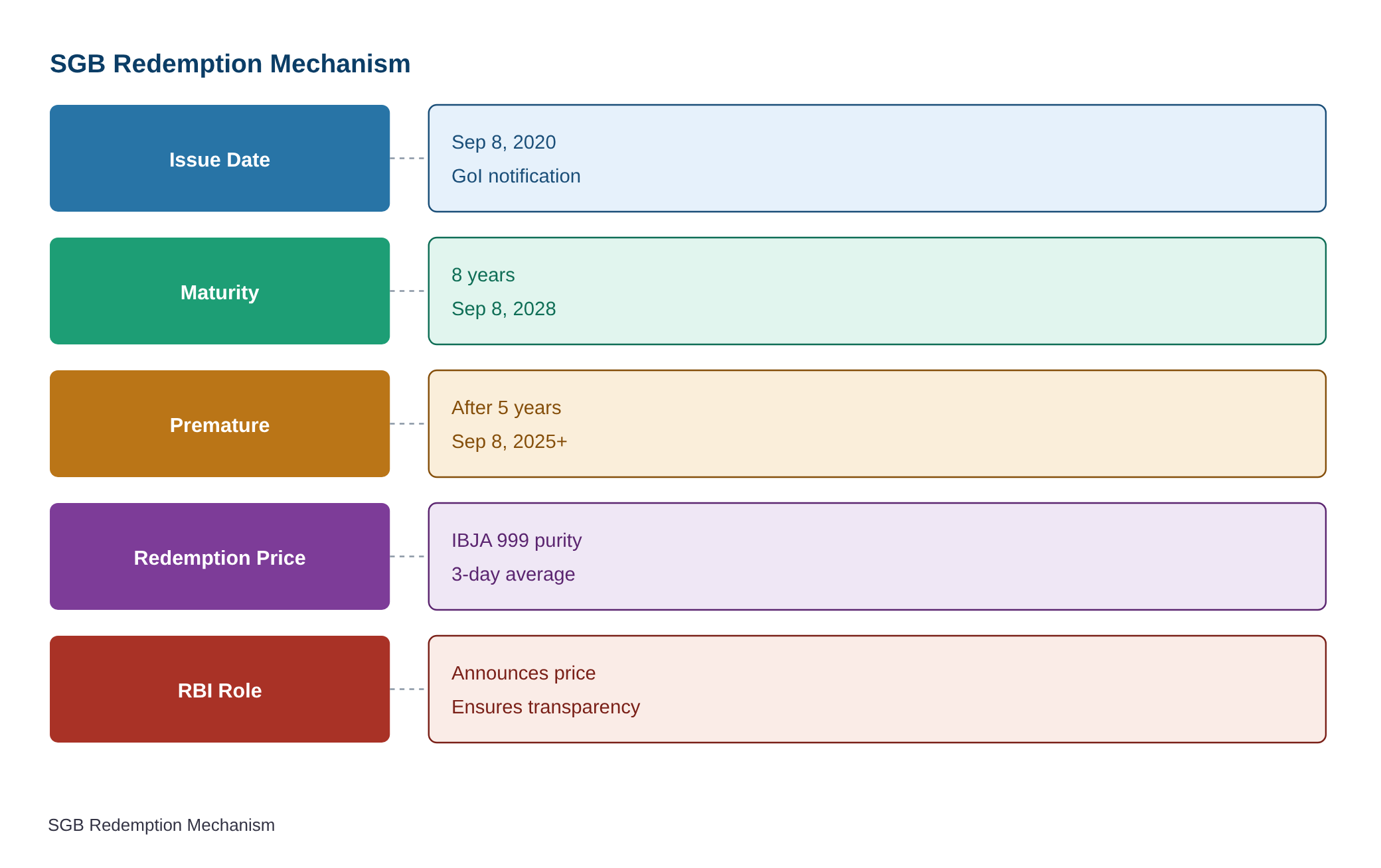
✎ Premature redemption of SGBs is permitted after the fifth year from the date of issue, and the redemption price is calculated as the simple average of the closing price of 999 purity gold over the three preceding business days…
Subject Relevance — Where This Topic Fits
- GS Paper III — Indian Economy and Issues Relating to Planning, Mobilisation of Resources, Growth, Development and Employment
- Prelims: Sovereign Gold Bond (SGB) Scheme, Gold Monetisation Scheme, Commodity Markets, Financial Inclusion, Capital Markets Regulatory Framework, Government Securities, Inflation Hedging Instruments
- Essay: Role of Gold in Indian Economy and Financial System, Government Initiatives for Asset Monetisation
Quick Revision: Premature redemption of SGBs is permitted after the fifth year from the date of issue, and the redemption price is calculated as the simple average of the closing price of 999 purity gold over the three preceding business days, as published by IBJA.
Why is this in the news?
The Reserve Bank of India (RBI) has announced the redemption price for premature redemption of the Sovereign Gold Bond (SGB) 2020-21 Series VI, scheduled for September 8, 2026. This development highlights the operational aspects of the SGB Scheme, including eligibility for early redemption, pricing mechanisms, and the role of benchmark indices in determining redemption values. It serves as a practical illustration of India’s gold monetisation strategy and the functioning of sovereign-backed financial instruments.
Background
- The Sovereign Gold Bond (SGB) Scheme was launched in November 2015 by the Government of India in collaboration with the RBI to reduce the demand for physical gold and mobilise gold held by households into the financial system.
- The scheme offers an alternative investment avenue to individuals, allowing them to invest in gold in a dematerialised form without the risks and costs associated with physical gold ownership.
- SGBs are government securities denominated in grams of gold, with a fixed interest rate and a maturity period of eight years, though premature redemption is permitted after the fifth year from the date of issue.
- The redemption price for SGBs is determined based on the simple average of the closing price of gold of 999 purity over the three business days preceding the redemption date, as published by the India Bullion and Jewellers Association Ltd (IBJA).
- The SGB Scheme is part of broader efforts to channelise household savings into productive investments and reduce the country’s reliance on gold imports.
- The scheme also contributes to the government’s fiscal consolidation by substituting gold imports with domestic investment instruments.
What is the Sovereign Gold Bond (SGB) Scheme?
- The SGB Scheme is a government-backed financial instrument introduced to monetise gold holdings in the economy by offering investors an opportunity to earn returns linked to gold prices without holding physical gold.
- SGBs are issued by the RBI on behalf of the Government of India and are denominated in grams of gold, with a minimum investment of one gram and a maximum limit of 4 kg for individuals and 20 kg for trusts and similar entities.
- Investors receive a fixed annual interest rate of 2.5% on the issue price, payable semi-annually, in addition to the capital appreciation linked to gold prices.
- The bonds have a maturity period of eight years, but premature redemption is permitted after the fifth year from the date of issue, subject to the terms and conditions specified by the RBI.
- The redemption price is determined based on the simple average of the closing price of gold of 999 purity over the three business days preceding the redemption date, as published by the India Bullion and Jewellers Association Ltd (IBJA).
- SGBs are traded on stock exchanges, providing liquidity to investors who wish to exit before maturity.
- The scheme is designed to reduce the demand for physical gold, thereby lowering gold imports and supporting the current account deficit.
- Tax benefits are available under the scheme, including exemption from capital gains tax if held till maturity, though interest income is taxable as per the Income Tax Act.
Key Features
| Feature | Significance |
|---|---|
| Premature Redemption Eligibility | Permits investors to exit SGB holdings after the fifth year from the issue date, subject to interest payment dates, enhancing liquidity for long-term investors. |
| Redemption Price Calculation | Determined by the simple average of the closing price of 999 purity gold over the three preceding business days, as published by IBJA, ensuring market-linked valuation. |
| Issue Date and Tenure | Series VI of SGB 2020-21 was issued on September 08, 2020, with a standard maturity of eight years; premature redemption is permitted from September 08, 2025, onwards. |
| Government Notification Basis | Governed by GoI notification F.No. 4(4)-B(W&M)/2020 dated April 13, 2020, which outlines the operational framework for premature redemption under the SGB Scheme. |
| Price Transparency | The redemption price is publicly disclosed by the RBI, ensuring fairness and reducing information asymmetry for investors. |
Why it Matters
Economic Stability and Capital Markets
- Provides an alternative to physical gold investment, reducing the demand for imported gold and thereby contributing to the stability of the current account deficit.
- Enhances the depth of the domestic gold market by offering a sovereign-backed, interest-bearing instrument, diversifying investment avenues.
- Supports the monetisation of gold holdings, aligning with the government’s objective of reducing reliance on imported gold.
Investor Protection and Confidence
- Offers a secure, government-guaranteed investment avenue with assured returns, reducing exposure to market risks inherent in physical gold trading.
- Ensures fair valuation through transparent price determination, mitigating the risk of price manipulation or undervaluation.
- Provides liquidity options for investors who may need to exit before maturity, balancing long-term commitment with financial flexibility.
Fiscal Policy and Revenue Implications
- Generates revenue for the government through the issuance of bonds, which can be utilised for public expenditure or debt management.
- Reduces the fiscal burden associated with gold imports by promoting domestic investment in sovereign gold bonds.
Monetary Policy and Inflation Management
- Indirectly supports monetary policy objectives by reducing the inflationary pressures linked to gold imports, a non-productive asset.
- Encourages savings in financial instruments rather than physical assets, aligning with broader macroeconomic stability goals.
Challenges
1. Liquidity Constraints in Secondary Market
- Limited secondary market liquidity for SGBs may deter investors seeking early exit options, despite the premature redemption facility.
- Potential mismatch between redemption demand and available liquidity could lead to delays or suboptimal pricing.
UPSC Link: GS3: Financial Inclusion and Capital Markets
2. Price Volatility and Market Risk
- The redemption price is linked to gold prices, which are subject to global market fluctuations, introducing volatility in investor returns.
- Investors may face capital losses if gold prices decline between the issue date and the redemption date.
UPSC Link: GS3: Commodity Markets and Price Stability
3. Investor Awareness and Participation
- Low awareness among retail investors about the features, benefits, and operational aspects of the SGB Scheme may limit its uptake.
- Complexity in understanding redemption terms, including eligibility and pricing mechanisms, could deter potential investors.
UPSC Link: GS3: Financial Literacy and Inclusive Growth
4. Operational and Administrative Challenges
- Ensuring seamless coordination between RBI, IBJA, and issuing banks for accurate price determination and timely redemption settlements.
- Addressing grievances related to redemption delays or discrepancies in pricing to maintain investor trust.
UPSC Link: GS2: Governance and Institutional Mechanisms
Challenges — UPSC Perspective
| Issue | Concern |
|---|---|
| Secondary Market Liquidity | Limited trading volume may hinder investors’ ability to exit positions before maturity. |
| Gold Price Volatility | Fluctuations in global gold prices can impact redemption value and investor returns. |
| Investor Awareness Gaps | Insufficient understanding of SGB features may reduce participation and uptake. |
| Administrative Delays | Potential bottlenecks in redemption processing could erode investor confidence. |
| Pricing Transparency | Ensuring accurate and timely disclosure of redemption prices to avoid disputes. |
| Regulatory Compliance | Adherence to RBI guidelines and GoI notifications across all stages of redemption. |
Government Initiatives — Must-Memorise for Prelims
- Sovereign Gold Bond (SGB) Scheme
- Gold Monetisation Scheme (GMS)
Way Forward
- Enhance investor awareness campaigns through digital and print media to educate potential investors about the features, benefits, and redemption process of SGBs.
- Strengthen the secondary market for SGBs by encouraging participation from institutional investors and market makers to improve liquidity.
- Streamline the redemption process by leveraging digital platforms for seamless application, verification, and disbursement of funds.
- Conduct periodic reviews of the SGB Scheme to assess its impact on gold imports, fiscal revenue, and investor participation, with necessary modifications.
- Collaborate with financial literacy initiatives under the Ministry of Finance to integrate SGB education into school and college curricula.
- Improve transparency in price determination by publishing historical redemption prices and comparative analyses to build investor trust.
- Explore the introduction of flexible redemption options, such as partial redemptions, to cater to diverse investor needs.
- Monitor global gold price trends and their impact on SGB returns to proactively address investor concerns and policy adjustments.
UPSC Value Addition
Keywords for Mains Answer-Writing
Sovereign Gold Bonds (SGB) · premature redemption · capital market instruments · gold monetisation · monetary policy framework · financial inclusion · inflation hedging · fiscal policy instruments · Government Securities Act, 2006 · India Bullion and Jewellers Association Ltd (IBJA) · gold pricing mechanism · financial savings instruments · capital market development · liquidity in gold market
Concept Flow
Issue of SGB 2020-21 Series VI on September 08, 2020, under GoI notification F.No. 4(4)-B(W&M)/2020. → Investor commitment to an eight-year tenure with optional premature redemption after the fifth year. → Eligibility for premature redemption on September 08, 2026, coinciding with an interest payment date. → Redemption price determination based on the simple average of IBJA’s closing gold prices over three preceding business days. → Public disclosure of the redemption price (₹15,384 per unit) to ensure transparency and fairness. → Investor decision to redeem or hold, influenced by market conditions, liquidity needs, and gold price trends. → Impact on capital markets, fiscal policy, and investor confidence, contingent on redemption outcomes.
Prelims Practice Questions
Q1. Consider the following statements regarding the Sovereign Gold Bond (SGB) Scheme:
1. Premature redemption is permitted only after the fifth year from the date of issue.
2. The redemption price is based on the simple average of the closing price of gold of 999 purity of the previous three business days as published by IBJA.
3. The SGB Scheme was notified under the Gold (Control) Act, 1968.
How many of the above statements are correct?
- Only one
- Only two
- Only three
- None
Answer: Only two — Statement 1 and 2 are correct as per the RBI notification and the SGB Scheme framework. Statement 3 is incorrect as the SGB Scheme was notified under the Government Securities Act, 2006, not the Gold (Control) Act, 1968.
Q2. Assertion (A): The Sovereign Gold Bond Scheme aims to reduce the demand for physical gold in India.
Reason (R): The scheme offers an alternative investment avenue that provides returns linked to gold prices without the need for physical storage.
In the context of the above two statements, which one of the following is correct?
- Both A and R are true and R is the correct explanation of A
- Both A and R are true but R is NOT the correct explanation of A
- A is true but R is false
- A is false but R is true
Answer: Both A and R are true and R is the correct explanation of A — Both Assertion (A) and Reason (R) are true. The SGB Scheme is designed to channel household savings into financial instruments, thereby reducing the demand for physical gold. The Reason (R) correctly explains the Assertion (A).
Q3. Match the following columns related to the Sovereign Gold Bond Scheme:
Column I (Feature) | Column II (Description)
——————-|———————-
A. Issue Price | 1. Based on simple average of closing price of gold of 999 purity of previous three business days as published by IBJA
B. Tenure | 2. Issued by Reserve Bank of India on behalf of Government of India
C. Premature Redemption | 3. Permitted after fifth year from the date of issue
D. Redemption Price | 4. Fixed at the time of issue and linked to the nominal value of gold
Select the correct match:
- A-4, B-2, C-3, D-1
- A-2, B-4, C-1, D-3
- A-1, B-3, C-2, D-4
- A-3, B-1, C-4, D-2
Answer: A-4, B-2, C-3, D-1 — A-4: Issue Price is fixed at the time of issue and linked to the nominal value of gold. B-2: SGBs are issued by RBI on behalf of GoI. C-3: Premature redemption is permitted after the fifth year. D-1: Redemption price is based on the simple average of closing price of gold of 999 purity of previous three business days as published by IBJA.
Mains Practice Question
✍ The Sovereign Gold Bond (SGB) Scheme represents a significant innovation in India’s financial sector by providing a financial savings instrument linked to gold prices. Critically analyse the objectives, operational framework, and challenges associated with the SGB Scheme. Also, examine its role in promoting financial inclusion and reducing the demand for physical gold. (15 Marks)
Approach: MODEL-ANSWER SKELETON:
1. **Objectives of SGB Scheme** (3 points):
– Reduce physical gold demand and import dependence (link to ‘Gold Monetisation Scheme’).
– Provide a safe, government-backed alternative to physical gold for retail investors.
– Encourage financial savings and diversify household investment portfolios.
2. **Operational Framework** (4 points):
– Issued by RBI on behalf of GoI under the Government Securities Act, 2006.
– Issue price linked to nominal value of gold; redemption price based on IBJA’s 999 purity gold price average.
– Tenure: 8 years with exit option after 5 years (premature redemption).
– Interest paid semi-annually at a fixed rate (e.g., 2.5% p.a. as per earlier tranches).
3. **Challenges** (4 points):
– Liquidity constraints: Secondary market trading is limited; premature redemption may not always be optimal.
– Price volatility: Returns are linked to gold prices, which can be volatile.
– Awareness and accessibility: Rural and low-income groups may lack access to digital platforms for subscription.
– Taxation: Capital gains tax implications may deter certain investors.
4. **Role in Financial Inclusion and Gold Demand Reduction** (4 points):
– **Financial Inclusion**: SGBs democratise gold investment by allowing small denominations (1 gram units) and digital KYC, reducing barriers for marginalised groups.
– **Gold Demand Reduction**: By offering a financial substitute, SGBs aim to curb gold imports, thereby supporting the current account and forex reserves.
– **Comparison with Gold Monetisation Scheme (GMS)**: While GMS focuses on monetising existing gold, SGBs target new savings, complementing each other in reducing physical gold demand.
– **Policy Synergy**: Link to broader monetary policy goals of reducing gold imports and promoting formal financial channels.
Balance of Views:
– Proponents argue SGBs reduce systemic risks by formalising gold savings.
– Critics highlight liquidity risks and the need for stronger secondary market infrastructure.
Conclusion: SGBs are a well-conceived instrument with potential to reshape India’s gold economy, but their success hinges on improving liquidity, awareness, and tax clarity.
Source: RBI
Generated by AanyaAi for educational purpose.
Related guides on our sites
- Best PSIR optional coaching for upsc
- UPSC EPFO Test series
- Best PSIR optional test series
- Best PSIR optional teacher for upsc

- UPSC Civil Services (Main) Examination 2026 — Philosophy Optional Paper I: Questions with Model Answers | Plutus IAS - September 8, 2026
- UPSC Civil Services (Main) Examination 2026 — Public Administration Optional Paper II: Questions with Model Answers | Plutus IAS - September 8, 2026
- UPSC Civil Services (Main) Examination 2026 — Public Administration Optional Paper I: Questions with Model Answers | Plutus IAS - September 7, 2026

No Comments