


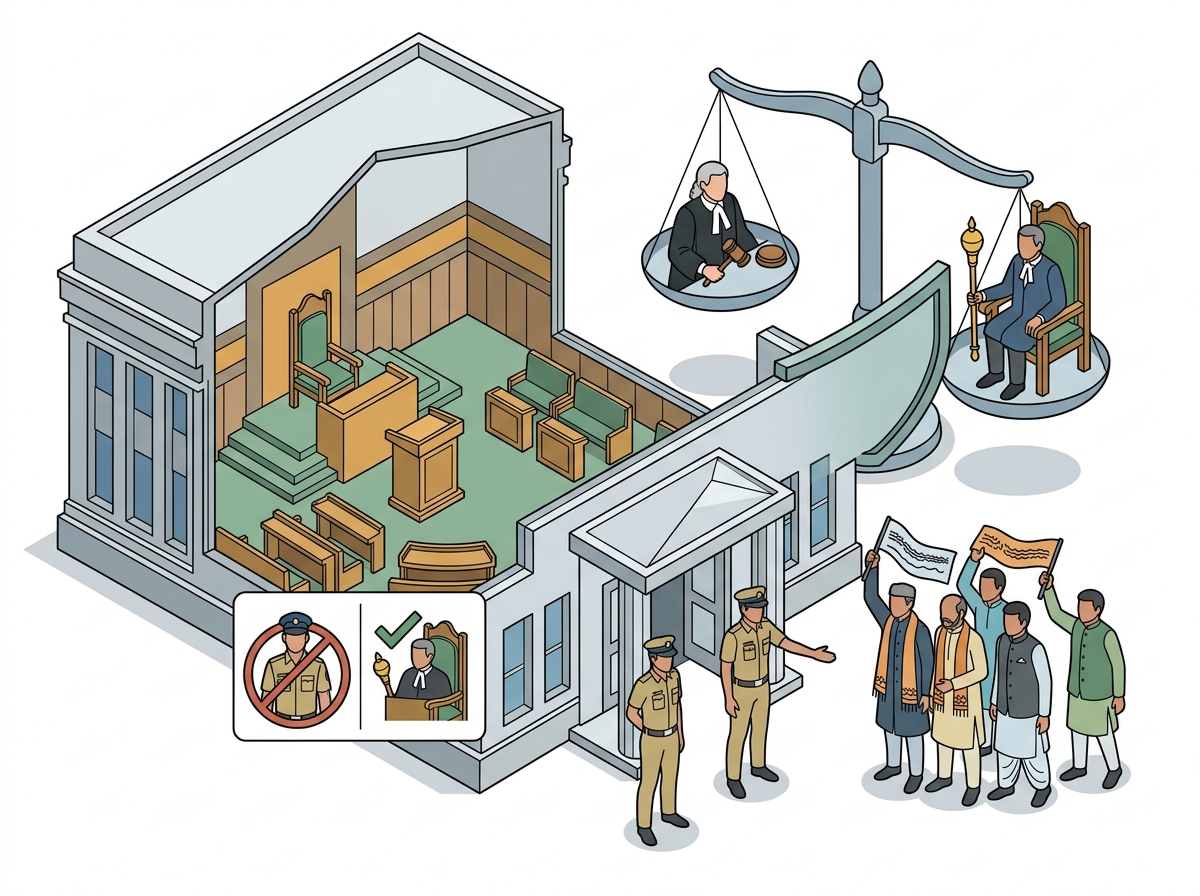
07 Sep High Court Rules: Speaker, Not Police, to Act on Assembly Rule Violations
✎ The Speaker of a State Legislative Assembly is the sole constitutional authority empowered to enforce rules of procedure and discipline within the House, and police intervention in legislative proceedings is constitutionally…
Subject Relevance — Where This Topic Fits
- GS Paper II — Polity and Governance
- Prelims: Anti-Defection Law (Tenth Schedule), Article 178, Article 212, Article 213, Rules of Procedure and Conduct of Business in State Legislatures, Speaker’s powers, Judicial Review of Legislative Proceedings
- Essay: The delicate balance between legislative autonomy and executive oversight: A case study of the Speaker’s constitutional mandate
Quick Revision: The Speaker of a State Legislative Assembly is the sole constitutional authority empowered to enforce rules of procedure and discipline within the House, and police intervention in legislative proceedings is constitutionally impermissible unless expressly mandated by law.
Why is this in the news?
The Telangana High Court, in a significant ruling on September 7, 2026, reaffirmed the exclusive jurisdiction of the Speaker of the State Legislative Assembly to enforce rules of procedure and discipline within the House, thereby restraining police interference in legislative proceedings. The judgment arose from a writ petition filed by legislators of the Telangana Legislative Assembly, who contended that police personnel had prevented them from entering the Assembly premises, allegedly due to their attire displaying slogans, which they argued violated no established rule. The Court’s directive to the Director General of Police (DGP) to identify and take strict action against erring police officials underscores the constitutional principle that the Speaker, and not the police, is the sole authority empowered to regulate conduct within the Assembly.
Background
- The Constitution of India, under Article 178, establishes the office of the Speaker of a State Legislative Assembly.
- The Rules of Procedure and Conduct of Business in State Legislatures are framed under Article 208.
- The principle of legislative privilege, enshrined in the Constitution, protects the internal functioning of legislatures from external interference, including that by law enforcement agencies.
What is the Constitutional and Statutory Framework Governing the Speaker’s Authority in State Legislatures?
- The Speaker of a State Legislative Assembly is a constitutional office established under Article 178, elected by the members of the Assembly from among themselves.
- The Speaker’s primary functions include maintaining order, regulating the conduct of business, and enforcing the Rules of Procedure and Conduct of Business framed under Article 208 of the Constitution.
- Under Rule 316 of the Telangana Legislative Assembly’s Rules of Procedure, members are prohibited from wearing or displaying badges, symbols, or slogans within the House, a provision that was cited in the instant case.
- The principle of ‘exclusive cognizance’ empowers the Speaker to determine whether a member’s conduct constitutes a breach of privilege or contempt, without interference from external agencies like the police.
- The Constitution grants the Speaker immunity from legal proceedings for actions taken in the discharge of duties, as protected by Article 194.
- The Speaker’s role is distinct from that of the executive, and the separation of powers doctrine ensures that the police, as an executive agency, cannot usurp the Speaker’s constitutional mandate to regulate legislative proceedings.
Key Features
| Feature | Significance |
|---|---|
| Jurisdictional Primacy of the Speaker | The High Court reaffirmed that the Speaker of the Legislative Assembly is the sole constitutional authority empowered to enforce rules of procedure and conduct within the Assembly, overriding any executive or police interference. |
| Police Restraint in Legislative Proceedings | The judgment underscores the constitutional principle that police authorities cannot obstruct legislators’ entry to the Assembly or interfere in legislative business, except under explicit legal mandates. |
| Procedural Rules of the Assembly | Rule 316 and clauses xiii and xv of the Procedure and Conduct of Business in the Assembly regulate attire and conduct, demonstrating the Assembly’s internal disciplinary mechanisms. |
| Gender-Sensitive Interpretation of Rules | The Court’s observation on the differential treatment of women legislators highlights the need for gender-neutral application of Assembly rules and procedural fairness. |
| Judicial Review of Legislative Processes | The High Court’s intervention in a legislative matter illustrates the judiciary’s role in safeguarding procedural integrity and constitutional balance between institutions. |
Why it Matters
Institutional Balance and Separation of Powers
- The judgment reinforces the doctrine of separation of powers by delineating the exclusive domain of the Legislative Assembly in regulating its own proceedings.
- It prevents executive overreach, particularly by police authorities, into the internal affairs of the legislature, a core feature of parliamentary democracy.
- The ruling aligns with constitutional principles that the legislature is supreme in matters of its own procedure, subject only to judicial review for constitutional validity.
- It acts as a safeguard against arbitrary executive actions that could undermine legislative autonomy and democratic accountability.
Procedural Integrity in Legislatures
- The case underscores the importance of adhering to the Rules of Procedure and Conduct of Business in the Assembly to maintain decorum and discipline.
- It highlights the need for clarity in rules governing attire and conduct to avoid ambiguity that could lead to disputes or misinterpretation.
- The judgment serves as a precedent for future disputes involving legislative procedure, ensuring consistency in judicial interpretation.
- It reinforces the role of the Speaker as the final authority in interpreting and enforcing Assembly rules.
Judicial Oversight of Legislative Institutions
- The High Court’s proactive stance in reviewing legislative procedural disputes demonstrates judicial willingness to intervene when institutional integrity is at stake.
- It sets a precedent for judicial review of actions by police or executive authorities that encroach upon legislative functions.
- The ruling ensures that legislative proceedings are not disrupted by external agencies, preserving the sanctity of democratic processes.
- It reinforces public confidence in the judiciary as a neutral arbiter in institutional conflicts.
Challenges
1. Executive Overreach into Legislative Functions
- Police interference in legislative proceedings undermines the autonomy of the legislature and violates the principle of separation of powers.
- Such actions can lead to erosion of public trust in democratic institutions and create a chilling effect on legislators’ ability to discharge their duties.
- Executive agencies may misinterpret their role, leading to unnecessary confrontations with the legislature over procedural matters.
UPSC Link: GS-II: Separation of Powers
2. Ambiguity in Rules of Procedure
- The case highlights potential gaps or ambiguities in the Rules of Procedure and Conduct of Business in the Assembly, particularly regarding attire and conduct.
- Unclear rules can lead to disputes, misinterpretation, and arbitrary enforcement, as seen in the differential treatment of legislators based on attire.
- The legislature must periodically review and update its rules to ensure they are comprehensive, clear, and gender-neutral.
UPSC Link: GS-II: Parliamentary Procedures
3. Gender Bias in Enforcement of Rules
- The differential treatment of women legislators by police authorities raises concerns about gender bias in the enforcement of Assembly rules.
- Such biases can perpetuate systemic inequalities and undermine the principle of equality before the law.
- The legislature and executive must ensure that rules are applied uniformly, irrespective of gender, to uphold constitutional values.
UPSC Link: GS-I: Gender Justice
4. Judicial Intervention in Legislative Matters
- Frequent judicial interventions in legislative procedural disputes may blur the lines between judicial and legislative functions, raising concerns about judicial overreach.
- The judiciary must exercise restraint and limit its role to ensuring constitutional validity rather than dictating procedural details.
- Balancing judicial oversight with legislative autonomy is a delicate task that requires careful consideration of constitutional principles.
UPSC Link: GS-II: Judicial Review
5. Public Perception and Institutional Trust
- Instances of police obstruction or executive interference in legislative proceedings can erode public trust in democratic institutions.
- Such incidents may be perceived as attempts to suppress dissent or undermine the legislature, leading to political instability.
- The judiciary’s role in safeguarding institutional autonomy is crucial to maintaining public confidence in democratic processes.
UPSC Link: GS-II: Democratic Institutions
Challenges — UPSC Perspective
| Issue | Concern |
|---|---|
| Police Interference in Legislative Proceedings | Undermines legislative autonomy and violates separation of powers. |
| Ambiguity in Assembly Rules | Leads to disputes, misinterpretation, and arbitrary enforcement. |
| Gender Bias in Rule Enforcement | Perpetuates systemic inequalities and undermines constitutional values. |
| Judicial Overreach in Legislative Matters | Blurs lines between judicial and legislative functions, raising concerns about judicial activism. |
| Erosion of Public Trust in Institutions | Undermines democratic processes and creates a chilling effect on legislators. |
Way Forward
- The Speaker of the Legislative Assembly should issue a formal circular clarifying the rules governing attire and conduct, ensuring gender neutrality and unambiguous interpretation.
- The Assembly Secretariat should conduct a review of the Rules of Procedure and Conduct of Business to identify and rectify ambiguities or gaps.
- Police authorities must undergo sensitization training on the constitutional limits of their role in legislative proceedings and the principle of separation of powers.
- The legislature should establish an internal mechanism for grievance redressal to address disputes arising from procedural violations without resorting to judicial intervention.
- The High Court’s judgment should be widely disseminated among legislators, police officials, and executive authorities to ensure awareness and compliance.
- The Assembly should consider adopting a code of conduct for legislators that aligns with constitutional values and promotes gender equality in enforcement.
- Judicial training programs should emphasize the delicate balance between judicial review and legislative autonomy to prevent overreach.
UPSC Value Addition
Keywords for Mains Answer-Writing
Legislative Assembly privileges · Speaker’s powers · Parliamentary Sovereignty · Police role in Legislative Precincts · Procedural Rules of Legislative Bodies · Constitutional Immunity of Legislators · Judicial Review of Legislative Proceedings · Separation of Powers · Rule of Law in Legislative Context · Gender Sensitivity in Legislative Procedures · Procedural Fairness · Constitutional Governance · Legislative Autonomy · Judicial Intervention in Legislative Affairs
Constitutional & Policy Linkages
- Article 208: Rules of procedure and conduct of business in the State Legislature.
- Article 212: Courts not to inquire into the validity of legislative proceedings.
Concept Flow
Police obstruction of legislators’ entry to Assembly → Violation of legislative autonomy → Writ petition filed in High Court → Judicial review of police action → High Court reaffirms Speaker’s primacy → Judgment on separation of powers → Clarification of Assembly rules → Institutional safeguards strengthened
Prelims Practice Questions
Q1. Consider the following statements regarding the powers of the Speaker of a Legislative Assembly in India:
1. The Speaker is the final authority to decide on matters of breach of privilege and contempt of the House.
2. The Speaker’s decisions are subject to judicial review if they violate constitutional provisions.
3. The Speaker can direct the police to take action against legislators for violating Assembly rules.
4. The Speaker’s rulings on procedural matters are binding on the members of the House.
How many of the above statements are correct?
- Only one
- Only two
- Only three
- All four
Answer: Only three — Statements 1 and 4 are correct: The Speaker is the final authority on matters of privilege and procedural rulings within the House, and these rulings are binding on members. Statement 2 is correct: The Speaker’s decisions are subject to judicial review if they violate constitutional or statutory provisions. Statement 3 is incorrect: The Speaker, not the police, is the authority to take action for violations of Assembly rules.
Q2. Assertion (A): The police have no jurisdiction to interfere in the internal proceedings of a Legislative Assembly.
Reason (R): The Constitution vests the exclusive authority to regulate the conduct of legislators and the functioning of the Assembly in the Speaker.
In the context of the above statements, which of the following is correct?
- Both A and R are true, and R is the correct explanation of A
- Both A and R are true, but R is not the correct explanation of A
- A is true, but R is false
- A is false, but R is true
Answer: Both A and R are true, but R is not the correct explanation of A — Assertion (A) is true: The police cannot interfere in the internal proceedings of a Legislative Assembly, as the Speaker is the constitutional authority to regulate such matters. Reason (R) is also true and correctly explains (A), as the Constitution vests this authority in the Speaker under Articles 178-187 (State Legislatures) and Articles 79-122 (Parliament).
Q3. Match the following provisions with their respective constitutional or statutory sources:
Column I (Provision) | Column II (Source)
1. Speaker’s power to regulate proceedings | A. Article 194(3) of the Constitution
2. Police jurisdiction in legislative precincts | B. Article 208 of the Constitution
3. Judicial review of Speaker’s decisions | C. State Legislative Assembly Rules
4. Privileges of legislators | D. Code of Criminal Procedure, 1973
Select the correct match:
- 1-A, 2-D, 3-C, 4-B
- 1-C, 2-D, 3-A, 4-B
- 1-B, 2-C, 3-A, 4-D
- 1-A, 2-B, 3-D, 4-C
Answer: 1-C, 2-D, 3-A, 4-B — 1-A: The Speaker’s power to regulate proceedings is derived from Article 194(3) of the Constitution. 2-D: Police jurisdiction in legislative precincts is governed by the Code of Criminal Procedure, 1973, subject to the immunity granted to legislators. 3-C: Judicial review of the Speaker’s decisions is subject to the State Legislative Assembly Rules and constitutional provisions. 4-B: The privileges of legislators are outlined in Article 208 of the Constitution.
Mains Practice Question
✍ The Speaker of a Legislative Assembly is the sole constitutional authority to enforce discipline and maintain order within the House, and no external agency, including the police, can interfere in its internal proceedings. Critically examine this proposition with reference to constitutional provisions, judicial precedents, and recent developments. (15 Marks)
Approach: MODEL-ANSWER SKELETON:
1. **Constitutional Basis**:
– Article 178 (State Legislatures) and Article 79 (Parliament) vest the Speaker with the authority to regulate proceedings.
– Article 194(3) explicitly states that the Speaker’s powers, privileges, and immunities are those of the House of Commons, subject to the Constitution and the rules of the House.
– Article 208 outlines the procedure for regulating the conduct of members, reinforcing the Speaker’s role.
2. **Judicial Precedents**:
– *Kihoto Hollohan v. Zachillhu* (1992): The Supreme Court held that the Speaker’s decision on disqualification under the Tenth Schedule is subject to judicial review only on grounds of constitutional violations or mala fide.
– *Raja Ram Pal v. Hon’ble Speaker, Lok Sabha* (2007): The Court reiterated the Speaker’s authority to expel members for contempt and breach of privilege, subject to constitutional limits.
– *State of Kerala v. N. M. Thomas* (1976): The Court upheld the Speaker’s power to enforce discipline, stating that legislative autonomy is a basic feature of the Constitution.
3. **Police’s Role and Limitations**:
– Police jurisdiction is limited to maintaining law and order outside the legislative precincts (Article 208 read with CrPC).
– The Speaker’s authority is absolute within the House, and police interference violates the doctrine of separation of powers.
– Recent judgments (e.g., Telangana High Court, 2026) reinforce that the Speaker, not the police, is the authority to take action for violations of Assembly rules.
4. **Procedural Fairness and Gender Sensitivity**:
– The Speaker must ensure procedural fairness, including gender-sensitive enforcement of rules (e.g., Telangana HC’s observation on the treatment of women legislators).
– The Speaker’s actions must align with constitutional morality and fundamental rights (Article 14, 15, and 21).
5. **Critique and Balance**:
– **Strengths**: The Speaker’s authority ensures legislative autonomy and prevents executive overreach.
– **Weaknesses**: Potential for partisan misuse; lack of transparency in disciplinary actions.
– **Suggestions**: Strengthen judicial oversight, codify procedural rules, and ensure gender-neutral enforcement.
6. **Conclusion**:
– The proposition is largely correct, but the Speaker’s authority must be exercised within constitutional and judicial boundaries to prevent abuse.
Source: The Hindu
Generated by AanyaAi for educational purpose.
Related guides on our sites
- Best PSIR optional coaching for upsc
- Best PSIR optional teacher for upsc
- Best teacher of PSIR optional for upsc
- Best PSIR optional coaching in delhi for UPSC

- Shivraj Singh Chouhan launches ‘Khet Bachao Abhiyan’ to save farmland - October 23, 2026
- उत्तराखंड राज्यपाल की पीएम मोदी से महत्वपूर्ण बैठक: जानिए मुख्य बिंदु - October 23, 2026
- How India’s Rs 20,000 Cr CCUS Budget Can Drive Net-Zero Goals - October 23, 2026

No Comments