


08 Sep Delhi Building Collapse: New Safety Policy & Structural Audit for PG Hubs
✎ The Delhi PG hostel collapse underscores the critical need for stringent enforcement of structural safety norms, proactive urban governance, and innovative utilisation of existing infrastructure to address urban housing shortages…
Subject Relevance — Where This Topic Fits
- GS Paper II — Governance, Constitution, Polity, Social Justice | GS Paper III — Disaster Management, Urban Development
- Prelims: Building Bye-Laws, Floor Area Ratio (FAR), Municipal Corporation of Delhi (MCD), Delhi Development Authority (DDA), structural audit, National Building Code (NBC) 2016, disaster resilience, urban housing shortage
- Essay: Urbanisation and Housing: Balancing Growth with Safety, Governance Challenges in Urban Disaster Management
Quick Revision: The Delhi PG hostel collapse underscores the critical need for stringent enforcement of structural safety norms, proactive urban governance, and innovative utilisation of existing infrastructure to address urban housing shortages while ensuring disaster resilience.
Why is this in the news?
The collapse of a private paying guest (PG) hostel in Delhi’s Satya Niketan, resulting in multiple fatalities, has exposed systemic vulnerabilities in urban housing governance, particularly concerning structural safety, regulatory compliance, and the adequacy of student accommodation infrastructure. The incident has prompted immediate policy responses, including structural audits, and exploration of alternative housing solutions, underscoring the intersection of urban planning, disaster management, and public welfare governance.
Background
- The incident occurred in Satya Niketan, a locality in South West Delhi, adjacent to Delhi University’s South Campus, highlighting the concentration of student housing in unregulated private PG accommodations.
- Delhi, as a major educational hub, hosts over 2.45 lakh regular students in its universities, with only 18 university-run hostels, indicating a severe shortage of formal student housing infrastructure.
- Private PG accommodations, often unregistered or operating under lax regulatory oversight, have proliferated to meet demand, raising concerns about structural integrity, fire safety, and compliance with building bye-laws.
- The National Building Code (NBC) 2016 provides guidelines for structural safety, fire safety, and occupancy norms, but enforcement remains inconsistent, particularly in unorganised sectors like student housing.
- The Delhi Development Authority (DDA) and Municipal Corporation of Delhi (MCD) possess vacant buildings and land parcels that could be repurposed for student housing, but utilisation is constrained by bureaucratic and legal hurdles.
- Historical incidents, such as the 2010 Lalita Park building collapse in Delhi, have repeatedly highlighted the need for stringent structural audits and proactive urban governance to prevent such tragedies.
What is the Policy Response Framework to the Delhi PG Hostel Collapse Incident?
- Immediate Structural Audits: The Lieutenant Governor of Delhi has directed a structural audit of all buildings in PG hubs, prioritising those prima facie violating height and floor restrictions to avoid panic while ensuring safety.
- Exploration of Alternative Accommodation: The government is assessing the feasibility of utilising vacant buildings owned by the DDA, MCD, and other agencies to provide temporary and long-term student housing solutions.
- Mid- and Long-Term Planning: A comprehensive plan is being formulated to augment hostel accommodations, addressing the structural deficit in student housing infrastructure through policy reforms and infrastructure development.
- Regulatory Strengthening: The incident has catalysed discussions on strengthening building bye-laws, streamlining registration processes for PG accommodations, and enforcing mandatory structural audits at periodic intervals.
- Inter-Agency Coordination: The policy response involves coordination between the DDA, MCD, Land and Development Office, and Delhi University to ensure holistic and sustainable solutions to urban housing challenges.
- Disaster Resilience Focus: The response underscores the need for integrating disaster resilience into urban planning, including retrofitting existing structures and ensuring compliance with the National Building Code (NBC) 2016.
- Public Awareness and Compliance: The incident highlights the importance of public awareness campaigns to educate stakeholders—including landlords, students, and local authorities—on structural safety and regulatory compliance.
Key Features
| Feature | Significance |
|---|---|
| Structural audit of PG hubs | Mandatory inspection of all buildings in student accommodation clusters to identify structural vulnerabilities and prevent future collapses. |
| New safety policy for public-purpose buildings | Development of a comprehensive regulatory framework for buildings used for public accommodation, including hostels, with stricter compliance and liability norms. |
| Exploration of alternative student housing | Assessment of feasibility to utilise vacant MCD and DDA buildings for student accommodation to address the acute shortage of hostel facilities. |
| Relaxation in Floor Area Ratio (FAR) for hostels | Permitting higher building heights and larger floor areas for hostels to increase accommodation capacity while ensuring safety standards. |
| Mid- and long-term hostel augmentation plan | Formulation of a strategic roadmap to systematically expand hostel infrastructure in alignment with student demand and urban planning norms. |
Why it Matters
Urban Governance and Public Safety
- Highlights systemic failures in urban planning and building regulation, particularly in high-density student hubs like Satya Niketan.
- Exposes the inadequacy of existing hostel infrastructure vis-à-vis the demand from over 2.45 lakh regular students in Delhi University alone.
- Demonstrates the need for integrated governance between municipal bodies (MCD), development authorities (DDA), and educational institutions.
Regulatory and Compliance Framework
- Emphasises the critical role of structural audits and safety certifications in preventing disasters in privately managed accommodations.
- Underscores the necessity of revising FAR norms to balance urban density with habitability and safety in student housing.
- Illustrates the importance of proactive policy interventions to address gaps in existing laws governing public-purpose buildings.
Resource Utilisation and Efficiency
- Showcases the potential of repurposing underutilised public assets (MCD/DDA buildings) for social infrastructure, aligning with principles of sustainable urban development.
- Highlights the economic rationale for optimising land use in urban centres to meet housing demands without encroaching on green or residential zones.
Disaster Preparedness and Response
- Reveals vulnerabilities in emergency response mechanisms, including the lack of emergency exits in collapsed structures.
- Demonstrates the need for coordinated multi-agency protocols for rapid assessment and evacuation in urban disaster scenarios.
Challenges
1. Regulatory Enforcement Gaps
- Inadequate implementation of existing building bye-laws and safety regulations in privately managed hostels.
- Lack of a unified regulatory authority to oversee compliance across municipal, development, and educational jurisdictions.
- Delayed or absent structural audits in high-risk zones due to bureaucratic inertia or resource constraints.
UPSC Link: GS2: Urban governance
2. Urban Housing Shortage
- Severe deficit in hostel accommodation for students, particularly in metropolitan cities like Delhi.
- Over-reliance on unregulated private PG accommodations due to limited public sector provisioning.
- Geographical concentration of student housing in specific clusters, exacerbating safety and infrastructure pressures.
UPSC Link: GS1: Urbanisation
3. Institutional Coordination Failures
- Fragmented responsibilities among MCD, DDA, universities, and the Lieutenant Governor’s administration in managing student housing.
- Absence of a centralised database or monitoring mechanism for student accommodations.
- Delays in inter-departmental decision-making during crises, as seen in the post-collapse response.
UPSC Link: GS2: Centre-State relations
4. Safety and Compliance Culture
- Prevalence of unauthorised construction and structural modifications in privately owned hostels.
- Low awareness among stakeholders (owners, students, authorities) about safety standards and audit requirements.
- Inadequate penalties or deterrents for violations of building norms.
UPSC Link: GS2: Governance
5. Resource Mobilisation for Public Infrastructure
- Limited availability of vacant or underutilised public buildings for conversion into student housing.
- Financial and logistical constraints in retrofitting existing structures to meet safety and habitability standards.
- Need for public-private partnerships to augment hostel infrastructure without compromising quality or safety.
UPSC Link: GS3: Infrastructure
Challenges — UPSC Perspective
| Issue | Concern |
|---|---|
| Enforcement of building bye-laws | Systemic failure to ensure compliance with structural safety norms in private hostels. |
| Student housing deficit | Insufficient public and private sector hostel capacity to meet demand from migrating students. |
| Inter-agency coordination | Fragmented governance between MCD, DDA, universities, and LG administration. |
| Unauthorised construction | Prevalence of illegal structural modifications in hostels, compromising safety. |
| Resource constraints for retrofitting | Financial and technical limitations in upgrading existing buildings for student use. |
| Public asset utilisation | Under-explored potential of vacant MCD/DDA buildings for social infrastructure. |
Way Forward
- Constitute a multi-stakeholder task force comprising MCD, DDA, DU administration, and student representatives to draft the new safety policy for public-purpose buildings.
- Mandate quarterly structural audits for all PG accommodations in high-density clusters, with penalties for non-compliance.
- Develop a GIS-based inventory of vacant or underutilised public buildings (MCD/DDA) for potential conversion into student housing.
- Relax FAR norms for hostels in designated zones, subject to strict adherence to safety standards and environmental clearances.
- Launch a public awareness campaign for students and hostel owners on structural safety, legal obligations, and emergency protocols.
- Establish a centralised grievance redressal mechanism for students to report safety violations in hostels.
- Integrate hostel capacity planning into urban development policies to align with projected student migration trends.
- Pilot a model hostel project in collaboration with private developers to demonstrate scalable and safe accommodation solutions.
UPSC Value Addition
Keywords for Mains Answer-Writing
Building safety regulations in India · Structural audit of buildings · Urban housing policy for students · Floor Area Ratio (FAR) in hostel construction · Delhi Development Authority (DDA) housing stock · Municipal Corporation of Delhi (MCD) vacant buildings · Disaster management and structural failures · Public safety in urban housing · Governance of student accommodations · Urban governance and building bye-laws
Concept Flow
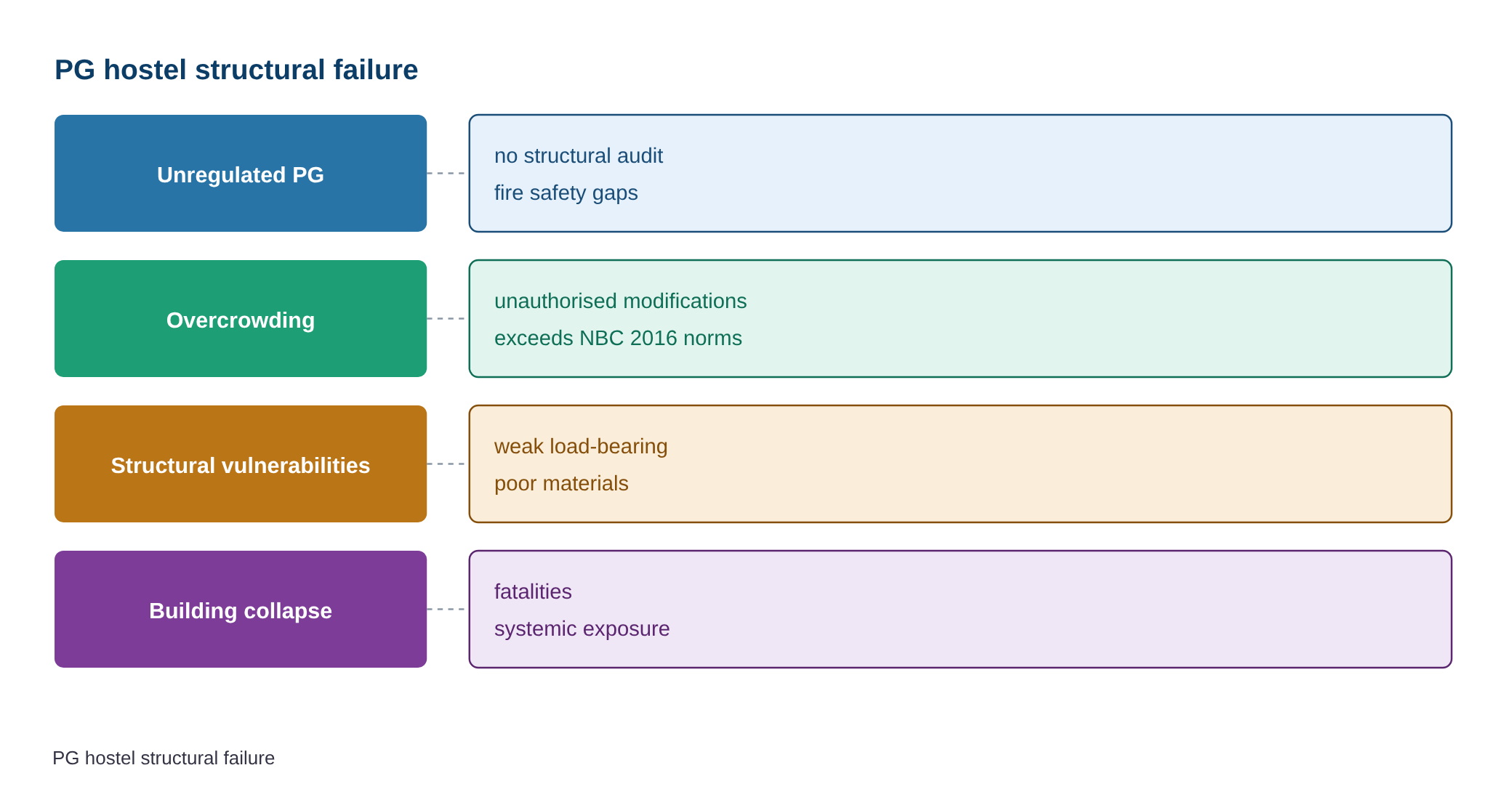
Unregulated private hostels in student hubs → Overcrowding and unauthorised structural modifications → Structural vulnerabilities → Building collapse → Immediate crisis response (rescue, displacement) → High-level review meeting (LG, CM, ministers) → Policy directives (structural audits, safety policy, FAR relaxation) → Long-term planning (hostel augmentation, resource utilisation) → Institutional reforms (task force, enforcement mechanisms) → Sustainable urban housing ecosystem.
Prelims Practice Questions
Q1. Consider the following statements regarding structural audits in India:
1. Structural audits are mandatory for all buildings in India under the National Building Code 2016.
2. The purpose of a structural audit is to assess the safety and stability of a building.
3. Structural audits are conducted only after a building collapse has occurred.
How many of the above statements are correct?
- Only one
- Only two
- All
- None
Answer: Only two — Statement 1 is incorrect; while the National Building Code 2016 provides guidelines, structural audits are not mandatory for all buildings. Statement 2 is correct; structural audits assess safety and stability. Statement 3 is incorrect; audits are conducted periodically or as per legal requirements, not only post-collapse.
Q2. Assertion (A): The Floor Area Ratio (FAR) is a regulatory tool used to control building density in urban areas.
Reason (R): Higher FAR allows for taller and larger buildings, which can increase housing supply but may compromise structural safety if not regulated properly.
- Both A and R are true, and R is the correct explanation of A.
- Both A and R are true, but R is not the correct explanation of A.
- A is true, but R is false.
- A is false, but R is true.
Answer: Both A and R are true, and R is the correct explanation of A. — Assertion (A) is correct; FAR is a key urban planning tool. Reason (R) is also correct and directly explains how FAR impacts building design and safety regulations.
Q3. Match the following urban governance bodies with their respective functions:
Column I (Body) | Column II (Function)
— | —
A. Municipal Corporation of Delhi (MCD) | 1. Allocation and management of government land
B. Delhi Development Authority (DDA) | 2. Maintenance of civic infrastructure and services
C. Land and Development Office (L&DO) | 3. Urban planning and development control
D. National Building Code | 4. Regulatory framework for building construction and safety
- A-2, B-3, C-1, D-4
- A-3, B-2, C-1, D-4
- A-2, B-1, C-3, D-4
- A-1, B-3, C-2, D-4
Answer: A-2, B-3, C-1, D-4 — Correct matches: MCD (A) maintains civic infrastructure (2); DDA (B) handles urban planning (3); L&DO (C) manages government land (1); National Building Code (D) provides regulatory framework (4).
Mains Practice Question
✍ The recent building collapse in Delhi’s Satya Niketan has underscored systemic gaps in urban housing governance, particularly concerning student accommodations. Critically examine the adequacy of existing regulatory frameworks for building safety and urban housing policies in India. Also, evaluate the proposed measures by the Delhi government in response to the incident, with reference to constitutional and statutory provisions governing urban development and public safety. (15 Marks)
Approach: MODEL-ANSWER SKELETON:
1. **Regulatory Frameworks for Building Safety:**
– National Building Code (NBC) 2016: Role in setting safety standards; voluntary vs. mandatory compliance.
– Municipal bye-laws and state-specific regulations (e.g., Delhi Building Bye-Laws 2016): Enforcement mechanisms and challenges.
– Structural audit requirements: Periodicity, agencies responsible (e.g., municipal corporations, certified engineers), and gaps in implementation.
– Disaster Management Act, 2005: Institutional framework for disaster preparedness and response.
2. **Urban Housing Policies for Students:**
– Central and state schemes: e.g., ‘Affordable Rental Housing Complexes (ARHCs)’ under Pradhan Mantri Awas Yojana (PMAY-U); limitations in coverage.
– Hostel construction norms: Floor Area Ratio (FAR) relaxations, zoning regulations, and their impact on safety.
– Role of universities and private players: Accountability in accommodation provision; lack of standardized guidelines.
3. **Delhi Government’s Proposed Measures:**
– Structural audits of PG hubs: Feasibility, timelines, and enforcement challenges.
– Utilization of vacant MCD/DDA buildings: Legal and logistical hurdles (e.g., land ownership, conversion norms).
– FAR relaxations for hostels: Potential benefits (increased supply) vs. risks (safety compromises).
– Mid- and long-term plans: Need for integrated urban planning, inter-departmental coordination, and stakeholder consultations.
4. **Constitutional and Statutory Provisions:**
– Article 21 (Right to Life and Personal Liberty): State’s obligation to ensure safe living conditions.
– 74th Constitutional Amendment Act, 1992: Role of urban local bodies in housing and safety; challenges in devolution.
– Delhi Municipal Corporation Act, 1957: Powers of MCD in building regulation and disaster management.
5. **Critical Evaluation and Way Forward:**
– Balance between housing demand and safety: Need for data-driven urban planning.
– Strengthening enforcement: Role of technology (e.g., GIS mapping, IoT-based monitoring) and third-party audits.
– Public awareness and grievance redressal: Mechanisms for reporting structural deficiencies.
– Comparative insights: Lessons from other states (e.g., Maharashtra’s ‘Building Repairs and Reconstruction Policy’).
**Balanced View:** Acknowledge the Delhi government’s proactive steps while highlighting systemic issues (e.g., bureaucratic delays, lack of standardized audits, and private sector accountability gaps). Conclude with actionable recommendations for sustainable urban housing governance.
Source: The Indian Express
Generated by AanyaAi for educational purpose.
Related guides on our sites
- Best PSIR optional coaching in delhi for UPSC
- Best PSIR optional coaching for upsc
- Best PSIR optional teacher for upsc
- Best teacher of PSIR optional for upsc

- Delhi Building Collapse: New Safety Policy & Structural Audit for PG Hubs - September 8, 2026
- डीडीयू-जीकेवाई 1.0 परियोजनाओं के समापन पर राष्ट्रीय कार्यशाला का आयोजन, जानें मुख्य बिंदु - September 8, 2026
- डीडीयू-जीकेवाई 1.0: राष्ट्रीय कार्यशाला ग्रामीण कौशल विकास पर केंद्रित - September 8, 2026

No Comments