


09 Sep Himachal’s Tax Revenue Doubles But Falls Short of Budget Targets: CAG Report
✎ The CAG’s audit of Himachal Pradesh’s finances highlights the need for robust revenue forecasting, efficient tax administration, and adherence to fiscal targets to ensure sustainable public finance management.
Subject Relevance — Where This Topic Fits
- GS Paper III — Indian Economy: Issues relating to Planning, Mobilisation of Resources, Growth, Development and Employment
- Prelims: CAG, State Finance Audit, Goods and Services Tax (GST), State Goods and Services Tax (SGST), Fiscal Deficit, Revenue Receipts, Comptroller and Auditor General of India
Quick Revision: The CAG’s audit of Himachal Pradesh’s finances highlights the need for robust revenue forecasting, efficient tax administration, and adherence to fiscal targets to ensure sustainable public finance management.
Why is this in the news?
The Comptroller and Auditor General (CAG) of India’s financial audit report for Himachal Pradesh highlights a significant increase in the state’s tax revenue over five years, yet underscores a shortfall in meeting budgetary targets for 2024-25. This discrepancy between revenue growth and fiscal performance raises critical questions about revenue estimation, tax administration, and fiscal discipline in state governance.
Background
- The Comptroller and Auditor General (CAG) of India conducts financial audits of state governments to assess the accuracy of revenue and expenditure reporting, compliance with financial rules, and adherence to budgetary provisions under Article 149 of the Constitution of India.
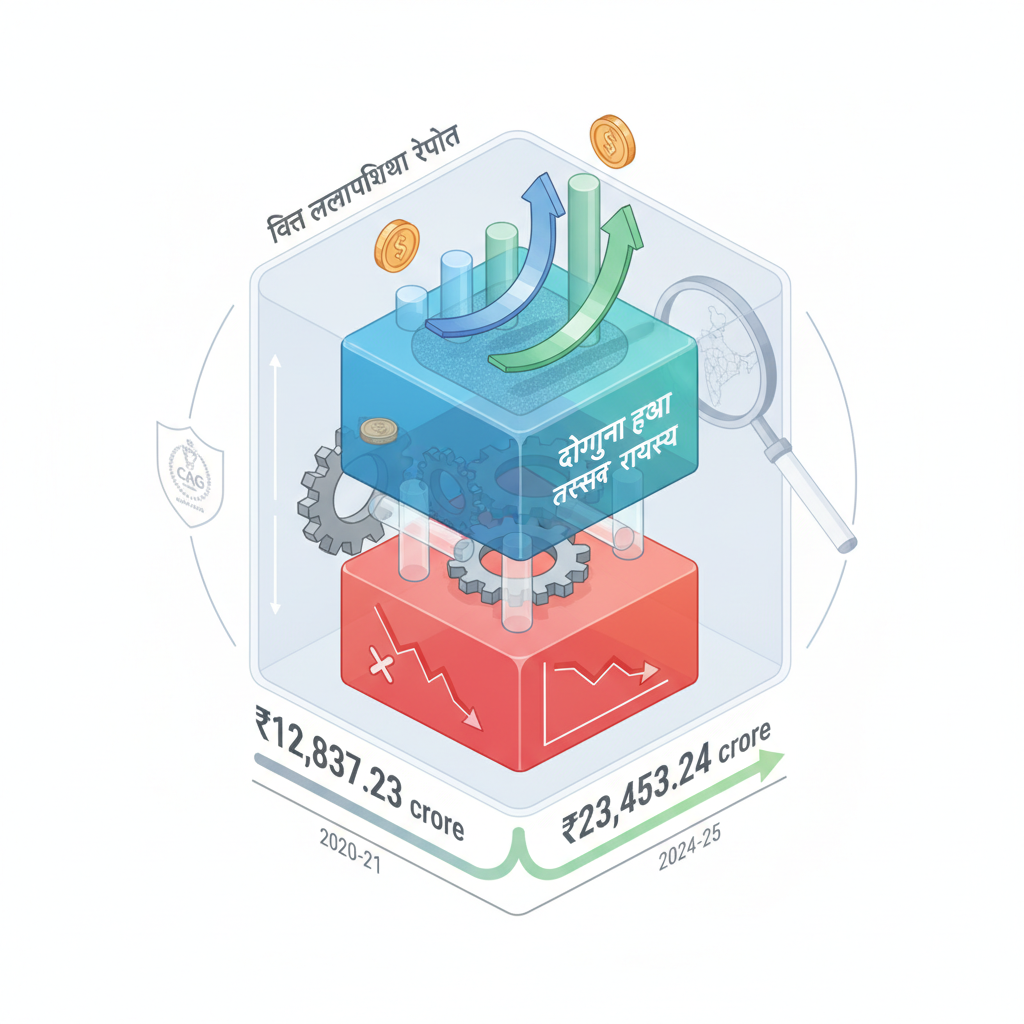
- Himachal Pradesh’s total tax revenue increased from ₹12,837.23 crore in 2020-21 to ₹23,453.24 crore in 2024-25, reflecting an 83% growth over five years.
- The State Goods and Services Tax (SGST) contributed the largest share (₹5,816.61 crore) to the state’s own tax revenue in 2024-25, followed by excise duties and trade taxes.
- Central tax devolution to Himachal Pradesh increased from ₹4,753.92 crore in 2020-21 to ₹10,681.24 crore in 2024-25, while grants-in-aid from the Centre decreased from ₹18,412.58 crore to ₹16,469.50 crore during the same period.
What is a Financial Audit by the CAG?
- The Comptroller and Auditor General (CAG) of India is a constitutional authority established under Article 148, responsible for auditing the accounts of the Union and State governments, including public sector undertakings and autonomous bodies.
- Financial audits assess the correctness and completeness of financial statements, compliance with financial rules and procedures, and the efficiency of financial management.
- The CAG’s audit reports are submitted to the Governor of the state, who presents them to the State Legislature for discussion and action, as mandated by Article 151 of the Constitution.
- The audit examines revenue receipts (tax and non-tax), expenditure (plan and non-plan), and fiscal deficits to ensure fiscal prudence and transparency.
- Audits also evaluate the effectiveness of tax administration, including the collection efficiency of State Goods and Services Tax (SGST), excise duties, and other local taxes.
- The CAG’s observations on shortfalls in revenue targets or expenditure overruns are critical inputs for the Public Accounts Committee (PAC) and the State Legislature in holding the executive accountable.
- The audit process includes test checks, analytical reviews, and compliance audits to identify deviations from financial rules, such as the Himachal Pradesh Financial Rules, 2005.
- The CAG’s reports are tabled in the State Assembly, where legislators debate the findings and recommend corrective measures to improve fiscal governance.
Key Features
| Feature | Significance |
|---|---|
| Doubling of tax revenue (2020-21 to 2024-25) | Demonstrates robust growth in state’s own tax base, indicating improved economic activity and compliance. |
| Deviation from budgeted tax revenue (2024-25) | Highlights fiscal management challenges despite revenue growth, with a shortfall of ₹2,328.68 crore against the budget estimate. |
| Composition of state tax revenue (2024-25) | SGST (₹5,816.61 crore) remains the largest contributor, followed by excise (₹2,698.23 crore) and sales/trade taxes (₹1,842.30 crore), reflecting reliance on consumption-based taxes. |
| Central tax devolution increase (2020-21 to 2024-25) | State’s share in central taxes more than doubled, enhancing fiscal resources but also increasing dependence on central transfers. |
| Decline in central grants (2020-21 to 2024-25) | Reduction in grants-in-aid (₹18,412.58 crore to ₹16,469.50 crore) underscores the need for enhanced state-level revenue mobilization. |
Why it Matters
Fiscal Federalism
- The report underscores the evolving dynamics of fiscal federalism, where states must balance autonomy in revenue generation with reliance on central transfers.
- Increased central tax devolution (15th Finance Commission recommendations) has augmented state resources, but persistent shortfalls in own-tax revenue targets signal structural fiscal gaps.
- The decline in grants-in-aid highlights the need for states to diversify revenue streams beyond central assistance, particularly for fiscally stressed regions.
State Revenue Architecture
- The dominance of SGST (81% of own-tax revenue) reflects the structural shift post-GST implementation, where consumption taxes form the backbone of state finances.
- Excise and sales/trade taxes, though significant, indicate the need for broadening the tax base to include services and digital transactions.
- The shortfall in vehicle taxes (₹907.04 crore) and stamp duties (₹491.12 crore) suggests inefficiencies in tax administration or underreporting in key sectors.
Budgetary Discipline
- The failure to meet budgeted tax revenue targets (84.57% achievement) raises questions about the accuracy of revenue forecasting and the efficacy of tax administration reforms.
- Revised estimates (94.42% achievement) indicate that initial projections may have been overly optimistic, necessitating more realistic fiscal planning.
- The gap between budgeted and actual revenue (₹2,328.68 crore) constrains the state’s ability to meet developmental expenditures without resorting to fiscal deficits.
Challenges
1. Revenue Mobilisation Gaps
- Persistent shortfall in own-tax revenue targets despite robust growth, indicating systemic inefficiencies in tax collection and administration.
- Over-reliance on SGST (81% of own-tax revenue) creates vulnerability to economic slowdowns or policy changes in GST structure.
- Underperformance in non-SGST taxes (e.g., excise, vehicle taxes) suggests gaps in compliance or administrative capacity.
UPSC Link: GS-III: Indian Economy – Taxation
2. Fiscal Federalism Constraints
- Increased dependence on central tax devolution (more than double) while grants-in-aid decline, limiting state autonomy in fiscal decision-making.
- The mismatch between state revenue growth and central transfers highlights the need for a more equitable distribution of fiscal resources.
- State’s inability to meet budget targets despite higher central transfers underscores the limitations of fiscal federalism in addressing regional disparities.
UPSC Link: GS-II: Federalism
3. Tax Administration Reforms
- The report suggests the need for modernising tax administration to improve compliance, particularly in sectors like excise, vehicle registration, and stamp duties.
- Digitalisation of tax processes (e.g., e-taxation, GSTN integration) must be accelerated to reduce leakages and enhance transparency.
- Capacity-building in revenue departments is critical to address the widening gap between budgeted and actual revenue collection.
UPSC Link: GS-III: Economic Reforms
4. Budgetary Planning and Forecasting
- The discrepancy between budget estimates and actuals (84.57% achievement) indicates flaws in revenue forecasting methodologies.
- States must adopt more data-driven approaches, incorporating macroeconomic indicators and sectoral trends to improve forecast accuracy.
- Revised estimates (94.42% achievement) suggest that initial projections were overly optimistic, necessitating iterative adjustments during the fiscal year.
UPSC Link: GS-III: Public Finance
5. Economic Diversification
- The heavy reliance on consumption-based taxes (SGST, excise) makes the state vulnerable to economic downturns or policy shifts in indirect taxation.
- Diversification into direct taxes (e.g., income tax, property tax) and non-tax revenues (e.g., user charges, royalties) is essential for long-term fiscal sustainability.
- Promoting industrialisation and services sector growth can broaden the tax base and reduce dependence on volatile revenue streams.
UPSC Link: GS-III: Economic Development
Challenges — UPSC Perspective
| Issue | Concern |
|---|---|
| Shortfall in own-tax revenue targets | Undermines state’s fiscal autonomy and constrains developmental expenditure. |
| Over-reliance on SGST | Exposes state to risks from GST structural changes or economic slowdowns. |
| Decline in central grants-in-aid | Reduces fiscal cushion and increases pressure on state to mobilise own resources. |
| Inefficiencies in tax administration | Leads to underreporting, leakages, and suboptimal compliance in key sectors. |
| Flaws in revenue forecasting | Results in misaligned budgetary allocations and fiscal imbalances. |
| Limited diversification of tax base | Increases vulnerability to economic shocks and policy changes. |
Way Forward
- Enhance tax administration efficiency through digitalisation, automation, and capacity-building in revenue departments.
- Diversify the tax base by expanding the scope of direct taxes (e.g., property tax, professional tax) and non-tax revenues (e.g., user charges for public services).
- Improve revenue forecasting by adopting data-driven models that incorporate macroeconomic trends and sectoral performance.
- Strengthen compliance mechanisms for SGST, excise, and stamp duties through stricter audits, e-invoicing, and third-party verifications.
- Promote economic diversification to reduce reliance on consumption-based taxes, focusing on industrialisation and services sector growth.
- Optimise central tax devolution and grants-in-aid utilisation by aligning state priorities with central schemes and leveraging additional fiscal space.
- Conduct periodic reviews of tax policies to identify bottlenecks and align them with evolving economic and administrative realities.
UPSC Value Addition
Keywords for Mains Answer-Writing
State Finance Audit · State Tax Revenue · CAG Audit · State Budget Targets · State Own Tax Revenue (SOTR) · SGST Revenue · Excise Duty · Centre-State Fiscal Relations · Grant-in-Aid · Fiscal Deficit Management · State Financial Accountability · Comptroller and Auditor General (CAG) · State Budgeting Process · Fiscal Federalism in India · State Revenue Mobilisation · Tax Buoyancy
Concept Flow
Economic Growth → Increased Tax Base → Higher Tax Revenue Collection → Tax Revenue Growth → Improved Fiscal Capacity of State → Fiscal Capacity → Budgetary Targets (Own-Tax Revenue) → Budgetary Targets → Shortfall → Fiscal Constraints → Fiscal Constraints → Dependence on Central Transfers (Tax Devolution + Grants-in-Aid) → Central Transfers → Enhanced Resources but Reduced Autonomy → Autonomy Constraints → Need for Tax Administration Reforms → Tax Administration Reforms → Compliance Improvement → Sustainable Revenue Mobilisation
Prelims Practice Questions
Q1. Consider the following statements regarding the Comptroller and Auditor General (CAG) of India:
1. The CAG audits the accounts of the Union Government only.
2. The CAG can audit the accounts of any state government upon a request from the Governor of that state.
3. The CAG submits its audit reports to the President of India, who then places them before Parliament.
4. The CAG is appointed by the Prime Minister of India.
How many of the above statements are correct?
- Only one
- Only two
- Only three
- All
Answer: Only two — Only statement 3 is correct. The CAG audits the accounts of both the Union and State Governments (statement 1 is incorrect). The CAG does not require a request from the Governor to audit state accounts (statement 2 is incorrect). The CAG is appointed by the President of India (statement 4 is incorrect).
Q2. Assertion (A): The State Goods and Services Tax (SGST) is a significant contributor to the state’s own tax revenue.
Reason (R): SGST is levied and collected by the state governments under the GST framework, and a substantial portion of the tax base remains within the state.
Options:
A. Both A and R are true, and R is the correct explanation of A.
B. Both A and R are true, but R is NOT the correct explanation of A.
C. A is true, but R is false.
D. A is false, but R is true.
Answer: ? — Both the Assertion (A) and Reason (R) are true. SGST is indeed a major contributor to the state’s own tax revenue, and the Reason (R) correctly explains why this is the case, as SGST is levied and collected by state governments under the GST framework.
Q3. Match the following pairs related to India’s fiscal federalism:
Column I (Institution/Concept) Column II (Function/Role)
A. Comptroller and Auditor General (CAG) 1. Preparation of Union Budget
B. Finance Commission 2. Audit of State Government Accounts
C. NITI Aayog 3. Recommendations on devolution of taxes
D. Ministry of Finance 4. Policy think-tank for economic development
Options:
A B C D
1. 2 3 4 1
2. 1 2 3 4
3. 4 3 2 1
4. 2 1 4 3
- 1
- 2
- 3
- 4
Answer: 1 — Correct match: A-2 (CAG audits state government accounts), B-3 (Finance Commission recommends tax devolution), C-4 (NITI Aayog is a policy think-tank), D-1 (Ministry of Finance prepares the Union Budget).
Mains Practice Question
✍ The Comptroller and Auditor General (CAG) of India, in its recent State Finance Audit Report, highlighted that while Himachal Pradesh’s tax revenue nearly doubled over five years, the state failed to meet its budgeted tax revenue targets. Critically examine the implications of this discrepancy for fiscal federalism and state financial accountability in India. (15 Marks)
Approach: MODEL-ANSWER SKELETON:
1. **Context and Data**: Briefly state the CAG report findings—tax revenue growth (83% over 5 years) vs. shortfall in budget targets (15.43% gap in 2024-25). Highlight key tax heads (SGST, Excise, Sales Tax) and their contribution.
2. **Fiscal Federalism Dimensions**:
– **Revenue Autonomy**: Discuss the significance of State Own Tax Revenue (SOTR) in fiscal federalism (Article 279A, GST Council, Article 280).
– **Centre-State Fiscal Relations**: Explain the role of tax devolution (Finance Commission recommendations) and grants-in-aid in state finances. Cite the decline in grants-in-aid (from ₹18,412.58 crore to ₹16,469.50 crore) and its implications.
– **Fiscal Discipline**: Link the shortfall to the constitutional obligation of states under Article 279A(3) to adhere to fiscal targets.
3. **Institutional Accountability**:
– **Role of CAG**: Explain the constitutional mandate of the CAG (Article 148-151) in auditing state finances and its independence.
– **State Legislative Accountability**: Discuss the mechanism of legislative scrutiny of audit reports (e.g., Public Accounts Committee) and its effectiveness.
– **Budgetary Processes**: Critically assess the state’s budget formulation, execution, and monitoring mechanisms (e.g., Medium-Term Fiscal Policy Statement under FRBM Act).
4. **Challenges and Reforms**:
– **Tax Buoyancy and Compliance**: Examine factors like tax buoyancy, compliance gaps, and administrative inefficiencies.
– **Policy Recommendations**: Suggest reforms such as strengthening tax administration (e.g., GST Network integration), rationalizing tax exemptions, and enhancing fiscal transparency.
5. **Conclusion**: Summarize the broader implications for fiscal federalism—balancing state autonomy with accountability, and the need for cooperative federalism in achieving fiscal targets.
Source: amarujala.com
Himachal Pradesh PCS (HPPSC (HAS)) — State PCS Practice
Prelims: As per the recent Finance Audit Report of Himachal Pradesh, which of the following statements is correct regarding the state’s tax revenue performance?
- Tax revenue doubled in the last fiscal year but still fell short of the budgeted target by 15%.
- Tax revenue increased by 50% but remained 20% below the budgeted estimate due to lower GST collections.
- Tax revenue doubled and exceeded the budget target by 10% due to improved compliance.
- Tax revenue remained stagnant despite a 25% increase in tax rates, failing to meet any budgetary goals.
Answer: Tax revenue doubled in the last fiscal year but still fell short of the budgeted target by 15%. — The report highlights that Himachal Pradesh’s tax revenue doubled but still lagged behind the budget target by 15%.
Mains: Critically analyze the reasons behind Himachal Pradesh’s tax revenue growth not aligning with the budgetary targets, despite a significant increase in revenue collection. Suggest measures to bridge the revenue gap in the state’s fiscal management.
Generated by AanyaAi for educational purpose.
Related guides on our sites
- Best PSIR optional coaching for upsc
- Best economics optional coaching for upsc
- Best PSIR optional teacher for upsc
- Best teacher of PSIR optional for upsc

- नीति आयोग ने बताया: सशक्त शहरी सरकारें ही देश को बना सकती हैं विकसित - October 25, 2026
- Kerala PSC Chairperson Removal: Governor’s Recommendation Explained for UPSC - October 25, 2026
- लोकसभा स्पीकर बिरला और रूस के ड्यूमा स्पीकर वोलोडिन ने संसदीय सहयोग बढ़ाने पर बातचीत की - October 25, 2026

No Comments