


09 Sep NCSC issues notice to Punjab govt over Gulzar Singh’s death
✎ The National Commission for Scheduled Castes (NCSC) is a constitutional body mandated under Article 338 to investigate complaints of atrocities or discrimination against Scheduled Castes and recommend measures for their welfare…
Subject Relevance — Where This Topic Fits
- GS Paper II — Constitutional and Non-Constitutional Bodies (Statutory, Regulatory and various Quasi-judicial Bodies) | GS Paper II — Fundamental Rights and Directive Principles of State Policy (Articles 15, 17, 21, 46) | GS Paper IV — Ethics and Human Interface (Accountability and Ethical Governance)
- Prelims: National Commission for Scheduled Castes (NCSC), Article 338 of the Constitution, Scheduled Castes and Scheduled Tribes (Prevention of Atrocities) Act, 1989, Constitutional bodies, Social justice and empowerment
- Essay: Role of Constitutional Institutions in Upholding Social Justice, Ethical Governance and Accountability in Public Life
Quick Revision: The National Commission for Scheduled Castes (NCSC) is a constitutional body mandated under Article 338 to investigate complaints of atrocities or discrimination against Scheduled Castes and recommend measures for their welfare and justice.
Why is this in the news?
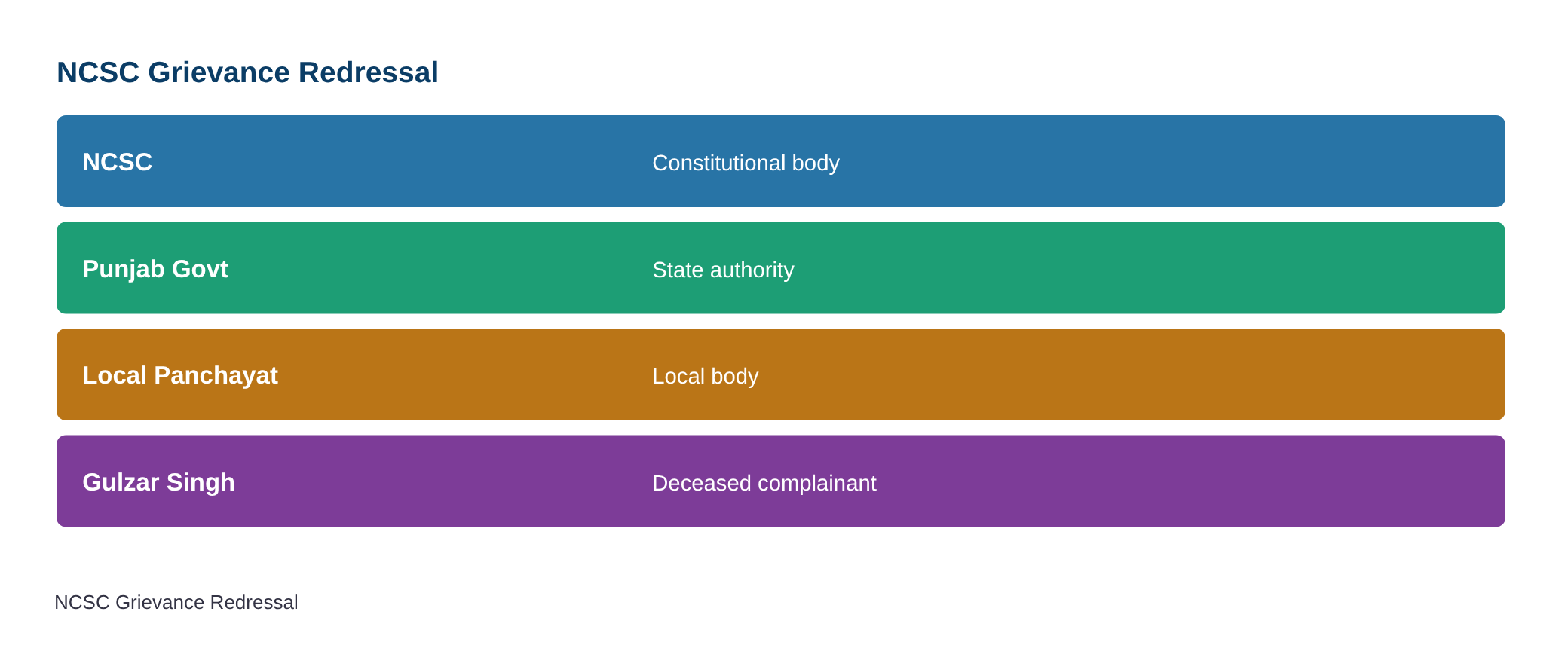
The National Commission for Scheduled Castes (NCSC) has issued a notice to the Punjab Government in the case of the death of Gulzar Singh from Sangrur district, following allegations of coercion, substance abuse issues, and serious accusations against a Minister and local Panchayat members. The incident underscores the constitutional mandate of the NCSC to investigate complaints of atrocities or discrimination against Scheduled Castes, ensuring justice and safeguarding constitutional rights. The issuance of the notice and the subsequent visit by the NCSC Chairperson highlight the institutional mechanism for addressing grievances and upholding the rights of marginalised communities.
Background
- The National Commission for Scheduled Castes (NCSC) was established under Article 338 of the Constitution to investigate and monitor matters relating to the constitutional safeguards for Scheduled Castes and to evaluate the working of such safeguards.
- Article 338 empowers the NCSC to investigate complaints of atrocities, discrimination, or denial of rights to Scheduled Castes, and to recommend measures for their welfare.
- The Scheduled Castes and Scheduled Tribes (Prevention of Atrocities) Act, 1989, provides legal protection against social, economic, and political exploitation of Scheduled Castes, with stringent provisions for offences committed against them.
- Punjab, like other states, is required to submit periodic reports to the NCSC on the implementation of constitutional safeguards and the status of Scheduled Caste welfare.
- The death of Gulzar Singh, allegedly due to coercion and substance abuse, raises questions about the implementation of these safeguards and the accountability of public representatives and local institutions.
- The NCSC’s intervention follows a complaint filed by a former legislator and state president of the BJP Scheduled Castes Morcha, indicating the involvement of political and social dynamics in the case.
National Commission for Scheduled Castes (NCSC)
- The NCSC is a statutory body constituted under Article 338 of the Constitution to protect the rights of Scheduled Castes and to investigate complaints of atrocities or discrimination against them.
- The Commission consists of a Chairperson, Vice-Chairperson, and three other members, all appointed by the President of India for a term of three years.
- The primary functions of the NCSC include investigating and monitoring matters relating to the constitutional safeguards for Scheduled Castes, evaluating the working of such safeguards, and making recommendations for their effective implementation.
- The NCSC has the power to summon witnesses, examine documents, and conduct on-the-spot inquiries into complaints of atrocities or discrimination against Scheduled Castes.
- The Commission submits annual reports to the President of India, which are laid before Parliament, and may also submit reports on specific issues to the Central or State Governments.
- The NCSC plays a crucial role in addressing grievances of Scheduled Castes, ensuring justice, and recommending measures for their socio-economic empowerment.
- The Commission also monitors the implementation of various welfare schemes and programmes for Scheduled Castes, such as the Pradhan Mantri Adarsh Gram Yojana and the Scheduled Castes Sub-Plan.
- The NCSC’s interventions are guided by the principles of equity, justice, and non-discrimination, as enshrined in the Constitution.
Key Features
| Feature | Significance |
|---|---|
| Constitutional Authority of NCSC | The National Commission for Scheduled Castes (NCSC) derives its investigative powers from Article 338 of the Constitution, enabling it to issue notices to state governments for alleged violations of rights of Scheduled Caste (SC) members. |
| Procedural Safeguards | NCSC’s directive to the Punjab government to submit a detailed report within five days underscores the urgency and procedural rigor in addressing complaints of caste-based discrimination or threats. |
| On-Site Investigation | The announcement of an on-site visit by the NCSC Chairperson to Sangrur on 10 September 2026 reflects the Commission’s commitment to first-hand verification of allegations and evidence. |
| Social Media as Evidence | The viral video recording of the deceased’s allegations highlights the role of digital platforms in documenting caste-related grievances and potential threats, necessitating their inclusion in formal investigations. |
| Intersection of Governance and Social Justice | The case exemplifies the overlap between public administration (e.g., drug policy, local governance) and the constitutional mandate to protect SC rights, requiring a multi-institutional response. |
Why it Matters
Constitutional and Legal
- The incident triggers the constitutional machinery under Article 338, which empowers NCSC to monitor the implementation of constitutional safeguards for SCs and investigate complaints of atrocities or discrimination.
- The case tests the efficacy of institutional mechanisms such as the NCSC in addressing allegations against public officials and local bodies, ensuring accountability within the framework of the Constitution.
- The invocation of Article 338 underscores the principle that the state must ensure the protection of marginalised communities from threats, coercion, or intimidation, irrespective of the source.
Administrative and Governance
- The Punjab government’s response to the NCSC notice will demonstrate the operationalisation of inter-departmental coordination between the police, civil administration, and elected representatives in addressing caste-related grievances.
- The case highlights the need for proactive governance in addressing systemic issues such as drug abuse and local governance deficits, which may exacerbate social tensions and marginalisation.
- The incident serves as a reminder of the importance of grievance redressal mechanisms at the grassroots level, including gram panchayats, to prevent escalation of disputes.
Social and Institutional
- The allegations, if substantiated, point to the vulnerability of SC members to threats and coercion, necessitating institutional safeguards to prevent intimidation and ensure free expression of grievances.
- The case underscores the role of social media as both a tool for empowerment and a medium for documenting threats, requiring legal and institutional frameworks to address digital evidence.
- The incident reflects broader societal challenges in ensuring the safety and dignity of SC communities, particularly in rural and semi-urban areas where local power structures may influence governance.
Challenges
1. Threats to Marginalised Communities
- The alleged coercion and intimidation faced by the deceased highlight the persistent risk of violence or threats against SC members when raising grievances against powerful local actors.
- The case illustrates the challenge of ensuring the safety of complainants in caste-sensitive environments, where local power dynamics may deter reporting or investigation.
- The need for witness protection and secure grievance mechanisms remains critical to prevent retaliation and ensure justice.
UPSC Link: GS-II: Vulnerable Sections
2. Institutional Accountability and Delayed Justice
- The NCSC’s intervention underscores the systemic delays in addressing caste-based grievances, often due to lack of timely responses from state authorities or procedural bottlenecks.
- The case highlights the challenge of ensuring that constitutional bodies like the NCSC have the capacity and authority to conduct swift and impartial investigations.
- The need for time-bound reporting and on-site verification by constitutional bodies is critical to prevent erosion of public trust in institutional mechanisms.
UPSC Link: GS-II: Constitutional Bodies
3. Convergence of Governance and Social Justice
- The intersection of drug policy, local governance, and caste-based discrimination requires a multi-dimensional approach to governance, which often lacks coordination in practice.
- The case exemplifies the challenge of integrating social justice concerns into routine administrative functions, such as law enforcement, public health, and local governance.
- Ensuring that public officials and local bodies are held accountable for actions or inactions that perpetuate marginalisation is a persistent governance challenge.
UPSC Link: GS-II: Governance
4. Digital Evidence and Legal Frameworks
- The viral video recording raises questions about the admissibility, authenticity, and ethical handling of digital evidence in caste-related cases, requiring clear legal and procedural guidelines.
- The case highlights the need for digital literacy and awareness among marginalised communities to utilise social media as a tool for empowerment and justice.
- Institutional mechanisms must adapt to the evolving nature of evidence, including digital content, to ensure fair and comprehensive investigations.
UPSC Link: GS-II: Cyber Governance
5. Local Governance and Power Dynamics
- The allegations against gram panchayat members underscore the challenge of ensuring accountability in local governance structures, which often wield significant influence over marginalised communities.
- The case reflects the need for capacity-building and empowerment of local bodies to address caste-based discrimination and threats effectively.
- Ensuring that local governance institutions are inclusive and representative of all communities remains a critical challenge in rural India.
UPSC Link: GS-II: Panchayati Raj
Challenges — UPSC Perspective
| Issue | Concern |
|---|---|
| Safety of Complainants | Marginalised individuals face risks of coercion or violence when raising grievances against powerful local actors, deterring justice. |
| Institutional Delays | Constitutional bodies like NCSC often face procedural bottlenecks, leading to delayed investigations and eroded public trust. |
| Digital Evidence Handling | The admissibility and authenticity of digital content, such as viral videos, pose challenges in legal and investigative processes. |
| Local Power Structures | Gram panchayats and local officials may wield undue influence, complicating accountability and grievance redressal. |
| Inter-Departmental Coordination | Addressing caste-based grievances requires seamless coordination between police, civil administration, and elected representatives, which is often lacking. |
Way Forward
- The Punjab government must submit a detailed report to the NCSC within five days, outlining actions taken on the allegations and the status of the investigation.
- The NCSC should conduct an impartial, high-level inquiry during its on-site visit to Sangrur on 10 September 2026, including interviews with witnesses and examination of digital evidence.
- State authorities must ensure the safety of the deceased’s family and witnesses, providing protection against intimidation or retaliation.
- The police should expedite forensic and digital evidence analysis, including the viral video, to ascertain the circumstances of the death and the veracity of the allegations.
- Grassroots institutions, such as gram panchayats, should undergo capacity-building to address caste-based discrimination and threats, with a focus on inclusivity and accountability.
- The NCSC should recommend systemic reforms to strengthen grievance redressal mechanisms for marginalised communities, including digital literacy and witness protection programs.
- Civil society organisations and local leaders should collaborate with authorities to monitor the investigation and ensure transparency in the process.
UPSC Value Addition
Keywords for Mains Answer-Writing
Constitutional bodies · National Commission for Scheduled Castes (NCSC) · Article 338 of the Constitution · Scheduled Castes and Scheduled Tribes (Prevention of Atrocities) Act, 1989 · Social justice governance · Protection of SC rights · Gram Panchayat functioning · Subordinate legislation and executive accountability · Judicial review of administrative actions · Constitutional morality · Procedural justice · Rule of law in governance · Protection of civil rights
Constitutional & Policy Linkages
- {‘article’: ‘Article 338’, ‘note’: ‘Constitutional mandate of NCSC to investigate SC grievances’}
- {‘article’: ‘Article 17’, ‘note’: ‘Abolition of untouchability and protection of SC rights’}
- {‘article’: ‘Article 46’, ‘note’: ‘Duty of state to promote educational and economic interests of SCs’}
Concept Flow
Alleged coercion/threats against SC member (Gulzar Singh) → Viral video documenting claims → NCSC receives complaint under Article 338 → NCSC issues notice to Punjab government for report within 5 days → NCSC Chairperson announces on-site visit to Sangrur on 10 September 2026 for first-hand verification → Punjab government submits report to NCSC → NCSC conducts impartial inquiry, examines digital evidence, and interviews witnesses → Findings submitted to central government and state authorities → State authorities initiate legal proceedings or administrative action based on NCSC’s recommendations → Ensuring justice for the deceased’s family and protection of SC rights → Systemic reforms recommended to strengthen grievance redressal mechanisms and prevent recurrence of such incidents
Prelims Practice Questions
Q1. Consider the following statements regarding the National Commission for Scheduled Castes (NCSC):
1. The NCSC is a constitutional body established under Article 338 of the Constitution of India.
2. The NCSC has the power to investigate and monitor matters relating to the constitutional and other legal safeguards for the Scheduled Castes.
3. The NCSC can only advise the Central Government and has no power to issue binding directives to State Governments.
4. The Chairperson of the NCSC is appointed by the President of India on the recommendation of the Prime Minister.
How many of the above statements are correct?
- Only one
- Only two
- Only three
- All four
Answer: Only three — Statements 1 and 2 are correct as the NCSC is indeed a constitutional body under Article 338 with powers to investigate and monitor safeguards for Scheduled Castes. Statement 3 is incorrect because the NCSC can issue binding directives to State Governments, as seen in the issuance of a notice to the Punjab Government in the given case. Statement 4 is incorrect as the Chairperson is appointed by the President on the recommendation of the Ministry of Social Justice and Empowerment, not the Prime Minister.
Q2. Assertion (A): The National Commission for Scheduled Castes (NCSC) can suo motu take cognizance of matters related to the rights of Scheduled Castes.
Reason (R): The NCSC derives its powers from Article 338 of the Constitution, which empowers it to investigate and monitor matters relating to the constitutional safeguards for Scheduled Castes.
In the context of the above two statements, which one of the following is correct?
- Both A and R are true and R is the correct explanation of A
- Both A and R are true but R is NOT the correct explanation of A
- A is true but R is false
- A is false but R is true
Answer: Both A and R are true and R is the correct explanation of A — Both the Assertion (A) and Reason (R) are correct. The NCSC, under Article 338, has the power to suo motu take cognizance of matters related to the rights of Scheduled Castes, and the Reason (R) correctly explains the constitutional basis for this power.
Mains Practice Question
✍ The National Commission for Scheduled Castes (NCSC) has issued a notice to the Punjab Government in a case involving the death of a Scheduled Caste individual, highlighting systemic failures in the protection of constitutional rights. Critically examine the role and powers of the NCSC in safeguarding the rights of Scheduled Castes in India. Also, analyse the challenges faced by such constitutional bodies in ensuring effective implementation of protective legislations. (15 Marks)
Approach: MODEL-ANSWER SKELETON:
1. **Constitutional Basis and Composition of NCSC** (2 marks)
– Article 338 of the Constitution: Establishment of the NCSC as a statutory body.
– Composition: Chairperson, Vice-Chairperson, and other members appointed by the President on the recommendation of the Ministry of Social Justice and Empowerment.
– Term and conditions of service.
2. **Powers and Functions of NCSC** (4 marks)
– Investigative powers: Inquire into specific complaints and suo motu take cognizance (as in the given case).
– Monitoring powers: Review the implementation of constitutional and legal safeguards for Scheduled Castes.
– Advisory powers: Advise the Central and State Governments on measures to improve the welfare of Scheduled Castes.
– Binding directives: Power to issue binding directives to State Governments (e.g., notices, reports, and recommendations).
– Reporting: Annual and special reports submitted to the President and Parliament.
3. **Role in Safeguarding Rights** (4 marks)
– Protection against atrocities: Monitoring the implementation of the Scheduled Castes and Scheduled Tribes (Prevention of Atrocities) Act, 1989.
– Social justice: Addressing issues of discrimination, exclusion, and denial of rights in governance (e.g., Gram Panchayats, police, and administrative bodies).
– Access to justice: Ensuring that complaints of atrocities are investigated promptly and fairly.
– Constitutional morality: Upholding the principles of equality, liberty, and fraternity enshrined in the Preamble and Fundamental Rights.
4. **Challenges Faced by NCSC** (3 marks)
– Limited autonomy: Dependence on the Central Government for resources and appointments.
– State resistance: Reluctance of State Governments to comply with directives, as seen in delays or non-submission of reports.
– Lack of enforcement powers: While the NCSC can issue directives, it lacks the power to enforce them directly.
– Overlapping jurisdictions: Coordination issues with other bodies like the National Human Rights Commission (NHRC) and State Commissions for Scheduled Castes.
– Political interference: Potential influence in the appointment of members or the prioritization of cases.
5. **Way Forward** (2 marks)
– Strengthening autonomy: Independent funding and appointment processes to reduce executive influence.
– Enhanced enforcement: Empowering the NCSC to impose penalties or refer cases to higher authorities for non-compliance.
– Capacity building: Training for members and staff to handle complex cases of atrocities and discrimination.
– Public awareness: Educating Scheduled Caste communities about their rights and the role of the NCSC.
– Inter-institutional coordination: Collaborating with State Commissions, judiciary, and civil society for holistic redressal.
Source: PIB (Press Information Bureau)
Punjab PCS (PPSC) — State PCS Practice
Prelims: Which constitutional body issued a notice to the Punjab Government regarding the death of Gulzar Singh from Sangrur?
- A. National Commission for Scheduled Castes (NCSC)
- B. National Human Rights Commission (NHRC)
- C. National Commission for Women (NCW)
- D. National Commission for Minorities (NCM)
Answer: A. National Commission for Scheduled Castes (NCSC) — The National Commission for Scheduled Castes (NCSC) issued the notice to the Punjab Government over the death of Gulzar Singh from Sangrur.
Mains: Discuss the constitutional provisions and role of the National Commission for Scheduled Castes (NCSC) in addressing atrocities against marginalized communities in Punjab. Also, analyze the significance of such notices in ensuring accountability of state governments.
Generated by AanyaAi for educational purpose.
Related guides on our sites
- Current affairs for upsc 2026
- How to prepare for GS paper 1 for UPSC CSE mains exam
- Best UPSC coaching for IFOS exam
- Best mentorship programme for upsc

- Madras HC Rules: Life Convicts Can Avail 40 Days Leave in Two Instalments - October 25, 2026
- तेलंगाना का नया एयरोस्पेस और रक्षा नीति 2.0: UPSC के लिए महत्वपूर्ण जानकारी - October 24, 2026
- Agricultural Biological Resources ABS Benefits ₹1.04 Crore for Biodiversity - October 24, 2026

No Comments