


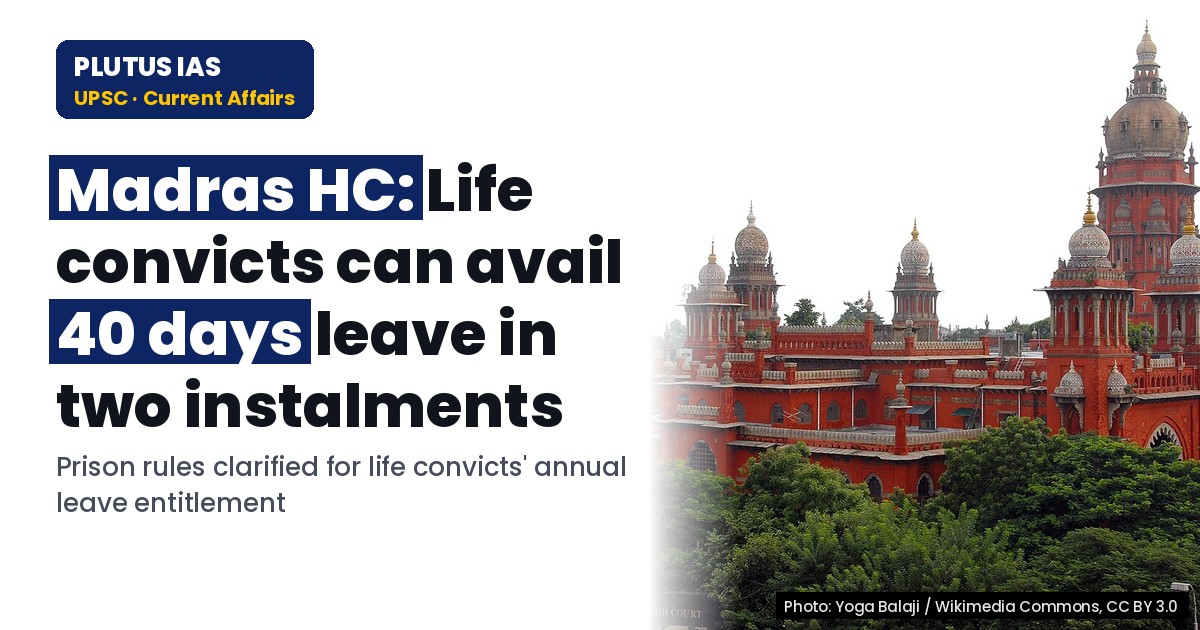
25 Oct Madras HC Rules: Life Convicts Can Avail 40 Days Leave in Two Instalments
✎ Life convicts in Tamil Nadu can avail 40 days of annual ordinary leave in two instalments within a year, as clarified by the Madras High Court in its interpretation of Rule 22(2)(c) and Rule 22(3) of the Tamil Nadu Suspension of…
Subject Relevance — Where This Topic Fits
- GS Paper II — Fundamental Rights and DPSP (Prisoners’ Rights) | GS Paper III — Role of Judiciary in Governance and Reformative Justice
- Prelims: Prisoners’ rights under Articles 14, 19, and 21, Tamil Nadu Suspension of Sentence Rules, 1982, Judicial review of administrative rules, Life imprisonment and parole, Prison reforms in India
- Essay: Reformative justice: Balancing prisoners’ rights and societal security, Judicial activism in protecting constitutional rights of marginalised groups
Quick Revision: Life convicts in Tamil Nadu can avail 40 days of annual ordinary leave in two instalments within a year, as clarified by the Madras High Court in its interpretation of Rule 22(2)(c) and Rule 22(3) of the Tamil Nadu Suspension of Sentence Rules, 1982.
Why is this in the news?
The Madras High Court, in a landmark judgment, clarified the interpretation of Rule 22(2)(c) and Rule 22(3) of the Tamil Nadu Suspension of Sentence Rules, 1982, enabling life convicts to avail 40 days of annual ordinary leave in two instalments rather than a single spell. This ruling resolves a long-standing ambiguity in prison administration, ensuring that the reformative intent of the law is upheld while maintaining the procedural integrity of prison governance. The decision underscores the judiciary’s role in interpreting administrative rules to align with constitutional principles of justice and fairness.
Background
- The Tamil Nadu Suspension of Sentence Rules, 1982, govern the grant of ordinary leave to prisoners, including life convicts, as part of their reformative rehabilitation.
- Rule 22(2)(c) permits life convicts to avail up to 40 days of ordinary leave annually, either in one spell or in two spells of any duration.
- Rule 22(3) stipulates that subsequent spells of leave must be granted only after a one-year gap from the last leave availed.
- Prison authorities had interpreted the term ‘spell’ in Rule 22(2)(c) as requiring the entire 40-day leave to be availed in a single instalment, thereby denying convicts the flexibility intended by the rule.
- The ambiguity arose from the identical use of the term ‘spell’ in both Rule 22(2)(c) and Rule 22(3), leading to conflicting interpretations by prison officials.
- The ruling responds to a writ petition filed by a life convict denied leave on the ground that he had already availed 26 days in April 2026, thereby being barred from further leave until April 2027.
What are the Tamil Nadu Suspension of Sentence Rules, 1982, and their significance in prison governance?
- The Tamil Nadu Suspension of Sentence Rules, 1982, are a set of administrative regulations framed under the Prison Act, 1894, and the Code of Criminal Procedure, 1973, to govern the suspension of sentences for prisoners, including life convicts.
- These rules provide a framework for the grant of ordinary leave, parole, and furlough to prisoners as part of their reformative rehabilitation, aiming to reintegrate them into society gradually.
- Rule 22 specifically addresses the grant of ordinary leave to prisoners, including the quantum of leave (40 days annually for life convicts) and the conditions for availing it.
- The rules reflect the state’s obligation under Article 21 of the Constitution to ensure humane conditions of incarceration and the right to dignity for prisoners, as recognised in landmark judgments such as *Sunil Batra v. Delhi Administration* (1978).
- The rules also balance the need for reformative justice with the security concerns of prison administration, ensuring that leave is granted only to those who demonstrate good conduct and low risk of absconding.
- The Madras High Court’s ruling clarifies the interpretation of Rule 22(2)(c) and Rule 22(3), ensuring that the reformative intent of the rules is not subverted by administrative rigidity.
- The rules are periodically reviewed to align with evolving judicial precedents and international standards on prisoners’ rights, such as the United Nations Standard Minimum Rules for the Treatment of Prisoners (the Nelson Mandela Rules).
Key Features
| Feature | Significance |
|---|---|
| Annual leave entitlement for life convicts | Provides structured respite from incarceration under Rule 22(2)(c) of the Tamil Nadu Suspension of Sentence Rules, 1982, ensuring humane treatment within legal frameworks. |
| Two-instalment provision | Allows flexibility in availing leave, addressing logistical and psychological needs of prisoners while maintaining prison discipline. |
| Judicial interpretation of ‘spell’ vs ‘instalment’ | Resolves ambiguity in statutory language, reinforcing the principle that legal provisions must be read in consonance with their intended humanitarian purpose. |
| Eligibility criterion (14 years of incarceration) | Balances the need for rehabilitation with state interest in deterrence, reflecting progressive penal philosophy. |
| Annual reset of leave entitlement | Ensures periodic review of prisoner conduct and reintegration potential, aligning with correctional objectives. |
Why it Matters
Penological and Correctional
- Reinforces the rehabilitative aspect of imprisonment, as envisaged in the Model Prison Manual for the Superintendence and Management of Prisons in India (2016).
- Demonstrates judicial activism in interpreting prison rules to align with constitutional principles of dignity and reform under Article 21.
- Highlights the role of the judiciary in ensuring that administrative rules do not dilute statutory entitlements granted to prisoners.
Legal and Administrative
- Clarifies the ambiguity in Rule 22(2)(c) and Rule 22(3) of the Tamil Nadu Suspension of Sentence Rules, 1982, by judicial interpretation.
- Sets a precedent for harmonious reading of statutory provisions to avoid absurdities in their application.
- Emphasizes the need for prison authorities to adhere strictly to the letter and spirit of correctional laws.
Human Rights Perspective
- Affirms the right of prisoners to periodic respite, in line with international standards such as the United Nations Standard Minimum Rules for the Treatment of Prisoners (Mandela Rules).
- Underscores the state’s obligation to balance security concerns with the fundamental rights of incarcerated individuals.
- Contributes to the discourse on prisoner welfare and the ethical dimensions of incarceration.
Challenges
1. Ambiguity in Statutory Language
- The use of the term ‘spell’ in both Rule 22(2)(c) and Rule 22(3) led to conflicting interpretations by prison authorities.
- Such ambiguities can result in denial of statutory entitlements, undermining the rule of law.
- Requires systematic review of prison rules to eliminate redundant or contradictory terminology.
UPSC Link: GS-II: Judiciary – Judicial Activism and Interpretation
2. Implementation Gaps in Prison Administration
- Prison authorities may resist changes that increase prisoner privileges, citing security concerns.
- Inadequate training of prison staff on legal entitlements and judicial precedents can lead to non-compliance.
- Need for robust grievance redressal mechanisms within prisons to address disputes over entitlements.
UPSC Link: GS-II: Governance – Prison Reforms
3. Balancing Security and Rehabilitation
- Granting leave to life convicts poses risks of absconding or reoffending, necessitating stringent eligibility and monitoring mechanisms.
- Overemphasis on security can undermine the rehabilitative goals of the penal system.
- Requires a nuanced approach that prioritizes both public safety and prisoner welfare.
UPSC Link: GS-II: Internal Security – Prison Management
Challenges — UPSC Perspective
| Issue | Concern |
|---|---|
| Ambiguity in Rule 22(2)(c) and Rule 22(3) | Led to conflicting interpretations by prison authorities, denying prisoners their statutory entitlements. |
| Resistance to change in prison administration | May result in non-compliance with judicial directives, undermining reformative justice. |
| Risk of absconding during leave periods | Poses challenges to public safety and necessitates robust monitoring mechanisms. |
| Inadequate training of prison staff | Can lead to misinterpretation of legal provisions and denial of prisoner rights. |
| Overlapping eligibility criteria | May create confusion in determining which prisoners qualify for leave entitlements. |
Way Forward
- Prison authorities must conduct mandatory training programs for staff on the interpretation of prison rules and judicial precedents.
- State governments should review and harmonize prison rules to eliminate ambiguities and redundancies in statutory language.
- Establish an independent grievance redressal mechanism within prisons to address disputes over prisoner entitlements.
- Strengthen monitoring mechanisms during leave periods to mitigate risks of absconding or reoffending.
- Promote periodic review of correctional policies to align with evolving judicial interpretations and international standards.
- Encourage research on the impact of leave entitlements on prisoner rehabilitation and recidivism rates.
- Facilitate collaboration between judiciary, prison administration, and civil society to enhance prisoner welfare programs.
UPSC Value Addition
Keywords for Mains Answer-Writing
Prisoners’ rights · Judicial review of prison rules · Tamil Nadu Suspension of Sentence Rules, 1982 · Life imprisonment and parole · Judicial interpretation of statutory provisions · Judicial activism in prison reforms · Constitutional rights of prisoners · Judicial separation of powers · Rule of law in prison administration · Judicial clarification of ambiguous legal terms
Constitutional & Policy Linkages
- [‘Article 21: Right to Life and Personal Liberty (Prisoner Dignity)’, ‘Ensures humane treatment and rehabilitation of prisoners.’]
- [‘Article 14: Equality Before Law’, ‘Mandates non-discriminatory application of prison rules.’]
- [‘Article 39A: Equal Justice and Free Legal Aid’, ‘Supports access to justice for prisoners in disputes over entitlements.’]
Concept Flow
Statutory Entitlement → Tamil Nadu Suspension of Sentence Rules, 1982 (Rule 22(2)(c)) grants 40 days annual leave to life convicts. → Ambiguity in Language → Use of ‘spell’ in Rule 22(2)(c) and Rule 22(3) leads to conflicting interpretations by prison authorities. → Judicial Interpretation → Madras High Court clarifies ‘spell’ in Rule 22(2)(c) as ‘instalment’ to resolve ambiguity. → Implementation → Prison authorities denied leave in instalments, prompting a writ petition by a life convict. → Judicial Verdict → Court rules in favour of prisoners, allowing leave in two instalments annually. → Correctional Objective → Judgment reinforces rehabilitative aspect of imprisonment under Article 21. → Administrative Reform → Verdict underscores the need for systematic review of prison rules and staff training.
Prelims Practice Questions
Q1. Consider the following statements regarding the Tamil Nadu Suspension of Sentence Rules, 1982:
1. Life convicts are entitled to 40 days of ordinary leave annually.
2. The leave can be availed in two instalments under Rule 22(2)(c).
3. The second instalment of leave can be granted immediately after the first instalment without any waiting period.
4. The term ‘spell’ in Rule 22(3) refers to the period of incarceration, not the leave period.
How many of the above statements are correct?
- Only one
- Only two
- Only three
- All four
Answer: Only three — Statements 1 and 2 are correct as per the Rules and the Madras High Court’s interpretation. Statement 3 is incorrect because Rule 22(3) mandates a one-year waiting period between instalments. Statement 4 is incorrect as the term ‘spell’ in Rule 22(3) refers to the leave period, not incarceration.
Q2. Assertion (A): The Madras High Court ruled that life convicts can avail 40 days of ordinary leave in two instalments annually.
Reason (R): The Court interpreted Rule 22(2)(c) to mean that the word ‘spell’ should be read as ‘instalment’ to distinguish it from Rule 22(3).
Options:
A. Both A and R are true, and R is the correct explanation of A.
B. Both A and R are true, but R is not the correct explanation of A.
C. A is true, but R is false.
D. A is false, but R is true.
Answer: ? — Both A and R are true. The Court’s ruling explicitly allowed life convicts to avail leave in two instalments, and the interpretation of ‘spell’ as ‘instalment’ was the basis for this decision.
Q3. Match the following provisions of the Tamil Nadu Suspension of Sentence Rules, 1982 with their correct descriptions:
Column I (Provision) | Column II (Description)
———————————————–|———————————————–
1. Rule 22(2)(c) | A. Mandates a one-year waiting period between leave instalments
2. Rule 22(3) | B. Allows life convicts to avail 40 days of leave in one or two instalments
3. Proviso to Rule 22(2)(c) | C. Clarifies that ‘spell’ in Rule 22(2)(c) means ‘instalment’
Options for matching:
1. 1-B, 2-A, 3-C
2. 1-A, 2-B, 3-C
3. 1-C, 2-A, 3-B
4. 1-B, 2-C, 3-A
- 1-B, 2-A, 3-C
- 1-A, 2-B, 3-C
- 1-C, 2-A, 3-B
- 1-B, 2-C, 3-A
Answer: 1-B, 2-A, 3-C — Rule 22(2)(c) allows life convicts to avail 40 days of leave in one or two instalments (B). Rule 22(3) mandates a one-year waiting period between leave instalments (A). The proviso to Rule 22(2)(c) clarifies the interpretation of ‘spell’ as ‘instalment’ (C).
Mains Practice Question
✍ The Madras High Court’s recent judgment in S. Babu v. State of Tamil Nadu (2026) clarifies the entitlement of life convicts to ordinary leave under the Tamil Nadu Suspension of Sentence Rules, 1982. Critically examine the judicial role in interpreting prison rules to balance prisoners’ rights with the objectives of incarceration. Also, discuss the constitutional and statutory framework governing prisoners’ rights in India. (15 Marks)
Approach: MODEL-ANSWER SKELETON:
1. **Judicial Role in Interpreting Prison Rules** (4 Marks)
– Judicial activism vs. judicial restraint: The Court’s proactive interpretation to remove ambiguity in Rule 22(2)(c) and Rule 22(3).
– Separation of powers: How the judiciary ensures that prison authorities do not exceed their statutory mandate.
– Precedent: Reference to landmark judgments like *Sunil Batra v. Delhi Administration* (1978) and *Hussainara Khatoon v. State of Bihar* (1979) on prisoners’ rights.
– Balancing act: The Court’s role in harmonising prisoners’ rights (e.g., Article 21) with the state’s duty to maintain prison discipline and security.
2. **Prisoners’ Rights Framework in India** (5 Marks)
– Constitutional basis: Article 21 (right to life and personal liberty) and its judicial expansion to include dignity, health, and humane treatment.
– Statutory framework: The Prison Act, 1894; Prisoners Act, 1900; and state-specific rules like the Tamil Nadu Suspension of Sentence Rules, 1982.
– International standards: Reference to the UN Standard Minimum Rules for the Treatment of Prisoners (Mandela Rules) and India’s obligations under international law.
– Judicial recognition: Cases like *Rajesh Kumar v. State of Rajasthan* (2020) on prisoners’ right to healthcare and *Shatrughan Chauhan v. Union of India* (2014) on the right to remission.
3. **Objectives of Incarceration and Rights** (4 Marks)
– Reformative vs. punitive justice: The Court’s emphasis on rehabilitation through leave provisions.
– Prison discipline: How the state justifies restrictions on prisoners’ rights (e.g., Articles 19 and 21 restrictions under *A.K. Gopalan v. State of Madras*).
– Public safety: The state’s argument for limiting leave to prevent recidivism and maintain order.
– Comparative perspective: Contrast with jurisdictions like the UK or US on parole and leave policies.
4. **Conclusion** (2 Marks)
– Synthesis: The judgment reinforces the judiciary’s role in safeguarding prisoners’ rights while ensuring that restrictions are reasonable and proportionate.
– Way forward: Suggestions for comprehensive prison reforms, including statutory clarity, independent oversight, and rehabilitation-focused policies.
Source: The Hindu
Generated by AanyaAi for educational purpose.
Related guides on our sites
- Anthropology VS PSIR
- Best PSIR optional coaching
- Best PSIR optional coaching online
- Best PSIR optional teacher

- Madras HC Rules: Life Convicts Can Avail 40 Days Leave in Two Instalments - October 25, 2026
- तेलंगाना का नया एयरोस्पेस और रक्षा नीति 2.0: UPSC के लिए महत्वपूर्ण जानकारी - October 24, 2026
- Agricultural Biological Resources ABS Benefits ₹1.04 Crore for Biodiversity - October 24, 2026

No Comments