


09 Sep UPSC Perspective: Journey of Calcutta HC Chief Justice from Bicycle to Bench
✎ The appointment of the Chief Justice of a High Court in India is governed by Article 217 of the Constitution, in consultation with the Chief Justice of India and the Governor of the State, and is facilitated through the Collegium…
Subject Relevance — Where This Topic Fits
- GS Paper II — Polity and Governance: Judiciary and Constitutional Framework | GS Paper IV — Ethics, Integrity and Aptitude: Ethical Governance and Public Service
- Prelims: Collegium System, Judicial Appointments Commission (JAC), High Court Chief Justice, Article 217 of the Constitution, Judicial Independence, First-Generation Lawyer, Calcutta High Court, Bombay High Court
- Essay: Judicial Independence and the Rule of Law: Safeguarding Democracy, Meritocracy and Social Mobility in Public Institutions
Quick Revision: The appointment of the Chief Justice of a High Court in India is governed by Article 217 of the Constitution, in consultation with the Chief Justice of India and the Governor of the State, and is facilitated through the Collegium System to ensure judicial independence.
Why is this in the news?
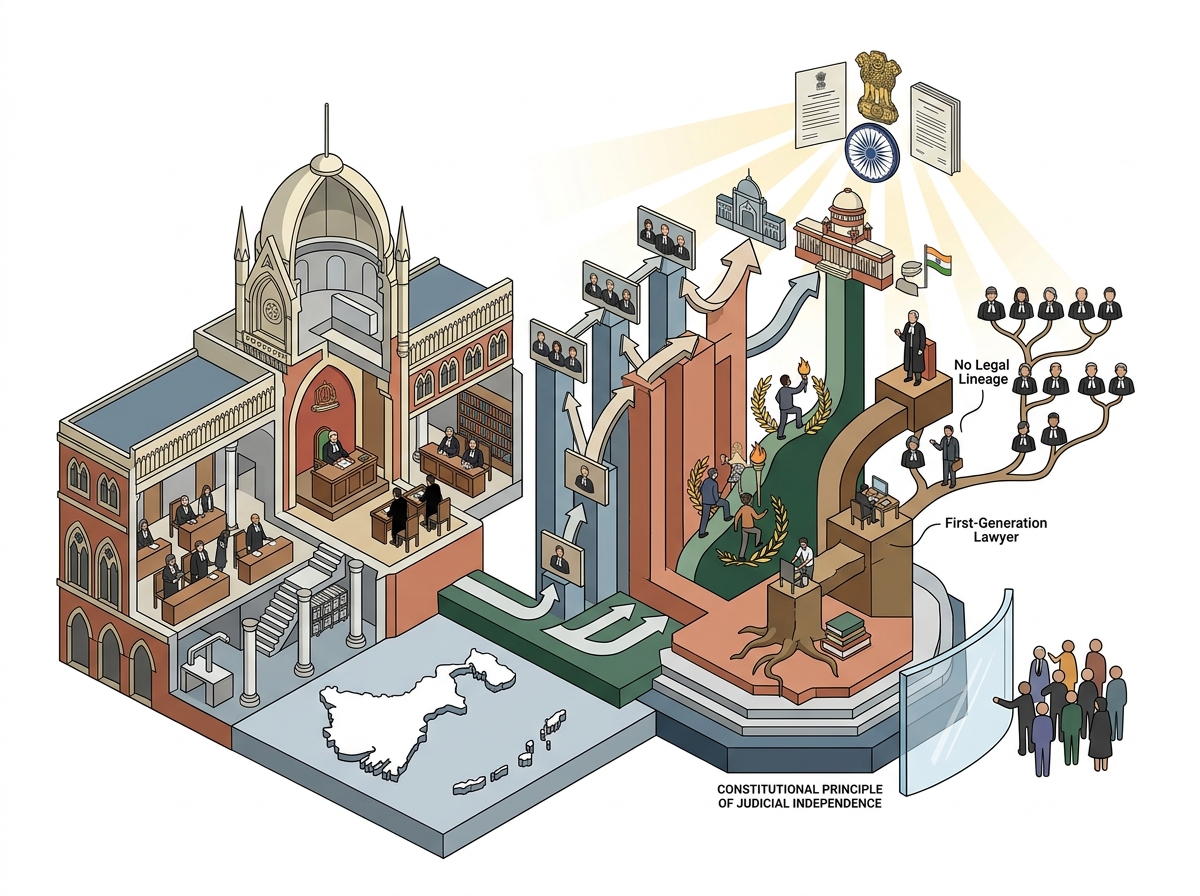
The appointment of Justice Ravindra V. Ghuge as the 45th Chief Justice of the Calcutta High Court has been widely noted for its emphasis on meritocracy, institutional continuity, and the constitutional principle of judicial independence. The event underscores the role of the judiciary in upholding constitutional values while reflecting on the professional journey of a first-generation lawyer, thereby highlighting the intersection of personal ethos and institutional responsibility within the Indian judicial system.
Background
- The Calcutta High Court, established in 1862 under the High Courts Act, 1861, is one of the oldest and most prestigious high courts in India, with jurisdiction over West Bengal and the Union Territory of Andaman and Nicobar Islands.
- The Collegium System, as evolved through judicial pronouncements such as the Second and Third Judges Cases (1993 and 1998), governs the appointment and transfer of judges to the higher judiciary in India, ensuring judicial independence from executive interference.
- The Bombay High Court, another premier judicial institution, has historically contributed significantly to the development of constitutional law and governance in India, particularly in matters related to public interest litigation and economic reforms.
- The appointment of a Chief Justice to a high court is a constitutional function under Article 217 of the Constitution of India, which mandates consultation with the Chief Justice of India and the Governor of the State.
- Judicial independence is a cornerstone of the Indian constitutional framework, as enshrined in Articles 50 and 124(2) of the Constitution, and is essential for the protection of fundamental rights and the rule of law.
- The elevation of Justice Ghuge, who served as Acting Chief Justice of the Bombay High Court, reflects the principle of institutional continuity and meritocracy in judicial appointments.
Appointment and Role of the Chief Justice of a High Court in India
- The Chief Justice of a High Court is the administrative and judicial head of the court, responsible for the allocation of cases, supervision of judicial work, and maintenance of judicial discipline.
- Appointment to the position of Chief Justice is governed by Article 217 of the Constitution, which stipulates that the Chief Justice of India and the Governor of the State must be consulted before the appointment is made.
- The Collegium System, as articulated in the Second and Third Judges Cases, ensures that judicial appointments are insulated from political interference, thereby safeguarding the independence of the judiciary.
- The Chief Justice plays a pivotal role in the administration of justice, ensuring that the court functions efficiently and that judicial proceedings are conducted in accordance with constitutional principles and legal precedents.
- The position of Chief Justice carries significant constitutional and ethical responsibilities, including the duty to uphold the rule of law, protect fundamental rights, and ensure the fair and impartial dispensation of justice.
- The appointment process underscores the principle of meritocracy, as candidates are evaluated based on their legal acumen, integrity, and contributions to the judiciary, rather than their social or familial background.
- The Chief Justice of a High Court also serves as a member of the State Judicial Academy, contributing to the training and capacity-building of judicial officers and legal professionals.
- The role of the Chief Justice is not merely administrative but also involves upholding the constitutional ethos of justice, equity, and fairness in the dispensation of judicial power.
Key Features
| Feature | Significance |
|---|---|
| Appointment of Chief Justice Ravindra V Ghuge | Demonstrates the constitutional principle of meritocracy and inclusivity in the higher judiciary, reinforcing the idea that the legal profession is accessible to all regardless of background. |
| First-generation lawyer trajectory | Highlights the institutional capacity of the Indian judiciary to absorb talent from non-elite backgrounds, contributing to judicial diversity and social representation. |
| Calcutta High Court’s historical legacy | Reinforces the court’s role as a bastion of constitutional governance, civil liberties, and intellectual rigour in India’s legal system. |
| Judicial independence and integrity | Emphasises the court’s tradition of rendering justice without fear or favour, a cornerstone of the rule of law in a democratic society. |
| Collegium System’s role in appointments | Illustrates the collegium’s discretion in recommending judges for higher positions, ensuring continuity and quality in judicial leadership. |
Why it Matters
Judicial Governance
- The appointment underscores the judiciary’s commitment to constitutional values, particularly the guarantee of equal opportunity in public office under Article 14.
- The Chief Justice’s reflection on humble origins aligns with the constitutional ideal of social justice, as envisaged in the Preamble and Directive Principles.
- The Calcutta High Court’s historical role in defending civil liberties and upholding the rule of law is reaffirmed, reinforcing its institutional prestige.
Legal Profession
- The trajectory of a first-generation lawyer to the highest judicial office in a High Court exemplifies the democratisation of the legal profession in India.
- The emphasis on perseverance and dedication highlights the ethical and professional standards expected of legal practitioners.
- The role of family support in overcoming professional challenges reflects the socio-economic realities faced by many young lawyers in India.
Constitutional Framework
- The appointment process, governed by the collegium system, demonstrates the judiciary’s self-regulation in matters of appointments and transfers, as per judicial precedents like the Third Judges Case.
- The oath of office administered under Article 219 of the Constitution reaffirms the Chief Justice’s commitment to upholding the Constitution and the laws of India.
Challenges
1. Judicial Appointment Bottlenecks
- The collegium system, while ensuring judicial independence, faces criticism for its opacity and potential delays in appointments, affecting judicial vacancies.
- Ensuring diversity in higher judiciary appointments remains a challenge, despite constitutional guarantees of equality and representation.
UPSC Link: Judicial Appointments (Collegium System) – Basic Structure Doctrine
2. Access to Legal Profession
- The legal profession’s elitism persists, with socio-economic barriers limiting entry for many talented individuals from non-privileged backgrounds.
- Geographical and financial constraints disproportionately affect young lawyers in rural and underprivileged areas, impacting their career trajectories.
UPSC Link: Legal Profession in India – Bar Council of India Regulations
3. Judicial Vacancies and Backlog
- High judicial vacancies, particularly in High Courts, impede the timely dispensation of justice, contributing to case backlog and delays.
- The administrative and logistical challenges in filling vacancies, including the need for transparent and efficient processes, remain unresolved.
UPSC Link: Judicial Vacancies and Pendency – Supreme Court Directives
4. Judicial Independence vs. Accountability
- Balancing judicial independence with mechanisms for accountability continues to be a contentious issue, particularly in the context of judicial appointments and transfers.
- The lack of a formal impeachment process for judges of the higher judiciary (beyond the constitutional provisions) raises questions about accountability.
UPSC Link: Judicial Accountability – Constitutional Provisions and Judicial Review
Challenges — UPSC Perspective
| Issue | Concern |
|---|---|
| Collegium System | Lack of transparency and potential delays in judicial appointments. |
| Judicial Vacancies | High number of pending cases due to unfilled judicial positions. |
| Socio-Economic Barriers | Limited access to the legal profession for individuals from non-privileged backgrounds. |
| Case Backlog | Delays in justice delivery due to systemic inefficiencies and resource constraints. |
| Judicial Accountability | Balancing independence with mechanisms for ensuring judicial accountability. |
Way Forward
- Strengthen the collegium system by introducing greater transparency in the appointment process, including public disclosure of criteria and consultations.
- Expand initiatives to mentor and support first-generation lawyers, particularly those from rural and underprivileged backgrounds, to enhance diversity in the legal profession.
- Address judicial vacancies through expedited appointments, leveraging technology to streamline the process and reduce delays.
- Enhance the capacity of the judiciary by improving infrastructure, digitalisation, and administrative efficiency to reduce case backlog.
- Promote judicial training programmes focused on constitutional values, ethical standards, and socio-economic realities to ensure judges are equipped to handle diverse challenges.
- Encourage state governments to fill judicial vacancies promptly, ensuring a balanced distribution of judges across regions.
- Foster collaboration between the Bar and Bench to address systemic issues, including mentorship programmes and career guidance for young lawyers.
UPSC Value Addition
Keywords for Mains Answer-Writing
Judicial Independence · First-Generation Lawyers · Judicial Appointments · Collegium System · Judicial Activism · Rule of Law · Judicial Ethics · Constitutional Morality · Judicial Accountability · Judicial Institutions in India
Constitutional & Policy Linkages
- Article 14 (Right to Equality)
- Article 219 (Oath of Office for Judges)
- Article 124 (Appointment of Supreme Court Judges)
- Article 217 (Appointment of High Court Judges)
- Preamble (Social Justice)
- Directive Principles of State Policy (Article 38, 39A)
Concept Flow
First-generation lawyer’s journey to judicial office → Demonstrates constitutional principle of meritocracy and inclusivity. → Appointment process governed by Collegium System → Highlights judicial self-regulation and independence. → Oath under Article 219 → Reaffirms commitment to upholding the Constitution. → Calcutta High Court’s historical legacy → Reinforces role as a bastion of constitutional governance. → Challenges in judicial appointments and vacancies → Underscores need for transparency and efficiency. → Socio-economic barriers in legal profession → Reflects on broader issues of access and representation. → Way forward: Strengthening systems → Ensures continued judicial independence and accountability.
Prelims Practice Questions
Q1. Consider the following statements regarding the Collegium System in India:
1. The Collegium System is a formal constitutional provision enshrined in Article 124(2) of the Constitution.
2. The Supreme Court Collegium is a five-member body comprising the Chief Justice of India and four senior-most judges.
3. The Collegium System was introduced by the 42nd Constitutional Amendment Act, 1976.
4. The Collegium System has been upheld by the Supreme Court in the Second and Third Judges Cases.
How many of the above statements are correct?
- Only one
- Only two
- Only three
- All
Answer: Only three — Statements 2 and 4 are correct. Statement 1 is incorrect as the Collegium System is not a constitutional provision but a judicial innovation. Statement 3 is incorrect as the Collegium System was not introduced by the 42nd Amendment but evolved through judicial pronouncements.
Q2. Assertion (A): The Chief Justice of India is the head of the Supreme Court and the highest judicial authority in India.
Reason (R): Article 124(1) of the Constitution vests the judicial power of the Union exclusively in the Supreme Court.
Options:
A. Both A and R are true, and R is the correct explanation of A.
B. Both A and R are true, but R is not the correct explanation of A.
C. A is true, but R is false.
D. A is false, but R is true.
Answer: ? — Assertion (A) is true as the Chief Justice of India is the head of the Supreme Court. Reason (R) is false because the judicial power of the Union is not exclusively vested in the Supreme Court; it is shared with other courts as per Article 124(1).
Q3. Match the following High Courts with their respective states/union territories:
Column I (High Court) | Column II (State/UT)
1. Calcutta High Court | A. Maharashtra
2. Bombay High Court | B. West Bengal
3. Madras High Court | C. Tamil Nadu
4. Delhi High Court | D. National Capital Territory of Delhi
Options:
A. 1-B, 2-A, 3-C, 4-D
B. 1-A, 2-B, 3-C, 4-D
C. 1-C, 2-A, 3-B, 4-D
D. 1-D, 2-A, 3-C, 4-B
Answer: ? — 1-B (Calcutta High Court is in West Bengal), 2-A (Bombay High Court is in Maharashtra), 3-C (Madras High Court is in Tamil Nadu), 4-D (Delhi High Court is in the National Capital Territory of Delhi).
Mains Practice Question
✍ The appointment of judges in India, particularly at the highest levels, is governed by the Collegium System. In this context, critically examine the significance of judicial independence in maintaining the integrity of the judiciary. Also, discuss the role of first-generation lawyers in enhancing the diversity and inclusivity of the Indian judiciary. (15 Marks)
Approach: MODEL-ANSWER SKELETON:
1. **Introduction (2 marks)**
– Define judicial independence: freedom from executive or legislative interference (Art. 50, Directive Principles of State Policy).
– Mention the Collegium System: its evolution through the Second and Third Judges Cases (1993, 1998), and its role in appointments and transfers.
2. **Significance of Judicial Independence (5 marks)**
– **Safeguarding Rule of Law**: Independence ensures that judges can adjudicate without fear or favour, upholding constitutional morality (e.g., ADM Jabalpur case, 1976; Keshavananda Bharati case, 1973).
– **Judicial Activism**: Independence enables the judiciary to intervene in matters of public interest (e.g., PILs, environmental cases like MC Mehta vs. Union of India).
– **Checks and Balances**: Acts as a counter-majoritarian institution, protecting minority rights (e.g., Naz Foundation case, 2009).
– **Global Benchmark**: India’s judiciary is often cited for its independence in comparative constitutional law (e.g., World Justice Project Rule of Law Index).
3. **Role of First-Generation Lawyers (5 marks)**
– **Diversity and Inclusivity**: First-generation lawyers from humble backgrounds (e.g., Justice Ravindra V Ghuge) bring diverse perspectives, reducing elitism in the judiciary.
– **Representation**: Enhances social legitimacy and trust in the judiciary, particularly among marginalised communities.
– **Challenges**: High costs of legal education, lack of mentorship, and systemic barriers often limit their representation.
– **Judicial Appointments**: Collegium System, while not explicitly inclusive, has shown a trend toward appointing judges from varied backgrounds (e.g., Justice DY Chandrachud, Justice UU Lalit).
4. **Critique and Way Forward (3 marks)**
– **Criticisms of Collegium System**: Lack of transparency, opacity in decision-making, and potential for nepotism.
– **Reforms**: Need for a National Judicial Appointments Commission (NJAC) with legislative and executive representation (struck down in 2015) or a balanced alternative.
– **Institutional Support**: Strengthening legal aid, scholarships, and mentorship programs to encourage first-generation lawyers.
**Balanced Conclusion**: Judicial independence is the bedrock of democracy, and diversity in the judiciary strengthens its legitimacy. While the Collegium System has ensured judicial independence, reforms are needed to enhance transparency and inclusivity.
Source: The Indian Express
Generated by AanyaAi for educational purpose.
Related guides on our sites
- Current affairs for upsc 2026
- Best PSIR optional coaching for upsc
- Best PSIR optional teacher for upsc
- Best teacher of PSIR optional for upsc

- यूएन महासभा में भारत के विदेश मंत्री जयशंकर के उच्चस्तरीय दौरे का महत्व - September 21, 2026
- मध्य प्रदेश: हाईकोर्ट ने बलात्कार मामले में आरोपी को डीएनए सबूत के आधार पर किया दोषमुक्त - September 21, 2026
- MP High Court Acquits Rape Convict Due to Negative DNA Evidence - September 21, 2026

No Comments