


09 Sep DRDO seizes 740 kg ganja in anti-drug ops; 13 arrested under NDPS Act
✎ The Narcotic Drugs and Psychotropic Substances (NDPS) Act, 1985, is the cornerstone of India’s legal framework against drug trafficking, mandating stringent penalties and empowering agencies like the DRI to conduct seizures and…
Subject Relevance — Where This Topic Fits
- GS Paper III — Security: Role of Intelligence and Enforcement Agencies | GS Paper III — Economy: Illicit Trade and its Economic Impact | GS Paper III — Environment: Drug Cultivation and Ecological Concerns
- Prelims: NDPS Act, 1985, Revenue Intelligence Directorate (DRI), Narcotics Control Bureau (NCB), Financial Action Task Force (FATF), Illicit drug trafficking, Drug trafficking routes, Prevention of Illicit Traffic in Narcotic Drugs and Psychotropic Substances Act, 1988
- Essay: The Nexus Between Illicit Trade and National Security, Balancing Law Enforcement and Public Health in Drug Policy
Quick Revision: The Narcotic Drugs and Psychotropic Substances (NDPS) Act, 1985, is the cornerstone of India’s legal framework against drug trafficking, mandating stringent penalties and empowering agencies like the DRI to conduct seizures and arrests without warrants in specified cases.
Why is this in the news?
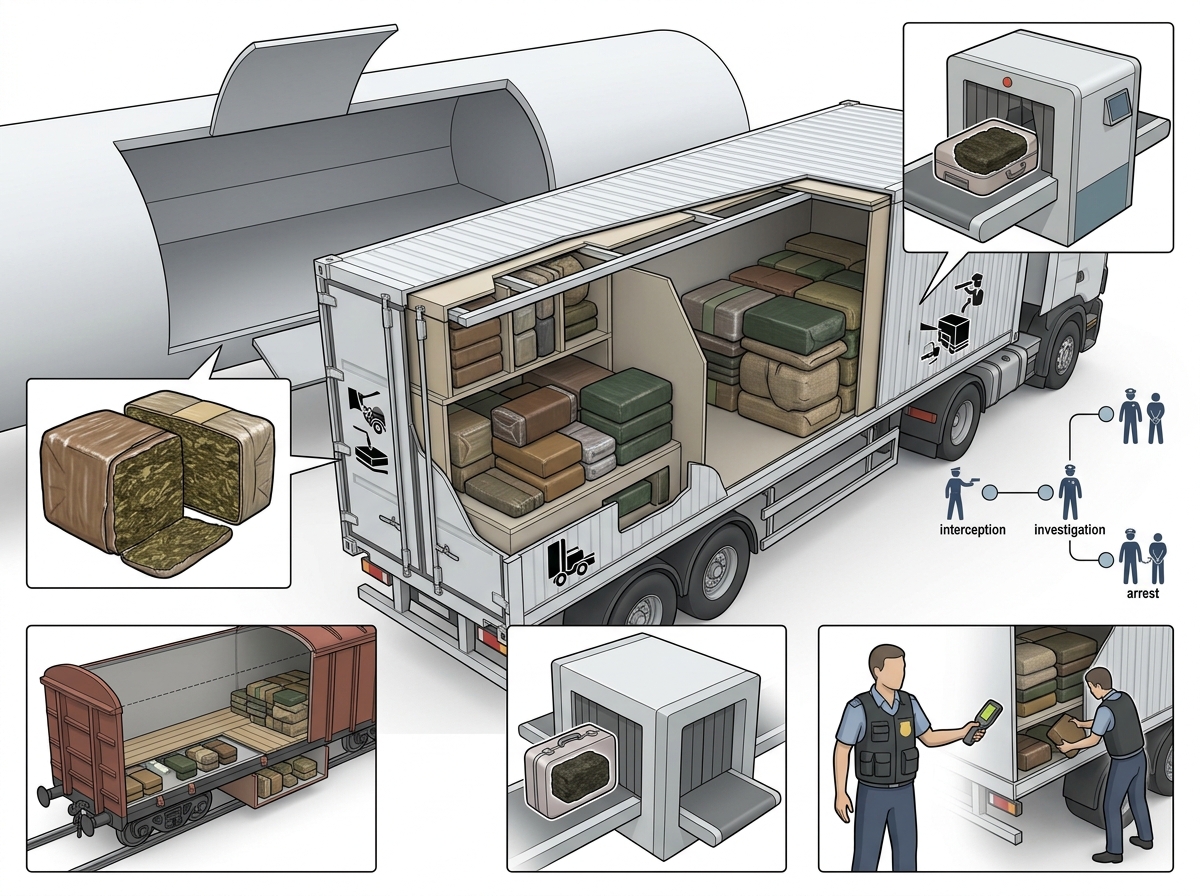
The Directorate of Revenue Intelligence (DRI) has intensified its crackdown on illicit cannabis trafficking across India, seizing approximately 740 kg of ganja and charas in coordinated operations over the past fortnight. This surge in enforcement action underscores the persistent challenge of drug trafficking through land, rail, and air routes, necessitating a multi-agency response under the Narcotic Drugs and Psychotropic Substances (NDPS) Act, 1985.
Background
- The NDPS Act, 1985, is the primary legal framework in India for regulating narcotic drugs and psychotropic substances, including cannabis, and prescribes stringent penalties for trafficking, cultivation, and possession.
- Cannabis (ganja and charas) remains one of the most widely trafficked illicit substances in India, with trafficking networks often exploiting porous borders, maritime routes, and commercial logistics to move consignments across states and international borders.
- The DRI, under the Central Board of Indirect Taxes and Customs (CBIC), functions as the apex intelligence and investigative agency for smuggling and narcotics interdiction, collaborating with state agencies, the Narcotics Control Bureau (NCB), and international counterparts.
- India’s geographical position, with extensive land borders and coastal access, makes it vulnerable to transnational drug trafficking, particularly from South-East Asia and Nepal, necessitating proactive interdiction measures.
- Illicit drug trafficking is a transnational organised crime with linkages to terrorism financing, money laundering, and corruption, posing significant threats to public health, governance, and national security.
- The NDPS Act empowers authorities to conduct searches, seizures, and arrests without warrants in specified cases, and to attach properties derived from drug trafficking under the Prevention of Money Laundering Act, 2002.
What is the Revenue Intelligence Directorate (DRI)?
- The DRI is India’s premier intelligence and investigative agency under the Ministry of Finance (Department of Revenue), tasked with countering smuggling, narcotics trafficking, and economic offences.
- It operates under the Central Board of Indirect Taxes and Customs (CBIC) and functions as the nodal agency for coordinating intelligence on cross-border and inter-state smuggling of contraband, including narcotics.
- The DRI’s mandate includes conducting clandestine operations, gathering actionable intelligence, executing raids, effecting seizures, and facilitating prosecutions under various laws, including the NDPS Act, 1985.
- It collaborates with domestic agencies such as the NCB, state police forces, and the Directorate General of GST Intelligence (DGGI), as well as international bodies like INTERPOL, ASEAN, and the FATF to combat transnational drug trafficking.
- The DRI employs advanced techniques such as undercover operations, electronic surveillance, and forensic analysis to dismantle smuggling syndicates and trace the financial trails of drug traffickers.
- Its operational focus spans multiple modes of transport—land, rail, air, and maritime—targeting concealed consignments in vehicles, cargo, luggage, and even human couriers.
- The agency also conducts capacity-building programs for customs and enforcement personnel and participates in regional initiatives like the Colombo Plan and the UNODC’s Global Synthetics Monitoring Programme.
- The DRI’s success hinges on real-time intelligence sharing, inter-agency coordination, and leveraging technological tools such as AI-driven data analytics and blockchain for tracking illicit financial flows.
Key Features
| Feature | Significance |
|---|---|
| Multi-modal interception (road, rail, air) | Demonstrates DRI’s integrated approach to disrupt drug trafficking across all major transport corridors, reducing the likelihood of successful smuggling. |
| Use of intelligence-led operations | Highlights the role of real-time intelligence in identifying and intercepting consignments, enhancing the efficacy of enforcement agencies. |
| Seizure of high-grade contraband | Includes 24.5 kg of hydroponic cannabis, indicating the sophistication of smuggling networks and the need for advanced detection methods. |
| Arrests under NDPS Act, 1985 | Ensures legal deterrence against offenders, with provisions for stringent penalties and asset forfeiture under the Act. |
| Cross-border linkages (e.g., Nepal) | Reveals transnational dimensions of drug trafficking, necessitating international cooperation and intelligence sharing. |
Why it Matters
Economic
- Prevents revenue loss to the exchequer by disrupting illegal trade in controlled substances, which often evades taxation and customs duties.
- Protects legitimate agricultural and industrial sectors from competition with illicit drug production, which undermines market integrity.
Social
- Mitigates public health risks by reducing the availability of harmful substances like cannabis and charas, particularly among vulnerable populations.
- Curbs the social costs associated with drug abuse, including addiction, crime, and family disintegration.
Legal-Administrative
- Strengthens enforcement of the Narcotic Drugs and Psychotropic Substances (NDPS) Act, 1985, through coordinated seizures and arrests.
- Demonstrates the operational effectiveness of the Directorate of Revenue Intelligence (DRI) in combating cross-border and domestic drug trafficking.
Strategic-Security
- Undermines the financial resources of organised crime syndicates, which often fund other illicit activities, including terrorism and arms smuggling.
- Highlights the need for inter-agency coordination (e.g., with state police, customs, and international agencies) to address transnational drug networks.
Challenges
1. Sophistication of Smuggling Networks
- Use of hidden compartments in vehicles, luggage, and even human body cavities to evade detection.
- Adoption of hydroponic cultivation techniques to produce high-potency cannabis, complicating interdiction efforts.
- Leveraging multiple transport modes (road, rail, air) to diversify smuggling routes and reduce interception risks.
UPSC Link: GS3: Internal Security – Challenges to Internal Security
2. Cross-Border Coordination Gaps
- Limited intelligence sharing and operational cooperation with neighbouring countries, particularly Nepal, a known source of charas.
- Differences in legal frameworks and enforcement priorities across jurisdictions hinder seamless action against transnational trafficking.
UPSC Link: GS2: International Relations – Cooperation in Combating Illicit Drug Trafficking
3. Resource Constraints in Enforcement
- Inadequate manpower, training, and technological capabilities to detect concealed contraband in real time.
- Delays in forensic analysis and legal proceedings reduce the deterrent effect of seizures and arrests.
UPSC Link: GS3: Security Forces – Challenges in Modernisation
4. Public Health and Awareness Deficits
- Low public awareness about the legal and health consequences of drug abuse, particularly among youth.
- Stigma associated with reporting drug-related activities limits community-based enforcement efforts.
UPSC Link: GS2: Health – Substance Abuse and Prevention
5. Legal and Procedural Bottlenecks
- Lengthy judicial processes for NDPS Act cases, leading to low conviction rates and prolonged legal battles.
- Challenges in proving intent and establishing chain of custody for seized substances in court.
UPSC Link: GS2: Judiciary – Challenges in Fast-Tracking Cases
Challenges — UPSC Perspective
| Issue | Concern |
|---|---|
| Hidden compartments in vehicles | Evasion of detection during routine checks, requiring advanced scanning technologies. |
| Transnational smuggling routes | Exploitation of porous borders and weak inter-agency coordination to move contraband. |
| High-potency drug variants | Increased potency of cannabis and charas complicates public health interventions. |
| Legal delays in NDPS cases | Prolonged trials reduce the deterrent effect of enforcement actions. |
| Limited forensic capacity | Delays in confirming drug identity and purity hinder timely prosecution. |
Way Forward
- Enhance inter-agency coordination between DRI, state police, customs, and international agencies (e.g., INTERPOL) to share real-time intelligence and conduct joint operations.
- Invest in advanced detection technologies, such as AI-driven scanning systems and sniffer dogs, to identify concealed contraband in vehicles, luggage, and cargo.
- Strengthen forensic infrastructure to expedite drug testing and analysis, reducing delays in legal proceedings.
- Launch targeted public awareness campaigns, particularly in border states and vulnerable communities, to educate youth about the legal and health risks of drug abuse.
- Simplify legal procedures under the NDPS Act to expedite trials, including the establishment of special courts for drug-related cases.
- Expand capacity-building programs for DRI personnel, focusing on modern investigative techniques, intelligence analysis, and cross-border cooperation.
- Strengthen border management through the deployment of advanced surveillance systems (e.g., drones, thermal imaging) and increased patrolling in high-risk zones.
- Promote international cooperation under frameworks like the UN Convention Against Illicit Traffic in Narcotic Drugs and Psychotropic Substances (1988) to combat transnational trafficking.
UPSC Value Addition
Keywords for Mains Answer-Writing
Narcotic Drugs and Psychotropic Substances Act, 1985 · Revenue Intelligence Directorate (DRI) · Illicit drug trafficking · NDPS Act provisions · Drug interdiction operations · Cross-border drug smuggling · NDPS Act penalties · Drug control mechanisms in India · Preventive detention under NDPS · International drug control conventions · Drug trafficking routes in India · Enforcement agencies and drug control
Constitutional & Policy Linkages
- Article 21: Right to Life and Personal Liberty – Implies the state’s duty to protect citizens from harm caused by drug abuse and trafficking.
Concept Flow
Illicit cultivation and production of cannabis/charas → Smuggling networks exploit porous borders and transport routes → DRI conducts intelligence-led interception operations → Seizure of contraband under NDPS Act, 1985 → Arrests and legal proceedings → Disruption of supply chains and deterrence of future trafficking.
Prelims Practice Questions
Q1. Consider the following statements regarding the Narcotic Drugs and Psychotropic Substances (NDPS) Act, 1985:
1. The Act empowers the Revenue Intelligence Directorate (DRI) to conduct searches, seizures, and arrests without a warrant under all circumstances.
2. The Act prescribes a minimum punishment of 10 years imprisonment for possession of commercial quantities of narcotic substances.
3. The Act allows for the preventive detention of accused persons for up to 12 months under Section 34.
How many of the above statements are correct?
- Only one
- Only two
- All three
- None
Answer: Only two — Statement 1 is incorrect as the NDPS Act does not grant blanket warrantless powers; searches and seizures require due process under Section 42. Statement 2 is correct as the Act mandates a minimum of 10 years for commercial quantity possession under Section 17. Statement 3 is incorrect as preventive detention is governed by separate laws (e.g., National Security Act) and not explicitly under the NDPS Act.
Q2. Assertion (A): The Revenue Intelligence Directorate (DRI) operates under the administrative control of the Department of Revenue, Ministry of Finance.
Reason (R): The DRI is the nodal agency for combating smuggling and commercial frauds, including drug trafficking, under the Customs Act, 1962 and allied laws.
Options:
A. Both A and R are true, and R is the correct explanation of A.
B. Both A and R are true, but R is not the correct explanation of A.
C. A is true, but R is false.
D. A is false, but R is true.
Answer: ? — Assertion (A) is correct as the DRI functions under the Department of Revenue, Ministry of Finance. Reason (R) is also correct and directly explains the role of DRI under the Customs Act, 1962 and allied laws, including combating drug trafficking.
Q3. Match the following terms related to drug control with their correct definitions:
Column I
1. Commercial quantity (under NDPS Act)
2. Small quantity (under NDPS Act)
3. Psychotropic substance
4. Illicit traffic
Column II
a. Substances listed in Schedule I or II of the NDPS Act, excluding narcotic drugs
b. Quantity of narcotic drug or psychotropic substance notified by the Central Government for the purpose of imposing higher penalties
c. Quantity of narcotic drug or psychotropic substance notified by the Central Government for the purpose of imposing lower penalties
d. Import, export, manufacture, sale, purchase, transport, warehousing, or use of any narcotic drug or psychotropic substance in contravention of the NDPS Act
- 1-b, 2-c, 3-a, 4-d; 1-c, 2-b, 3-a, 4-d; 1-b, 2-a, 3-c, 4-d; 1-c, 2-a, 3-b, 4-d
- answer_detailed_pairs”: [[
Answer: 1-b, 2-c, 3-a, 4-d; 1-c, 2-b, 3-a, 4-d; 1-b, 2-a, 3-c, 4-d; 1-c, 2-a, 3-b, 4-d — Correct matching: 1-b (Commercial quantity is defined for higher penalties), 2-c (Small quantity is defined for lower penalties), 3-a (Psychotropic substances are listed separately in Schedules I/II), 4-d (Illicit traffic is defined as contravention of NDPS provisions).
Mains Practice Question
✍ Critically examine the efficacy of the Narcotic Drugs and Psychotropic Substances (NDPS) Act, 1985 in addressing the menace of illicit drug trafficking in India. Highlight the role of enforcement agencies such as the Revenue Intelligence Directorate (DRI) in this context, and also discuss the challenges faced by these agencies in curbing cross-border drug smuggling. (15 Marks)
Approach: MODEL-ANSWER SKELETON:
1. **Introduction (2 marks)**
– Brief overview of the NDPS Act, 1985: Its objective to control and regulate narcotic drugs and psychotropic substances.
– Mention the dual role of the Act: Combating drug abuse and trafficking while balancing humanitarian concerns.
2. **Efficacy of NDPS Act (5 marks)**
– **Strengths**:
– Strict penal provisions (e.g., Section 17 for commercial quantities, Section 20 for small quantities).
– Empowers agencies like DRI, Narcotics Control Bureau (NCB), and state police with investigative and preventive powers.
– Provision for forfeiture of property under Section 68B.
– International compliance: Aligns with UN conventions (e.g., Single Convention on Narcotic Drugs, 1961).
– **Limitations**:
– Overlapping jurisdictions and lack of coordination among central and state agencies.
– Delayed trials and low conviction rates due to procedural complexities.
– Human rights concerns: Harsh penalties may lead to arbitrary detentions.
– Resource constraints: Limited forensic and technological capabilities.
3. **Role of Revenue Intelligence Directorate (DRI) (4 marks)**
– **Mandate**: Primary agency under the Department of Revenue, Ministry of Finance, for interdiction of drug trafficking.
– **Operations**: Use of intelligence-led enforcement (e.g., recent seizures of 740 kg of cannabis in multiple states).
– **Challenges**:
– Cross-border smuggling routes (e.g., Nepal-Bihar, Golden Triangle routes).
– Sophisticated concealment methods (e.g., hidden compartments in vehicles, human couriers).
– Limited jurisdiction over non-customs routes (e.g., air cargo, postal consignments).
4. **Challenges in Curbing Cross-Border Drug Smuggling (3 marks)**
– **Geographical factors**: Porous borders with Nepal, Myanmar, and Bangladesh.
– **Economic incentives**: High profitability of drug trade compared to legal alternatives.
– **Technological advancements**: Use of dark web, cryptocurrencies, and encrypted communication.
– **Institutional gaps**: Lack of real-time intelligence sharing between agencies (e.g., DRI, NCB, BSF).
5. **Conclusion (1 mark)**
– NDPS Act provides a robust legal framework but requires systemic reforms.
– Need for multi-agency coordination, technological upgradation, and international cooperation.
– Balance between strict enforcement and rehabilitation of drug abusers.
Source: PIB (Press Information Bureau)
Generated by AanyaAi for educational purpose.
Related guides on our sites
- Best PSIR optional coaching for upsc
- Best PSIR optional teacher for upsc
- Best teacher of PSIR optional for upsc
- Best PSIR optional coaching in delhi for UPSC

- Himachal CM Sukhu: All Doctor Vacancies to be Filled by March - September 27, 2026
- कैसे पुलिस की AI तकनीक पहचान कर रही है अस्पष्ट शवों को - September 27, 2026
- Jai Jyoti: 106 km Bisalpur Pipeline to End Jaipur Water Crisis - September 27, 2026

No Comments