


09 Sep Karnataka Challenges Supreme Court Over Cauvery Water Release Order
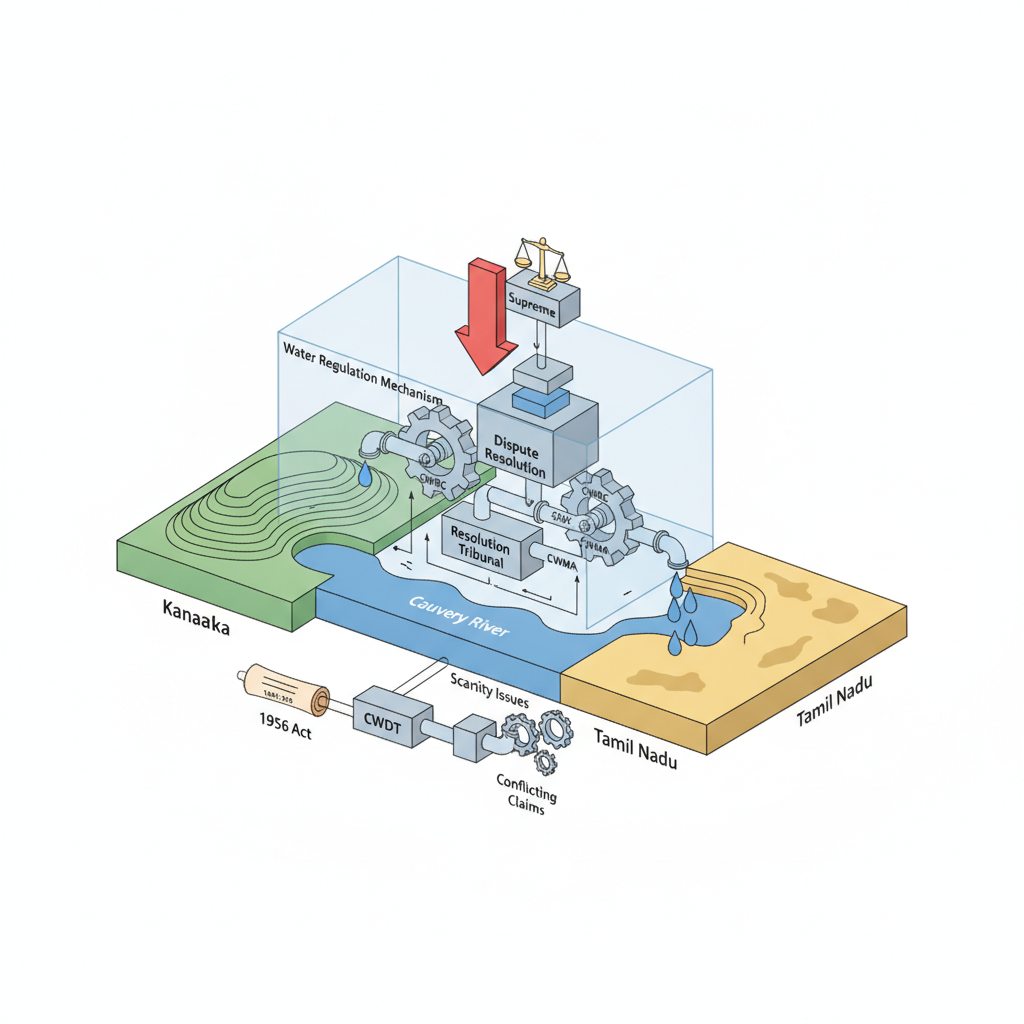
✎ The Cauvery Water Management Authority (CWMA) and the Cauvery Water Regulation Committee (CWRC) are statutory bodies established under the Cauvery Management Scheme, 2018, to implement the Cauvery Water Disputes Tribunal (CWDT)…
Subject Relevance — Where This Topic Fits
- GS Paper II — Functions and Responsibilities of the Union and the States (Inter-State Relations) | GS Paper III — Conservation, Environmental Pollution and Degradation, Environmental Impact Assessment
- Prelims: Cauvery Water Disputes Tribunal (CWDT), Cauvery Water Management Authority (CWMA), Cauvery Water Regulation Committee (CWRC), Inter-State Water Disputes Act, 1956, Article 262 of the Constitution
- Essay: Inter-State Water Sharing: Challenges of Federalism and Equity, Judicial Role in Resolving Environmental and Resource Conflicts
Quick Revision: The Cauvery Water Management Authority (CWMA) and the Cauvery Water Regulation Committee (CWRC) are statutory bodies established under the Cauvery Management Scheme, 2018, to implement the Cauvery Water Disputes Tribunal (CWDT) award and regulate inter-state water sharing.
Why is this in the news?
The Government of Karnataka has announced its intention to approach the Supreme Court against the directives of the Cauvery Water Regulation Committee (CWRC) and the Cauvery Water Management Authority (CWMA) to release 6,000 cusecs of Cauvery water daily to Tamil Nadu. This decision underscores the recurring tensions in inter-state river water governance, particularly during periods of water scarcity, and highlights the constitutional and institutional mechanisms available for dispute resolution.
Background
- The Cauvery river dispute is a long-standing inter-state water sharing conflict between Karnataka and Tamil Nadu, originating from divergent claims over the river’s waters, particularly during the dry season.
- The Cauvery Water Disputes Tribunal (CWDT), constituted under the Inter-State Water Disputes Act, 1956, delivered its final award in 2007, allocating specific quantum of water to Karnataka, Tamil Nadu, Kerala, and Puducherry.
- The Cauvery Water Management Authority (CWMA) and the Cauvery Water Regulation Committee (CWRC) were established in 2018 under the Cauvery Management Scheme to implement the CWDT award and regulate water releases.
- The dispute intensifies during monsoon deficits or delayed rainfall, as seen in Karnataka’s current water storage levels, which are insufficient to meet the CWRC’s release orders.
- The Supreme Court, in its 2018 judgment, upheld the CWDT award while modifying certain aspects, directing the Union Government to frame a scheme for implementation.
- The present situation reflects the operational challenges in balancing equitable water distribution with the hydrological realities of a monsoon-dependent river system.
What is the Cauvery Water Management Authority (CWMA) and the Cauvery Water Regulation Committee (CWRC)?
- The Cauvery Water Management Authority (CWMA) is a statutory body constituted by the Union Government under the Cauvery Management Scheme, 2018, to implement the final award of the Cauvery Water Disputes Tribunal (CWDT) and ensure compliance with water-sharing agreements.
- The CWMA is headed by a Chairman and includes representatives from the riparian states (Karnataka, Tamil Nadu, Kerala, and Puducherry) and the Union Government, ensuring a multi-stakeholder governance structure.
- The Cauvery Water Regulation Committee (CWRC) functions as the operational arm of the CWMA, tasked with monitoring water levels in reservoirs, determining daily water release schedules, and ensuring adherence to the CWDT award.
- The CWRC operates under the framework of the Inter-State Water Disputes Act, 1956, and the Cauvery Management Scheme, which delineates its powers, functions, and decision-making processes.
- The CWRC’s directives are binding on the riparian states, and non-compliance may trigger legal recourse, including appeals to the Supreme Court under Article 136 of the Constitution.
- The CWMA and CWRC were established to replace the earlier ad-hoc arrangements and provide a structured mechanism for resolving disputes and managing water resources in the Cauvery basin.
- The functioning of these institutions is critical for maintaining inter-state harmony and ensuring sustainable water use in a basin shared by multiple states with competing demands.
Key Features
| Feature | Significance |
|---|---|
| Cauvery Water Regulation Committee (CWRC) | Constitutional statutory body mandated under the Inter-State Water Disputes Act, 1956, to regulate and monitor the implementation of Cauvery Water Tribunal awards and Supreme Court directives. |
| Cauvery Water Management Authority (CWMA) | Central authority established under the Inter-State River Water Disputes (Amendment) Act, 2019, to enforce the final award of the Cauvery Water Disputes Tribunal (2007) and ensure equitable distribution of Cauvery waters among riparian states. |
| Inter-State Water Disputes Act, 1956 | Legislative framework governing the adjudication and resolution of disputes over inter-state river waters, including the Cauvery basin. |
| Supreme Court’s Appellate Jurisdiction | Constitutional provision under Article 136 enabling the apex court to entertain appeals against orders of statutory authorities like CWMA and CWRC, particularly in inter-state water disputes. |
| Riparian Principle | Doctrine governing water-sharing in international and inter-state river basins, prioritising equitable utilisation by states sharing the river, as enshrined in the National Water Policy (2012) and judicial precedents. |
Why it Matters
Legal and Institutional
- The dispute underscores the operational challenges of the CWMA and CWRC in implementing inter-state water-sharing agreements, highlighting the need for robust institutional mechanisms to enforce tribunal awards and judicial directives.
- The Supreme Court’s intervention reflects the constitutional obligation to resolve inter-state disputes through judicial review, ensuring compliance with federal principles and the rule of law.
- The episode demonstrates the tension between statutory bodies’ directives and state-level water management priorities, necessitating a balance between judicial orders and ground-level hydrological realities.
Hydrological and Environmental
- The directive to release 6,000 cusecs of water to Tamil Nadu, despite Karnataka’s severe water deficit, raises questions about the sustainability of water-sharing under prolonged drought conditions.
- The prioritisation of drinking water and ecological needs (e.g., filling dried lakes and tanks) in Karnataka reflects the broader challenge of balancing agricultural, domestic, and environmental water demands in a water-stressed basin.
- The reliance on monsoon rainfall for relief underscores the vulnerability of the Cauvery basin to climate variability and the need for adaptive water management strategies.
Political and Governance
- The dispute highlights the governance challenges of inter-state water management, where political pressures and electoral considerations often intersect with technical and legal obligations.
- The Karnataka government’s decision to approach the Supreme Court signals a shift from administrative compliance to judicial recourse, reflecting the increasing role of the judiciary in resolving inter-state disputes.
- The episode also illustrates the complexities of federal governance, where state autonomy in water management must be reconciled with national and judicial frameworks.
Challenges
1. Institutional Enforcement Gaps
- The CWMA and CWRC face challenges in enforcing water-sharing directives due to the lack of a unified, real-time monitoring system for water availability and utilisation across riparian states.
- The absence of a binding, time-bound mechanism for dispute resolution often leads to prolonged litigation and ad-hoc judicial interventions, delaying equitable water distribution.
- The reliance on judicial orders for implementation creates a reactive governance structure, where states resort to litigation rather than pre-emptive cooperation.
UPSC Link: Inter-State Water Disputes Act, 1956
2. Hydrological Uncertainty and Climate Variability
- Prolonged drought conditions in Karnataka have reduced reservoir levels, making it difficult to comply with water-sharing directives without compromising domestic and ecological needs.
- The lack of integrated basin-wide water management plans exacerbates the impact of climate variability, as states operate in silos without coordinated drought mitigation strategies.
- The unpredictability of monsoon patterns, exacerbated by climate change, necessitates adaptive water allocation policies that account for hydrological uncertainties.
UPSC Link: National Water Policy, 2012
3. Balancing Competing Water Demands
- The directive to prioritise drinking water and ecological needs in Karnataka highlights the challenge of balancing agricultural, domestic, and environmental water demands in a water-scarce basin.
- The absence of a prioritisation framework for water allocation during droughts leads to ad-hoc decisions, often favouring politically sensitive sectors over critical needs.
- The lack of a participatory mechanism involving local communities and stakeholders in water management decisions further complicates equitable distribution.
UPSC Link: Riparian Principle
4. Judicial Overreach vs. Executive Autonomy
- The increasing role of the judiciary in resolving inter-state water disputes raises questions about the balance between judicial intervention and executive autonomy in governance.
- Frequent Supreme Court interventions, while necessary for resolving disputes, may undermine the authority of statutory bodies like CWMA and CWRC, leading to institutional redundancy.
- The lack of a clear demarcation of roles between the judiciary, executive, and statutory bodies creates governance ambiguities and delays in implementation.
UPSC Link: Article 136 (Supreme Court’s Appellate Jurisdiction)
5. Political Economy of Water Allocation
- Water-sharing disputes often become politicised, with states prioritising electoral gains over technical and legal obligations, leading to protracted conflicts.
- The absence of a transparent, data-driven mechanism for water allocation fosters mistrust among riparian states, exacerbating disputes.
- The lack of a federal framework for compensating states for water-sharing sacrifices further disincentivises cooperation and compliance.
UPSC Link: Federalism and Water Governance
Challenges — UPSC Perspective
| Issue | Concern |
|---|---|
| Inadequate Real-Time Data Sharing | Lack of a unified, real-time monitoring system for water availability and utilisation across Karnataka and Tamil Nadu, leading to disputes over compliance with directives. |
| Drought-Induced Water Scarcity | Prolonged drought conditions in Karnataka have reduced reservoir levels, making it difficult to comply with water-sharing directives without compromising domestic and ecological needs. |
| Politicisation of Water Allocation | Water-sharing disputes often become politicised, with states prioritising electoral gains over technical and legal obligations, leading to protracted conflicts. |
| Judicial Overreach in Governance | Frequent Supreme Court interventions, while necessary for resolving disputes, may undermine the authority of statutory bodies like CWMA and CWRC, leading to institutional redundancy. |
| Absence of Compensation Mechanisms | The lack of a federal framework for compensating states for water-sharing sacrifices disincentivises cooperation and compliance, exacerbating disputes. |
| Climate Variability and Uncertainty | The unpredictability of monsoon patterns, exacerbated by climate change, necessitates adaptive water allocation policies that account for hydrological uncertainties. |
Way Forward
- Strengthen the institutional capacity of CWMA and CWRC through the establishment of a unified, real-time monitoring system for water availability and utilisation across riparian states.
- Develop a basin-wide, integrated water management plan that accounts for hydrological uncertainties, climate variability, and competing water demands, with provisions for drought mitigation.
- Formulate a transparent, data-driven mechanism for water allocation that prioritises drinking water, ecological needs, and agricultural requirements, with clear guidelines for drought conditions.
- Enhance inter-state cooperation through the establishment of a federal framework for compensating states for water-sharing sacrifices, incentivising compliance and cooperation.
- Clarify the roles and responsibilities of the judiciary, executive, and statutory bodies in resolving inter-state water disputes to avoid governance ambiguities and delays in implementation.
- Promote participatory governance by involving local communities, stakeholders, and riparian states in water management decisions to foster trust and cooperation.
- Invest in climate-resilient infrastructure and adaptive water management strategies to mitigate the impact of climate variability on water availability and distribution.
- Encourage the adoption of water-efficient technologies and practices in agriculture and industry to reduce water demand and enhance sustainability in the Cauvery basin.
UPSC Value Addition
Keywords for Mains Answer-Writing
Inter-State River Water Disputes Act, 1956 · Cauvery Water Disputes Tribunal (CWDT) · Cauvery Water Regulation Committee (CWRC) · Cauvery Water Management Authority (CWMA) · Supreme Court of India · Inter-State Water Disputes · Water sharing agreements · Federalism and Centre-State relations · Equitable apportionment · Judicial intervention in water disputes · Constitutional provisions on water · Inter-State River Water Disputes (Amendment) Act, 2019
Concept Flow
Cauvery Water Tribunal Award (2007) → Establishment of CWMA and CWRC under Inter-State River Water Disputes (Amendment) Act, 2019 → Implementation challenges due to drought and competing demands → CWRC directive for 6,000 cusecs release → Karnataka’s non-compliance citing water scarcity → Supreme Court intervention via Article 136 appeal → Judicial review and potential stay or modification of directive → Broader implications for inter-state water governance and federalism.
Prelims Practice Questions
Q1. Consider the following statements regarding the Cauvery Water Disputes:
1. The Cauvery Water Disputes Tribunal (CWDT) was constituted under the Inter-State River Water Disputes Act, 1956.
2. The Cauvery Water Management Authority (CWMA) was established by the Supreme Court in 2018.
3. The CWMA is mandated to implement the final award of the CWDT.
How many of the above statements are correct?
- Only one
- Only two
- All three
- None
Answer: All three — Statements 1 and 3 are correct. Statement 2 is incorrect as the CWMA was established by the Government of India in 2018 under the provisions of the Inter-State River Water Disputes (Amendment) Act, 2019, following the Supreme Court’s directions.
Q2. Assertion (A): The Supreme Court of India has the power to adjudicate disputes between states over the sharing of river waters.
Reason (R): The Constitution of India empowers the Supreme Court to settle disputes between states under Article 131.
- Both A and R are true, and R is the correct explanation of A.
- Both A and R are true, but R is not the correct explanation of A.
- A is true, but R is false.
- A is false, but R is true.
Answer: A is true, but R is false. — Assertion (A) is true as the Supreme Court has adjudicated inter-state water disputes (e.g., Cauvery, Krishna, Godavari). Reason (R) is false because Article 131 empowers the Supreme Court to adjudicate disputes between states, but inter-state water disputes are typically addressed under the Inter-State River Water Disputes Act, 1956, and the Supreme Court’s original jurisdiction under Article 131 is rarely invoked for such disputes.
Q3. Which of the following committees/authorities is responsible for the day-to-day regulation and monitoring of the Cauvery river water sharing as per the Cauvery Water Disputes Tribunal’s final award?
- Cauvery Water Disputes Tribunal (CWDT)
- Cauvery Water Regulation Committee (CWRC)
- Cauvery Water Management Authority (CWMA)
- National Water Commission (NWC)
Answer: Cauvery Water Regulation Committee (CWRC) — The Cauvery Water Regulation Committee (CWRC) is responsible for the day-to-day regulation and monitoring of the Cauvery river water sharing as per the Cauvery Water Disputes Tribunal’s final award. The CWMA, established in 2018, oversees the implementation of the final award but does not handle day-to-day regulation.
Mains Practice Question
✍ The Inter-State River Water Disputes Act, 1956, and the Cauvery Water Disputes Tribunal (CWDT) award have been the subject of repeated judicial scrutiny and executive intervention in recent years. Critically examine the efficacy of the institutional mechanisms for resolving inter-state river water disputes in India, with particular reference to the Cauvery dispute. Also, analyse the role of the Supreme Court in adjudicating such disputes. (15 Marks)
Approach: MODEL-ANSWER SKELETON:
1. **Introduction**: Define inter-state river water disputes and their constitutional/legal context (Article 262, Inter-State River Water Disputes Act, 1956).
2. **Institutional Mechanisms**:
– **CWDT (1990)**: Composition, powers, final award (2007), and its binding nature.
– **CWRC (2018)**: Role in day-to-day regulation and monitoring.
– **CWMA (2018)**: Implementation and oversight of the CWDT award.
– **Supreme Court’s Role**: Original jurisdiction (Article 131), appellate jurisdiction, and suo motu interventions.
3. **Efficacy and Challenges**:
– Delays in adjudication (e.g., CWDT took 17 years).
– Implementation gaps (e.g., Karnataka-Tamil Nadu conflicts, political interference).
– Lack of permanent tribunal (Inter-State River Water Disputes (Amendment) Act, 2019).
– Equitable apportionment vs. state-centric demands.
4. **Judicial Activism**: Supreme Court’s role in directing releases (e.g., 2018 judgment, recent orders).
5. **Way Forward**:
– Strengthening institutional mechanisms (e.g., permanent tribunal, data transparency).
– Balancing federalism and equity.
– Role of Centre in mediation and enforcement.
6. **Conclusion**: Balanced assessment of the current system’s strengths and weaknesses.
Source: orissapost.com
Karnataka PCS (KPSC) — State PCS Practice
Prelims: Which constitutional provision empowers the Karnataka government to approach the Supreme Court against the Cauvery Water Disputes Tribunal’s order on water release?
- Article 131 (Original Jurisdiction of the Supreme Court)
- Article 262 (Inter-State Water Disputes)
- Article 32 (Right to Constitutional Remedies)
- Article 256 (Obligation of States in the Union)
Answer: Article 131 (Original Jurisdiction of the Supreme Court) — Article 131 grants the Supreme Court original jurisdiction in disputes between the Government of India and one or more States, or between States themselves.
Mains: Critically analyze the legal and political implications of Karnataka’s decision to approach the Supreme Court against the Cauvery Water Disputes Tribunal’s order mandating the release of 6,000 cusecs of water. Suggest a sustainable resolution framework for inter-state water disputes in India.
Generated by AanyaAi for educational purpose.
Related guides on our sites
- Anthropology VS PSIR
- Best PSIR optional coaching
- Best PSIR optional coaching online
- Best PSIR optional teacher

- आरबीआई ने सरकारी प्रतिभूतियों की ओएमओ बिक्री की घोषणा, जानिए पूरा विवरण - September 23, 2026
- RBI to Sell ₹25,000 Crore Govt Securities via OMO on Sept 28, 2026 - September 23, 2026
- भारत-श्रीलंका नौसैनिक अभ्यास ‘स्लाईनेक्स-26’: विशाखापत्तनम में संपन्न, जानें प्रमुख बिंदु - September 23, 2026

No Comments