


09 Sep Cabinet Approves 3 Multi-Tracking Rail Projects for 14 Districts in 5 States
✎ Multi-tracking projects in Indian Railways enhance line capacity, reduce congestion, and improve logistics efficiency by adding parallel tracks, aligning with the Gati Shakti National Master Plan and contributing to climate goals…
Subject Relevance — Where This Topic Fits
- GS Paper III — Infrastructure: Energy, Ports, Roads, Airports, Railways and Human Resources | GS Paper III — Investment Models
- Prelims: Multi-tracking, Railway line capacity augmentation, Gati Shakti National Master Plan, Railway freight logistics, Carbon footprint reduction in transport
- Essay: Infrastructure as a Catalyst for Regional Development, Sustainable Transport Solutions for a Growing Economy
Quick Revision: Multi-tracking projects in Indian Railways enhance line capacity, reduce congestion, and improve logistics efficiency by adding parallel tracks, aligning with the Gati Shakti National Master Plan and contributing to climate goals through reduced carbon emissions.
Why is this in the news?
The Union Cabinet, chaired by the Prime Minister, approved five multi-tracking railway projects spanning Tamil Nadu, Andhra Pradesh, Karnataka, and Telangana, with a cumulative investment of ₹10,021 crore. These projects, aligned with the Gati Shakti National Master Plan, aim to enhance operational efficiency, reduce congestion, and improve rail connectivity across 17 districts, thereby bolstering freight and passenger movement while contributing to climate goals through reduced carbon emissions.
Background
- Indian Railways operates one of the world’s largest rail networks, with a route length of approximately 68,000 km as of 2023, but faces significant congestion on key routes due to single or double-track sections.
- The National Rail Plan (2030) envisages doubling the rail network capacity by 2030 to meet growing freight and passenger demand, with a focus on decongestion and multi-tracking of critical corridors.
- The Gati Shakti National Master Plan (2021), launched to integrate infrastructure planning, prioritizes multi-modal connectivity and logistics efficiency, with railways as a key component.
- Freight logistics costs in India are higher than global averages, with railways aiming to increase their modal share from 36% to 45% by 2030 to reduce costs and emissions.
- Railway electrification and capacity augmentation are critical to India’s commitments under the Paris Agreement, targeting a 33-35% reduction in carbon intensity by 2030.
What are Multi-tracking Projects in Indian Railways?
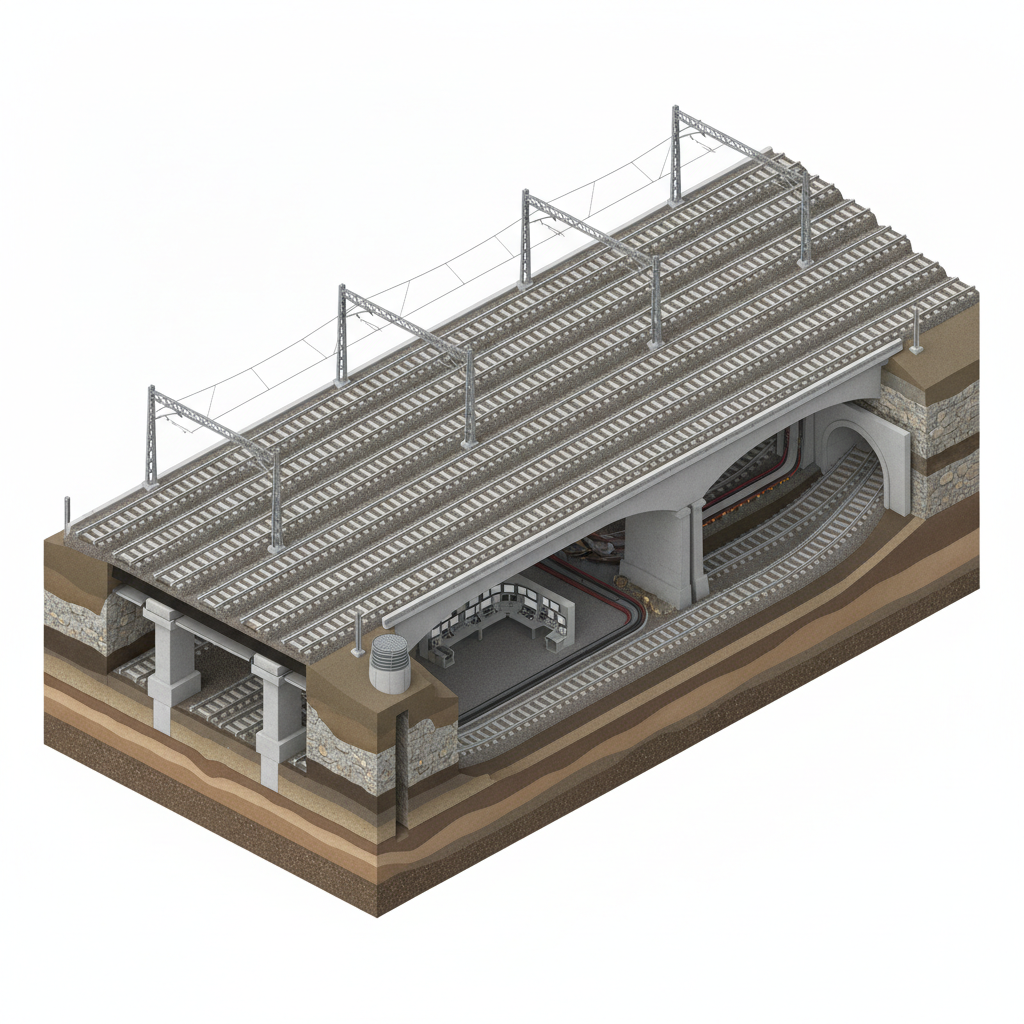
- Multi-tracking involves the construction of additional parallel tracks alongside existing ones to increase line capacity, reduce congestion, and improve operational efficiency by segregating freight and passenger traffic.
- These projects enhance the average speed of trains, reduce delays, and increase the frequency of services, thereby improving reliability and passenger experience.
- Multi-tracking is particularly critical on high-density corridors such as the Chennai–Bengaluru–Hyderabad–Secunderabad axis, where existing double or single tracks are insufficient to meet demand.
- The projects approved include third and fourth lines (e.g., Arakkonam–Renigunta), doubling of existing single tracks (e.g., Salem–Karur–Dindigul), and multi-tracking of freight corridors (e.g., Secunderabad–Kazipet).
- The total length of the approved projects is approximately 540 km, with an estimated investment of ₹10,021 crore and completion targeted by 2029–30.
- These projects will improve connectivity to 2,121 villages, benefiting an estimated population of 52 lakh, and enhance access to key religious and tourist destinations such as Tirupati, Kolar Gold Fields, and Hogenakkal Falls.
- The projects will generate additional freight capacity of 47 million tonnes per annum (MTPA), supporting the transportation of coal, cement, iron and steel, automobiles, and agricultural commodities.
Key Features
| Feature | Significance |
|---|---|
| Multi-tracking projects | Enhances rail network capacity by adding new tracks, reducing congestion and improving operational efficiency. |
| Geographical coverage | Covers 17 districts across Tamil Nadu, Andhra Pradesh, Karnataka, and Telangana, improving regional connectivity. |
| Project length | Total addition of ~540 km to the existing rail network, with individual projects ranging from 47 km to 159 km. |
| Estimated cost | Total outlay of ₹10,021 crore, with completion targeted by 2029-30. |
| Freight capacity addition | Projected increase of 47 million tonnes per annum (MTPA) in freight handling capacity. |
Why it Matters
Economic Integration
- Facilitates seamless movement of goods (coal, cement, iron & steel, automobiles, grains, petroleum products, fertilizers) across southern India, reducing logistics costs.
- Enhances supply chain efficiency, particularly for industries in Tamil Nadu, Andhra Pradesh, Karnataka, and Telangana.
- Supports the ‘One District, One Product’ (ODOP) initiative by improving market access for local products.
Strategic Connectivity
- Improves rail connectivity to major tourism hubs (Tirupati, Kolar Gold Fields, Hogenakkal Falls, etc.), boosting tourism-driven economic activity.
- Strengthens hinterland linkages for ports (e.g., Chennai, Visakhapatnam) and industrial corridors (e.g., Bengaluru-Chennai, Hyderabad-Bengaluru).
- Reduces dependency on road transport for long-distance freight, enhancing national supply chain resilience.
Environmental and Climate Benefits
- Rail transport is ~70% more energy-efficient than road transport, reducing carbon emissions (~420 million kg CO₂ annually).
- Lowers oil import dependency by ~80 million litres annually, contributing to energy security.
- Aligns with India’s Nationally Determined Contributions (NDCs) under the Paris Agreement.
Governance and Policy Alignment
- Integrated under the PM Gati Shakti National Master Plan, ensuring multi-modal connectivity and stakeholder coordination.
- Supports the ‘Vocal for Local’ initiative by enhancing regional economic integration.
- Contributes to the ‘Atmanirbhar Bharat’ vision through infrastructure-led growth and job creation.
Challenges
1. Land Acquisition and Rehabilitation
- Multi-tracking projects require substantial land acquisition, often leading to delays due to legal disputes or compensation issues.
- High population density in southern India increases the complexity of land acquisition processes.
- Need for transparent and expeditious land acquisition mechanisms under the Right to Fair Compensation and Transparency in Land Acquisition, Rehabilitation and Resettlement (RFCTLARR) Act, 2013.
UPSC Link: Land Acquisition Act, 2013
2. Environmental Clearances
- Projects may face delays due to environmental impact assessments (EIA) and compliance with Forest (Conservation) Act, 1980.
- Need for balancing infrastructure development with biodiversity conservation, particularly in ecologically sensitive areas.
UPSC Link: Forest Conservation Act, 1980
3. Project Implementation and Funding
- Large-scale projects require robust project management to meet the 2029-30 deadline, with potential risks of cost overruns.
- Railway infrastructure projects often face funding constraints, necessitating efficient budgetary allocations and public-private partnerships (PPPs).
UPSC Link: Public-Private Partnerships
4. Operational Challenges
- Integration of new tracks with existing rail infrastructure requires meticulous planning to avoid disruptions.
- Need for modern signaling and automation systems to optimize multi-track operations and reduce human errors.
UPSC Link: Railway Signaling Systems
5. Stakeholder Coordination
- Coordination between central and state governments, local authorities, and private stakeholders is critical for timely execution.
- Ensuring alignment with state-level industrial and urban development plans to maximize socio-economic benefits.
UPSC Link: Inter-State Coordination
Challenges — UPSC Perspective
| Issue | Concern |
|---|---|
| Land acquisition delays | Legal disputes, compensation issues, and high population density in southern India. |
| Environmental clearances | Delays due to EIA compliance and adherence to Forest Conservation Act, 1980. |
| Funding constraints | Risk of cost overruns and need for efficient budgetary allocations or PPP models. |
| Project execution risks | Potential delays in meeting the 2029-30 deadline due to operational complexities. |
| Stakeholder alignment | Need for seamless coordination between central, state, and local authorities. |
Way Forward
- Establish a dedicated Project Monitoring Unit (PMU) under the Ministry of Railways to oversee timely execution and address bottlenecks.
- Streamline land acquisition processes by leveraging digital land records (e.g., Bhu-Naksha) and expediting RFCTLARR Act compliance.
- Prioritize environmental clearances through pre-emptive consultations with the Ministry of Environment, Forest and Climate Change (MoEFCC).
- Explore Public-Private Partnership (PPP) models for funding and technical expertise, particularly for high-cost segments.
- Invest in modern signaling and automation technologies (e.g., Kavach, ERTMS) to enhance multi-track operational efficiency.
- Conduct periodic socio-economic impact assessments to ensure alignment with regional development goals.
- Strengthen inter-state coordination mechanisms (e.g., zonal railway councils) to resolve disputes and ensure seamless project integration.
UPSC Value Addition
Keywords for Mains Answer-Writing
Multi-tracking railway projects · Railway infrastructure expansion · PM Gati Shakti National Master Plan · Logistics efficiency and connectivity · Operational efficiency of Indian Railways · Railway capacity augmentation · Regional economic development through rail · Sustainable transport and decarbonisation · Multi-modal connectivity · Railway freight corridors · Railway line doubling and quadrupling · Railway network expansion in South India
Concept Flow
Multi-tracking projects initiated under PM Gati Shakti National Master Plan for integrated infrastructure development. → Projects approved by the Union Cabinet to enhance rail network capacity and reduce congestion in southern India. → Land acquisition and environmental clearances obtained under statutory frameworks (RFCTLARR Act, 2013; Forest Conservation Act, 1980). → Infrastructure development leads to increased freight capacity (~47 MTPA) and reduced logistics costs. → Enhanced connectivity improves economic integration, supports tourism, and aligns with climate goals (reduced CO₂ emissions). → Operational efficiency gains translate into improved service reliability and reduced travel time for passengers. → Long-term impact: Strengthened supply chains, job creation, and contribution to ‘Atmanirbhar Bharat’ vision.
Prelims Practice Questions
Q1. Consider the following statements regarding the PM Gati Shakti National Master Plan:
1. It aims to enhance multi-modal connectivity and logistics efficiency.
2. It is a digital platform integrating various infrastructure ministries.
3. It is implemented solely by the Ministry of Railways.
4. It seeks to reduce logistics costs and improve supply chain resilience.
How many of the above statements are correct?
- Only one
- Only two
- Only three
- All
Answer: All — Statements 1, 2, and 4 are correct as per the official objectives of the PM Gati Shakti National Master Plan. Statement 3 is incorrect because it involves multiple ministries, not solely the Ministry of Railways.
Q2. Assertion (A): Multi-tracking railway projects enhance the operational efficiency of Indian Railways.
Reason (R): They reduce congestion and increase freight and passenger carrying capacity.
Options:
A. Both A and R are true, and R is the correct explanation of A.
B. Both A and R are true, but R is not the correct explanation of A.
C. A is true, but R is false.
D. A is false, but R is true.
Answer: ? — Multi-tracking projects indeed enhance operational efficiency by reducing congestion and increasing capacity. The reason correctly explains the assertion.
Q3. Match the following railway projects with their respective states:
Column I (Project) | Column II (State)
——————————————–|——————
1. Arrakonam – Renigunta third and fourth line | A. Karnataka
2. Whitefield – Bangarpet third and fourth line | B. Andhra Pradesh
3. Salem – Karur – Dindigul doubling | C. Tamil Nadu
4. Secunderabad (Ghatkesar) – Kazipet multi-tracking | D. Telangana
Options:
A. 1-D, 2-A, 3-C, 4-B
B. 1-C, 2-A, 3-B, 4-D
C. 1-B, 2-A, 3-C, 4-D
D. 1-C, 2-B, 3-A, 4-D
- A
- B
- C
- D
Answer: C — 1. Arrakonam – Renigunta is in Tamil Nadu (C). 2. Whitefield – Bangarpet is in Karnataka (A). 3. Salem – Karur – Dindigul is in Tamil Nadu (B). 4. Secunderabad – Kazipet is in Telangana (D).
Mains Practice Question
✍ The expansion of railway infrastructure through multi-tracking projects is a critical component of India’s logistics and economic growth strategy. Critically examine the role of such projects in enhancing operational efficiency, regional connectivity, and sustainability. Also, analyse how these initiatives align with the PM Gati Shakti National Master Plan. (15 Marks)
Approach: MODEL-ANSWER SKELETON:
1. **Introduction (2 Marks)**
– Define multi-tracking railway projects and their purpose.
– Mention the PM Gati Shakti National Master Plan as a framework for integrated infrastructure development.
2. **Operational Efficiency (4 Marks)**
– Explain how multi-tracking reduces congestion and increases line capacity.
– Discuss the impact on average speeds, punctuality, and freight/passenger throughput.
– Cite data from the given projects (e.g., 540 km expansion, 47 million tonnes additional freight capacity).
– Reference: Indian Railways’ operational challenges and the need for capacity augmentation.
3. **Regional Connectivity and Economic Development (4 Marks)**
– Highlight improved connectivity to 2,121 villages and major tourist/religious sites (e.g., Tirupati, Kolar Gold Fields).
– Explain the role in facilitating movement of essential commodities (coal, cement, iron, steel, etc.).
– Link to regional economic development and employment generation (as per the vision of ‘Atmanirbhar Bharat’).
4. **Sustainability and Decarbonisation (3 Marks)**
– Discuss the environmental benefits: reduction in carbon emissions (~42 crore kg CO2), oil imports (~8 crore litres), and equivalent tree plantation.
– Emphasise the role of railways as an energy-efficient transport mode.
– Reference: India’s climate commitments (e.g., Paris Agreement, Net Zero by 2070).
5. **Alignment with PM Gati Shakti (2 Marks)**
– Explain how these projects integrate with the PM Gati Shakti National Master Plan’s objectives of multi-modal connectivity and logistics efficiency.
– Discuss the role of digital platforms (e.g., GIS-based planning) and inter-ministerial coordination.
6. **Conclusion (2 Marks)**
– Summarise the transformative potential of multi-tracking projects.
– Acknowledge challenges (e.g., land acquisition, funding, execution timelines) and suggest measures for effective implementation.
Source: PIB (Press Information Bureau)
Chhattisgarh PCS (CGPSC) — State PCS Practice
Prelims: Which of the following districts of Chhattisgarh is NOT covered under the recently approved multi-tracking projects by the Union Cabinet in May 2024?
- Balod
- Jashpur
- Korba
- Surguja
Answer: Korba — The three multi-tracking projects approved by the Union Cabinet cover 14 districts across West Bengal, Jharkhand, Odisha, Madhya Pradesh, and Chhattisgarh. Korba district in Chhattisgarh is not included in the approved list.
Mains: Discuss the significance of the Union Cabinet’s approval of multi-tracking projects for Chhattisgarh’s socio-economic development. Highlight the potential benefits for tribal communities and regional connectivity in the state.
Generated by AanyaAi for educational purpose.
Related guides on our sites
- Best PSIR optional coaching for upsc
- Best PSIR optional teacher for upsc
- Best teacher of PSIR optional for upsc
- Best PSIR optional coaching in delhi for UPSC

- मिशन कर्मयोगी: पहली क्षेत्रीय कार्यशाला विजयवाड़ा में संपन्न, जानें मुख्य बिंदु - October 2, 2026
- UPSC Focus: Arjun Ram Meghwal Leads Tree Plantation at IIAC - October 2, 2026
- गोबरधन योजना: सीबीजी क्षेत्र को बढ़ावा देने के लिए केंद्र सरकार की पहल - October 2, 2026

No Comments