


13 Sep Punjab Power Crisis: Coal Supply Adequate, Focus on Timely Lifting & Utilization
✎ Coal supply to thermal power plants in Punjab is governed by institutional mechanisms including CIL’s subsidiaries, captive mining regulations, and operational parameters like PLF, with the Ministry of Coal ensuring adequate…
Subject Relevance — Where This Topic Fits
- GS Paper II — Government Policies and Interventions for Development | GS Paper III — Infrastructure: Energy
- Prelims: Coal India Limited (CIL), Independent Power Producers (IPPs), Plant Load Factor (PLF), Captive Coal Mines, Coal Supply Chain Management, Thermal Power Plants, Coal India Limited subsidiaries (CCL, BCCL), Coal Dispatch, Power Purchase Agreements (PPAs)
Quick Revision: Coal supply to thermal power plants in Punjab is governed by institutional mechanisms including CIL’s subsidiaries, captive mining regulations, and operational parameters like PLF, with the Ministry of Coal ensuring adequate stock levels and timely dispatch to mitigate shortages.
Why is this in the news?
The Ministry of Coal, Government of India, has clarified that coal supply to thermal power plants in Punjab is adequate and that Coal India Limited (CIL) is fully prepared to meet uninterrupted coal supply requirements for power generation across the country. The clarification follows media reports highlighting power shortages in Punjab, attributing them to reduced coal supply and plant outages. The Ministry has emphasized the need for timely coal lifting by Punjab State Power Corporation Limited (PSPCL) from captive mines and optimal utilisation of captive coal to ensure sustained electricity generation in the state.
Background
- Coal remains the primary source of energy for thermal power plants in India, contributing approximately 70% of the country’s electricity generation.
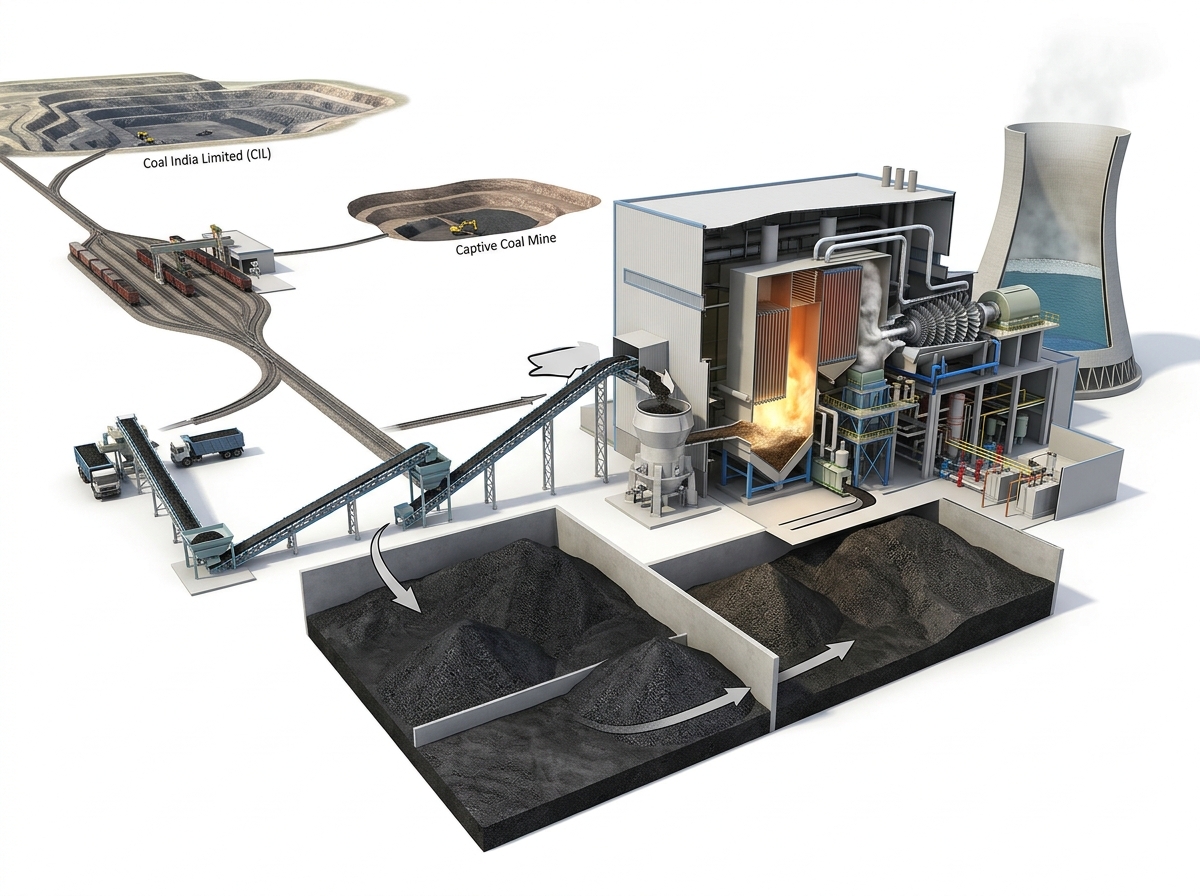
- Punjab relies on both state-owned thermal power plants and Independent Power Producers (IPPs) for electricity generation, with a significant portion of coal supplied by Coal India Limited (CIL) and its subsidiaries.
- The Government of India has been promoting the use of captive coal to reduce dependence on external coal supplies and enhance energy security.
- Thermal power plants in Punjab, including those operated by PSPCL and IPPs, face operational challenges such as plant load factor (PLF) variations, coal stock management, and logistical constraints in coal dispatch.
- The Ministry of Coal has been actively facilitating the movement of coal from captive mines to IPPs to ensure uninterrupted power supply, particularly in states like Punjab.
What is the institutional and operational framework for coal supply to thermal power plants in India, with specific reference to Punjab?
- Coal India Limited (CIL) is a Maharatna public sector undertaking under the Ministry of Coal, responsible for the majority of coal production and supply in India.
- CIL operates through eight subsidiaries, which supply coal to power plants across the country.
- Independent Power Producers (IPPs) are private entities that generate electricity and sell it to state utilities or directly to consumers under Power Purchase Agreements (PPAs).
- Captive coal mining allows end-use industries, including power producers, to mine coal for their own consumption, subject to regulatory approvals and environmental clearances.
- The Plant Load Factor (PLF) measures the utilisation level of a power plant, expressed as a percentage of its maximum capacity over a given period. A lower PLF indicates underutilisation of plant capacity.
- Coal dispatch involves the systematic movement of coal from mines to power plants, governed by logistical arrangements, railway rake availability, and contractual obligations under PPAs.
- The Ministry of Coal monitors coal supply chains to ensure adequate stock levels at power plants, particularly during peak demand seasons or supply disruptions.
- State utilities like PSPCL in Punjab operate their own thermal power plants and also procure electricity from IPPs, necessitating coordinated coal supply management to avoid shortages.
Key Features
| Feature | Significance |
|---|---|
| Adequate coal supply to Punjab’s thermal power plants | Ensures uninterrupted electricity generation, critical for industrial and agricultural operations in Punjab. |
| Timely coal lifting by Coal India Limited (CIL) | Prevents stockpiling and ensures continuous supply to meet Punjab’s power demand. |
| Utilisation of captive coal mines (Pachwara Central Coal Mine) | Enhances coal availability for Independent Power Producers (IPPs) in Punjab, reducing dependency on external supply. |
| Plant Load Factor (PLF) of PSPCL’s thermal plants | Indicates operational efficiency; low PLF despite sufficient coal stock suggests inefficiencies in utilisation. |
| Monitoring of IPP breakdowns | Ensures reliability of power supply by addressing technical failures promptly. |
| Coal supply optimisation through CIL subsidiaries | Facilitates additional coal allocation to Punjab’s IPPs, improving supply chain efficiency. |
Why it Matters
Economic
- Sustained electricity supply is vital for Punjab’s industrial sector, particularly agro-based industries and manufacturing units, which contribute significantly to the state’s GDP.
- Adequate coal supply prevents economic losses from power cuts, which can disrupt production cycles and supply chains.
- Efficient coal utilisation in thermal plants reduces operational costs, enhancing the financial viability of power generation.
Energy Security
- Reduces Punjab’s vulnerability to energy shortages, ensuring grid stability and energy independence.
- Diversification of coal sources through captive mines and CIL supply mitigates risks of supply chain disruptions.
- Optimal utilisation of domestic coal resources aligns with India’s energy security goals under the National Electricity Policy.
Governance and Policy
- Demonstrates the role of central and state agencies (CIL, PSPCL) in coordinating coal supply and power generation to meet regional demands.
- Highlights the need for inter-agency cooperation to address logistical and operational bottlenecks in coal and power sectors.
- Underscores the importance of data-driven monitoring (e.g., PLF, coal stock levels) for policy formulation and corrective action.
Environmental
- Efficient coal utilisation in thermal plants reduces carbon emissions per unit of electricity generated, contributing to climate goals.
- Optimal use of captive mines minimises the need for long-distance coal transportation, reducing logistical emissions.
Challenges
1. Suboptimal utilisation of captive coal mines
- Pachwara Central Coal Mine has achieved 83.67% of annual production target but dispatched only 68.44%, leading to 3.21 lakh tonnes of idle stock.
- State-owned plants (PSPCL) are not fully utilising available coal, despite sufficient stock (114% of standard requirement).
- Policy and logistical barriers may be restricting the movement of coal from captive mines to IPPs, despite regulatory approvals.
UPSC Link: Mains: GS-III, Energy Resources
2. Low Plant Load Factor (PLF) in state-owned thermal plants
- PSPCL’s thermal plants operated at ~59% PLF in September 2026, despite adequate coal stock, indicating inefficiencies in plant operations.
- Possible causes include maintenance delays, fuel quality issues, or suboptimal scheduling of power generation.
- Low PLF increases per-unit cost of electricity, reducing the competitiveness of state-owned plants.
UPSC Link: Prelims: Energy Terms; Mains: GS-III
3. Inadequate coal lifting by Independent Power Producers (IPPs)
- CIL subsidiaries (e.g., CCL, BCCL) offered additional coal to Punjab’s IPPs, but lifting remained below proposed quantities (e.g., only 3.2 lakh tonnes lifted against 5 lakh tonnes offered by CCL).
- Bureaucratic or logistical hurdles may be delaying the execution of coal supply agreements.
- Delays in coal lifting by IPPs exacerbate supply-demand mismatches in Punjab’s power sector.
UPSC Link: Mains: GS-III, Infrastructure
4. Monitoring and coordination gaps in power sector
- Breakdowns in IPPs have been reported, requiring real-time monitoring to prevent grid instability.
- Lack of synchronised data sharing between PSPCL, CIL, and IPPs may lead to misaligned supply and demand planning.
- Need for a centralised monitoring mechanism to track coal stock, PLF, and breakdowns across all thermal plants in Punjab.
UPSC Link: Mains: GS-II, Governance
5. Regulatory and statutory compliance in captive mine operations
- Movement of coal from captive mines (e.g., Pachwara) to IPPs is subject to statutory payment obligations (e.g., to Jharkhand), which may delay logistics.
- Complex inter-state coal transportation rules can create bottlenecks in supply chains.
- Need for streamlined compliance processes to facilitate cross-state coal movement.
UPSC Link: Prelims: Constitutional Provisions; Mains: GS-II
Challenges — UPSC Perspective
| Issue | Concern |
|---|---|
| Idle coal stock in captive mines | Failure to utilise 3.21 lakh tonnes of coal at Pachwara mine, leading to financial and resource inefficiencies. |
| Low PLF in state-owned plants | Operational inefficiencies despite sufficient coal stock, increasing per-unit generation costs. |
| Underutilisation of CIL’s coal offers by IPPs | Only 64% of offered coal lifted by IPPs, exacerbating supply-demand gaps. |
| Inter-state coal transportation delays | Statutory obligations and regulatory hurdles slow coal movement from Jharkhand to Punjab. |
| Lack of real-time monitoring in power sector | Breakdowns in IPPs and low PLF go unaddressed due to delayed data sharing and coordination gaps. |
| Policy-implementation mismatch | Regulatory approvals for coal movement exist, but ground-level execution faces logistical and bureaucratic barriers. |
Way Forward
- Strengthen inter-agency coordination between PSPCL, CIL, and IPPs to synchronise coal supply, lifting schedules, and power generation plans.
- Conduct a performance audit of PSPCL’s thermal plants to identify causes of low PLF and implement corrective measures (e.g., maintenance, fuel quality checks).
- Streamline the process for moving coal from captive mines (e.g., Pachwara) to IPPs by expediting statutory clearances and inter-state transport permits.
- Enhance real-time monitoring of coal stock, PLF, and breakdowns through a centralised dashboard accessible to all stakeholders.
- Encourage IPPs to lift the maximum proposed coal quantities from CIL subsidiaries by addressing logistical and contractual barriers.
- Promote the use of blended coal (e.g., imported coal mixed with domestic coal) in thermal plants to improve efficiency and reduce emissions.
- Develop a contingency plan for Punjab’s power sector, including backup fuel sources and grid integration strategies to mitigate supply disruptions.
- Conduct capacity-building programs for state agencies (e.g., PSPCL) on best practices in thermal plant operations and coal management.
UPSC Value Addition
Keywords for Mains Answer-Writing
Thermal power generation · Coal supply chain · Coal India Limited (CIL) · Independent Power Producers (IPPs) · Plant Load Factor (PLF) · Captive coal mines · PSPCL · Energy security · Coal linkage mechanism · Power sector governance · Thermal plant efficiency · Coal dispatch optimisation · Grid stability · Power purchase agreements · Central Electricity Authority (CEA)
Concept Flow
Coal supply from CIL and captive mines (Pachwara) to Punjab’s thermal plants → Stockpiling and utilisation inefficiencies → Low PLF in state-owned plants and breakdowns in IPPs → Power shortages and economic disruptions → Need for inter-agency coordination and policy reforms → Implementation of corrective measures (e.g., streamlined logistics, real-time monitoring) → Optimised coal utilisation and stable power supply.
Prelims Practice Questions
Q1. Consider the following statements regarding the coal supply chain for thermal power plants in India:
1. Coal India Limited (CIL) is the sole supplier of coal to Independent Power Producers (IPPs) in all states.
2. The Plant Load Factor (PLF) of a thermal power plant is a measure of its operational efficiency and is expressed as a percentage of its maximum capacity.
3. Captive coal mines are exclusively owned by the central government and cannot be utilised by state-owned power utilities.
4. The Central Electricity Authority (CEA) monitors the coal stock levels at thermal power plants to ensure grid stability.
How many of the above statements are correct?
- Only one
- Only two
- Only three
- All
Answer: Only three — Statements 2 and 4 are correct. Statement 1 is incorrect as CIL is not the sole supplier; state utilities and captive mines also contribute. Statement 3 is incorrect as captive mines can be owned by state utilities like PSPCL.
Q2. Assertion (A): The Plant Load Factor (PLF) of a thermal power plant is influenced by factors such as coal availability, plant maintenance, and grid demand.
Reason (R): A higher PLF indicates greater operational efficiency and utilisation of the plant’s installed capacity.
Code:
A. Both A and R are true, and R is the correct explanation of A.
B. Both A and R are true, but R is not the correct explanation of A.
C. A is true, but R is false.
D. A is false, but R is true.
Answer: ? — Both Assertion (A) and Reason (R) are true. The PLF is indeed influenced by coal availability, maintenance, and grid demand, and a higher PLF reflects greater efficiency in utilising the plant’s capacity.
Q3. Match the following pairs related to coal supply and thermal power generation in India:
Column I (Entity/Concept)
A. Coal India Limited (CIL)
B. Plant Load Factor (PLF)
C. Captive Coal Mine
D. Independent Power Producer (IPP)
Column II (Description)
1. A power plant owned by a private entity that sells electricity to the grid under long-term agreements.
2. A government-owned coal mining company responsible for the majority of coal production in India.
3. A measure of the operational efficiency of a thermal power plant, expressed as a percentage of its maximum capacity.
4. A coal mine owned by a power utility for its exclusive use in generating electricity.
Select the correct match:
A-2, B-3, C-4, D-1
A-1, B-3, C-2, D-4
A-3, B-2, C-4, D-1
A-2, B-4, C-3, D-1
- A-2, B-3, C-4, D-1
- A-1, B-3, C-2, D-4
- A-3, B-2, C-4, D-1
- A-2, B-4, C-3, D-1
Answer: A-2, B-3, C-4, D-1 — Correct matches: A-2 (CIL is a government-owned coal mining company), B-3 (PLF measures operational efficiency), C-4 (Captive coal mine is owned by a utility for exclusive use), D-1 (IPP is a private entity selling electricity to the grid).
Mains Practice Question
✍ The reliability of India’s thermal power sector is critically dependent on the efficiency of its coal supply chain and the operational performance of Independent Power Producers (IPPs). In light of recent reports on coal supply disruptions and their impact on power generation in Punjab, critically examine the challenges in the coal supply chain for thermal power plants. Also, analyse the role of captive coal mines and state-owned utilities like PSPCL in ensuring energy security. (15 Marks)
Approach: MODEL-ANSWER SKELETON:
1. **Introduction (2 Marks)**
– Define thermal power generation and its share in India’s energy mix (approx. 70% of installed capacity as per CEA data).
– State the criticality of coal supply chain for grid stability and energy security.
2. **Challenges in Coal Supply Chain (5 Marks)**
– **Logistical bottlenecks**: Distance between coalfields (e.g., Jharia, Talcher) and power plants, railway capacity constraints, and seasonal variations.
– **Dependence on CIL**: Monopolistic structure of CIL (produces ~80% of domestic coal) and its operational challenges (e.g., production shortfalls, evacuation constraints).
– **IPP vulnerabilities**: Issues such as delayed coal linkages, sub-optimal Plant Load Factor (PLF) due to maintenance or grid constraints, and contractual disputes.
– **Data from the case**: Reference to Punjab’s IPPs (NPL and TSPL) where coal supply (4.3-3.8 rakes/day) exceeded consumption (4.9-4.1 rakes/day) but PLF remained low (~59%) due to plant-specific issues.
3. **Role of Captive Coal Mines (4 Marks)**
– Definition and purpose: Mines owned by power utilities (e.g., PSPCL’s Pachwara Central Coal Mine) to ensure fuel security.
– **Mechanism**: Allocation of coal from captive mines to IPPs (e.g., 50% of production allowed for sale to IPPs after meeting utility’s needs).
– **Constraints**: Legal and statutory obligations (e.g., Jharkhand’s royalty payments), production shortfalls (Pachwara mine achieved 83.67% of annual target but dispatched only 68.44%), and underutilisation.
– **Policy gaps**: Need for streamlined dispatch mechanisms and incentives for state utilities to utilise captive mines optimally.
4. **State-Owned Utilities and Energy Security (3 Marks)**
– **PSPCL’s role**: Owns three thermal plants (Guru Hargobind TPS, Goindwal Sahib TPP, Ropar TPS) with sufficient coal stock (114% of standard requirement) but low PLF (~59%).
– **Governance issues**: Underutilisation despite adequate coal stocks highlights operational inefficiencies (e.g., maintenance schedules, grid constraints).
– **Recommendations**: Enhance coordination between state utilities, IPPs, and CIL; incentivise utilisation of captive mines; adopt real-time monitoring of PLF and coal stocks (e.g., via CEA’s dashboard).
5. **Conclusion (1 Mark)**
– Reiterate the need for a multi-pronged approach: improving logistics, optimising captive mine utilisation, and enforcing contractual discipline among IPPs.
– Emphasise the role of regulatory oversight (e.g., CEA, CERC) in ensuring transparency and accountability.
Source: PIB (Press Information Bureau)
Punjab PCS (PPSC) — State PCS Practice
Prelims: Which of the following is a key challenge highlighted in Punjab’s recent efforts to ensure adequate coal supply for its power plants?
- A. Delayed coal lifting from Coal India Limited (CIL) leading to power generation disruptions
- B. Excessive rainfall affecting coal transportation via railways
- C. Over-reliance on imported coal due to insufficient domestic reserves
- D. Ban on coal mining in Punjab due to environmental concerns
Answer: A. Delayed coal lifting from Coal India Limited (CIL) leading to power generation disruptions — Punjab has emphasized timely coal lifting from Coal India Limited (CIL) to sustain power generation, indicating delays as a key challenge.
Mains: Discuss the significance of maximizing the use of captive coal in Punjab’s power plants for ensuring sustainable electricity production. Highlight the role of Coal India Limited (CIL) in this context and suggest measures to address any existing gaps.
Generated by AanyaAi for educational purpose.
Related guides on our sites
- Current affairs for upsc 2026
- How to prepare for GS paper 1 for UPSC CSE mains exam
- Best UPSC coaching for IFOS exam
- Best mentorship programme for upsc

- यूएनजीए 2026: युद्ध, एआई और सुधार – दुनिया के नेता क्या करेंगे? (UPSC दृष्टिकोण) - September 22, 2026
- 40 दिन बाद भी संसद सत्र अनिर्णीत, महिला आरक्षण विधेयक पर सरकार की तैयारी - September 22, 2026
- Why Parliament Session Still Unprorogued After 40 Days? Women’s Quota Law Buzz Explained - September 22, 2026

No Comments