


14 Sep WPI Inflation August 2026: Key Highlights for UPSC & State PCS
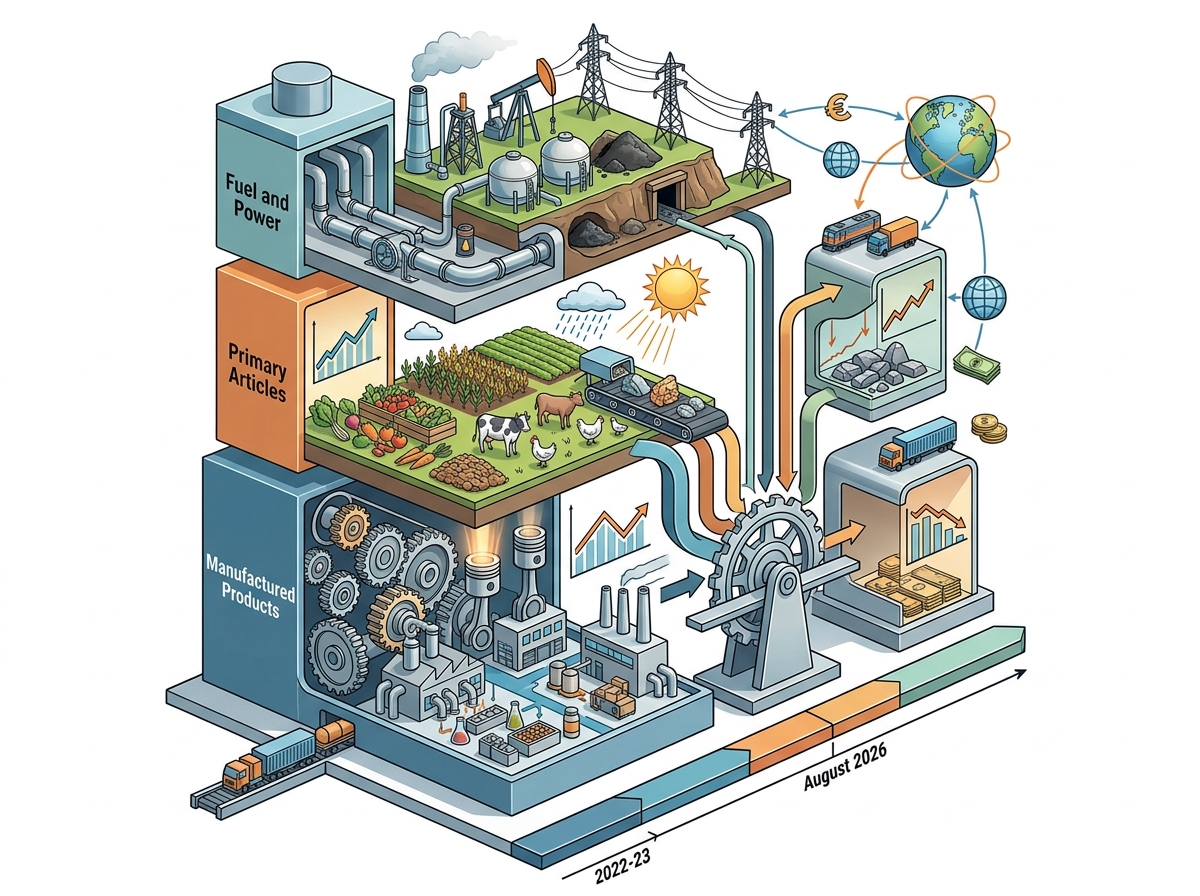
✎ WPI measures wholesale price changes in India with base year 2022-23; August 2026 WPI inflation stood at 9.92% YoY, driven by primary articles (7.76%), fuel and power (22.93%), and manufactured products (8.37%).
Subject Relevance — Where This Topic Fits
- GS Paper III — Indian Economy and Issues Relating to Planning, Mobilisation of Resources, Growth, Development and Employment
- Prelims: Wholesale Price Index (WPI), Inflation, Base Year Revisions, Producer Price Index (PPI), Index of Industrial Production (IIP), Price Monitoring Cell (PMC), Ministry of Commerce and Industry, Office of the Economic Adviser
- Essay: Economic Challenges of Inflation Management in India: Balancing Growth and Price Stability
Quick Revision: WPI measures wholesale price changes in India with base year 2022-23; August 2026 WPI inflation stood at 9.92% YoY, driven by primary articles (7.76%), fuel and power (22.93%), and manufactured products (8.37%).
Why is this in the news?
The Ministry of Commerce and Industry, Government of India, released the provisional Wholesale Price Index (WPI) for August 2026 (base year 2022-23) on 14 September 2026. This release is significant as it provides the latest inflation trajectory for key commodity groups, including primary articles, fuel and energy, and manufactured products, which are critical inputs for monetary policy formulation, fiscal planning, and industrial policy decisions. The data also reflects the impact of global commodity price movements and domestic supply-side factors on India’s inflation dynamics.
Background
- The Wholesale Price Index (WPI) is a price index that measures and monitors the changes in the price of goods in the wholesale market. It is compiled and published monthly by the Office of the Economic Adviser, Ministry of Commerce and Industry.
- WPI is a key indicator used by policymakers, including the Reserve Bank of India (RBI), for inflation targeting and monetary policy decisions, alongside the Consumer Price Index (CPI).
- The WPI basket comprises three major groups: Primary Articles, Fuel and Power, and Manufactured Products.
- The WPI is distinct from the Consumer Price Index (CPI), which measures retail inflation and is used for cost-of-living adjustments and wage negotiations.
- The WPI data is also utilised for deflating nominal values in national accounts, assessing industrial performance, and designing sector-specific policies.
What is the Wholesale Price Index (WPI)?
- The WPI is a measure of the average change in wholesale prices of goods over time. It is a Laspeyres-type price index, which uses a fixed basket of goods and their respective weights to calculate price changes.
- The base year for the current WPI series is 2022-23, which serves as the reference point (value = 100) for measuring price changes. This revision ensures that the index reflects the current composition of the Indian economy.
- The WPI basket includes a wide range of commodities such as food items, minerals, fuels, chemicals, textiles, machinery, and manufactured goods, classified into three main groups: Primary Articles, Fuel and Power, and Manufactured Products.
- The weights assigned to each commodity group are derived from the value of production or trade in the base year.
- The WPI is published monthly by the Office of the Economic Adviser, Ministry of Commerce and Industry, with provisional estimates released on the 14th of every month (or the next working day if the 14th is a holiday). Final estimates are revised subsequently.
- The WPI is used for short-term economic analysis, inflation targeting by the RBI, and as an input for the Index of Industrial Production (IIP) to measure real growth in industrial output.
Key Features
| Feature | Significance |
|---|---|
| Wholesale Price Index (WPI) Base Year 2022-23 | Serves as the official measure of producer price inflation in India, replacing the earlier base year (2011-12). It reflects price movements at the first point of bulk transaction, excluding indirect taxes and retail margins. |
| Year-on-Year (YoY) WPI Inflation Rate (August 2026) | Indicates the rate of increase in wholesale prices compared to August 2025. A YoY inflation rate of 9.92% suggests persistent upward pressure on producer prices, influencing cost-push inflation dynamics. |
| Weighted Response Rate (August 2026) | The WPI for August 2026 is compiled with an 84.4% weighted response rate, reflecting the proportion of representative commodities for which price data was collected. Lower response rates may introduce sampling bias. |
| Primary Articles Group Inflation (7.76% YoY) | Includes food items, non-food items, and minerals. Food inflation remains a critical driver of WPI, impacting rural incomes and food security. |
| Fuel & Energy Group Inflation (22.93% YoY) | Driven by petroleum products and coal. High fuel inflation transmits to transportation, manufacturing, and household costs, exacerbating cost-push inflation. |
| Manufactured Products Group Inflation (8.37% YoY) | Covers finished goods excluding food and fuel. Reflects industrial cost pressures, including raw material and wage costs. |
| Revised Final Index for June 2026 (110.3) | The final WPI for June 2026 was revised upward from 110.2 to 110.3, indicating an adjustment in price data collection or methodology. |
| WPI Food Index (7.05% YoY) | A sub-index tracking wholesale prices of food items. Persistent food inflation impacts nutritional security and agricultural policy interventions. |
Why it Matters
Macroeconomic Policy
- The WPI is a key input for monetary policy decisions by the Reserve Bank of India (RBI), particularly in assessing cost-push inflation pressures that may influence interest rate adjustments.
Fiscal Policy and Budgeting
Industrial Competitiveness
Agricultural and Rural Economy
Price Stability and Inflation Targeting
Challenges
1. COST-PUSH INFLATION PRESSURES
- Persistent high WPI inflation, particularly in fuel and energy (22.93% YoY), indicates structural supply-side constraints, including global oil price volatility and domestic energy sector inefficiencies.
- Manufactured products inflation (8.37% YoY) suggests rising input costs for industries, which may be passed on to consumers, exacerbating retail inflation.
UPSC Link: https://www.upsc.gov.in
2. DATA COLLECTION AND SAMPLING BIAS
- The weighted response rate for August 2026 (84.4%) is lower than the June 2026 final rate (99.3%), raising concerns about the representativeness of the WPI data.
- Discrepancies between provisional and final WPI estimates (e.g., June 2026 revision) highlight challenges in real-time price data collection and validation.
UPSC Link: https://pib.gov.in
3. FOOD INFLATION AND NUTRITIONAL SECURITY
- The WPI Food Index (7.05% YoY) reflects persistent food price inflation, which disproportionately affects low-income households and undermines food security goals.
- High food inflation may necessitate targeted interventions such as food subsidy expansions or buffer stock management, straining fiscal resources.
UPSC Link: https://fci.gov.in
4. INDUSTRIAL COST MANAGEMENT
- Rising WPI inflation in manufactured goods (8.37% YoY) indicates cost pressures on industries, including raw material and wage costs, which may reduce profitability and investment.
UPSC Link: https://msme.gov.in
5. GLOBAL COMMODITY PRICE VOLATILITY
- Fuel and energy inflation (22.93% YoY) is influenced by global crude oil prices, geopolitical tensions, and supply chain disruptions, which are beyond domestic policy control.
UPSC Link: https://commerce.gov.in
Challenges — UPSC Perspective
| Issue | Concern |
|---|---|
| High Fuel and Energy Inflation | Transmits to transportation, manufacturing, and household costs, exacerbating cost-push inflation. |
| Low Weighted Response Rate (84.4%) | Raises concerns about data representativeness and potential sampling bias in WPI compilation. |
| Persistent Food Inflation (7.05% YoY) | Impacts rural incomes, food security, and necessitates fiscal interventions such as subsidies. |
| Revisions in Final WPI Estimates | Indicates challenges in real-time price data collection and validation, affecting policy credibility. |
| Industrial Cost Pressures (8.37% YoY) | Reduces profitability and investment in manufacturing, impacting industrial competitiveness. |
| Global Commodity Price Volatility | Exposes domestic inflation to external shocks, limiting the effectiveness of domestic policy measures. |
Way Forward
- Enhance real-time price data collection mechanisms to improve the weighted response rate and reduce sampling bias in WPI compilation.
- Strengthen coordination between the Ministry of Commerce and Industry, RBI, and NITI Aayog to align WPI trends with monetary and fiscal policy responses.
- Implement structural reforms in the energy sector to reduce dependence on imported fuels and mitigate fuel price volatility.
- Expand agricultural productivity through investment in irrigation, technology adoption, and supply chain efficiency to stabilize food prices.
- Introduce targeted fiscal measures, such as food subsidy rationalization and buffer stock management, to address food inflation without straining fiscal resources.
- Monitor WPI trends closely for signs of second-round inflation effects, which may necessitate pre-emptive monetary policy adjustments by the RBI.
- Promote industrial cost management through input cost subsidies, energy efficiency programs, and skill development initiatives to enhance competitiveness.
UPSC Value Addition
Keywords for Mains Answer-Writing
Wholesale Price Index (WPI) · Inflation measurement · Base year revision · Primary articles inflation · Fuel and energy inflation · Manufactured products inflation · Price stability · Macroeconomic policy · Index of Industrial Production (IIP) · Consumer Price Index (CPI) · Price transmission mechanism · Commodity price volatility · Monetary policy transmission · Inflation targeting framework
Concept Flow
Global crude oil price volatility → Domestic fuel and energy inflation (22.93% YoY) → Transmission to transportation and manufacturing costs → Rise in WPI for manufactured products (8.37% YoY) → Agricultural supply chain inefficiencies → Food price inflation (7.05% YoY) → Impact on rural incomes and food security → Fiscal interventions (subsidies, buffer stocks) → High WPI inflation → Cost-push inflation pressures → Transmission to consumer price inflation (CPI) → RBI monetary policy response (interest rate adjustments) → Low weighted response rate (84.4%) → Potential sampling bias in WPI data → Impact on policy credibility and decision-making → Rising industrial costs → Reduced profitability and investment → Decline in industrial competitiveness → Impact on export growth and GDP
Prelims Practice Questions
Q1. Consider the following statements regarding the Wholesale Price Index (WPI) in India:
1. The WPI is compiled and released by the Office of the Economic Adviser, Ministry of Commerce and Industry.
2. The base year for WPI was revised to 2011-12 in 2017.
3. The WPI basket includes services sector components such as education and healthcare.
4. The WPI does not include indirect taxes in its calculation.
How many of the above statements are correct?
- Only one
- Only two
- Only three
- All four
Answer: Only three — Statements 1 and 4 are correct. The WPI is compiled by the Office of the Economic Adviser, Ministry of Commerce and Industry, and it does not include indirect taxes. Statement 2 is incorrect as the base year was revised to 2011-12 in 2017, not 2022-23. Statement 3 is incorrect as the WPI basket does not include services sector components.
Q2. Assertion (A): The Wholesale Price Index (WPI) is a more accurate measure of inflation than the Consumer Price Index (CPI) for policymakers.
Reason (R): The WPI captures price changes at the producer level, which are less influenced by retail margins and taxes.
In the context of the above two statements, which one of the following is correct?
- Both A and R are true and R is the correct explanation of A.
- Both A and R are true but R is not the correct explanation of A.
- A is true but R is false.
- A is false but R is true.
Answer: Both A and R are true but R is not the correct explanation of A. — The WPI measures price changes at the wholesale/producer level, making it a leading indicator of inflation trends. The CPI, on the other hand, reflects retail prices and is more influenced by taxes and distribution costs. Thus, the WPI is often preferred by policymakers for its broader coverage and timeliness.
Q3. Match the following columns related to inflation measurement in India:
Column I (Index) | Column II (Purpose)
A. Wholesale Price Index (WPI) | 1. Measures retail inflation for households
B. Consumer Price Index (CPI) | 2. Measures producer-level price changes
C. Producer Price Index (PPI) | 3. Measures price changes at the farm gate and factory gate
D. GDP Deflator | 4. Measures overall price level in the economy
Select the correct match:
- A-2, B-1, C-3, D-4
- A-3, B-1, C-2, D-4
- A-1, B-2, C-3, D-4
- A-4, B-3, C-2, D-1
Answer: A-3, B-1, C-2, D-4 — The WPI measures producer-level price changes (A-2), the CPI measures retail inflation for households (B-1), the PPI measures price changes at the farm gate and factory gate (C-3), and the GDP deflator measures the overall price level in the economy (D-4).
Mains Practice Question
✍ The Wholesale Price Index (WPI) remains a critical macroeconomic indicator for India despite the growing prominence of the Consumer Price Index (CPI) in policy discourse. Critically examine the relevance of WPI in contemporary Indian economic policy, with particular reference to its role in inflation measurement, price stability, and the transmission of monetary policy. Also, discuss the structural limitations of WPI in capturing the true cost of living for households. (15 Marks)
Approach: MODEL-ANSWER SKELETON:
1. **Introduction (2 Marks)**
– Define WPI: A measure of price changes at the wholesale/producer level, compiled by the Office of the Economic Adviser, Ministry of Commerce and Industry.
– Context: WPI is the oldest inflation measure in India (since 1942), with the base year revised to 2011-12 in 2017 and further to 2022-23 in recent years.
2. **Relevance of WPI in Contemporary Policy (6 Marks)**
– **Inflation Measurement**: WPI provides early signals of inflation trends due to its producer-level focus, useful for policymakers in anticipating CPI movements.
– **Price Stability**: The Reserve Bank of India (RBI) uses WPI data to assess supply-side pressures, particularly in primary articles (e.g., food, fuel) and manufactured goods.
– **Monetary Policy Transmission**: WPI helps evaluate the effectiveness of monetary policy in curbing inflation, especially in sectors like fuel and energy where price transmission is direct.
– **Comparative Advantage**: WPI excludes services and indirect taxes, making it a purer measure of production costs compared to CPI.
3. **Structural Limitations of WPI (5 Marks)**
– **Exclusion of Services**: WPI does not cover the services sector (e.g., education, healthcare), which constitutes over 50% of India’s GDP and household expenditure.
– **Retail Margins and Taxes**: WPI does not account for retail margins, distribution costs, or indirect taxes (e.g., GST), which significantly impact household budgets.
– **Weightage Bias**: The WPI basket (with weights like 24.99% for food) may not reflect the consumption patterns of households, where services and discretionary spending dominate.
– **Global Comparability**: WPI is less comparable internationally due to its narrow basket, whereas CPI is more aligned with global standards (e.g., IMF’s Consumer Price Index).
4. **Conclusion (2 Marks)**
– Balance: WPI remains indispensable for supply-side analysis and early inflation warnings but must be complemented with CPI and other indicators (e.g., GDP deflator) for a holistic view.
– Policy Suggestion: Enhance the WPI basket to include more services or develop a hybrid index that bridges the gap between WPI and CPI for better policy outcomes.
Source: PIB (Press Information Bureau)
Generated by AanyaAi for educational purpose.
Related guides on our sites
- Current affairs for upsc 2026
- Best PSIR optional coaching for upsc
- Best economics optional coaching for upsc
- Best PSIR optional teacher for upsc

- अगस्त 2026 में थोक मूल्य सूचकांक मुद्रास्फीति 9.92%: प्रमुख समूहों का विश्लेषण - September 14, 2026
- WPI Inflation August 2026: Key Highlights for UPSC & State PCS - September 14, 2026
- कोयला मंत्रालय ने किया विशेष अभियान 6.0 का शुभारंभ: जानिए प्रमुख लक्ष्य और उपलब्धियां - September 14, 2026

No Comments