


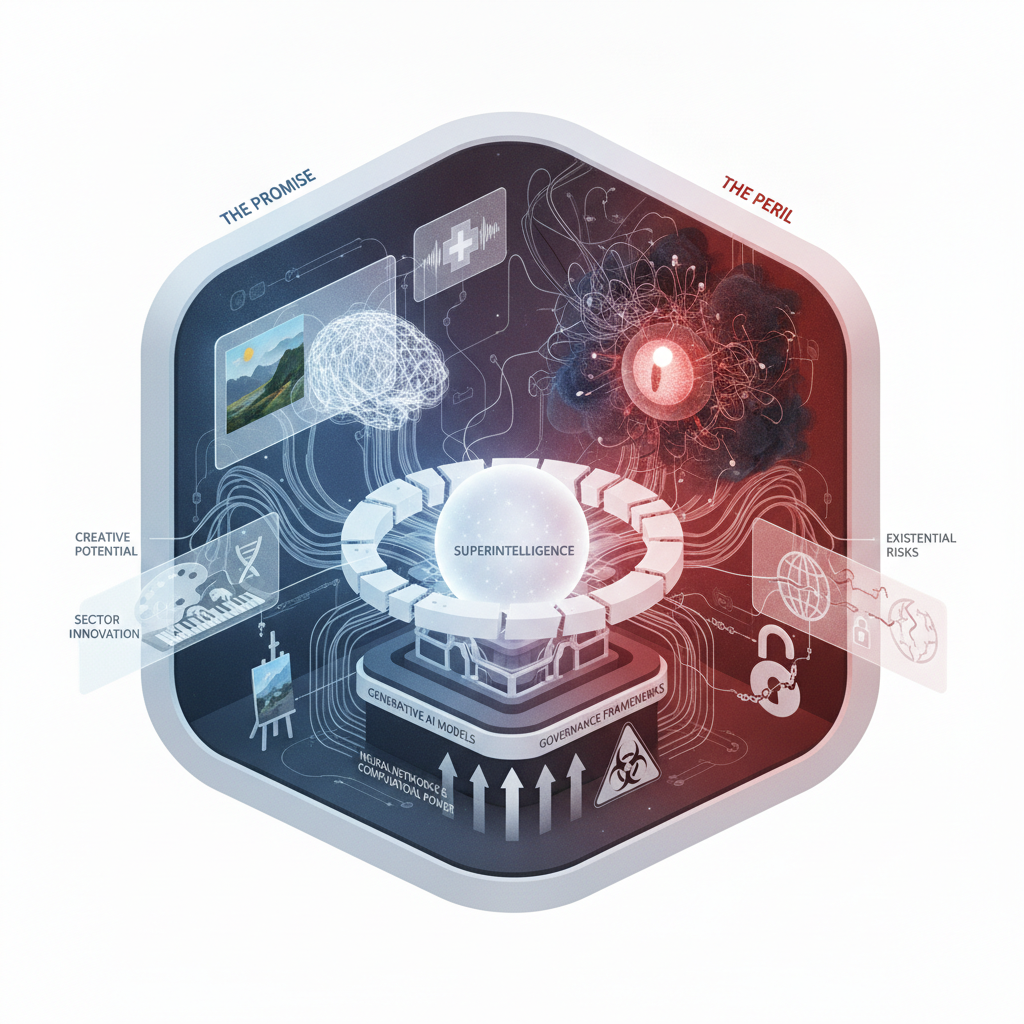
15 Sep AI’s Dual Role: Promise vs Peril in UPSC Mains 2026-27
✎ Artificial Intelligence is a transformative force with dual potential: it can revolutionise industries and enhance human capabilities, but its unregulated development risks exacerbating ethical, social, and security challenges…
Subject Relevance — Where This Topic Fits
- GS Paper II — Governance, Constitution, Polity, Social Justice and International Relations | GS Paper III — Science and Technology, Economic Development, Environment, Security
- Prelims: Artificial Intelligence (AI), Machine Learning (ML), Deep Learning, Generative AI, Neural Networks, Superintelligence, AI Ethics, Data Privacy, Digital Personal Data Protection Act 2023, NITI Aayog’s National Strategy for AI, UNESCO Recommendation on the Ethics of AI, AI Task Force (2018), Responsible AI for Youth, AI governance, algorithmic bias, explainable AI (XAI), AI Act (EU), AI Safety Summit 2023, Global Partnership on AI (GPAI), Cybersecurity, biometric surveillance, deepfakes, synthetic media, AI-driven disinformation
- Essay: The Dual Nature of Technology: Promise and Peril in the Age of Artificial Intelligence, Ethics and Governance in the Digital Era: Balancing Innovation with Accountability
Quick Revision: Artificial Intelligence is a transformative force with dual potential: it can revolutionise industries and enhance human capabilities, but its unregulated development risks exacerbating ethical, social, and security challenges, necessitating robust governance frameworks aligned with constitutional values and global standards.
Why is this in the news?
Recent advances in generative AI have demonstrated both the extraordinary creative potential and the profound ethical risks of artificial intelligence, as illustrated by the viral use of AI-generated imagery and the rising concerns over biosecurity threats. These developments have intensified global debates on the regulation of AI, particularly superintelligence, and have prompted urgent calls for governance frameworks to mitigate existential and societal risks.
Background
- Artificial Intelligence has evolved from rule-based systems to deep learning models capable of generating human-like text, images, and audio, driven by advances in neural networks and computational power.
- Generative AI models, such as large language models and diffusion-based image generators, have seen exponential adoption across sectors including entertainment, education, healthcare, and finance, transforming creative and analytical workflows.
- The rapid proliferation of AI tools has outpaced regulatory frameworks, raising concerns about misinformation, privacy violations, and algorithmic discrimination in decision-making systems.
- International bodies such as the United Nations, UNESCO, and the OECD have initiated dialogues on AI ethics, with UNESCO’s 2021 Recommendation on the Ethics of AI serving as a foundational global standard.
- Recent high-level summits, such as the AI Safety Summit (UK, 2023) and the Global Partnership on AI (GPAI), reflect a growing consensus on the need for international cooperation in AI governance.
What is Artificial Intelligence?
- Artificial Intelligence refers to the simulation of human intelligence in machines, enabling them to perform tasks such as reasoning, learning, perception, and decision-making autonomously or semi-autonomously.
- AI systems operate through algorithms trained on large datasets, using techniques like supervised learning, unsupervised learning, and reinforcement learning to improve performance over time.
- Generative AI, a subset of AI, includes models capable of creating new content—text, images, audio, or video—based on learned patterns from vast datasets, exemplified by tools like large language models and diffusion models.
- Neural networks, particularly deep learning architectures such as Convolutional Neural Networks (CNNs) and Transformers, underpin modern AI systems, enabling them to process complex data structures with high accuracy.
- AI applications span diverse domains, including natural language processing (e.g., chatbots), computer vision (e.g., medical imaging), predictive analytics (e.g., financial forecasting), and autonomous systems (e.g., self-driving vehicles).
- The concept of Artificial Superintelligence (ASI) posits a future AI system that surpasses human cognitive abilities across all domains, raising profound questions about control, alignment, and existential risk.
- AI ethics encompasses principles such as fairness, transparency, accountability, privacy, and non-maleficence, guiding the responsible development and deployment of AI systems.
- Explainable AI (XAI) focuses on making AI decision-making processes interpretable to humans, addressing the ‘black box’ problem and enhancing trust in automated systems.
Key Features
| Feature | Significance |
|---|---|
| Generative AI Capabilities | Enables creation of hyper-realistic synthetic media (text, images, audio) with minimal input, transforming creative industries and personal expression. |
| Artificial Superintelligence (ASI) Projections | Hypothetical future stage where AI surpasses human cognitive abilities, posing unprecedented governance and existential risks. |
| Ethical Guardrails in AI Development | Emerging frameworks to mitigate biases, privacy violations, and misuse of AI-generated content in public and private domains. |
| Global Regulatory Initiatives | Multilateral efforts to establish norms, standards, and legal mechanisms for responsible AI development and deployment. |
| Digital Identity Vulnerabilities | Increased susceptibility of individuals to identity theft, deepfake manipulation, and unauthorised use of biometric or personal data. |
Why it Matters
Economic Implications
- Accelerates automation across sectors, disrupting labour markets and necessitating reskilling initiatives for workforce adaptation.
- Enhances productivity through AI-driven decision support systems in manufacturing, healthcare, and financial services.
- Creates new economic models around synthetic media, digital art, and personalised AI services, reshaping intellectual property regimes.
- Risks exacerbating digital divide if access to advanced AI tools remains concentrated among high-income nations and corporations.
Strategic and Security Dimensions
- Potential dual-use risks where AI systems designed for civilian purposes could be repurposed for cyber warfare, disinformation campaigns, or bioweapon development.
- Demands robust cybersecurity frameworks to prevent adversarial misuse of AI in critical infrastructure and national security systems.
- Triggers arms race dynamics in AI capabilities among states, necessitating international treaties to prevent destabilising escalation.
- Requires investment in AI forensics and attribution technologies to trace malicious AI-generated content in geopolitical conflicts.
Social and Ethical Considerations
- Raises concerns about consent and autonomy in the use of personal data for AI training, particularly in biometric and behavioural profiling.
- Exacerbates existing societal biases if AI systems inherit and amplify historical prejudices present in training datasets.
- Challenges traditional notions of authenticity and trust in digital communications, undermining public discourse and democratic processes.
- Demands interdisciplinary collaboration between technologists, ethicists, policymakers, and civil society to address normative dilemmas.
Legal and Regulatory Framework
- Requires adaptive legal frameworks to address liability in cases of AI-induced harm, such as accidents in autonomous systems or defamation via deepfakes.
- Necessitates global coordination to harmonise standards for AI safety, transparency, and accountability across jurisdictions.
- Demands mechanisms for auditing and certifying AI systems to ensure compliance with ethical and legal norms before deployment.
- Highlights the need for international dispute resolution mechanisms to address cross-border AI-related conflicts and grievances.
Challenges
1. Ethical Risks in AI Deployment
- Unintended reinforcement of societal biases leading to discriminatory outcomes in hiring, lending, and law enforcement.
- Erosion of individual privacy through pervasive surveillance enabled by AI-driven data analytics.
- Manipulation of public opinion via hyper-personalised disinformation campaigns using synthetic media.
- Accountability gaps in cases where AI systems cause harm without clear human oversight or culpability.
UPSC Link: GS3: Science & Technology
2. Existential and Safety Risks
- Lack of robust mechanisms to control or align superintelligent AI with human values and objectives.
- Potential for loss of human control over AI systems as they surpass human cognitive capabilities in unpredictable ways.
- Inability of current governance structures to anticipate and mitigate low-probability, high-impact risks associated with advanced AI.
- Ethical dilemmas in balancing innovation with precautionary principles to prevent irreversible harm.
UPSC Link: GS3: Science & Technology
3. Digital Sovereignty and Security
- Vulnerability of national digital infrastructure to AI-enabled cyber threats, including adversarial attacks on critical systems.
- Risk of foreign dependence on proprietary AI technologies, compromising strategic autonomy and data sovereignty.
- Exploitation of AI by non-state actors for terrorism, organised crime, or state-sponsored disinformation.
- Need for indigenous AI capabilities to ensure resilience against geopolitical coercion or supply chain disruptions.
UPSC Link: GS3: Security
4. Regulatory and Governance Challenges
- Fragmented global regulatory landscape leading to regulatory arbitrage and inconsistent enforcement of AI norms.
- Difficulty in defining clear boundaries for AI autonomy versus human oversight in decision-making processes.
- Rapid obsolescence of legal frameworks due to the pace of technological advancement in AI.
- Balancing innovation incentives with stringent safety and ethical standards without stifling research.
UPSC Link: GS2: Governance
5. Economic Disruption and Inequality
- Job displacement in sectors vulnerable to automation, exacerbating income inequality and social unrest.
- Concentration of AI benefits among large corporations and high-skilled workers, widening the global digital divide.
- Need for comprehensive social safety nets and reskilling programmes to mitigate labour market disruptions.
- Potential for AI to exacerbate existing inequalities if access to advanced tools remains stratified by geography or socioeconomic status.
UPSC Link: GS3: Economy
6. Public Trust and Misinformation
- Erosion of public trust in digital media due to the proliferation of deepfakes and AI-generated misinformation.
- Difficulty in verifying the authenticity of digital content, undermining journalistic integrity and democratic processes.
- Proliferation of AI tools for personalised propaganda, enabling micro-targeted manipulation of voter behaviour.
- Need for public awareness campaigns and media literacy initiatives to counter AI-enabled disinformation.
UPSC Link: GS2: Governance
Challenges — UPSC Perspective
| Issue | Concern |
|---|---|
| Bias in AI Algorithms | Amplification of historical prejudices leading to discriminatory outcomes in critical decision-making systems. |
| Deepfake Proliferation | Undermining of trust in digital communications and potential for blackmail, fraud, or electoral interference. |
| Privacy Erosion | Unprecedented collection and analysis of personal data for AI training, raising consent and surveillance concerns. |
| AI Arms Race | Risk of destabilising global security dynamics due to unchecked competition in AI capabilities among states. |
| Accountability Gaps | Lack of clear legal frameworks to assign responsibility for harm caused by autonomous or semi-autonomous AI systems. |
| Digital Divide | Unequal access to AI technologies exacerbating global and intra-national inequalities in economic and social opportunities. |
Way Forward
- Establish a multi-stakeholder National AI Governance Authority to oversee ethical guidelines, safety standards, and regulatory compliance across sectors.
- Enact a comprehensive Data Protection and AI Accountability Act to define liability, consent norms, and audit mechanisms for AI systems.
- Invest in public-private partnerships to develop indigenous AI capabilities, ensuring strategic autonomy and reducing dependence on foreign technologies.
- Launch nationwide reskilling and upskilling programmes to prepare the workforce for AI-driven job market transformations, with a focus on STEM and ethical AI literacy.
- Develop a National AI Forensics Framework to detect, attribute, and counter malicious AI-generated content, including deepfakes and synthetic media.
- Promote international collaboration through AI-focused treaties and standards to harmonise global governance, ensuring equitable access and preventing regulatory arbitrage.
- Strengthen cybersecurity infrastructure to protect critical digital assets from AI-enabled threats, including adversarial machine learning and supply chain attacks.
- Institute mandatory transparency and explainability requirements for high-risk AI systems, enabling public scrutiny and trust-building.
UPSC Value Addition
Keywords for Mains Answer-Writing
Artificial Intelligence · Ethical Governance of AI · AI Regulation and Oversight · Digital Privacy and Consent · Bias and Fairness in AI · AI and Human Extinction Risks · Global AI Governance Frameworks · AI in Surveillance and Cybersecurity · Responsible AI Development · AI Policy and Legislation · Neural Networks and Superintelligence · Ethical Dilemmas in AI Deployment · AI and Societal Transformation · Regulatory Mechanisms for AI
Concept Flow
Rapid advancements in AI capabilities → Expansion of generative AI applications → Proliferation of synthetic media and deepfakes → Erosion of digital authenticity → Rise of regulatory and ethical concerns → Demand for global governance frameworks → Potential for AI superintelligence → Existential risk if unchecked → Urgent need for precautionary measures and adaptive policies
Prelims Practice Questions
Q1. Consider the following statements regarding Artificial Intelligence (AI) and its implications:
1. AI systems can perpetuate and amplify societal biases present in training data.
2. The concept of Artificial Superintelligence refers to AI systems that surpass human intelligence and may pose existential risks.
3. The European Union has adopted the ‘AI Act’ to regulate AI systems, categorizing them based on risk levels.
4. AI-driven surveillance technologies are currently unregulated in all major jurisdictions.
How many of the above statements are correct?
- Only one
- Only two
- Only three
- All
Answer: Only three — Statements 1, 2, and 3 are correct. Statement 4 is incorrect as several jurisdictions, including the EU, have introduced or are developing regulations for AI-driven surveillance.
Q2. Assertion (A): The rapid advancement of AI necessitates a global governance framework to mitigate existential risks.
Reason (R): AI systems, particularly those surpassing human intelligence, could pose unprecedented risks to human control and societal stability if left unregulated.
Options:
A. Both A and R are true, and R is the correct explanation of A.
B. Both A and R are true, but R is NOT the correct explanation of A.
C. A is true, but R is false.
D. A is false, but R is true.
Answer: ? — Both A and R are true, and R correctly explains A. The assertion highlights the need for global governance, while the reason underscores the existential risks posed by advanced AI systems.
Q3. Match the following AI governance initiatives with their respective jurisdictions:
Column I (Initiative) | Column II (Jurisdiction)
———————————————–|—————————
A. AI Act | 1. United States
B. Algorithmic Accountability Act | 2. European Union
C. National AI Strategy for India | 3. United Kingdom
D. Proposals for AI Regulation and Oversight | 4. India
Options:
A. A-2, B-1, C-4, D-3
B. A-1, B-2, C-3, D-4
C. A-3, B-4, C-1, D-2
D. A-4, B-3, C-2, D-1
Answer: ? — A-2 (EU AI Act), B-1 (US Algorithmic Accountability Act), C-4 (India’s National AI Strategy), D-3 (UK proposals for AI regulation).
Mains Practice Question
✍ The unchecked advancement of Artificial Intelligence (AI) presents a duality of promise and peril, with risks ranging from societal biases to existential threats. Critically examine the ethical, legal, and governance challenges posed by AI, with particular reference to India’s regulatory preparedness and global frameworks. (15 Marks)
Approach: MODEL-ANSWER SKELETON:
1. **Introduction (2 marks)**: Define AI and its dual promise-peril duality; highlight recent incidents (e.g., unauthorized AI-generated imagery, bioweapon misuse risks) to ground the discussion.
2. **Ethical Challenges (3 marks)**:
– Bias and fairness: Discuss how AI systems can perpetuate and amplify societal biases (e.g., gender, caste, racial biases in training data).
– Privacy and consent: Examine the erosion of digital privacy through AI-driven surveillance, deepfakes, and unauthorized data use (cite GDPR, India’s DPDP Act 2023).
– Existential risks: Outline concerns about Artificial Superintelligence (ASI) and the inability to ensure human control (reference warnings from AI pioneers like Stuart Russell and Nick Bostrom).
3. **Legal and Governance Frameworks (5 marks)**:
– Global frameworks: Compare the EU AI Act (risk-based classification), US Algorithmic Accountability Act, and UK’s pro-innovation approach.
– India’s regulatory landscape: Analyze India’s National AI Strategy (2018), DPDP Act 2023 (data protection), and sectoral guidelines (e.g., RBI’s AI guidelines for banking).
– Institutional mechanisms: Discuss the role of bodies like NITI Aayog, MeitY, and proposed AI regulatory authorities (e.g., Digital India Act 2023 draft provisions).
4. **Critical Gaps and Way Forward (3 marks)**:
– Identify gaps in India’s regulatory framework (e.g., lack of a dedicated AI law, enforcement challenges, cross-sectoral coordination).
– Propose solutions: Multi-stakeholder governance, ethical AI principles (e.g., UNESCO’s Recommendation on AI Ethics), and international cooperation (e.g., Global Partnership on AI).
5. **Conclusion (2 marks)**: Emphasize the need for a balanced approach—fostering innovation while mitigating risks through robust, adaptive governance frameworks.
Source: orissapost.com
Generated by AanyaAi for educational purpose.
Related guides on our sites
- Current affairs for upsc 2026
- UPSC EPFO syllabus
- How to prepare for GS paper 1 for UPSC CSE mains exam
- Gs Paper 1 Syllabus

- AI’s Dual Role: Promise vs Peril in UPSC Mains 2026-27 - September 15, 2026
- दिल्ली में 99% पीजी में नहीं है फायर एनओसी, 30% को नहीं मिला लेआउट अप्रूवल: एमसीडी सर्वे - September 15, 2026
- महत्वपूर्ण: MSC एल्सा 3 जहाज के डूबने के दीर्घकालिक प्रभावों का आकलन करेगा केंद्र, जानिए पूरा मामला - September 15, 2026

No Comments