


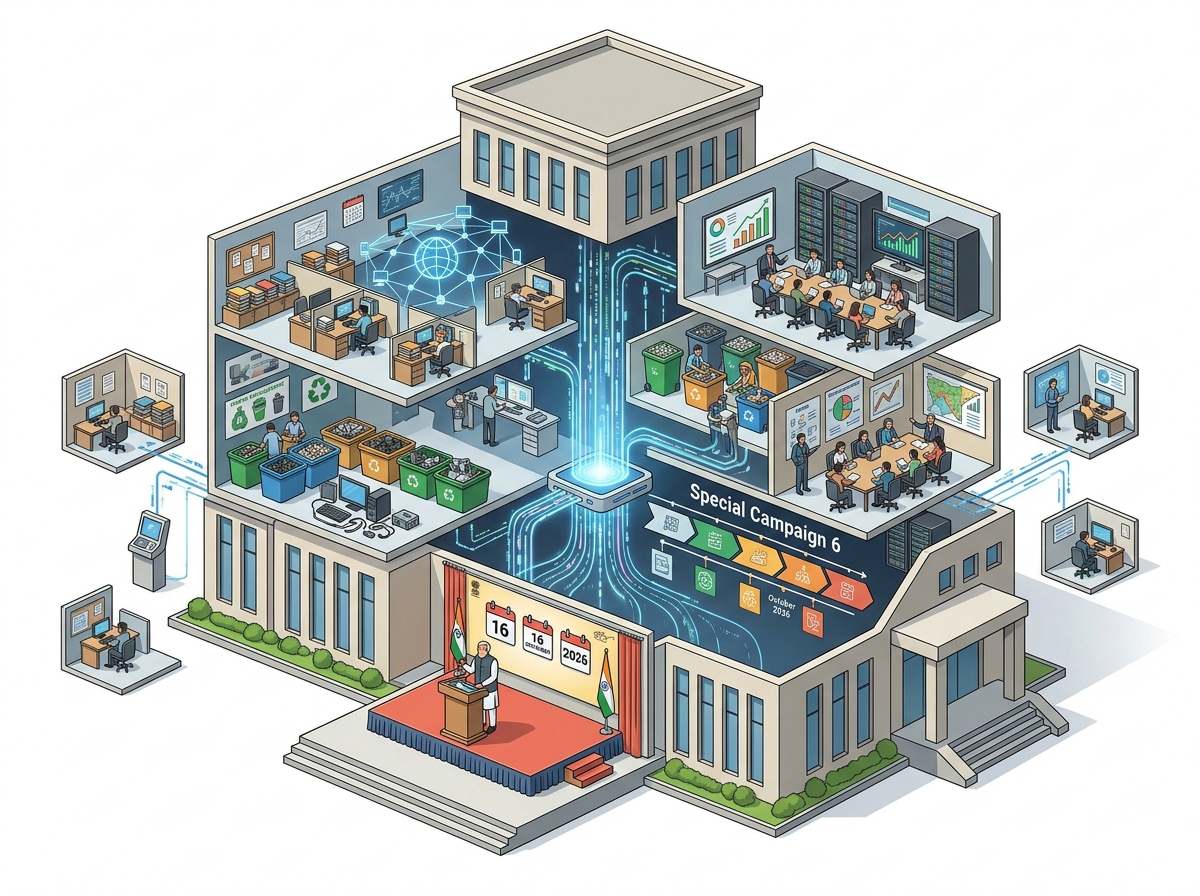
15 Sep Union Minister to Launch Special Campaign 6 Web-Portal on 16 Sept 2026
✎ Special Campaign 6 (16 Sep–31 Oct 2026) is a government-wide cleanliness and efficiency drive coordinated by DARPG, featuring a dedicated web-portal for real-time monitoring, e-waste management focus, and preparation for Sushasan…
Subject Relevance — Where This Topic Fits
- GS Paper II — Governance, Transparency and Accountability | GS Paper III — Environment and Sustainable Development | GS Paper IV — Ethics in Governance
- Prelims: Special Campaign 6, e-waste management, Department of Administrative Reforms and Public Grievances (DARPG), Sushasan Saptah, Government web-portals for transparency, Cabinet Secretariat directives, Nodal officers for campaigns
- Essay: E-governance as a tool for administrative efficiency and citizen-centric governance, Sustainable waste management in public institutions: Balancing development and environmental responsibility
Quick Revision: Special Campaign 6 (16 Sep–31 Oct 2026) is a government-wide cleanliness and efficiency drive coordinated by DARPG, featuring a dedicated web-portal for real-time monitoring, e-waste management focus, and preparation for Sushasan Saptah 2026.
Why is this in the news?
The launch of a dedicated web-portal for Special Campaign 6 by the Union Minister Dr. Jitendra Singh on 16 September 2026 marks a significant step in institutionalising cleanliness, efficiency, and digital monitoring in government offices across India. This initiative, coordinated by the Department of Administrative Reforms and Public Grievances (DARPG), aims to streamline administrative processes, reduce pendency of files, and enhance sustainable waste management, including e-waste, during the campaign period from 2 to 31 October 2026.
Background
- Special Campaigns were initiated in 2021 as a government-wide effort to institutionalise cleanliness and reduce pendency in government offices.
- The campaigns are coordinated by the Department of Administrative Reforms and Public Grievances (DARPG), under the Ministry of Personnel, Public Grievances and Pensions.
- Over five editions (2021–2025), the campaigns have covered 24.20 lakh sites, disposed of 180.48 lakh files, and generated revenue of ₹5,102.91 crore through scrap disposal.
- Special Campaign 5 alone covered 11.6 lakh sites, disposed of 29.52 lakh files, freed 233.75 lakh sq. ft. of office space, and generated ₹833.92 crore.
- The campaigns include innovative practices documented and evaluated during Sushasan Saptah (Good Governance Week) in December each year.
- The Prime Minister’s ‘Mann Ki Baat’ has acknowledged the achievements and innovations of these campaigns.
What is Special Campaign 6?
- Special Campaign 6 is the sixth edition of an annual government-wide initiative launched by the Union Government to institutionalise cleanliness, reduce pendency of files, and improve administrative efficiency in all ministries, departments, and their subordinate offices, including regional and foreign missions.
- The campaign is divided into two phases: a preparation phase (16–30 September 2026) and an implementation phase (2–31 October 2026).
- The preparation phase involves identifying pending tasks, deploying ground-level staff, finalising campaign sites, reviewing records, preparing space management plans, and identifying scrap material.
- The implementation phase focuses on e-waste management and the adoption of citizen-centric best practices.
- A dedicated web-portal (https://scdpm.nic.in/SCDPM26) has been launched to monitor progress, track pendency, and facilitate real-time reporting by nodal officers across all ministries and departments.
- The campaign emphasises sustainable waste management, particularly the effective collection, segregation, and disposal of e-waste, aligning with the Government of India’s broader environmental and digital governance objectives.
- Best practices identified during the campaign will be documented and showcased during Sushasan Saptah 2026 (19–25 December 2026) for wider dissemination and replication.
- The campaign is guided by detailed guidelines issued by DARPG on 13 August 2026 and directives from the Cabinet Secretary to all secretaries on 5 August 2026.
Key Features
| Feature | Significance |
|---|---|
| Dedicated Web-Portal for Special Campaign 6 | Facilitates real-time monitoring, progress tracking, and transparent reporting of campaign activities across 84 ministries/departments, ensuring accountability and stakeholder engagement. |
| Two-Phase Implementation (Preparation: 16–30 Sep 2026; Execution: 2–31 Oct 2026) | Structured approach ensures systematic identification of pending tasks, ground-level mobilization, and phased execution to maximize efficiency and coverage. |
| Focus on E-Waste Management | Addresses environmental sustainability by mandating effective collection, segregation, and disposal of electronic waste, aligning with circular economy principles. |
| Inclusion of Field Offices and Missions Abroad | Extends the campaign’s reach to regional, external offices, and Indian missions, ensuring uniform implementation across all government units. |
| Best Practices Repository for SuShasan Saptah 2026 | Documentation of innovative initiatives for dissemination during SuShasan Saptah (Dec 2026), promoting replicability and institutional learning. |
Why it Matters
Administrative Reforms and Governance
- Institutionalizes cleanliness and efficiency in government offices through structured campaigns, reducing pendency and improving service delivery.
- Demonstrates the government’s commitment to administrative efficiency, transparency, and citizen-centric practices.
- Provides a scalable model for periodic review and reform in public administration, with measurable outcomes in file disposal and revenue generation.
Environmental Sustainability
- Promotes responsible e-waste management, contributing to environmental protection and compliance with e-waste management rules.
- Aligns with national and international sustainability goals, including the Swachh Bharat Mission and circular economy principles.
- Generates revenue through scrap disposal, demonstrating economic viability alongside environmental benefits.
Economic Impact
- Revenue generation from scrap disposal (₹5,102.91 crore in previous campaigns) enhances financial efficiency in government operations.
- Optimization of office space (233.75 lakh sq. ft. freed in Special Campaign 5) reduces operational costs and improves resource utilization.
- Encourages innovation in waste management, potentially creating new economic opportunities in recycling and green technologies.
Institutional Learning and Capacity Building
- Documentation of best practices and their dissemination during SuShasan Saptah fosters a culture of continuous improvement.
- Engagement of nodal officers across ministries ensures cross-departmental collaboration and shared learning.
- Real-time monitoring via the web-portal enables data-driven decision-making and corrective actions.
Challenges
1. Scalability and Uniform Implementation
- Ensuring consistent participation and adherence to guidelines across 84 ministries, 700+ departments, and diverse field offices.
- Addressing logistical challenges in e-waste collection and disposal, particularly in remote or resource-constrained regions.
- Maintaining momentum post-campaign to prevent relapse into pre-intervention practices.
UPSC Link: GS-II: Governance, Transparency
2. Stakeholder Engagement and Behavioral Change
- Overcoming resistance to change among government employees accustomed to traditional workflows and documentation practices.
- Ensuring active participation from ground-level staff, including support staff and field officers, who are critical to implementation.
- Balancing campaign objectives with routine administrative functions to avoid disruption of essential services.
UPSC Link: GS-IV: Ethics, Human Interface
3. Data Integrity and Monitoring
- Ensuring accurate reporting of progress, file disposal, and revenue generation to maintain transparency and credibility.
- Addressing potential data manipulation or underreporting, especially in large-scale campaigns with multiple stakeholders.
- Leveraging technology effectively to minimize manual errors and enhance real-time tracking.
UPSC Link: GS-II: Transparency & Accountability
4. Environmental and Regulatory Compliance
- Adhering to the E-Waste (Management) Rules, 2022, and other environmental regulations during collection and disposal.
- Ensuring safe handling and disposal of hazardous e-waste to prevent environmental degradation or health hazards.
- Coordinating with state pollution control boards and local authorities for compliance and monitoring.
UPSC Link: GS-III: Environment, Conservation
5. Resource Allocation and Budgetary Constraints
- Allocating adequate financial and human resources for campaign preparation, execution, and post-campaign follow-up.
- Balancing campaign priorities with other developmental and welfare schemes to avoid resource dilution.
- Ensuring cost-effectiveness in e-waste management, including transportation, segregation, and disposal.
UPSC Link: GS-III: Resource Mobilisation
Challenges — UPSC Perspective
| Issue | Concern |
|---|---|
| Inter-Ministerial Coordination | Ensuring seamless collaboration and alignment of objectives across diverse ministries with varying priorities. |
| E-Waste Logistics | Challenges in transporting e-waste from dispersed locations to centralized disposal facilities. |
| Employee Resistance | Overcoming inertia and skepticism among staff regarding the necessity and benefits of the campaign. |
| Data Accuracy | Risk of discrepancies in reporting due to manual processes or lack of standardized data collection methods. |
| Post-Campaign Sustainability | Preventing backsliding into pre-campaign practices once the campaign concludes. |
| Regulatory Compliance | Adherence to evolving environmental laws and ensuring third-party certification for disposal processes. |
Way Forward
- Conduct pre-campaign sensitization workshops for nodal officers and ground-level staff to ensure clarity on objectives and processes.
- Establish a dedicated helpline and grievance redressal mechanism to address implementation challenges in real time.
- Develop a standardized template for data reporting to ensure consistency and accuracy across all ministries/departments.
- Partner with certified e-waste recyclers and state pollution control boards to streamline collection and disposal processes.
- Incentivize best practices through recognition awards during SuShasan Saptah to motivate participation and innovation.
- Integrate the campaign’s monitoring framework with existing governance platforms (e.g., CPGRAMS) for seamless tracking.
- Conduct mid-campaign reviews to identify bottlenecks and implement corrective measures promptly.
- Document case studies of successful interventions to serve as reference material for future campaigns.
UPSC Value Addition
Keywords for Mains Answer-Writing
Special Campaign 6 · Administrative Reforms and Public Grievances Department (DARPG) · Swachhata Abhiyan · E-waste management · Government e-services · Nodal officers · Sushasan Saptah · Office cleanliness · Pending files disposal · Revenue from scrap disposal · Institutionalising cleanliness · Governance reforms · Digital governance · Public accountability · Ministry of Personnel, Public Grievances and Pensions
Constitutional & Policy Linkages
- [‘Article 41: Directive Principles of State Policy (Promotion of Welfare)’, “Reinforces the state’s obligation to ensure cleanliness and efficiency in public administration.”]
- [‘Article 51A(g): Fundamental Duties (Environmental Protection)’, ‘Encourages citizens and institutions to protect and improve the natural environment.’]
Concept Flow
Government offices accumulate physical and digital pendency over time → Leads to inefficiency, delayed service delivery, and environmental harm (e.g., e-waste). → Special Campaigns (since 2021) are launched as structured interventions to address pendency and institutionalize cleanliness. → Preparation Phase (16–30 Sep 2026): Identification of pending tasks, ground-level mobilization, and resource allocation. → Execution Phase (2–31 Oct 2026): Implementation of best practices, file disposal, and e-waste management across all offices. → Monitoring via Dedicated Web-Portal: Ensures transparency, real-time tracking, and accountability. → Post-Campaign: Documentation of best practices and dissemination during SuShasan Saptah (Dec 2026) for institutional learning. → Outcomes: Reduced pendency, revenue generation, environmental sustainability, and improved governance.
Prelims Practice Questions
Q1. Consider the following statements regarding the Special Campaign 6 launched by the Government of India:
1. The Special Campaign 6 is scheduled to be implemented from 2 to 31 October 2026.
2. The preparation phase for Special Campaign 6 will be from 16 to 30 September 2026.
3. The focus of Special Campaign 6 includes effective collection, segregation, and disposal of e-waste.
4. The campaign is coordinated by the Ministry of Environment, Forest and Climate Change.
How many of the above statements are correct?
- Only one
- Only two
- Only three
- All four
Answer: Only three — Statements 1, 2, and 3 are correct. Statement 4 is incorrect as the campaign is coordinated by the Department of Administrative Reforms and Public Grievances (DARPG) under the Ministry of Personnel, Public Grievances and Pensions.
Q2. Assertion (A): The Special Campaign series initiated by the Government of India aims to institutionalise cleanliness and reduce pendency in government offices.
Reason (R): The campaigns have resulted in significant revenue generation from scrap disposal and disposal of pending files across government offices.
(a) Both A and R are true, and R is the correct explanation of A
(b) Both A and R are true, but R is NOT the correct explanation of A
(c) A is true, but R is false
(d) A is false, but R is true
- (a)
- (b)
- (c)
- (d)
Answer: (b) — Both Assertion (A) and Reason (R) are true. The campaigns aim to institutionalise cleanliness and reduce pendency. The revenue generation from scrap disposal is a consequence of these efforts, making R a correct explanation of A.
Q3. Match the following phases of Special Campaign 6 with their respective durations:
Column I (Phase) | Column II (Duration)
——————————————-|—————————————-
A. Preparation Phase | 1. 16 September 2026 to 30 September 2026
B. Implementation Phase | 2. 2 October 2026 to 31 October 2026
C. Review and Documentation Phase | 3. 1 September 2026 to 15 September 2026
D. Sushasan Saptah Presentation | 4. 19 December 2026 to 25 December 2026
- A-1, B-2, C-3, D-4
- A-2, B-1, C-3, D-4
- A-3, B-2, C-1, D-4
- A-1, B-3, C-2, D-4
Answer: A-1, B-2, C-3, D-4 — The correct match is: A (Preparation Phase) – 1 (16 September 2026 to 30 September 2026), B (Implementation Phase) – 2 (2 October 2026 to 31 October 2026), C (Review and Documentation Phase) – 3 (not explicitly mentioned but logically precedes D), D (Sushasan Saptah Presentation) – 4 (19 December 2026 to 25 December 2026).
Mains Practice Question
✍ The Special Campaign series, launched annually since 2021, represents a flagship governance reform initiative aimed at institutionalising cleanliness and reducing pendency in government offices. In this context, critically examine the significance of Special Campaign 6, scheduled for October 2026, and analyse how it aligns with broader objectives of administrative efficiency and citizen-centric governance. (15 Marks)
Approach: MODEL-ANSWER SKELETON:
1. **Introduction**: Define Special Campaign series and its objectives (institutionalising cleanliness, reducing pendency, revenue generation from scrap disposal). Mention the timeline for Special Campaign 6 (preparation: 16-30 Sept 2026; implementation: 2-31 Oct 2026).
2. **Significance of Special Campaign 6**:
– **Administrative Efficiency**: Highlight the role of DARPG as the nodal department and the involvement of 84 ministries/departments. Mention the scale of previous campaigns (e.g., Special Campaign 5 covered 11.6 lakh sites, disposed 29.52 lakh files, and generated ₹833.92 crore from scrap disposal).
– **Citizen-Centric Governance**: Emphasise the focus on best practices, inclusivity, and e-waste management. Link to the broader goal of improving service delivery and public accountability.
– **Revenue Generation**: Cite the revenue earned from scrap disposal (e.g., ₹5,102.91 crore across all campaigns) and its potential reinvestment in governance infrastructure.
3. **Alignment with Broader Objectives**:
– **Sushasan Saptah**: Explain the role of Sushasan Saptah (19-25 Dec 2026) in reviewing and documenting best practices from the campaign.
– **Digital Governance**: Highlight the launch of a dedicated web-portal for monitoring progress, which aligns with the Digital India mission.
– **Sustainability**: Discuss the emphasis on e-waste management as part of India’s commitment to environmental sustainability and the Swachh Bharat Mission.
4. **Challenges and Way Forward**:
– **Scalability**: Discuss the challenge of scaling the campaign across all ministries, including regional and foreign offices.
– **Sustained Impact**: Highlight the need for post-campaign monitoring to ensure long-term institutionalisation of cleanliness and efficiency.
– **Citizen Participation**: Suggest mechanisms for greater citizen involvement in reporting pendency and inefficiencies.
5. **Conclusion**: Summarise the transformative potential of Special Campaign 6 in improving governance quality and suggest that its success will depend on sustained political will, administrative commitment, and technological integration.
Source: PIB (Press Information Bureau)
Generated by AanyaAi for educational purpose.
Related guides on our sites
- Best PSIR optional coaching for upsc
- Best PSIR optional teacher for upsc
- Best teacher of PSIR optional for upsc
- Best PSIR optional coaching in delhi for UPSC

- Union Minister to Launch Special Campaign 6 Web-Portal on 16 Sept 2026 - September 15, 2026
- UPSC Civil Services (Main) Examination 2026 — Tamil Literature Paper I: Question Paper | Plutus IAS - September 15, 2026
- उत्तराखंड सीएम धामी ने चारधाम यात्रा की ऑनलाइन समीक्षा बैठक की, जानिए तैयारी - September 15, 2026

No Comments