


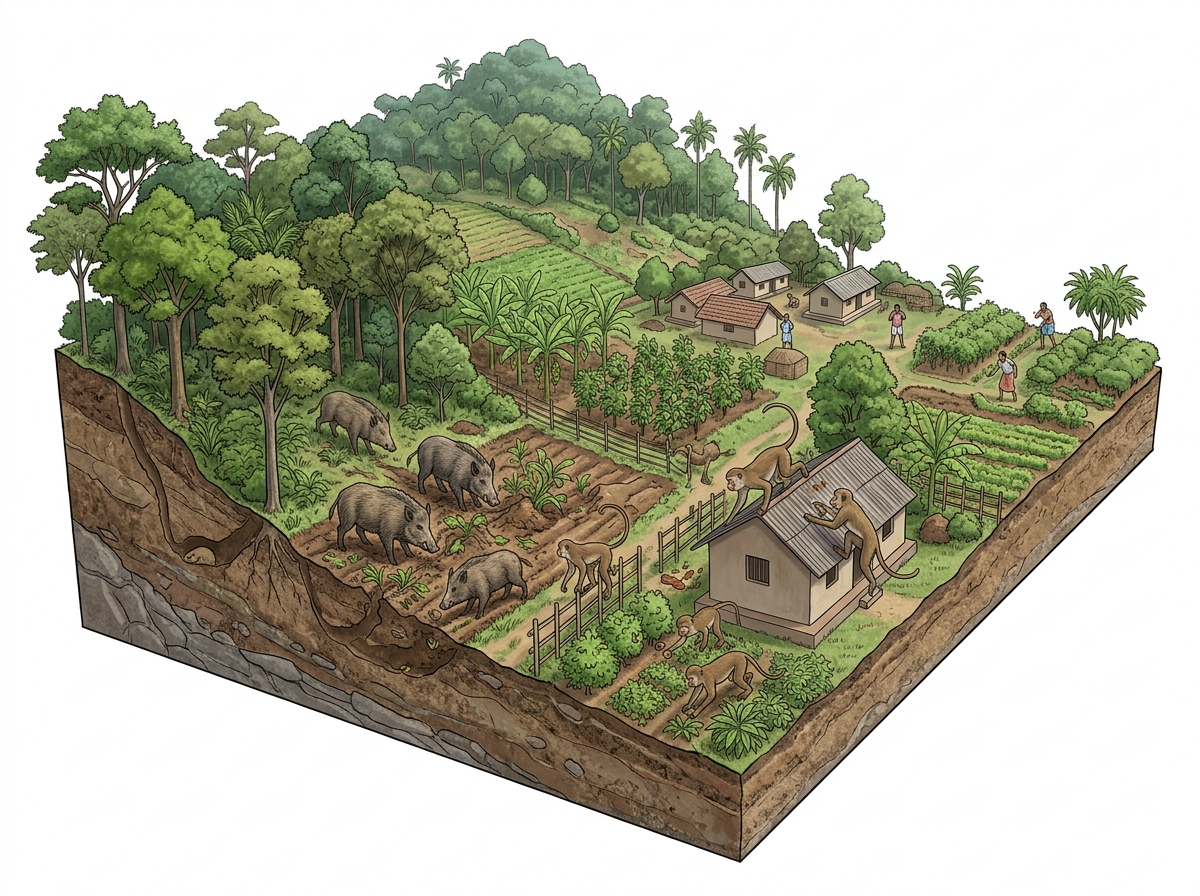
16 Sep Monkeys & Wild Boars: Rising Human-Wildlife Conflict in Wayanad for UPSC
✎ Human-Wildlife Conflict in India is governed by the Wildlife Protection Act, 1972, which mandates habitat management and compensation for damage, but requires integration with local ecological and socio-economic realities for…
Subject Relevance — Where This Topic Fits
- GS Paper III — Environment, Ecology, Biodiversity, and Climate Change | GS Paper III — Agricultural and Rural Development | GS Paper III — Disaster Management
- Prelims: Human-Wildlife Conflict (HWC), Wildlife Protection Act, 1972, Project Tiger, Forest Rights Act, 2006, Compensatory Afforestation Fund Management and Planning Authority (CAMPA), Wildlife Corridors, Crop Damage Compensation, Biodiversity Hotspots
- Essay: Human-Wildlife Coexistence: Balancing Conservation and Livelihood Security, The Role of Science in Policy-Making: Bridging Research and Ground-Level Governance
Quick Revision: Human-Wildlife Conflict in India is governed by the Wildlife Protection Act, 1972, which mandates habitat management and compensation for damage, but requires integration with local ecological and socio-economic realities for effective mitigation.
Why is this in the news?
A three-year scientific study published in *Scientific Reports* (Nature Portfolio) has identified monkeys and wild boars as the primary sources of human-wildlife conflict in Wayanad, Kerala, challenging the conventional perception that large mammals like elephants and tigers are the sole drivers of such conflicts. The research, conducted across 49 villages with 998 respondents, highlights the disproportionate socio-economic burden posed by smaller species, particularly in agricultural landscapes, and underscores the need for nuanced conservation strategies that address both ecological and livelihood concerns.
Background
- Wayanad, a district in Kerala, is part of the Western Ghats, a globally recognised biodiversity hotspot and a critical tiger reserve under Project Tiger.
- The region has witnessed a rise in human-wildlife conflict (HWC) due to habitat fragmentation, agricultural expansion into forest fringes, and increasing human settlements near wildlife corridors.
- Traditionally, HWC has been associated with large mammals such as elephants and tigers, which often result in catastrophic damage and fatalities, drawing significant policy and media attention.
- Smaller species, including monkeys and wild boars, have historically received less focus despite their frequent interactions with humans, particularly in agricultural and peri-urban areas.
- The Wildlife Protection Act, 1972, provides the legal framework for wildlife conservation in India, including provisions for mitigating human-wildlife conflict through habitat management and compensation mechanisms.
- Kerala’s forest cover stands at approximately 29.1% of its geographical area, with Wayanad alone contributing significantly to the state’s biodiversity but also facing intense pressure from developmental activities.
What is Human-Wildlife Conflict (HWC)?
- Human-Wildlife Conflict (HWC) refers to the negative interactions between humans and wildlife, where wildlife causes harm to human life, livelihoods, or property, or where human actions result in the injury or death of wildlife.
- HWC arises from competition for shared resources such as food, water, and habitat, particularly in areas where human settlements encroach upon wildlife corridors or critical habitats.
- The conflict manifests in various forms, including crop raiding, livestock predation, property damage, human injuries or fatalities, and retaliatory killings of wildlife.
- HWC is not limited to large mammals; smaller species such as monkeys, wild boars, and even peafowl can cause significant disruptions, particularly in agricultural landscapes.
- The severity of HWC is influenced by factors such as the frequency of encounters, the intensity of damage, the species involved, and the socio-economic vulnerability of affected communities.
- HWC poses a dual challenge: it threatens biodiversity conservation efforts while also undermining rural livelihoods, food security, and socio-economic stability in affected regions.
- Mitigation strategies for HWC include habitat management, community-based conservation, early warning systems, compensation mechanisms, and the use of non-lethal deterrents such as fencing, guard animals, and crop protection techniques.
Key Features
| Feature | Significance |
|---|---|
| Species Involved | Monkeys and wild boars dominate human-wildlife conflict (HWC) incidents, surpassing traditionally prioritised large mammals like elephants and tigers in Wayanad. |
| Study Scope | Three-year scientific study across 49 villages involving 998 respondents, providing empirical data on HWC patterns and perceptions. |
| Perception Metrics | 81% of respondents held negative perceptions toward wildlife conservation, indicating deep-seated frustration with recurring losses. |
| Conflict Severity | Monkeys and wild boars cause moderate to high severity conflicts, with 5% of respondents reporting extreme severity due to crop/property damage. |
| Methodology | Multi-species analysis integrating frequency, intensity, and cumulative burden of conflicts, not merely the presence of species. |
Why it Matters
Economic
- Repeated agricultural losses from wild boars and monkeys impose cumulative financial burdens on farming communities, affecting livelihoods and food security.
- Property damage from wildlife interactions increases household expenditure on repairs and deterrents, straining rural economies.
- Cumulative burden of small-scale conflicts may exceed episodic large-mammal incidents in economic impact, necessitating targeted mitigation strategies.
Ecological
- Shifts in HWC patterns from large predators to smaller species reflect changes in land use, habitat fragmentation, and resource availability in Wayanad.
- High human-wildlife interaction rates in all surveyed villages indicate pervasive ecological overlap, raising questions about sustainable coexistence.
- Understanding species-specific conflict drivers is critical for designing biodiversity conservation policies that account for human needs.
Social
- Negative perceptions toward wildlife conservation (81%) highlight the need for community-centric approaches to reconcile conservation goals with livelihood concerns.
- Frequent conflicts erode trust in wildlife management institutions, potentially undermining long-term conservation efforts.
- Gendered impacts of HWC (e.g., women managing crop fields) may exacerbate socio-economic vulnerabilities, requiring inclusive policy responses.
Policy
- The study underscores the inadequacy of one-size-fits-all HWC mitigation strategies, advocating for species-specific and context-sensitive interventions.
- Current policies often prioritise large mammals, leaving smaller but persistent conflict sources under-addressed in resource allocation.
- Evidence-based policymaking is essential to balance conservation objectives with rural development goals in human-dominated landscapes.
Challenges
1. Inadequate Mitigation Strategies
- Existing HWC mitigation measures are predominantly designed for large mammals, leaving gaps in addressing persistent conflicts with monkeys and wild boars.
- Lack of species-specific, evidence-based interventions exacerbates the cumulative burden on affected communities.
- Insufficient integration of traditional knowledge and modern scientific approaches in conflict resolution.
UPSC Link: GS3: Environment & Biodiversity
2. Habitat Fragmentation & Encroachment
- Expansion of agricultural and human settlements into wildlife habitats increases frequency of interactions with species like monkeys and wild boars.
- Fragmented habitats reduce natural prey availability, pushing wild boars into croplands in search of food.
- Urbanisation and infrastructure development exacerbate habitat loss, intensifying human-wildlife overlap.
UPSC Link: GS3: Environment & Biodiversity
3. Community-Resilience Gaps
- Negative perceptions toward wildlife conservation (81%) reflect a breakdown in trust between communities and conservation authorities.
- Limited access to alternative livelihoods and insurance mechanisms compounds vulnerability to repeated losses.
- Insufficient awareness and participation in conflict mitigation programs hinder effective local engagement.
UPSC Link: GS3: Rural Development
4. Data and Research Deficits
- Limited long-term, multi-species studies on HWC in India, particularly in biodiversity-rich regions like Wayanad.
- Underreporting of conflicts due to stigma or lack of reporting mechanisms may skew policy priorities.
- Need for interdisciplinary research integrating ecology, economics, and social sciences to inform holistic solutions.
UPSC Link: GS3: Science & Tech
5. Institutional Coordination Failures
- Fragmented governance between forest departments, agricultural agencies, and local bodies hampers cohesive HWC management.
- Lack of standardised protocols for conflict reporting, assessment, and response across regions.
- Inadequate funding and capacity-building for frontline staff in conflict-prone areas.
UPSC Link: GS2: Governance
6. Ethical and Equity Concerns
- Marginalised communities, including smallholder farmers and indigenous groups, bear disproportionate burdens of HWC due to limited resources.
- Compensation mechanisms often fall short of covering actual losses, exacerbating economic hardships.
- Need for inclusive policies that address differential impacts based on socio-economic status and gender.
UPSC Link: GS2: Governance
Challenges — UPSC Perspective
| Issue | Concern |
|---|---|
| Species-Specific Gaps | Mitigation strategies are not tailored to the behavioural and ecological needs of monkeys and wild boars, leading to ineffective interventions. |
| Perception-Response Mismatch | Negative public perceptions toward conservation are not adequately addressed in policy design, perpetuating distrust. |
| Resource Allocation Bias | Funding and attention are skewed toward large mammals, neglecting smaller but persistent conflict sources. |
| Habitat Encroachment | Unplanned land-use changes increase human-wildlife overlap, intensifying conflicts in agricultural landscapes. |
| Institutional Fragmentation | Lack of coordination between forest, agricultural, and local bodies delays effective conflict resolution. |
| Compensation Deficits | Inadequate and delayed compensation mechanisms fail to mitigate economic losses for affected communities. |
Way Forward
- Conduct species-specific pilot projects in Wayanad to test and refine mitigation strategies for monkeys and wild boars, integrating traditional and modern techniques.
- Develop a multi-stakeholder platform involving forest departments, agricultural agencies, local bodies, and communities for coordinated HWC management.
- Expand and streamline compensation mechanisms with transparent, timely disbursement and grievance redressal to restore trust in conservation efforts.
- Integrate HWC mitigation into land-use planning and rural development policies to reduce habitat fragmentation and encroachment.
- Launch targeted awareness campaigns to educate communities on coexistence strategies and the ecological role of conflict species.
- Strengthen data collection systems for real-time monitoring of HWC incidents, enabling evidence-based policy adjustments.
- Promote alternative livelihoods and insurance schemes for farming communities to reduce dependence on high-risk crops.
- Enhance capacity-building for frontline staff in conflict-prone areas to improve response efficiency and community engagement.
UPSC Value Addition
Keywords for Mains Answer-Writing
Human-Wildlife Conflict (HWC) · Wildlife Conservation in India · Forest Rights Act, 2006 · Wildlife (Protection) Act, 1972 · Compensatory Afforestation Fund Management and Planning Authority (CAMPA) · Community-based conservation · Human-animal interface · Waynad Wildlife Sanctuary · Wildlife corridors · Agricultural encroachment into forest areas · Mitigation strategies for HWC · Scheduled Tribes and Other Traditional Forest Dwellers (Recognition of Forest Rights) Act, 2006
Concept Flow
Expansion of agricultural and human settlements → Habitat fragmentation and loss → Increased human-wildlife overlap → Persistent conflicts with monkeys and wild boars → Cumulative economic losses for farming communities → Negative perceptions toward wildlife conservation → Erosion of trust in conservation institutions → Policy gaps in mitigation strategies → Need for species-specific, community-centric interventions → Sustainable coexistence frameworks.
Prelims Practice Questions
Q1. Consider the following statements regarding human-wildlife conflict in India:
1. The Wildlife (Protection) Act, 1972, provides for the declaration of wildlife corridors as protected areas.
2. The Forest Rights Act, 2006, recognises the rights of forest-dwelling communities, which can influence human-wildlife conflict dynamics.
3. Compensatory Afforestation Fund Management and Planning Authority (CAMPA) is exclusively used for afforestation projects outside protected areas.
How many of the above statements are correct?
- Only one
- Only two
- All
- None
Answer: Only two — Statement 1 is incorrect: The Wildlife (Protection) Act, 1972, does not explicitly provide for the declaration of wildlife corridors as protected areas. Statement 2 is correct: The Forest Rights Act, 2006, recognises individual and community forest rights, which can impact conservation and conflict mitigation strategies. Statement 3 is incorrect: CAMPA funds are used for afforestation and regeneration activities, including those within and outside protected areas.
Q2. Assertion (A): The Wayanad Wildlife Sanctuary is a critical habitat for elephants, tigers, and gaurs in the Western Ghats.
Reason (R): The sanctuary is part of the Nilgiri Biosphere Reserve, which is a UNESCO-designated site.
Options:
A. Both A and R are true, and R is the correct explanation of A.
B. Both A and R are true, but R is not the correct explanation of A.
C. A is true, but R is false.
D. A is false, but R is true.
Answer: ? — Assertion (A) is true: Wayanad Wildlife Sanctuary is indeed a critical habitat for elephants, tigers, and gaurs. Reason (R) is also true: the sanctuary is part of the Nilgiri Biosphere Reserve, a UNESCO site. However, R does not explain A, as the assertion pertains to species presence, not the sanctuary’s UNESCO designation.
Q3. Which of the following species is NOT typically associated with human-wildlife conflict in Wayanad, Kerala, as per recent studies?
A. Wild boar
B. Monkey
C. Tiger
D. Peafowl
- A
- B
- C
- D
Answer: D — Tigers are less commonly reported as sources of human-wildlife conflict in Wayanad compared to wild boars, monkeys, and peafowl, as per the study published in Scientific Reports (2026).
Mains Practice Question
✍ The increasing incidence of human-wildlife conflict in regions like Wayanad is often attributed to the expansion of agricultural and settlement areas into wildlife habitats. Critically examine the legal and policy frameworks in India that address this challenge. Also, discuss the role of community participation in mitigating such conflicts. (15 Marks)
Approach: Introduction (2 marks): Define human-wildlife conflict (HWC) and its significance in contemporary India, citing the Wayanad study as an example. Highlight the dual objectives of conservation and livelihood protection. Legal frameworks (5 marks): 1. Wildlife (Protection) Act, 1972: Provisions for protected areas, wildlife corridors, and offences related to wildlife damage (Sections 9, 35, 38). 2. Scheduled Tribes and Other Traditional Forest Dwellers (Recognition of Forest Rights) Act, 2006: Recognition of forest rights and its impact on HWC dynamics. 3. Compensatory Afforestation Fund Management and Planning Authority (CAMPA): Role in afforestation and compensatory mechanisms for wildlife damage. 4. National Wildlife Action Plan (2017-2031): Emphasis on coexistence strategies and habitat management. Policy challenges (4 marks): 1. Fragmentation of habitats due to agricultural expansion and infrastructure development. 2. Inadequate compensation mechanisms and delayed disbursement of funds. 3. Lack of integrated land-use planning and enforcement gaps. 4. Limited awareness among local communities about legal recourse and mitigation measures. Community participation (4 marks): 1. Role of Joint Forest Management Committees (JFMCs) and Eco-development Committees (EDCs) in participatory conservation. 2. Success stories from states like Odisha (Community-based conflict mitigation in Similipal) and Assam (HWC mitigation in Kaziranga). 3. Challenges: Limited capacity, lack of incentives, and conflicts over resource use. Conclusion (2 marks): Emphasise the need for a multi-stakeholder approach combining legal reforms, policy implementation, and community engagement to achieve sustainable coexistence.
Source: The Hindu
Kerala PCS (Kerala PSC (KAS)) — State PCS Practice
Prelims: Which of the following districts in Kerala has recently reported a significant increase in human-wildlife conflict due to the rise in monkey and wild boar populations?
- Thrissur
- Wayanad
- Kollam
- Palakkad
Answer: Wayanad — Wayanad has emerged as a hotspot for human-wildlife conflict in Kerala due to the growing menace of monkeys and wild boars.
Mains: Analyze the socio-economic and ecological factors contributing to the escalation of human-wildlife conflict in Wayanad, particularly focusing on the role of monkeys and wild boars. Suggest sustainable mitigation strategies that align with Kerala’s conservation policies and community welfare.
Generated by AanyaAi for educational purpose.
Related guides on our sites
- Current affairs for upsc 2026
- How to prepare for GS paper 1 for UPSC CSE mains exam
- Best UPSC coaching for IFOS exam
- Best geography optional coaching

- Monkeys & Wild Boars: Rising Human-Wildlife Conflict in Wayanad for UPSC - September 16, 2026
- यूपी कैबिनेट ने लिया बड़ा फैसला: अग्निवीरों को मिलेगी 20% आरक्षण, मथुरा मिल बनेगी इथेनॉल प्लांट - September 16, 2026
- UP Cabinet Approves 20% Agniveer Quota & Mathura Ethanol Plant: Key Decisions Explained - September 16, 2026

No Comments