


16 Sep New Zealand Parliament Approves India FTA: Key Benefits for UPSC Aspirants
✎ The India-New Zealand FTA aims to eliminate tariffs on 95% of New Zealand's exports to India, enhance services trade, and streamline customs procedures, thereby fostering deeper economic integration between the two countries.
Subject Relevance — Where This Topic Fits
- GS Paper II — International Relations: Bilateral, Regional and Global Groupings and Agreements involving India and/or affecting India’s interests | GS Paper III — Economy: Foreign Trade — Issues and Policies, Trade Agreements, Tariff Reforms
- Prelims: Free Trade Agreement (FTA), Tariff Elimination, Most Favoured Nation (MFN), Rules of Origin, Trade in Services, Economic Partnership Agreements (EPA), Indo-Pacific Economic Framework (IPEF), WTO Compliance, Trade Facilitation Agreement (TFA), Export Promotion Council
- Essay: The role of Free Trade Agreements in shaping India’s economic diplomacy in the 21st century, Global supply chains and the strategic importance of trade corridors in the Indo-Pacific
Quick Revision: The India-New Zealand FTA aims to eliminate tariffs on 95% of New Zealand’s exports to India, enhance services trade, and streamline customs procedures, thereby fostering deeper economic integration between the two countries.
Why is this in the news?
The New Zealand Parliament’s ratification of the India-New Zealand Free Trade Agreement (FTA) on 16 September 2026 marks a significant milestone in bilateral economic engagement. The agreement, which will eliminate or reduce tariffs on 95% of New Zealand’s exports to India, underscores the strategic importance of trade liberalisation in fostering economic integration between two major economies in the Indo-Pacific region. This development is particularly consequential given India’s status as one of the world’s fastest-growing economies and New Zealand’s emphasis on diversifying trade partnerships beyond traditional partners.
Background
- India and New Zealand have historically maintained cordial bilateral relations, rooted in shared Commonwealth heritage, democratic governance, and people-to-people ties, including a significant Indian diaspora in New Zealand.
- Trade between the two countries has been constrained by high tariffs and non-tariff barriers, particularly on agricultural and dairy products from New Zealand and pharmaceuticals, textiles, and engineering goods from India.
- Negotiations for a comprehensive Free Trade Agreement (FTA) were formally launched in March 2025, following a joint statement by Prime Ministers Narendra Modi and Christopher Luxon in 2024 outlining a shared vision to double bilateral trade by 2030.
- The FTA aligns with India’s broader trade strategy of expanding market access for its goods and services, particularly in sectors such as IT, education, and pharmaceuticals, while addressing non-tariff barriers in agricultural trade.
- New Zealand’s trade policy has increasingly focused on diversifying its export markets beyond traditional partners like Australia, China, and the European Union, with India emerging as a key strategic partner in the Indo-Pacific.
- The agreement is expected to enhance trade facilitation through streamlined customs procedures, mutual recognition of standards, and improved market access for services, including professional and educational services.
What is the India-New Zealand Free Trade Agreement (FTA)?
- The India-New Zealand FTA is a comprehensive bilateral trade agreement designed to reduce or eliminate tariffs on a wide range of goods and services, thereby enhancing market access for exporters from both countries.
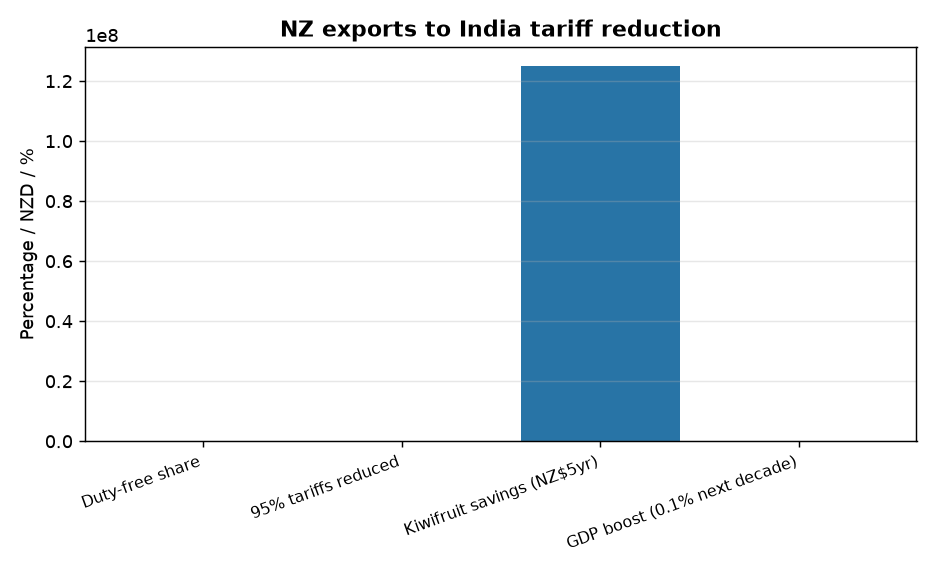
- Under the agreement, 57% of New Zealand’s exports to India will become duty-free when the agreement takes effect, and once fully implemented, tariffs will be removed or significantly reduced on 95% of exports, including key sectors such as kiwifruit, dairy, and wood products.
- For India, the FTA will provide improved access for its exports, including pharmaceuticals, textiles, engineering goods, and IT services, into the New Zealand market.
- The agreement includes provisions for trade in services, covering sectors such as education, tourism, professional services (e.g., legal, accounting), and digital trade, facilitating greater cross-border mobility of skilled professionals.
- Non-tariff measures, such as sanitary and phytosanitary (SPS) standards and technical barriers to trade (TBT), are addressed through mutual recognition agreements and harmonised regulatory frameworks.
- The FTA incorporates rules of origin to ensure that only goods originating in India or New Zealand benefit from preferential tariff treatment, thereby preventing trade deflection and ensuring compliance with WTO rules.
- Dispute resolution mechanisms are included to address trade-related disputes between businesses and governments, ensuring predictability and legal certainty in trade relations.
- The agreement is structured to be implemented in phases, with gradual tariff reductions and liberalisation schedules to allow industries in both countries to adjust to increased competition and market access.
Key Features
| Feature | Significance |
|---|---|
| Duty-free access on 57% of exports | Immediate reduction in tariff barriers for New Zealand exporters, particularly in sectors like kiwifruit, dairy, and wood products. |
| Tariff elimination on 95% of exports | Long-term structural benefit enabling deeper integration into India’s high-growth consumer and industrial markets. |
| Faster border clearance mechanisms | Streamlined customs procedures to reduce transaction costs and enhance supply chain efficiency. |
| Market access to India’s middle class | Opportunities in education, technology, tourism, and professional services sectors due to rising disposable incomes. |
| Two-way trade target of USD 2 billion by 2030 | Aligns with India’s broader strategy of diversifying trade partnerships beyond traditional partners. |
Why it Matters
Economic Significance
- Enhances economic interdependence between India and New Zealand, reducing reliance on traditional trade blocs.
Strategic Significance
- Diversifies India’s trade portfolio, mitigating risks associated with over-reliance on specific geographies.
Sectoral Significance
- Agricultural exporters (e.g., kiwifruit, dairy) gain preferential access to India’s expanding consumer base.
- Services sector (education, tourism, professional services) benefits from reduced regulatory barriers.
Macroeconomic Impact
- Estimated GDP boost of 0.1% for New Zealand over a decade, per Westpac Institutional Bank analysis.
Challenges
1. Non-Tariff Barriers (NTBs)
- India’s regulatory and procedural hurdles (e.g., sanitary and phytosanitary measures) may persist despite tariff reductions.
- Compliance costs for exporters to navigate India’s complex customs and certification regimes.
UPSC Link: WTO Agreements on SPS/TBT
2. Competition for Domestic Industries
- Indian sectors like dairy and agriculture may face increased competition from New Zealand imports.
UPSC Link: Agricultural Policy & WTO
3. Logistical and Infrastructure Gaps
- Inadequate port and cold-chain infrastructure in India may limit the realisation of FTA benefits.
UPSC Link: Logistics Efficiency Enhancement
4. Geopolitical and Regulatory Risks
- Potential shifts in trade policies due to global economic uncertainties or bilateral tensions.
UPSC Link: WTO & Global Trade Order
Challenges — UPSC Perspective
| Issue | Concern |
|---|---|
| Sanitary and Phytosanitary (SPS) Measures | Stringent Indian regulations may restrict market access despite tariff reductions. |
| Customs and Procedural Delays | Bureaucratic inefficiencies could undermine the FTA’s intended benefits. |
| Competition for Indian Farmers | Local producers may struggle to compete with subsidised or lower-cost imports. |
| Infrastructure Bottlenecks | Poor logistics and storage facilities may hinder supply chain optimisation. |
| Regulatory Harmonisation | Divergent standards between the two nations may require costly compliance adjustments. |
Way Forward
- Enhance India-New Zealand joint working groups to address NTBs and procedural bottlenecks.
- Invest in port and cold-chain infrastructure to facilitate seamless trade flows.
- Conduct capacity-building programs for Indian exporters to meet New Zealand’s SPS standards.
- Monitor sectoral impacts on domestic industries to mitigate adverse effects.
- Strengthen dispute-resolution mechanisms under the FTA to ensure compliance.
- Promote bilateral dialogues on regulatory harmonisation to reduce compliance costs.
- Leverage the FTA to diversify India’s trade partnerships beyond traditional partners.
UPSC Value Addition
Keywords for Mains Answer-Writing
Free Trade Agreement (FTA) · India-New Zealand trade relations · tariff reduction mechanisms · economic diplomacy · regional trade blocs · WTO-compliant trade policies · export-oriented growth · parliamentary ratification of treaties · trade facilitation measures · bilateral trade agreements · duty-free market access · economic integration · trade liberalisation · strategic economic partnerships
Concept Flow
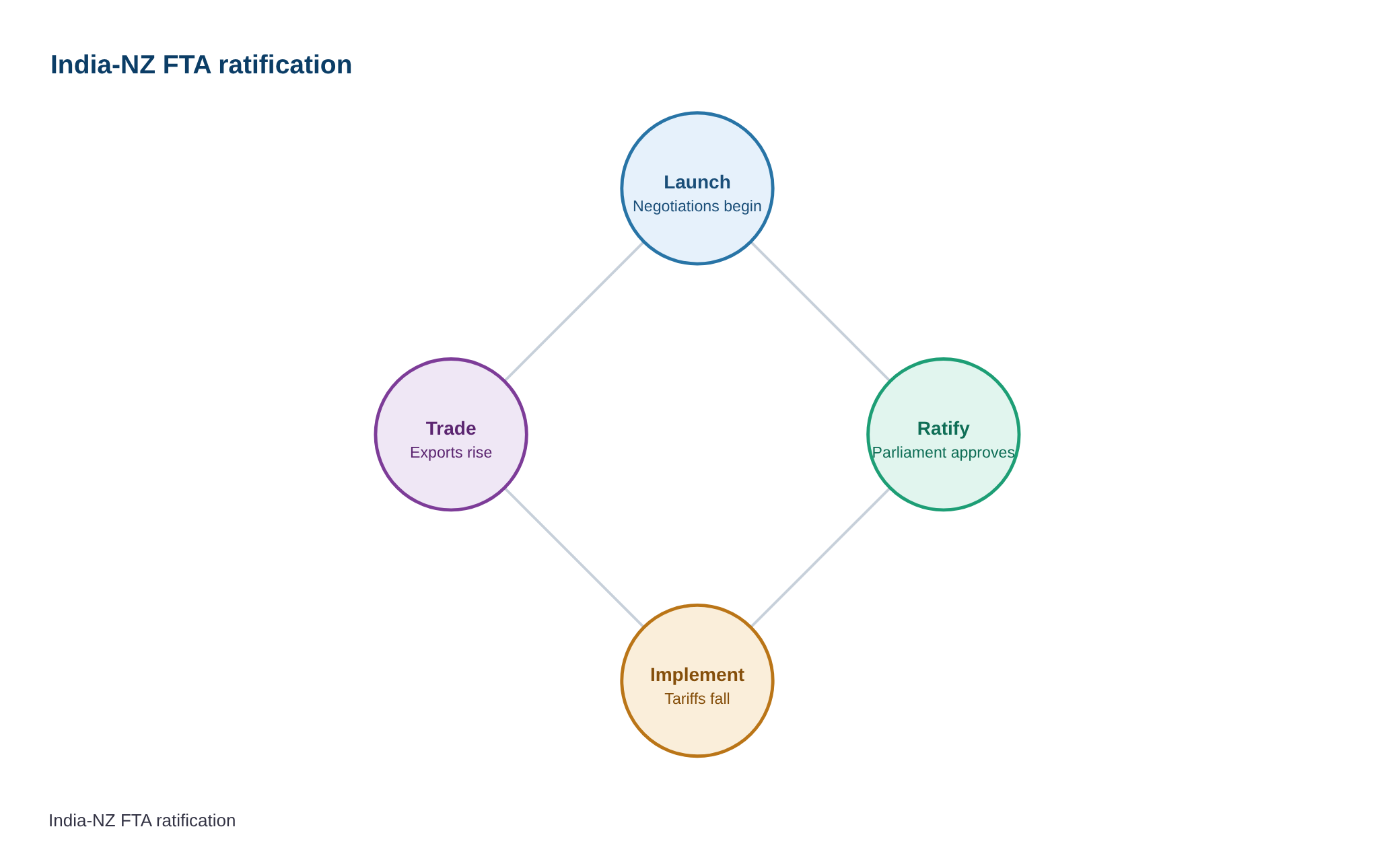
India and New Zealand initiate FTA negotiations to deepen economic ties. → Parliamentary ratification in New Zealand signals formal commitment to the agreement. → Tariff reductions and non-tariff barrier eliminations are implemented progressively. → Exporters from both nations gain preferential market access, reducing trade costs. → Supply chains and investment flows adjust to the new trade regime. → Economic growth in sectors like agriculture, services, and manufacturing is stimulated. → Bilateral trade targets (e.g., USD 2 billion by 2030) are pursued through policy coordination.
Prelims Practice Questions
Q1. Consider the following statements regarding Free Trade Agreements (FTAs) in India:
1. FTAs reduce or eliminate tariffs on goods traded between member countries.
2. The India-New Zealand FTA aims to remove tariffs on 95% of bilateral exports once fully implemented.
3. FTAs are governed exclusively by the World Trade Organization (WTO) and do not require parliamentary approval in member countries.
4. The kiwifruit industry in New Zealand is expected to benefit significantly from the India-New Zealand FTA.
How many of the above statements are correct?
- Only one
- Only two
- Only three
- All four
Answer: Only three — Statements 1, 2, and 4 are correct. Statement 3 is incorrect because FTAs are negotiated by member countries and require parliamentary ratification in many jurisdictions, including India and New Zealand.
Q2. Assertion (A): The India-New Zealand Free Trade Agreement (FTA) will eliminate tariffs on 57% of New Zealand’s exports to India immediately upon implementation.
Reason (R): The FTA aims to phase out tariffs on 95% of bilateral trade over time, aligning with India’s commitment to trade liberalisation under WTO principles.
Options:
A. Both A and R are true, and R is the correct explanation of A.
B. Both A and R are true, but R is not the correct explanation of A.
C. A is true, but R is false.
D. A is false, but R is true.
Answer: ? — Assertion (A) is true as the FTA will make 57% of New Zealand’s exports to India duty-free immediately. Reason (R) is also true but does not directly explain the specific figure in A, as the 95% reduction is a broader target over time.
Q3. Match the following pairs related to India’s trade agreements with their key features:
Column I (Trade Agreement) Column II (Key Feature)
A. India-Australia Economic Cooperation and Trade Agreement (IndAus ECTA) 1. Focuses on reducing tariffs on agricultural and dairy products
B. India-European Union (EU) Free Trade Agreement 2. Aims to double trade by 2030
C. India-New Zealand Free Trade Agreement (FTA) 3. Includes provisions for services and investment
D. Regional Comprehensive Economic Partnership (RCEP) 4. Excludes agricultural tariffs to protect domestic farmers
Options:
A-1, B-3, C-2, D-4
A-3, B-1, C-2, D-4
A-4, B-3, C-2, D-1
A-2, B-3, C-1, D-4
Answer: ? — A-1: IndAus ECTA focuses on reducing tariffs on agricultural and dairy products. B-3: The India-EU FTA includes provisions for services and investment. C-2: The India-New Zealand FTA aims to double trade by 2030. D-4: RCEP excludes agricultural tariffs to protect domestic farmers.
Mains Practice Question
✍ The India-New Zealand Free Trade Agreement (FTA) represents a significant step in India’s trade liberalisation strategy. Critically examine the economic rationale behind such bilateral FTAs, with particular reference to tariff reduction mechanisms and their impact on export-oriented growth. (15 Marks)
Approach: MODEL-ANSWER SKELETON:
1. **Introduction (2 marks)**
– Define Free Trade Agreements (FTAs) and their role in contemporary trade policy.
– Contextualise the India-New Zealand FTA within India’s broader trade diplomacy (e.g., FTAs with ASEAN, EU, Australia, UAE, etc.).
2. **Economic Rationale for FTAs (5 marks)**
– **Trade Creation vs. Trade Diversion**: Explain how FTAs can create new trade opportunities (e.g., duty-free access for New Zealand kiwifruit, dairy, and services) while minimising diversion from non-member countries.
– **Comparative Advantage**: Highlight how India’s labour-intensive sectors (e.g., textiles, pharmaceuticals) and New Zealand’s agricultural and dairy sectors can benefit from tariff reductions.
– **Economies of Scale**: Discuss how FTAs enable firms to expand production and reduce per-unit costs.
– **Strategic Partnerships**: Emphasise the role of FTAs in strengthening economic ties with key partners, particularly in the Indo-Pacific region.
– **WTO Compliance**: Note that FTAs under the WTO’s Article XXIV must cover substantially all trade, ensuring they do not violate multilateral trade rules.
3. **Tariff Reduction Mechanisms (4 marks)**
– **Immediate vs. Phased Tariff Elimination**: Differentiate between immediate duty-free access (e.g., 57% of New Zealand’s exports) and phased reductions (e.g., 95% over time).
– **Sensitive Lists**: Explain how some products (e.g., agricultural goods in India) may be excluded or subject to longer phase-out periods to protect domestic industries.
– **Rules of Origin**: Briefly mention how rules of origin prevent third-country goods from benefiting from FTA tariff reductions.
– **Non-Tariff Barriers**: Acknowledge that tariff reduction alone may not suffice; FTAs often include provisions on customs procedures, sanitary and phytosanitary (SPS) measures, and technical barriers to trade (TBT).
4. **Impact on Export-Oriented Growth (3 marks)**
– **Sectoral Benefits**: Cite specific examples (e.g., kiwifruit industry savings of NZ$125 million over five years, potential growth in India’s IT and education services exports).
– **Faster Border Clearance**: Highlight how FTAs streamline customs procedures, reducing transaction costs and improving supply chain efficiency.
– **Access to Middle-Class Markets**: Discuss how India’s growing middle class (projected to reach 600 million by 2030) can drive demand for New Zealand’s food, technology, and education services.
– **Macroeconomic Impact**: Reference studies (e.g., Westpac’s projection of a 0.1% boost to New Zealand’s GDP over a decade) to quantify potential gains.
5. **Challenges and Criticisms (3 marks)**
– **Domestic Industry Concerns**: Address potential opposition from domestic industries (e.g., dairy farmers in India) fearing competition from cheaper imports.
– **Trade Diversion Risks**: Discuss how FTAs may divert trade from more efficient non-member countries (e.g., EU or US exporters).
– **Implementation Bottlenecks**: Highlight the need for robust institutional mechanisms to ensure compliance with FTA provisions (e.g., customs reforms, dispute resolution).
6. **Conclusion (2 marks)**
– Summarise the strategic importance of FTAs in India’s trade policy.
– Reiterate the need for a balanced approach that maximises gains while mitigating risks to domestic industries.
– Conclude with a forward-looking statement on the role of FTAs in India’s ambition to become a $5 trillion economy by 2025-26.
Source: orissapost.com
Generated by AanyaAi for educational purpose.
Related guides on our sites
- Current affairs for upsc 2026
- Best PSIR optional coaching for upsc
- Best economics optional coaching for upsc
- Best PSIR optional teacher for upsc

- New Zealand Parliament Approves India FTA: Key Benefits for UPSC Aspirants - September 16, 2026
- तमिलनाडु: कामराज नाश्ता योजना विस्तार का शुभारंभ 22 सितंबर तक टला - September 16, 2026
- Tamil Nadu defers expansion of Kamarajar Breakfast Scheme to Sept 22 - September 16, 2026

No Comments