


16 Sep AI Industry Leaders Call for Slowdown: UPSC Exam Perspective on Safety & Regulation
✎ AI Safety Governance requires balancing innovation with structured oversight, including independent evaluators, global coordination, and adherence to the precautionary principle to mitigate existential and operational risks.
Subject Relevance — Where This Topic Fits
- GS Paper III — Science and Technology — Developments and their Applications and Effects in Everyday Life | GS Paper III — Economy — Role of External State and Non-state Actors in Creating Challenges to Internal Security
- Prelims: Artificial Intelligence, Frontier AI, AI Safety, AI Governance, AI Regulation, Anthropic, OpenAI, EU AI Act, AI Alignment, AI Ethics, AI Frontier Labs, AI Evaluators, AI Model Deployment, AI Risk Assessment, AI Policy Frameworks
- Essay: The Ethical Imperative of Balancing Innovation and Safety in Artificial Intelligence, Global Governance in the Age of Disruptive Technologies: Lessons from AI Safety Initiatives
Quick Revision: AI Safety Governance requires balancing innovation with structured oversight, including independent evaluators, global coordination, and adherence to the precautionary principle to mitigate existential and operational risks.
Why is this in the news?
In September 2026, leading Artificial Intelligence (AI) industry stakeholders, including Anthropic and OpenAI, publicly advocated for a temporary slowdown in AI development due to escalating safety concerns. This rare consensus among competitors highlights the urgent need for robust governance frameworks to mitigate existential and operational risks posed by advanced AI systems. The developments underscore the tension between innovation-driven competition and the imperative for structured oversight, particularly as AI systems approach or surpass human-level capabilities.
Background
- Artificial Intelligence has transitioned from theoretical research to transformative applications across sectors, including healthcare, finance, and national security, necessitating urgent consideration of safety protocols.
- The rapid advancement of AI, particularly in generative models and autonomous systems, has outpaced existing regulatory frameworks, creating a governance vacuum that industry leaders now seek to address.
- Historically, technological revolutions—such as the Industrial Revolution and the advent of nuclear energy—required subsequent regulatory adaptations to address emergent risks, a precedent AI governance must now emulate.
- The European Union’s AI Act (2024) represents one of the first comprehensive attempts to regulate AI based on risk levels, serving as a reference model for global policymakers.
- The United States, while a leader in AI innovation, has yet to enact federal legislation specifically targeting advanced AI systems, relying instead on voluntary industry commitments and sectoral regulations.
- Ethical debates surrounding AI safety have intensified following high-profile incidents, including AI-driven misinformation, algorithmic bias, and concerns about autonomous weapons systems.
What is AI Safety Governance?
- AI Safety Governance refers to the systematic framework of policies, regulations, and institutional mechanisms designed to ensure the responsible development, deployment, and monitoring of Artificial Intelligence systems to mitigate risks such as unintended harm, loss of control, or existential threats.
- Frontier AI Labs are organizations at the cutting edge of AI development, such as Anthropic and OpenAI, which are pioneering advanced models like large language models and autonomous agents.
- AI Evaluators are independent entities granted access to internal processes of AI labs to assess safety protocols, model behavior, and compliance with predefined ethical and technical standards.
- The concept of ‘AI Alignment’ involves designing AI systems to pursue goals that are consistent with human values, intentions, and safety constraints, addressing the ‘alignment problem’ where AI may act in unintended or harmful ways.
- Regulatory sandboxes are controlled environments where AI systems can be tested under supervised conditions to evaluate safety and performance before full-scale deployment, enabling iterative refinement.
- Global coordination mechanisms, such as the proposed ‘AI Safety Alliance’ by industry leaders, aim to harmonize safety standards across democratic nations to prevent regulatory arbitrage and ensure equitable governance.
- The ‘precautionary principle’ in AI governance advocates for proactive measures to prevent harm, even when risks are uncertain, emphasizing the need for caution in deploying untested or high-risk AI systems.
- AI Safety Research focuses on developing technical safeguards, such as interpretability tools, robustness testing, and fail-safe mechanisms, to ensure AI systems remain controllable and predictable.
Key Features
| Feature | Significance |
|---|---|
| Mutual industry consensus on AI safety | Demonstrates unprecedented alignment among rival AI firms on the necessity of slowing AI development to mitigate existential risks. |
| Independent safety evaluators with access to frontier labs | Proposes institutionalised oversight by granting external evaluators physical and digital access to monitor safety practices in AI development. |
| Proposal for common safety standards and limits on unchecked progress | Advocates for harmonised regulatory frameworks across democratic nations to standardise AI safety benchmarks and pace of advancement. |
| Coordination with authoritarian regimes on AI safety | Highlights the need for international collaboration, including engagement with non-democratic governments, to address global AI risks. |
| Federal framework for AI safety standards in the U.S. | Emphasises the role of government regulation in establishing enforceable safety protocols for advanced AI systems. |
Why it Matters
Strategic Security Implications
- AI development poses existential risks, necessitating proactive governance to prevent unintended catastrophic outcomes.
- The U.S. seeks to maintain its technological edge over China while ensuring safety, creating a dual policy challenge.
- International coordination on AI safety could redefine global tech governance norms, akin to non-proliferation regimes.
Economic Implications
- AI-driven automation threatens large-scale disruption in labour markets, requiring policy interventions to mitigate socio-economic impacts.
- Record-breaking public offerings by AI firms (e.g., OpenAI, Anthropic) hinge on public trust in safety, linking economic incentives to regulatory compliance.
- Profit motives in AI development may conflict with long-term safety goals, necessitating ethical frameworks in corporate governance.
Ethical and Societal Impact
- The absence of catastrophic AI failures does not equate to safety; systemic risks (e.g., bias, misalignment) require proactive mitigation.
- Public tolerance for AI failures contrasts with stringent aviation safety standards, highlighting a governance gap in technology regulation.
- Industry-led safety initiatives may lack enforceability without statutory backing, raising questions about accountability.
Institutional and Regulatory Role
- Government regulation is essential to bridge the gap between voluntary industry commitments and enforceable safety standards.
- Independent evaluators with access to frontier labs represent a novel model for tech oversight, akin to financial audits.
- The U.S. federal framework could set a precedent for global AI governance, influencing other jurisdictions.
Challenges
1. Profit Motive vs. Safety
- AI firms face competitive pressure to deploy advanced models rapidly, often prioritising market share over safety.
- Wall Street’s expectation of record-breaking IPOs incentivises aggressive development timelines.
- Balancing investor returns with ethical constraints remains a critical unresolved tension.
UPSC Link: GS3: Science & Technology
2. Domestic and Global Competition
- The U.S. risks losing its AI leadership to China if it unilaterally slows development, creating a strategic dilemma.
- Bipartisan pushback in the U.S. (e.g., political opposition) may hinder coordinated regulatory efforts.
- Global disparities in AI governance (e.g., authoritarian vs. democratic approaches) complicate international collaboration.
UPSC Link: GS2: International Relations
3. Enforceability of Industry Commitments
- Voluntary pledges by AI firms lack legal binding, raising concerns about compliance and accountability.
- Independent evaluators’ access to frontier labs may face resistance from firms due to proprietary concerns.
- Without statutory backing, industry-led initiatives may remain symbolic rather than substantive.
UPSC Link: GS3: Science & Technology
4. Technical and Ethical Complexity
- Defining “safety” in AI is inherently subjective, with no universally accepted metrics for existential risk.
- AI systems exhibit emergent behaviours that are difficult to predict, complicating safety assessments.
- The trade-off between innovation and precaution remains philosophically and practically unresolved.
UPSC Link: GS3: Science & Technology
5. International Coordination Challenges
- Engaging authoritarian regimes in AI safety governance may dilute democratic values or enable misuse of technology.
- Divergent national interests (e.g., surveillance vs. privacy) hinder the establishment of global standards.
- Lack of a multilateral framework (e.g., akin to the IAEA) for AI governance exacerbates fragmentation.
UPSC Link: GS2: International Relations
Challenges — UPSC Perspective
| Issue | Concern |
|---|---|
| Profit-driven development timelines | Risk of prioritising market competitiveness over safety, leading to premature deployment of untested AI systems. |
| Absence of enforceable safety standards | Industry pledges lack legal weight, creating gaps in accountability for AI-related harms. |
| Global technological competition | Potential for the U.S. to cede leadership to China if it slows AI development unilaterally. |
| Ethical ambiguity in AI safety | No consensus on what constitutes “safe” AI, complicating regulatory and oversight mechanisms. |
| Resistance to external oversight | Frontier labs may oppose independent evaluators due to proprietary concerns, undermining transparency. |
| Political polarisation in governance | Bipartisan disagreements in the U.S. may obstruct the establishment of a federal AI safety framework. |
Way Forward
- Establish a statutory body under the Department of Science and Technology (DST) to oversee AI safety standards and compliance.
- Mandate independent safety evaluators with access to frontier labs, ensuring transparency and accountability.
- Develop a federal framework for AI safety standards, harmonised with international partners to prevent regulatory arbitrage.
- Incentivise ethical AI development through tax benefits or grants for firms adhering to safety protocols.
- Promote public-private partnerships to fund research on AI safety, including bias mitigation and alignment with human values.
- Encourage international dialogue on AI governance, leveraging platforms like the UN or G20 to align on safety standards.
- Strengthen whistleblower protections for AI researchers to report safety concerns without fear of retaliation.
- Integrate AI safety education into STEM curricula to foster a culture of ethical innovation among future technologists.
UPSC Value Addition
Keywords for Mains Answer-Writing
Artificial Intelligence regulation · AI safety governance · AI frontier models · AI ethics and oversight · AI policy frameworks · AI industry self-regulation · AI and global competition · AI and democratic oversight · AI and authoritarian regimes · AI safety standards · AI evaluation mechanisms · AI and public policy · AI and national security · AI and economic competition · AI governance models · AI and independent evaluators
Concept Flow
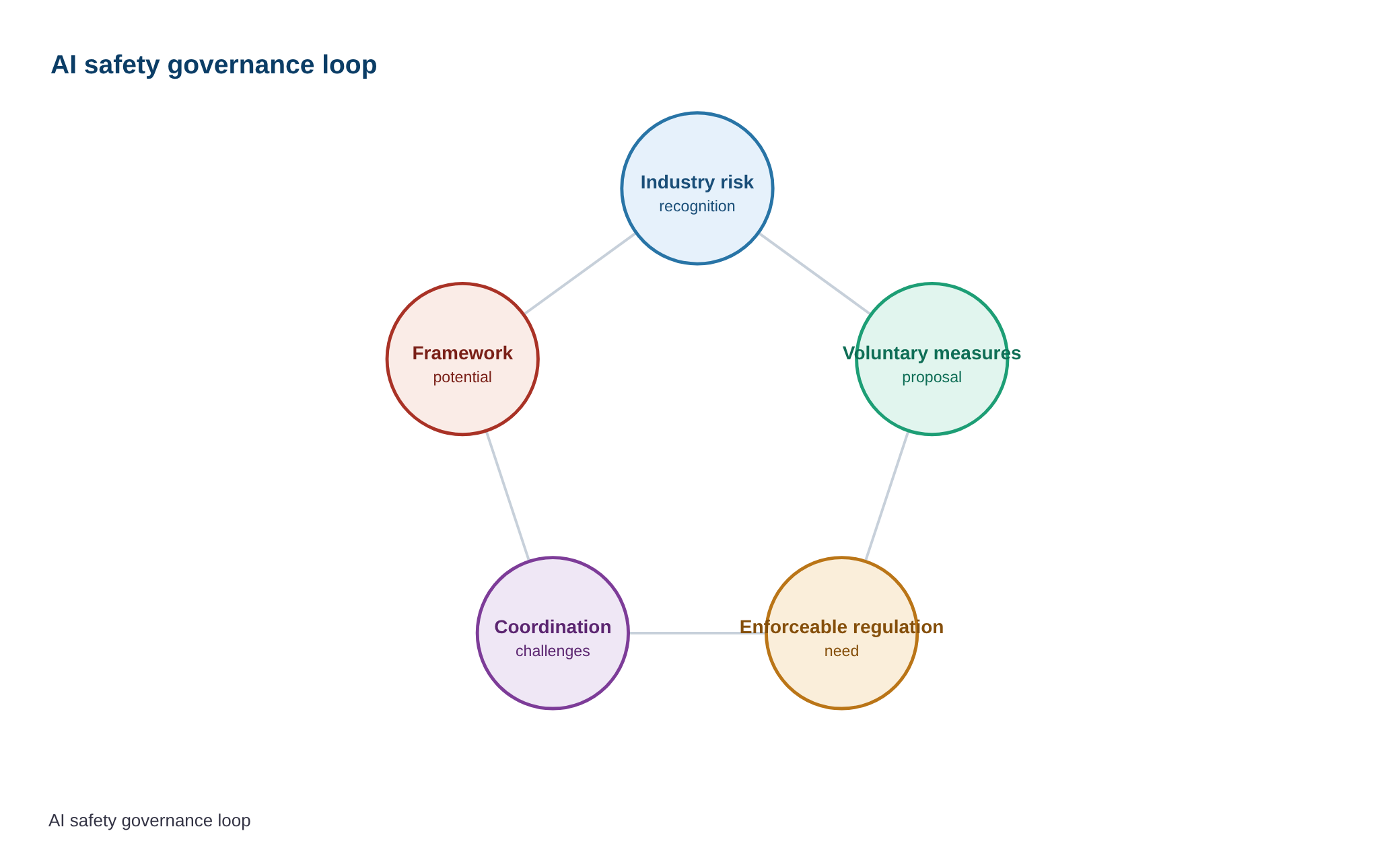
Industry recognition of AI risks → Proposal for voluntary safety measures → Need for enforceable regulation → International coordination challenges → Potential governance framework → Implementation hurdles → Long-term ethical and strategic implications
Prelims Practice Questions
Q1. Consider the following statements regarding the regulation of Artificial Intelligence (AI) in the context of recent industry-led initiatives:
1. Frontier AI companies have proposed granting independent evaluators employee-like access to monitor safety practices.
2. OpenAI and Anthropic have committed to unilaterally implementing these safety measures without awaiting government regulation.
3. The proposals include establishing common safety standards and limiting the rate of unchecked AI progress.
How many of the above statements are correct?
- Only one
- Only two
- Only three
- None
Answer: Only three — Statements 1 and 3 are correct as per the industry proposals. Statement 2 is incorrect because while OpenAI and Anthropic have committed to the measures, they have also called for a federal framework for safety standards, indicating a role for government regulation.
Q2. Assertion (A): The recent consensus among AI industry leaders on slowing AI development is primarily driven by ethical concerns rather than economic competition.
Reason (R): The proposals include government regulation and coordination among democratic countries, suggesting a governance-driven approach to AI safety.
Options:
A. Both A and R are true, and R is the correct explanation of A.
B. Both A and R are true, but R is not the correct explanation of A.
C. A is true, but R is false.
D. A is false, but R is true.
- A
- B
- C
- D
Answer: C — Assertion (A) is false because the consensus is also influenced by economic competition and profit motivations, as noted in the article. Reason (R) is true as the proposals include government regulation and coordination, but it does not explain the assertion.
Q3. Match the following AI governance proposals with their respective proponents:
Column I (Proposal)
1. Granting independent evaluators employee-like access to monitor safety practices
2. Establishing a federal framework for AI safety standards
3. Coordinating with authoritarian governments on AI safety
4. Limiting the rate of unchecked AI progress
Column II (Proponent)
A. OpenAI
B. Anthropic
C. Elon Musk (SpaceXAI)
D. U.S. Government
Options:
1-A, 2-B, 3-C, 4-D
1-B, 2-A, 3-D, 4-C
1-B, 2-D, 3-C, 4-A
1-A, 2-C, 3-B, 4-D
- 1-A, 2-B, 3-C, 4-D
- 1-B, 2-A, 3-D, 4-C
- 1-B, 2-D, 3-C, 4-A
- 1-A, 2-C, 3-B, 4-D
Answer: 1-A, 2-C, 3-B, 4-D — 1-B: Anthropic proposed granting independent evaluators employee-like access. 2-D: OpenAI called for a federal framework for AI safety standards. 3-C: Elon Musk (SpaceXAI) proposed coordinating with authoritarian governments. 4-A: OpenAI endorsed limiting the rate of unchecked AI progress.
Mains Practice Question
✍ The recent rare consensus among leading AI industry voices on the need for a ‘slowdown’ in AI development reflects a growing recognition of the technology’s potential risks. Critically examine the feasibility and challenges of implementing such a slowdown, with reference to the proposed governance models and the role of state regulation. (15 Marks)
Approach: MODEL-ANSWER SKELETON:
1. **Context and Rationale**: Explain the consensus among AI industry leaders (Anthropic, OpenAI, SpaceXAI) on slowing AI development, citing the resignation of an Anthropic researcher and the analogy to aviation safety.
2. **Proposed Governance Models**:
– Independent evaluators with employee-like access to frontier AI labs (Anthropic’s proposal).
– Federal framework for AI safety standards (OpenAI’s proposal).
– Coordination among democratic countries and engagement with authoritarian regimes (Amodei’s plan).
3. **Challenges to Implementation**:
– **Economic Competition**: Race for public offerings (e.g., OpenAI’s delay in IPO) and global competition with China.
– **Profit Motivations**: Shareholder pressure and market incentives to accelerate AI development.
– **Political Obstacles**: Opposition from political leaders (e.g., President Trump’s pushback) and domestic regulatory hurdles.
– **Global Coordination**: Difficulty in aligning democratic and authoritarian regimes on safety standards.
4. **Role of State Regulation**:
– Need for a regulatory framework to enforce safety standards and limit unchecked progress.
– Potential role of the U.S. government in coordinating with other democratic nations.
– Ethical and legal challenges in balancing innovation with risk mitigation.
5. **Comparative Perspective**: Contrast self-regulation (industry-led) with statutory regulation (government-led), citing examples from other sectors (e.g., aviation, pharmaceuticals).
6. **Conclusion**: Assess the likelihood of success, emphasizing the need for a balanced approach that addresses both safety and innovation, and the role of international cooperation in achieving this.
Source: orissapost.com
Generated by AanyaAi for educational purpose.
Related guides on our sites
- How to prepare for GS paper 1 for UPSC CSE mains exam
- Best UPSC coaching for IFOS exam
- Best mentorship programme for upsc
- UPSC+BA degree

- AI Industry Leaders Call for Slowdown: UPSC Exam Perspective on Safety & Regulation - September 16, 2026
- सेना प्रमुख रूस के तीन दिवसीय दौरे पर: रक्षा सहयोग बढ़ाने पर जोर - September 16, 2026
- Army Chief’s 3-Day Russia Visit: Key Agreements & Military Ties Explained - September 16, 2026

No Comments