


16 Sep Pakistan Navy’s Unprofessional Conduct: MEA Summons CDA Over Arabian Sea Collision
✎ The 1991 India-Pakistan Agreement on Advance Notice of Military Exercises mandates transparency to prevent miscalculations and requires 15 days’ prior notice for military activities near borders or disputed areas.
Subject Relevance — Where This Topic Fits
- GS Paper II — International Relations: India’s Foreign Policy, Maritime Security, and Bilateral Agreements with Neighbouring Countries | GS Paper III — Security: Issues Related to Maritime Security and Coastal Defence
- Prelims: Arabian Sea, Maritime Boundary, UNCLOS, Advance Notice on Military Exercises Agreement (1991), Charge d’Affaires, MEA, Indian Navy, Pakistan Navy
- Essay: Maritime Security: Challenges and Cooperation in the Indian Ocean Region, The Role of Diplomacy in Managing Bilateral Maritime Disputes
Quick Revision: The 1991 India-Pakistan Agreement on Advance Notice of Military Exercises mandates transparency to prevent miscalculations and requires 15 days’ prior notice for military activities near borders or disputed areas.
Why is this in the news?
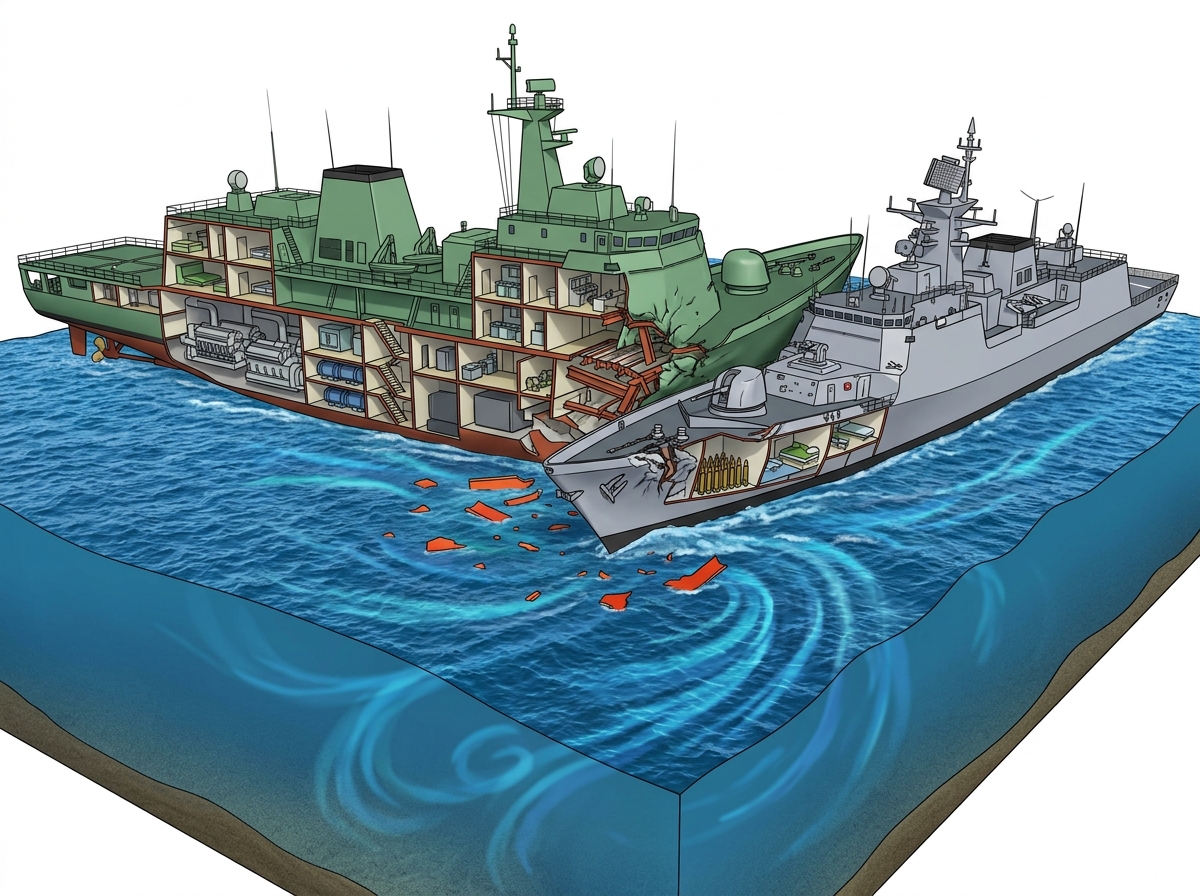
On 16 September 2026, a collision occurred between a Pakistan Navy vessel and an Indian Navy ship in international waters of the Arabian Sea. The Ministry of External Affairs (MEA) summoned the Pakistani Charge d’Affaires in New Delhi to lodge a formal protest, citing the incident as a violation of the 1991 India-Pakistan agreement on Advance Notice of Military Exercises, Manoeuvres, and Troop Movements. This event underscores the importance of adherence to bilateral and multilateral maritime protocols in preventing unintended escalations and maintaining regional stability.
Background
- The Arabian Sea is a critical maritime zone for both India and Pakistan, serving as a conduit for trade, energy supplies, and military logistics.
- India and Pakistan have a history of maritime incidents, necessitating structured mechanisms to prevent misunderstandings and ensure operational safety.
- Maritime incidents in international waters fall under the jurisdiction of the United Nations Convention on the Law of the Sea (UNCLOS), which governs the rights and responsibilities of states in oceanic spaces.
- The Indian Navy operates extensively in the Arabian Sea, including anti-piracy patrols, surveillance, and joint exercises with friendly nations.
- Diplomatic channels, such as the summoning of a Charge d’Affaires, are standard procedures in bilateral relations to address perceived violations of agreements or norms.
What is the 1991 India-Pakistan Agreement on Advance Notice of Military Exercises?
- Signed in April 1991, the agreement mandates that both India and Pakistan provide advance notice to each other regarding military exercises, manoeuvres, and troop movements near their borders or in disputed areas.
- The primary objective is to enhance transparency and reduce the risk of accidental escalation or misinterpretation of military activities.
- The agreement applies to all military units, including naval, air, and ground forces, operating in or near the land and maritime borders of the two countries.
- Advance notice is typically required 15 days prior to the commencement of such activities, though shorter notice may be given in exceptional circumstances.
- Both countries are expected to adhere to the agreement in good faith, and violations are addressed through diplomatic channels, as seen in the recent incident.
- The agreement is a confidence-building measure (CBM) aimed at fostering stability and predictability in bilateral relations.
- It is one of several CBMs between India and Pakistan, including the 1988 Agreement on Non-Attack Against Each Other’s Nuclear Facilities and the 2007 Agreement on Reducing the Risk of Nuclear Accidents.
UPSC Value Addition
Keywords for Mains Answer-Writing
Maritime security · India-Pakistan maritime agreements · Advance Notice of Military Exercises · Article 10 of India-Pakistan Agreement 1991 · Confidence-Building Measures (CBMs) · UNCLOS provisions on collision at sea · Maritime boundary management · Naval diplomacy · Incidents at sea agreement · Preventive diplomacy in South Asia · Maritime safety protocols · Procedures for military-to-military communication
Prelims Practice Questions
Q1. Consider the following statements regarding the Agreement between India and Pakistan on Advance Notice on Military Exercises, Manoeuvres and Troops Movements (1991):
1. The agreement mandates that both countries must provide advance notice of any military exercises, manoeuvres, or troop movements.
2. Article 10 of the agreement specifically addresses the conduct of naval vessels during peacetime.
3. The agreement was signed under the aegis of the United Nations to ensure transparency in military activities.
4. The agreement applies exclusively to exercises conducted on land and not to naval operations.
How many of the above statements are correct?
- Only one
- Only two
- Only three
- All four
Answer: Only two — Only statement 1 is correct. The agreement mandates advance notice of military exercises, manoeuvres, and troop movements, but Article 10 pertains to the conduct of military units at sea, not exclusively naval operations. It is a bilateral agreement, not under UN aegis, and applies to all military activities.
Q2. Assertion (A): The Ministry of External Affairs (MEA) summoned the Pakistani Charge d’Affaires over a naval collision in international waters.
Reason (R): The collision violated the provisions of Article 10 of the 1991 India-Pakistan Agreement on Advance Notice of Military Exercises, Manoeuvres and Troops Movements.
Options:
A. Both A and R are true, and R is the correct explanation of A.
B. Both A and R are true, but R is not the correct explanation of A.
C. A is true, but R is false.
D. A is false, but R is true.
Answer: ? — Both A and R are true, and R correctly explains A. The MEA summoned the Pakistani diplomat because the collision violated Article 10 of the 1991 agreement, which requires military units to observe due care and respect relevant agreements to prevent such incidents.
Q3. Match the following maritime agreements with their respective provisions:
Column I (Agreement) | Column II (Provision)
————————————————–|————————————————–
A. India-Pakistan Agreement on Advance Notice | 1. Mandates advance notice of military exercises
B. UN Convention on the Law of the Sea (UNCLOS) | 2. Governs conduct of warships in territorial seas
C. Incidents at Sea Agreement (INCSEA) | 3. Establishes rules for collision avoidance
D. Bilateral Maritime Boundary Agreement | 4. Defines maritime zones and rights of coastal states
Options:
A. A-1, B-4, C-3, D-2
B. A-2, B-3, C-1, D-4
C. A-1, B-2, C-4, D-3
D. A-4, B-1, C-2, D-3
Answer: ? — Correct matching: A-1 (India-Pakistan Agreement mandates advance notice of military exercises), B-4 (UNCLOS defines maritime zones and rights), C-3 (INCSEA establishes rules for collision avoidance), D-2 (Bilateral Maritime Boundary Agreement governs conduct in territorial seas).
Mains Practice Question
✍ The collision between a Pakistan Navy vessel and an Indian Navy ship in international waters in the Arabian Sea underscores the criticality of adherence to maritime confidence-building measures (CBMs). Critically examine the role of bilateral and multilateral agreements in preventing maritime incidents and ensuring regional maritime security. (15 Marks)
Approach: MODEL-ANSWER SKELETON:
1. **Introduction (2 marks)**: Define maritime CBMs and their significance in South Asia, citing the context of the incident. Mention the India-Pakistan Agreement on Advance Notice of Military Exercises (1991) and its Article 10.
2. **Bilateral Agreements (5 marks)**:
– **India-Pakistan Agreement on Advance Notice (1991)**: Purpose, scope, and provisions (Article 10 on conduct at sea).
– **Incidents at Sea Agreement (INCSEA)**: Purpose, key provisions (collision avoidance, communication protocols).
– **Bilateral Maritime Boundary Agreements**: Role in delineating maritime zones to prevent misunderstandings.
– **Naval Hotline**: Mechanism for direct communication between naval headquarters.
3. **Multilateral Frameworks (4 marks)**:
– **UN Convention on the Law of the Sea (UNCLOS)**: Provisions on innocent passage, collision avoidance (Rule 19 of COLREGs), and duty to render assistance.
– **Code for Unplanned Encounters at Sea (CUES)**: Adopted by Western Pacific Naval Symposium; relevance to Indian Ocean.
– **IBSA and BIMSTEC maritime cooperation**: Confidence-building measures in multilateral forums.
4. **Challenges and Gaps (3 marks)**:
– Lack of a comprehensive South Asian maritime CBM framework.
– Ambiguities in interpretation of ‘due care’ under Article 10.
– Limited transparency in naval exercises and movements.
– Role of non-state actors and asymmetric threats in complicating maritime security.
5. **Conclusion (1 mark)**: Emphasise the need for strengthened bilateral and multilateral mechanisms, including regular naval dialogues, joint exercises, and adherence to UNCLOS and CUES. Highlight the role of preventive diplomacy in averting future incidents.
Source: orissapost.com
Generated by AanyaAi for educational purpose.
Related guides on our sites
- Current affairs for upsc 2026
- How to prepare for GS paper 1 for UPSC CSE mains exam
- Best UPSC coaching for IFOS exam
- Best mentorship programme for upsc

- पाक नौसेना जहाज़ से टकराया भारतीय नौसेना जहाज़, विदेश मंत्रालय ने पाकिस्तान के चार्ज डी अफेयर्स को किया बुलाया - September 16, 2026
- Pakistan Navy’s Unprofessional Conduct: MEA Summons CDA Over Arabian Sea Collision - September 16, 2026
- जनरल धीरज सेठ की रूस यात्रा: भारत-रूस रक्षा सहयोग को मिलेगी नई ऊर्जा - September 16, 2026

No Comments