


16 Sep Calcutta HC quashes fire notice against Abhishek Banerjee’s office: Key UPSC insights
✎ Judicial review under Article 226 ensures that administrative actions, including those under fire safety laws, are procedurally fair, legally sound, and proportionate to the alleged non-compliance.
Subject Relevance — Where This Topic Fits
- GS Paper II — Polity and Governance: Judicial Review and Administrative Law | GS Paper III — Disaster Management and Safety Regulations
- Prelims: Calcutta High Court, judicial review, fire safety norms, writ jurisdiction, administrative action
- Essay: Judicial oversight of executive actions: Balancing public safety and administrative efficiency
Quick Revision: Judicial review under Article 226 ensures that administrative actions, including those under fire safety laws, are procedurally fair, legally sound, and proportionate to the alleged non-compliance.
Why is this in the news?
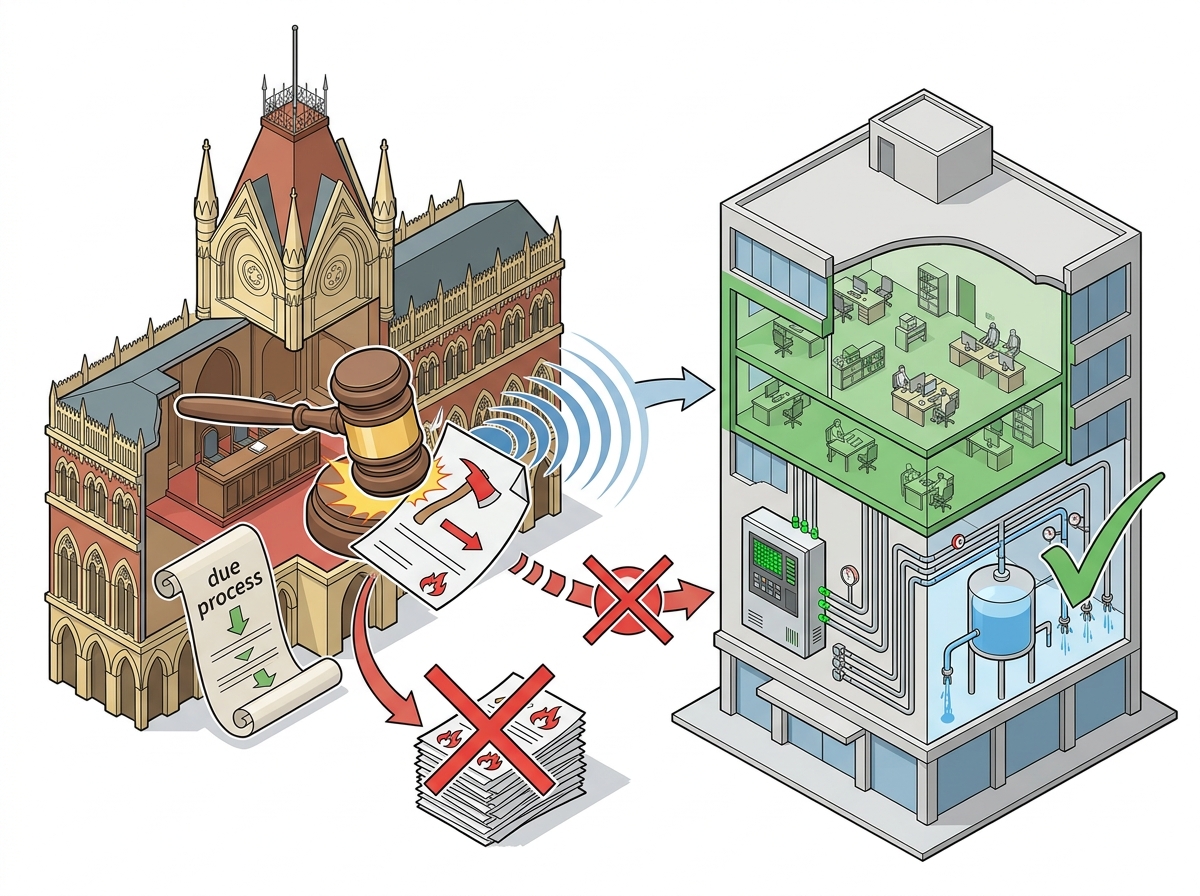
The Calcutta High Court recently set aside a notice issued by the West Bengal Fire and Emergency Services Department directing the evacuation of the office of a political party on grounds of alleged non-compliance with fire safety norms. The judgment underscores the procedural safeguards inherent in administrative enforcement, particularly the requirement for due process and the role of judicial review in ensuring compliance with constitutional and statutory mandates.
Background
- The department had issued a notice on September 4, 2026, directing the evacuation of specific floors of a building in Kolkata, citing the expiry of the fire safety certificate and non-compliance with safety norms.
- The notice was challenged before the Calcutta High Court by the occupant of the premises, alleging procedural impropriety and lack of due process in the enforcement action.
- The High Court, in its interim order, stayed the execution of the evacuation notice and subsequently directed the department to issue a fresh notice to the correct occupant, followed by a re-inspection.
- The case highlights the interplay between public safety regulations and the rights of property owners or occupants, particularly in cases involving political or institutional premises.
- The judgment reaffirms the principle that administrative actions must adhere to the principles of natural justice, including the right to be heard and the opportunity to rectify deficiencies before coercive measures are taken.
Judicial Review of Administrative Action in Fire Safety Enforcement
- Judicial review is the power of the High Courts under Article 226 of the Constitution of India to examine the legality and propriety of administrative actions.
- The Calcutta High Court’s intervention in this case exemplifies the court’s role in ensuring that administrative authorities act within the bounds of their statutory powers and do not exceed their jurisdiction.
- The principle of audi alteram partem (right to be heard) is a cornerstone of natural justice, requiring that affected parties be given an opportunity to present their case before adverse actions are taken.
- Administrative actions, including notices for evacuation or penalties for non-compliance, must be based on clear statutory provisions and supported by evidence of non-compliance.
- The court’s direction to issue a fresh notice and conduct a re-inspection underscores the need for procedural fairness and the avoidance of arbitrary or hasty actions by authorities.
- The case also highlights the importance of maintaining up-to-date fire safety certificates and compliance with building codes to prevent enforcement actions.
- Judicial review serves as a check on executive overreach, ensuring that public safety regulations are enforced in a manner that is fair, transparent, and consistent with constitutional principles.
- The judgment reinforces the doctrine of proportionality, requiring that enforcement actions be proportionate to the gravity of the non-compliance and that less coercive measures be exhausted before resorting to drastic steps.
Key Features
| Feature | Significance |
|---|---|
| Judicial Review of Administrative Action | Demonstrates the judiciary’s role in reviewing executive decisions, particularly those affecting fundamental rights and procedural fairness under Articles 14, 19, and 21 of the Constitution. |
| Procedural Compliance in Fire Safety Regulations | Highlights the necessity of strict adherence to statutory procedures in issuing notices under the West Bengal Fire Service Act, 1950, and the National Building Code of India. |
| Interim Relief in Public Interest Litigation | Showcases the judiciary’s power to grant interim relief to prevent irreparable harm while substantive issues are adjudicated, ensuring equity in governance. |
| Separation of Powers | Reaffirms the constitutional principle that administrative authorities must act within the bounds of their statutory powers, without encroaching on judicial or legislative domains. |
| Right to Property and Business Continuity | Examines the balance between public safety regulations and the right to carry on business, as envisaged under Article 19(1)(g) of the Constitution. |
Why it Matters
Administrative Governance
- The judgment underscores the importance of procedural correctness in administrative actions, particularly in matters of public safety and compliance with statutory norms.
- It reinforces the principle that executive authorities must act within the framework of the law, avoiding arbitrary or excessive actions that may infringe upon constitutional rights.
- The case highlights the need for coordination between statutory bodies (e.g., Fire Department) and property owners/occupiers to ensure compliance with safety regulations without undue disruption.
- It serves as a precedent for future cases involving enforcement of fire safety norms in commercial or political office premises.
Judicial Role in Governance
- The High Court’s intervention demonstrates the judiciary’s function as a check on executive overreach, ensuring that administrative actions are fair, reasoned, and legally sustainable.
- The order reflects the judiciary’s commitment to upholding the rule of law, even in politically sensitive cases, by focusing on legal and procedural merits rather than extraneous considerations.
- It reinforces the principle that courts must examine the legality of administrative actions de novo, rather than deferring to executive discretion without scrutiny.
Public Safety and Regulatory Framework
- The case brings attention to the critical role of fire safety regulations in urban governance, particularly in high-density commercial and political hubs like Kolkata.
- It highlights the challenges in enforcing fire safety norms in buildings with expired or lapsed certificates, necessitating systemic reforms in compliance monitoring.
- The judgment may prompt a review of the efficacy of existing fire safety enforcement mechanisms, including the role of local bodies and statutory authorities.
Challenges
1. Procedural Ambiguities in Fire Safety Enforcement
- The case exposes gaps in the clarity of procedures for issuing notices under the West Bengal Fire Service Act, 1950, particularly regarding the identification of responsible parties (owners vs. occupiers).
- The ambiguity in determining who bears the primary responsibility for compliance—building owners, occupiers, or tenants—can lead to delays and legal disputes.
- The absence of a unified national framework for fire safety enforcement complicates inter-state consistency in regulatory practices.
UPSC Link: GS-II: Governance, Transparency and Accountability
2. Balancing Public Safety with Business Continuity
- Regulatory authorities often face the challenge of enforcing safety norms without causing undue disruption to businesses or political activities housed in the premises.
- The case illustrates the tension between public interest (safety) and individual rights (property and livelihood), requiring nuanced judicial interpretation.
- Administrative authorities must develop protocols to ensure that enforcement actions are proportionate and do not result in arbitrary or discriminatory outcomes.
UPSC Link: GS-IV: Ethics, Integrity and Aptitude
3. Judicial Overreach vs. Executive Discretion
- The judgment raises questions about the extent to which courts should intervene in administrative matters, particularly when the executive claims a policy or technical justification for its actions.
- While judicial review is essential for accountability, excessive interference may undermine the autonomy of statutory bodies and delay critical enforcement actions.
- The case underscores the need for courts to adopt a balanced approach, deferring to executive expertise where appropriate while ensuring adherence to constitutional principles.
UPSC Link: GS-II: Separation of Powers
4. Urban Governance and Compliance Monitoring
- The enforcement of fire safety norms in urban areas like Kolkata is hindered by inadequate infrastructure for regular inspections and audits.
- The reliance on expired certificates and delayed compliance highlights systemic weaknesses in urban governance and regulatory oversight.
- The case calls for the adoption of technology-driven solutions (e.g., digital compliance tracking) to enhance transparency and efficiency in enforcement.
UPSC Link: GS-II: Urban Development
5. Political Sensitivity in Regulatory Enforcement
- The involvement of a prominent political figure (Abhishek Banerjee) in the case introduces an added layer of complexity, where regulatory actions may be perceived through a political lens.
- Administrative authorities must ensure that enforcement actions are devoid of political bias and are based solely on legal and technical grounds.
- The judiciary’s role in such cases is critical to maintaining public trust in the neutrality and fairness of regulatory processes.
UPSC Link: GS-II: Governance and Ethics
Challenges — UPSC Perspective
| Issue | Concern |
|---|---|
| Ambiguity in Responsible Party Identification | Delays in enforcement due to disputes over whether owners, occupiers, or tenants are liable for compliance. |
| Proportionality in Enforcement Actions | Risk of disproportionate actions (e.g., evacuation orders) that disrupt business continuity without addressing root causes. |
| Judicial-Executive Interface | Potential for judicial overreach or executive inaction, depending on the court’s interpretation of administrative discretion. |
| Urban Infrastructure Gaps | Inadequate resources for regular inspections and audits in high-density urban areas. |
| Political Perception and Neutrality | Challenges in ensuring regulatory actions are perceived as impartial, especially in politically sensitive cases. |
Way Forward
- Conduct a comprehensive review of the West Bengal Fire Service Act, 1950, to clarify procedural ambiguities regarding notice issuance and compliance responsibilities.
- Develop a national framework for fire safety enforcement, ensuring uniformity in procedures and timelines across states.
- Implement digital compliance tracking systems for fire safety certificates, enabling real-time monitoring and reducing delays in enforcement.
- Strengthen urban governance by investing in infrastructure for regular fire safety inspections and audits in high-risk buildings.
- Establish a dedicated grievance redressal mechanism for disputes arising from fire safety enforcement actions, ensuring timely resolution.
- Enhance capacity-building for fire department officials to ensure they are trained in legal procedures and proportional enforcement.
- Promote public awareness campaigns on fire safety norms and the rights of occupiers/owners in case of regulatory actions.
- Encourage inter-departmental coordination between fire departments, municipal bodies, and building owners to streamline compliance processes.
UPSC Value Addition
Keywords for Mains Answer-Writing
Fire Safety Standards in India · Constitutional Remedies against Executive Actions · Judicial Review of Administrative Orders · Fundamental Rights and State Action · Fire Prevention and Life Safety · Writ Jurisdiction of High Courts · Administrative Law Principles · Due Process of Law · Public Interest Litigation · West Bengal Fire and Emergency Services Department · Calcutta High Court · Separation of Powers · Rule of Law in Governance
Constitutional & Policy Linkages
- Article 14: Equality before law and equal protection of laws in administrative actions.
- Article 19(1)(g): Right to carry on business, subject to reasonable restrictions in the interest of public safety.
- Article 21: Right to life and personal liberty, including the right to a safe environment.
- Article 300A: Right to property, subject to reasonable restrictions under law.
Concept Flow
Building owner fails to comply with fire safety norms → Fire Department issues notice for evacuation → Notice challenged in Calcutta High Court → Court sets aside notice, directs fresh issuance to the occupier (TMC office) → Fire Department to re-inspect and point out deficiencies → Court to adjudicate on substantive merits of the case → Potential systemic reforms in fire safety enforcement.
Prelims Practice Questions
Q1. Consider the following statements regarding the writ jurisdiction of the High Courts in India:
1. The High Courts can issue writs under Article 226 of the Constitution for enforcement of Fundamental Rights.
2. The High Courts can issue writs only against the Government and not against private individuals.
3. The High Courts can issue writs for enforcement of any legal right, not necessarily a Fundamental Right.
How many of the above statements are correct?
- Only one
- Only two
- All three
- None
Answer: All three — Statements 1 and 3 are correct. The High Courts can issue writs under Article 226 for enforcement of Fundamental Rights (Statement 1) and also for enforcement of any legal right, not necessarily a Fundamental Right (Statement 3). Statement 2 is incorrect as writs can also be issued against private individuals if they are performing public functions or duties.
Q2. Assertion (A): The West Bengal Fire and Emergency Services Department can issue an eviction notice for non-compliance with fire safety norms without prior notice.
Reason (R): The Fire Safety Certificate is a mandatory requirement for all commercial buildings in India as per the National Building Code.
In the context of the above two statements, which one of the following is correct?
- Both A and R are true, and R is the correct explanation of A.
- Both A and R are true, but R is not the correct explanation of A.
- A is true, but R is false.
- A is false, but R is true.
Answer: A is true, but R is false. — The assertion (A) is true as the department can issue notices for non-compliance, but prior notice is generally required before eviction. The reason (R) is true as the National Building Code mandates fire safety certificates, but it does not explain the assertion.
Q3. Match the following columns related to fire safety regulations in India:
Column I (Provisions)
A. National Building Code of India
B. Fire Safety Certificate
C. Fire Prevention and Life Safety Measures
D. Evacuation Plans
Column II (Description)
1. Mandatory requirement for all commercial buildings
2. Guidelines for structural and operational safety
3. Document issued by competent authority certifying compliance
4. Mandatory for high-rise buildings and public spaces
Select the correct match:
- A-2, B-3, C-1, D-4; A-3, B-1, C-2, D-4; A-2, B-1, C-3, D-4; A-1, B-2, C-3, D-4
- answer_options_indexed_as_list_in_question_so_no_separate_answer_field_needed
Answer: A-2, B-3, C-1, D-4; A-3, B-1, C-2, D-4; A-2, B-1, C-3, D-4; A-1, B-2, C-3, D-4 — The correct match is: A-2 (National Building Code provides guidelines), B-3 (Fire Safety Certificate certifies compliance), C-1 (Fire Prevention and Life Safety Measures are mandatory), D-4 (Evacuation Plans are mandatory for high-rise buildings).
Mains Practice Question
✍ The Calcutta High Court’s intervention in the case of the fire department’s notice to the Trinamool Congress office underscores the judiciary’s role in upholding the rule of law against arbitrary executive actions. Critically examine the balance between administrative discretion and judicial review in the context of fire safety regulations and fundamental rights. (15 Marks)
Approach: MODEL-ANSWER SKELETON:
1. **Introduction (2 marks)**: Define the rule of law and judicial review; state the context of the Calcutta High Court’s order and its significance in protecting fundamental rights.
2. **Administrative Discretion in Fire Safety (3 marks)**:
– Role of the Fire and Emergency Services Department under the National Building Code (NBC) 2016 and state-specific regulations.
– Powers to issue notices, conduct inspections, and enforce compliance (e.g., Section 30 of the West Bengal Fire Service Act, 1950).
– Need for procedural fairness and prior notice before coercive action.
3. **Judicial Review and Fundamental Rights (4 marks)**:
– Writ jurisdiction under Article 226 of the Constitution: scope and limitations.
– Protection of fundamental rights (Article 14, 19, 21) against arbitrary executive actions.
– The Calcutta High Court’s reasoning: necessity of fresh notice and inspection before eviction.
– Cite relevant judgments: *Maneka Gandhi v. Union of India* (1978), *S.P. Gupta v. Union of India* (1981).
4. **Balance Between Discretion and Review (3 marks)**:
– Doctrine of proportionality in administrative actions.
– Need for transparency, accountability, and due process in enforcement.
– Role of the judiciary in ensuring that administrative actions are not ultra vires or arbitrary.
5. **Contemporary Relevance and Conclusion (3 marks)**:
– Importance of this case in ensuring that fire safety regulations do not become tools for political or extraneous considerations.
– Conclude with the necessity of a balanced approach where administrative efficiency is not compromised with constitutional safeguards.
Source: The Indian Express
Generated by AanyaAi for educational purpose.
Related guides on our sites
- Best PSIR optional coaching for upsc
- Best PSIR optional teacher for upsc
- Best teacher of PSIR optional for upsc
- Best PSIR optional coaching in delhi for UPSC

- Calcutta HC quashes fire notice against Abhishek Banerjee’s office: Key UPSC insights - September 16, 2026
- पाक नौसेना जहाज़ से टकराया भारतीय नौसेना जहाज़, विदेश मंत्रालय ने पाकिस्तान के चार्ज डी अफेयर्स को किया बुलाया - September 16, 2026
- Pakistan Navy’s Unprofessional Conduct: MEA Summons CDA Over Arabian Sea Collision - September 16, 2026

No Comments