


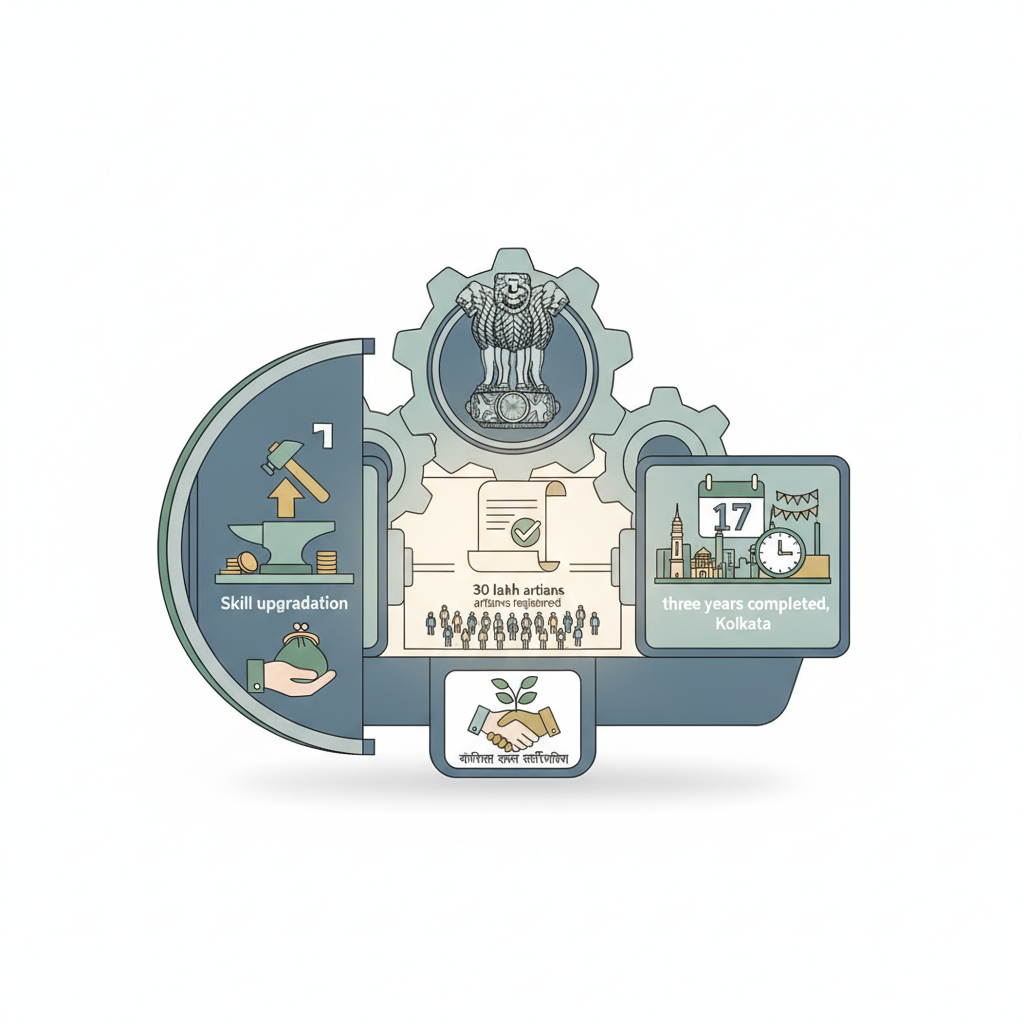
16 Sep PM Vishwakarma Yojana Completes 3 Years: 30 Lakh Artisans Registered
✎ The PM Vishwakarma Yojana is a holistic scheme providing recognition, skill upgradation, credit access, toolkit distribution, and market linkages to 18 designated traditional trades, with over 30 lakh artisans registered and…
Subject Relevance — Where This Topic Fits
- GS Paper II — Governance, Transparency and Accountability | GS Paper III — Development, Employment, Skill Development and Entrepreneurship
- Prelims: Pradhan Mantri Vishwakarma Yojana, MSME Sector, Skill India Mission, Credit Guarantee Scheme for Micro Enterprises, Artisan Identity and Skill Certification
- Essay: The Role of Government in Preserving Cultural Heritage through Institutional Support to Artisans, Skill Development and Entrepreneurship as Tools for Inclusive Growth in India
Quick Revision: The PM Vishwakarma Yojana is a holistic scheme providing recognition, skill upgradation, credit access, toolkit distribution, and market linkages to 18 designated traditional trades, with over 30 lakh artisans registered and ₹5,297 crore disbursed as concessional credit.
Why is this in the news?
The Pradhan Mantri Vishwakarma Yojana (PMVY) has completed three years of implementation, marking a significant milestone in the government’s efforts to provide comprehensive institutional support to traditional artisans and craftspeople across India. As of September 2026, over 30 lakh artisans have been registered under the scheme, achieving the target set for registration. The third anniversary celebration in Kolkata on 17 September 2026 underscores the scheme’s impact on livelihood enhancement, skill upgradation, and financial inclusion of artisans engaged in 18 designated trades.
Background
- The PMVY was launched on 17 September 2023 by the Prime Minister of India under the aegis of the Ministry of Micro, Small and Medium Enterprises (MSME) to address the challenges faced by traditional artisans and craftspeople, including lack of formal recognition, limited access to credit, inadequate skill upgradation, and restricted market linkages.
- The scheme is aligned with the broader objectives of the Skill India Mission, aiming to integrate traditional skills with modern technological advancements to enhance productivity and competitiveness.
- Artisans and craftspeople in India constitute a significant segment of the unorganised sector, contributing to both cultural preservation and economic output. However, they often face barriers such as low bargaining power, limited access to formal financial institutions, and inadequate exposure to contemporary markets.
- The scheme reflects India’s commitment to the United Nations Sustainable Development Goals (SDGs), particularly SDG 8 (Decent Work and Economic Growth) and SDG 9 (Industry, Innovation and Infrastructure), by fostering entrepreneurship and innovation among traditional artisans.
What is the Pradhan Mantri Vishwakarma Yojana?
- The PMVY is a centrally sponsored scheme launched to provide end-to-end support to artisans and craftspeople engaged in 18 designated trades, including carpenters, blacksmiths, goldsmiths, potters, sculptors, and traditional toy makers.
- The scheme offers a comprehensive support package comprising recognition through PM Vishwakarma certificates and identity cards, skill upgradation through basic and advanced training programs, distribution of modern toolkits, access to collateral-free credit at subsidised interest rates, incentives for digital transactions, and marketing support through exhibitions and e-commerce platforms.
- The registration process under PMVY involves a three-tier verification mechanism to ensure authenticity and prevent duplication, including verification by Gram Panchayats or Urban Local Bodies, state-level authorities, and central government agencies.
- Financial assistance under the scheme includes a concessional credit facility of up to ₹1,00,000 at a subsidised interest rate of 5% per annum, with a credit guarantee cover provided by the government.
- The toolkit component of the scheme provides modern tools and equipment to artisans, enabling them to improve the quality and efficiency of their work. As of September 2026, over 18.15 lakh toolkits have been distributed through India Post, ensuring last-mile delivery to artisans’ doorsteps.
- The skill development component of the scheme, implemented in collaboration with the Ministry of Skill Development and Entrepreneurship, has trained approximately 24.50 lakh artisans in basic and advanced skills, enhancing their employability and entrepreneurial capabilities.
- The marketing support component includes participation in national and state-level exhibitions, linkages with e-commerce platforms, and branding initiatives to promote traditional Indian crafts both domestically and internationally.
- The scheme operates through a multi-stakeholder governance framework involving the MSME Ministry, state governments, financial institutions, and grassroots organisations such as Common Service Centres (CSCs) and Village Level Entrepreneurs (VLEs).
Key Features
| Feature | Significance |
|---|---|
| Recognition and Identity | Issuance of PM Vishwakarma certificates and identity cards to 30 lakh artisans, providing formal recognition of traditional skills and facilitating access to formal credit and market linkages. |
| Skill Upgradation | Provision of basic skill training to approximately 24.50 lakh artisans, enhancing their technical competence and productivity in 18 identified trades. |
| Financial Support | Disbursement of collateral-free loans up to ₹1 lakh at a concessional interest rate of 5% per annum to 6.18 lakh artisans, totaling ₹5,297 crore, to support enterprise expansion. |
| Toolkit Distribution | Delivery of 18.15 lakh modern toolkits to artisans via India Post, enabling adoption of improved tools to enhance work quality and efficiency. |
| Digital Incentives | Promotion of digital transactions among artisans through incentives, fostering financial inclusion and enabling participation in the digital economy. |
Why it Matters
Economic Empowerment
- Enhances livelihood opportunities for traditional artisans by integrating them into formal economic structures through skill certification and financial inclusion.
- Promotes entrepreneurship among artisans by providing access to credit, reducing dependency on informal lenders and improving business sustainability.
- Contributes to the preservation and modernization of traditional crafts, ensuring their economic viability in a competitive market.
Social Inclusion
- Recognizes and uplifts marginalized sections of society engaged in traditional occupations, particularly in rural and semi-urban areas.
- Facilitates gender-inclusive participation by supporting women artisans, who constitute a significant portion of traditional craft communities.
- Strengthens community-based economic activities, reducing migration pressures and fostering local economic resilience.
Governance and Institutional Framework
- Demonstrates a structured approach to skill development and financial support through inter-ministerial coordination (MSME, Skill Development, and related departments).
- Leverages existing institutions such as KVIC, NSIC, and India Post for efficient implementation, ensuring last-mile delivery of benefits.
- Establishes a verifiable registration and certification process, ensuring transparency and accountability in beneficiary selection.
Market Integration
- Provides artisans with market linkages through exhibitions, digital platforms, and institutional support, reducing reliance on intermediaries.
- Encourages the adoption of modern marketing techniques, including e-commerce and digital payments, to expand market reach.
- Supports the branding and commercialization of traditional crafts, enhancing their appeal in domestic and international markets.
Challenges
1. Sustainability of Livelihoods
- Risk of artisans reverting to informal or low-income work due to inadequate post-training support or market demand fluctuations.
- Dependence on seasonal or cyclical demand for traditional crafts, which may limit year-round income stability.
- Need for continuous upskilling to adapt to evolving market preferences and technological advancements.
UPSC Link: GS-III: Employment & Skill Development
2. Access and Awareness Gaps
- Limited reach in remote and tribal areas where traditional artisans are concentrated, due to inadequate infrastructure or outreach mechanisms.
- Low awareness among artisans about the scheme’s benefits, eligibility criteria, and application processes, particularly in non-urban regions.
- Digital divide affecting participation in online training, certification, and market access components.
UPSC Link: GS-II: Governance & e-Governance
3. Financial Viability and Repayment
- Potential challenges in loan repayment due to fluctuating income streams or lack of financial literacy among beneficiaries.
- Need for robust monitoring of credit utilization to prevent diversion of funds to non-entrepreneurial purposes.
- Ensuring that the concessional interest rate does not create dependency on government subsidies.
UPSC Link: GS-III: Financial Inclusion & MSMEs
4. Quality and Standardization
- Maintaining consistent quality in traditional crafts while adopting modern tools and techniques to meet market standards.
- Risk of dilution of traditional art forms due to over-commercialization or mass production compromising authenticity.
- Need for certification standards to ensure that products meet quality benchmarks for domestic and international markets.
UPSC Link: GS-III: MSMEs & Entrepreneurship
5.
- Ensuring seamless coordination among multiple implementing agencies (MSME, Skill Development, KVIC, India Post, etc.) to avoid duplication or gaps in service delivery.
- Addressing delays in fund disbursement, toolkit distribution, or certification due to bureaucratic or logistical bottlenecks.
- Strengthening state-level implementation, particularly in states with lower uptake, through capacity building of local officials.
UPSC Link: GS-II: Inter-State Relations & Governance
Challenges — UPSC Perspective
| Issue | Concern |
|---|---|
| Low Awareness in Tribal Areas | Limited penetration of scheme benefits in regions with high concentration of traditional artisans due to geographical and linguistic barriers. |
| Seasonal Income Fluctuations | Traditional crafts often face demand variations, leading to inconsistent earnings and repayment challenges for artisans. |
| Digital Literacy Deficits | Artisans in rural areas lack access to digital tools, hindering participation in online training and market access components. |
| Toolkit Utilization Gaps | Risk of toolkits being underutilized due to lack of training in their operation or maintenance, reducing their intended impact. |
| Market Linkage Bottlenecks | Limited exposure to modern marketing channels restricts artisans’ ability to scale their businesses beyond local markets. |
| Repayment Discipline | Need for financial literacy programs to ensure artisans understand loan terms and repayment obligations to avoid default risks. |
Government Initiatives — Must-Memorise for Prelims
- Pradhan Mantri Vishwakarma Yojana (PMVY)
- Skill India Mission (under Ministry of Skill Development and Entrepreneurship)
- Khadi and Village Industries Commission (KVIC) schemes
Way Forward
- Strengthen grassroots awareness campaigns through local self-government bodies (Panchayats, ULBs) and community leaders to improve scheme uptake in rural and tribal areas.
- Expand digital literacy programs for artisans, including training in online certification, digital payments, and e-commerce platforms to enhance market access.
- Introduce mentorship programs pairing successful artisans with new beneficiaries to share best practices in skill application and business management.
- Enhance post-training support by establishing artisan cooperatives or clusters to facilitate bulk procurement of raw materials and collective marketing.
- Develop a real-time monitoring system for loan disbursement and repayment to identify and address bottlenecks promptly, ensuring financial sustainability.
- Collaborate with educational institutions and vocational training centers to integrate traditional crafts into formal skill development curricula.
- Promote research and development in traditional crafts to innovate product designs, improve quality standards, and align with contemporary market trends.
- Establish a dedicated grievance redressal mechanism for artisans to report delays, grievances, or discrepancies in benefit delivery.
UPSC Value Addition
Keywords for Mains Answer-Writing
PM Vishwakarma Yojana · traditional artisans and craftsmen · MSME sector · skill upgradation · financial inclusion · institutional support · livelihood enhancement · entrepreneurship development · credit subsidy · toolkit distribution · digital empowerment · market linkage · 30 lakh beneficiaries · PM Vishwakarma certificate and ID · West Bengal implementation
Concept Flow
Traditional artisans and craftsmen form the backbone of India’s cultural and economic heritage. → Government identifies gaps in skill recognition, financial access, and market integration for these artisans. → Pradhan Mantri Vishwakarma Yojana is launched to provide comprehensive support through certification, skill training, financial assistance, and toolkits. → Implementation involves multi-stakeholder coordination (MSME, Skill Development, KVIC, India Post) for last-mile delivery. → Artisans undergo skill upgradation, receive toolkits, and access concessional loans, enhancing productivity and income. → Digital incentives and market linkages expand artisans’ reach, integrating them into formal and digital economies. → Sustainable livelihoods are fostered, preserving traditional crafts while adapting to modern market demands.
Prelims Practice Questions
Q1. Consider the following statements regarding the PM Vishwakarma Yojana:
1. It aims to provide comprehensive support to traditional artisans and craftsmen.
2. The scheme offers a collateral-free loan of up to ₹1 lakh at a subsidised interest rate of 5% per annum.
3. The scheme guarantees direct employment generation for at least 50% of the beneficiaries.
4. Modern toolkits are distributed to artisans through India Post.
How many of the above statements are correct?
- Only one
- Only two
- Only three
- All
Answer: Only three — Statements 1, 2, and 4 are correct. Statement 3 is incorrect as the scheme does not guarantee direct employment generation; it focuses on skill upgradation, financial inclusion, and market linkage.
Q2. Assertion (A): The PM Vishwakarma Yojana is implemented under the Ministry of Micro, Small and Medium Enterprises (MSME).
Reason (R): The scheme targets traditional artisans and craftsmen to enhance their livelihoods and entrepreneurial capabilities.
- Both A and R are true, and R is the correct explanation of A
- Both A and R are true, but R is not the correct explanation of A
- A is true but R is false
- A is false but R is true
Answer: Both A and R are true, but R is not the correct explanation of A — The PM Vishwakarma Yojana is indeed implemented under the Ministry of MSME, and the scheme’s objective is to support traditional artisans and craftsmen, making both the assertion and reason true with R correctly explaining A.
Q3. Match the following components of the PM Vishwakarma Yojana with their respective benefits:
Component:
A. PM Vishwakarma Certificate and ID
B. Skill upgradation
C. Toolkit incentive
D. Credit support
Benefit:
1. Provides formal recognition and identity to artisans
2. Enhances productivity and quality of work
3. Facilitates access to finance at subsidised rates
4. Includes basic training and advanced skill development
- A-1, B-4, C-2, D-3; A-2, B-1, C-4, D-3; A-3, B-2, C-1, D-4; A-4, B-3, C-1, D-2
- answer_string_map_indexed_list_indexed_1
- explain_match_pairs
- format
- match_the_following
- q_pairs_list_indexed_1_to_4_pairs_list_indexed_1_to_4
- pairs_list_indexed_1_to_4_pairs_list_indexed_1_to_4
- A-1, B-4, C-2, D-3
Answer: A-1, B-4, C-2, D-3; A-2, B-1, C-4, D-3; A-3, B-2, C-1, D-4; A-4, B-3, C-1, D-2 —
Mains Practice Question
✍ The PM Vishwakarma Yojana represents a paradigm shift in India’s approach to supporting traditional artisans and craftsmen. Critically examine the institutional, financial, and skill-based dimensions of this scheme. Also, evaluate its potential to transform the livelihoods of artisans in the context of India’s broader MSME ecosystem. (15 Marks)
Approach: MODEL-ANSWER SKELETON:
1. **Institutional Dimension (4 Marks)**
– **Ministry of MSME as the nodal agency**: Role in policy formulation, implementation, and inter-ministerial coordination.
– **Multi-stakeholder governance**: Involvement of KVIC, NSIC, SLBC, India Post, and state governments; highlight the significance of decentralised implementation.
– **Recognition mechanism**: PM Vishwakarma Certificate and ID as formal recognition tools to enhance artisans’ social and economic identity.
– **Limitations**: Challenges in coordination, bureaucratic delays, and regional disparities in implementation.
2. **Financial Dimension (5 Marks)**
– **Credit support**: Collateral-free loans up to ₹1 lakh at 5% interest; total disbursement of ₹5,297 crore to 6.18 lakh artisans.
– **Subsidised interest rates**: Comparison with other government schemes (e.g., Mudra Yojana) and their impact on affordability.
– **Toolkit incentive**: Distribution of 18.15 lakh modern toolkits via India Post; link to productivity enhancement and quality improvement.
– **Digital empowerment**: Incentives for digital transactions and market linkage.
– **Limitations**: Coverage gaps, awareness issues among artisans, and sustainability of financial support.
3. **Skill-Based Dimension (4 Marks)**
– **Skill upgradation**: Training provided to 24.50 lakh artisans under the Ministry of Skill Development and Entrepreneurship.
– **Curriculum design**: Focus on traditional skills, modern techniques, and entrepreneurial development.
– **Certification and recognition**: Role of PM Vishwakarma certificates in enhancing employability and market access.
– **Limitations**: Quality of training, scalability challenges, and alignment with industry demands.
4. **Broader MSME Ecosystem and Way Forward (2 Marks)**
– **Integration with MSME policies**: Alignment with initiatives like ‘Make in India’, ‘Atmanirbhar Bharat’, and ‘Stand-Up India’.
– **Market linkage**: Role of exhibitions, CSC/VLE networks, and e-commerce platforms in connecting artisans with consumers.
– **Sustainability**: Need for continuous monitoring, feedback mechanisms, and adaptive policy design.
– **Conclusion**: The scheme is a transformative step but requires robust implementation, stakeholder engagement, and long-term sustainability to achieve its objectives.
Source: PIB (Press Information Bureau)
Generated by AanyaAi for educational purpose.
Related guides on our sites
- Best PSIR optional coaching for upsc
- Best PSIR optional teacher for upsc
- Best teacher of PSIR optional for upsc
- Best PSIR optional coaching in delhi for UPSC

- PM Vishwakarma Yojana Completes 3 Years: 30 Lakh Artisans Registered - September 16, 2026
- डीएफपीडी विशेष अभियान 6: 2 से 31 अक्टूबर 2026 तक स्वच्छता एवं दक्षता अभियान - September 16, 2026
- DFPD’s Special Campaign 6: Key Focus Areas for UPSC & State PCS - September 16, 2026

No Comments