


17 Sep Gandhinagar WCEF 2026: India Leads Global Push for Circular Economy Solutions
✎ The World Circular Economy Forum (WCEF) is a global platform for accelerating the adoption of circular economy principles through multi-stakeholder collaboration, policy innovation, and investment in sustainable resource…
Subject Relevance — Where This Topic Fits
- GS Paper II — International Organisations & Summits | GS Paper III — Environment & Sustainable Development
- Prelims: Circular Economy, WCEF 2026, Extended Producer Responsibility (EPR), Resource Efficiency, UN Sustainable Development Goals (SDGs), Plastic Waste Management Rules 2022, National Green Tribunal (NGT), Ecomark Scheme
- Essay: Sustainable Development: Balancing Economic Growth and Environmental Conservation, Circular Economy as a Catalyst for Inclusive and Resilient Development
Quick Revision: The World Circular Economy Forum (WCEF) is a global platform for accelerating the adoption of circular economy principles through multi-stakeholder collaboration, policy innovation, and investment in sustainable resource management.
Why is this in the news?
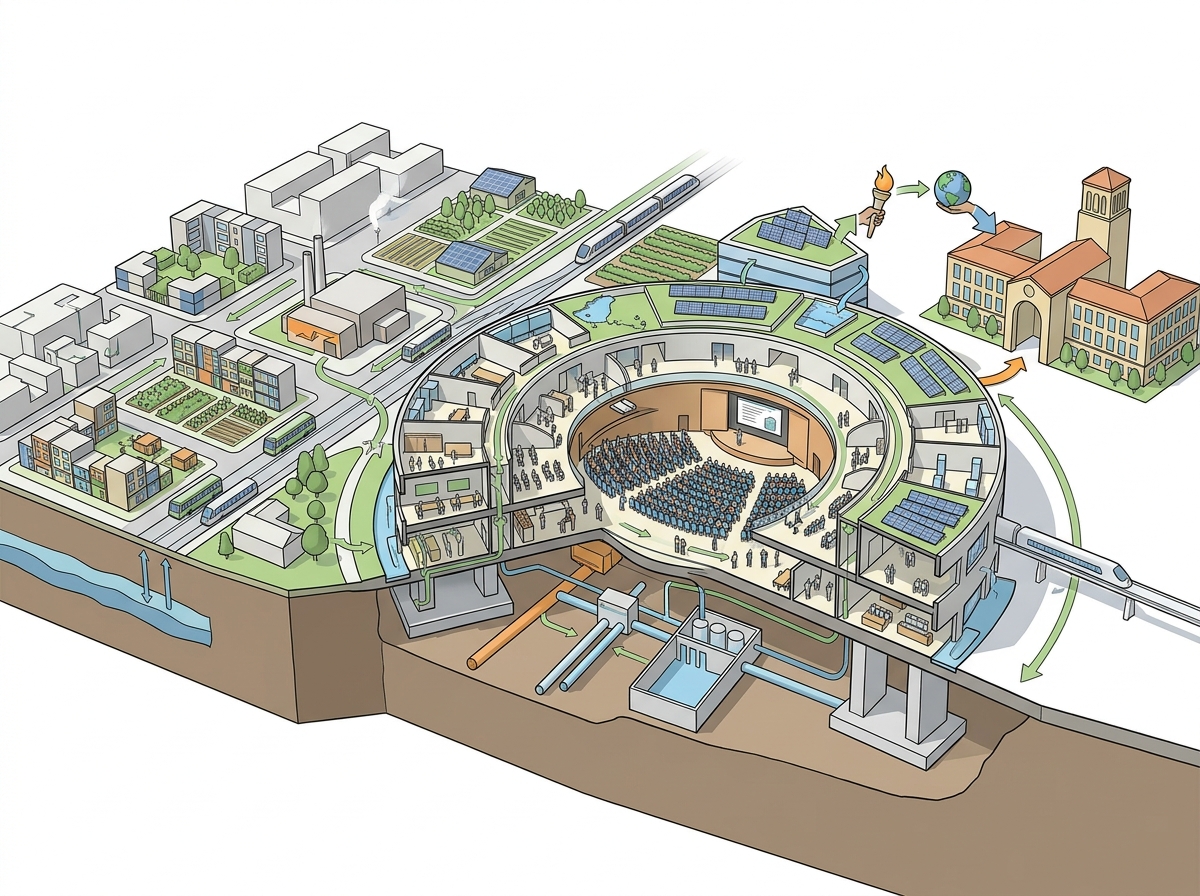
The World Circular Economy Forum (WCEF) 2026, held in Gandhinagar, Gujarat, concluded with a call for rapid adoption of inclusive and scalable circular economy solutions. The forum, attended by over 2,700 delegates from 60+ countries, underscored the need for ground-level collaboration, practical partnerships, and investment in circular economy models to address environmental challenges while unlocking economic opportunities. The event also marked the handover of the WCEF 2027 hosting responsibilities to Columbia University, USA.
Background
- Circular economy is a systemic approach to economic development designed to benefit businesses, society, and the environment by decoupling growth from the consumption of finite resources.
- The concept gained global traction following the adoption of the UN Sustainable Development Goals (SDGs) in 2015, particularly SDG 12 (Responsible Consumption and Production).
- India has been progressively integrating circular economy principles into its policy frameworks, including the National Resource Efficiency Policy (NREP) 2019 and the Plastic Waste Management Rules (Amended) 2022.
- The Ecomark Scheme, launched in 1991 and revised in 2023, promotes eco-friendly products and aligns with circular economy objectives.
- The World Circular Economy Forum (WCEF), initiated in 2017, is a global platform for governments, businesses, and civil society to collaborate on circular economy transitions.
- Gujarat, a pioneer in industrial and environmental governance, hosted WCEF 2026, reflecting India’s leadership in sustainable development.
What is the World Circular Economy Forum (WCEF)?
- The WCEF is an annual global event convened to accelerate the transition to a circular economy by fostering collaboration among stakeholders across sectors.
- It serves as a platform for sharing best practices, policy innovations, and business models that prioritise resource efficiency, waste reduction, and sustainable production-consumption systems.
- The forum brings together policymakers, industry leaders, academics, startups, and civil society to discuss challenges and opportunities in circular economy adoption.
- The forum emphasised the role of grassroots-level collaboration, gender equality, and skill development in scaling circular economy solutions.
- The Ecomark logo, launched during WCEF 2026, aims to standardise eco-friendly product certification and promote consumer awareness.
- Columbia University, USA, will host WCEF 2027, continuing the global dialogue on circular economy transitions.
Key Features
| Feature | Significance |
|---|---|
| Multi-stakeholder participation | Engagement of 60+ countries, 2,700 delegates, and 260 speakers across governments, industry, academia, and civil society to ensure inclusive and practical solutions. |
| Focus on ground-level implementation | Emphasis on grassroots collaboration and scalable circular economy solutions rather than theoretical discussions. |
| Launch of EcoMark logo | Symbolic initiative to standardize and promote environmentally sustainable products and practices in India. |
| Film on circular economy | Documentary showcasing global best practices and case studies to inspire action and replication. |
| Parallel thematic sessions | 16 concurrent sessions addressing financial, technical, social, and economic dimensions of circular economy. |
Why it Matters
Economic Opportunities
- Circular economy presents a USD 4.5 trillion economic opportunity globally by 2030, aligning with India’s goal of becoming a USD 5 trillion economy.
- Creation of new industries, jobs, and business models in waste management, recycling, and sustainable product design.
- Reduction in import dependency for raw materials through domestic resource efficiency.
Environmental Imperatives
- Mitigates environmental degradation by reducing waste generation, pollution, and greenhouse gas emissions.
- Supports India’s Nationally Determined Contributions (NDCs) under the Paris Agreement by promoting low-carbon growth.
- Addresses India’s commitment to achieving the Sustainable Development Goals (SDGs), particularly SDG 12 (Responsible Consumption and Production).
Social Inclusion
- Ensures equitable access to circular economy benefits, including marginalized communities and women-led enterprises.
- Promotes skill development and entrepreneurship in green technologies and waste management sectors.
- Enhances public awareness and behavioral change towards sustainable consumption patterns.
Global Leadership
- Demonstrates India’s proactive role in global sustainability dialogues, hosting WCEF 2026 and leading by example.
- Strengthens international partnerships for technology transfer, investment, and knowledge sharing in circular economy practices.
- Positions India as a hub for innovation in waste-to-wealth solutions, attracting global investments.
Challenges
1. Policy and Regulatory Gaps
- Fragmented regulatory frameworks across states leading to inconsistent enforcement of waste management rules.
- Need for harmonized national policies to incentivize circular economy practices, such as Extended Producer Responsibility (EPR).
UPSC Link: GS Paper III: Environmental Governance
2. Financial Constraints
- Limited access to affordable financing for small and medium enterprises (SMEs) in the circular economy sector.
- High initial capital costs for setting up recycling and waste-to-energy infrastructure.
UPSC Link: GS Paper III: Inclusive Growth
3. Technological and Infrastructure Deficits
- Inadequate waste collection, segregation, and processing infrastructure in urban and rural areas.
- Lack of advanced technologies for efficient recycling and upcycling of complex waste streams.
UPSC Link: GS Paper III: Science and Technology
4. Behavioral and Cultural Barriers
- Low public awareness and resistance to adopting circular economy practices due to convenience and cost considerations.
- Cultural norms favoring linear consumption models over sustainable alternatives.
UPSC Link: GS Paper IV: Ethics and Human Values
5. Market and Supply Chain Challenges
- Limited demand for recycled materials due to price competitiveness with virgin resources.
- Complex supply chains and lack of coordination among stakeholders in the circular economy ecosystem.
UPSC Link: GS Paper III: Economic Development
Challenges — UPSC Perspective
| Issue | Concern |
|---|---|
| Policy Fragmentation | Inconsistent enforcement of waste management rules across states. |
| Financial Accessibility | High capital costs and limited financing for SMEs in circular economy. |
| Technological Gaps | Inadequate infrastructure for recycling and upcycling of waste. |
| Public Awareness | Low adoption of circular practices due to cultural and behavioral barriers. |
| Market Demand | Limited demand for recycled materials due to cost competitiveness. |
Way Forward
- Establish a National Circular Economy Mission to coordinate policies, funding, and implementation across ministries and states.
- Strengthen Extended Producer Responsibility (EPR) frameworks with clear targets, monitoring mechanisms, and penalties for non-compliance.
- Invest in waste management infrastructure, including smart collection systems, material recovery facilities, and recycling parks.
- Promote public-private partnerships (PPPs) to leverage private sector expertise and capital for circular economy projects.
- Launch nationwide awareness campaigns to educate citizens on segregation, recycling, and sustainable consumption.
- Encourage R&D in green technologies and provide grants or tax incentives for startups innovating in circular economy solutions.
- Develop skill development programs to train workers in waste management, recycling, and sustainable manufacturing.
- Harmonize state-level policies and align them with national circular economy goals to ensure uniformity and effectiveness.
UPSC Value Addition
Keywords for Mains Answer-Writing
Circular Economy · Resource Efficiency · Sustainable Development · Waste Management · Climate Change Mitigation · Inclusive Growth · Circular Business Models · Extended Producer Responsibility · UN Sustainable Development Goals · Plastic Waste Management · Circular Economy Action Plan · G20 Principles on Circular Economy · National Circular Economy Policy · Extended Producer Responsibility Framework · Circular Economy Indicators
Concept Flow
Global recognition of circular economy as a sustainable development model → Hosting of WCEF 2026 in Gandhinagar to foster international collaboration → Multi-stakeholder participation (governments, industry, academia, civil society) to ensure inclusive and practical solutions → Identification of key challenges: policy gaps, financial constraints, technological deficits, behavioral barriers, and market challenges → Formulation of actionable strategies: EPR frameworks, infrastructure investment, awareness campaigns, and skill development → Implementation of circular economy practices at scale to achieve economic, environmental, and social benefits → Monitoring and evaluation to ensure progress and alignment with national and global sustainability goals
Prelims Practice Questions
Q1. Consider the following statements regarding the concept of Circular Economy:
1. It aims to eliminate waste and the continual use of resources.
2. It is primarily focused on reducing carbon emissions through renewable energy adoption.
3. Extended Producer Responsibility (EPR) is a key policy tool to operationalise Circular Economy principles.
4. The European Union’s Circular Economy Action Plan (2020) is legally binding on all member states.
How many of the above statements are correct?
- Only one
- Only two
- Only three
- All
Answer: Only three — Statements 1 and 3 are correct. Statement 2 is incorrect as the Circular Economy focuses on resource efficiency and waste elimination, not solely on renewable energy. Statement 4 is incorrect as the EU’s Circular Economy Action Plan is a policy framework, not a legally binding instrument.
Q2. Assertion (A): The World Circular Economy Forum (WCEF) is an annual international platform that brings together stakeholders to accelerate the transition to a circular economy.
Reason (R): The WCEF is organised by the United Nations Environment Programme (UNEP) to align with the Sustainable Development Goals (SDGs).
- Both A and R are true, and R is the correct explanation of A.
- Both A and R are true, but R is not the correct explanation of A.
- A is true, but R is false.
- A is false, but R is true.
Answer: A is true, but R is false. — Assertion (A) is true as the WCEF is indeed an international platform for circular economy stakeholders. Reason (R) is false because the WCEF is not organised by UNEP but by various partners, including governments and private entities, and is not exclusively aligned with UNEP’s mandate.
Q3. Match the following initiatives with their respective countries/regions:
Column I (Initiative) | Column II (Country/Region)
———————————————–|—————————-
A. National Circular Economy Policy | 1. India
B. Circular Economy Action Plan (2020) | 2. European Union
C. G20 Principles on Circular Economy | 3. Global
D. Extended Producer Responsibility Framework | 4. Japan
- A-1, B-2, C-3, D-4
- A-2, B-1, C-4, D-3
- A-3, B-4, C-1, D-2
- A-4, B-3, C-2, D-1
Answer: A-1, B-2, C-3, D-4 — A-1: India has adopted a National Circular Economy Policy. B-2: The European Union launched the Circular Economy Action Plan (2020). C-3: The G20 Principles on Circular Economy are a global initiative. D-4: Japan has implemented an Extended Producer Responsibility (EPR) Framework.
Mains Practice Question
✍ Critically examine the significance of the World Circular Economy Forum (WCEF) in accelerating the global transition to a circular economy. How far does India’s leadership in hosting WCEF 2026 reflect its commitment to sustainable development and resource efficiency? Substantiate your answer with reference to India’s policy framework and global best practices. (15 Marks)
Approach: MODEL-ANSWER SKELETON:
1. **Introduction**: Define Circular Economy (CE) as a system aimed at eliminating waste and the continual use of resources, aligned with SDGs (e.g., SDG 12: Responsible Consumption and Production).
2. **Global Significance of WCEF**:
– Platform for multi-stakeholder collaboration (governments, industries, academia, civil society).
– Focus on practical solutions: waste management, EPR frameworks, circular business models, and innovation.
– Role in shaping global policy narratives (e.g., G20 Principles on Circular Economy, EU’s Circular Economy Action Plan).
3. **India’s Commitment to CE**:
– **Policy Framework**: National Circular Economy Policy (draft), EPR guidelines for plastic waste (Plastic Waste Management Rules, 2022), and waste management under Swachh Bharat Mission 2.0.
– **Institutional Mechanisms**: Role of NITI Aayog, Ministry of Environment, Forest and Climate Change (MoEFCC), and Central Pollution Control Board (CPCB) in implementing CE principles.
– **State-Level Initiatives**: Gujarat’s leadership in hosting WCEF 2026, Odisha’s circular economy roadmap, and Tamil Nadu’s industrial symbiosis projects.
4. **Challenges in India’s CE Transition**:
– Fragmented waste management systems and informal sector integration.
– Limited investment in circular technologies and R&D.
– Need for stronger enforcement of EPR and extended producer responsibility.
5. **Global Best Practices**:
– **EU**: Circular Economy Action Plan (2020) with binding targets for recycling and waste reduction.
– **Japan**: EPR framework for packaging, electronics, and automobiles.
– **Finland**: Integration of CE into national innovation strategies.
6. **Conclusion**: India’s hosting of WCEF 2026 is a strategic step to position itself as a leader in CE, but sustained policy implementation, investment, and stakeholder collaboration are critical for tangible outcomes. Highlight the need for a National Circular Economy Act to provide a statutory backbone.
Source: PIB (Press Information Bureau)
Gujarat PCS (GPSC) — State PCS Practice
Prelims: Which of the following is a key objective of the ‘World Circular Economy Forum 2026’ to be hosted in Gandhinagar?
- To accelerate the adoption of inclusive and scalable circular economy solutions in Gujarat and beyond
- To promote linear economic models for rapid industrial growth in India
- To establish a global carbon trading platform in Gujarat
- To focus solely on waste management policies in urban areas
Answer: To accelerate the adoption of inclusive and scalable circular economy solutions in Gujarat and beyond — The forum aims to drive the adoption of circular economy solutions, emphasizing inclusivity and scalability, particularly in regions like Gujarat.
Mains: Discuss the significance of Gujarat hosting the ‘World Circular Economy Forum 2026’ and analyze the potential socio-economic and environmental impacts of implementing large-scale circular economy solutions in the state. (250 words)
Generated by AanyaAi for educational purpose.
Related guides on our sites
- Current affairs for upsc 2026
- How to prepare for GS paper 1 for UPSC CSE mains exam
- Best economics optional coaching for upsc
- Best economics optional teacher for upsc

- AI नियमों के लिए UN की पहल: क्या है वैश्विक दृष्टिकोण? - September 17, 2026
- UN’s AI Governance Push: Can Global Rules Prevent Existential Risks? - September 17, 2026
- अल्लाहाबाद हाईकोर्ट का बड़ा फैसला: धर्म और जीवनसाथी चुनने का अधिकार - September 17, 2026

No Comments