


17 Sep MoHUA to Launch Special Campaign 6 from Oct 2-31, 2026: Key Focus Areas
✎ Special Campaign 6 (2 Oct–31 Oct 2026) by MoHUA prioritises e-waste management under E-Waste (Management) Rules, 2022, and aims to reduce pendency in government offices while enhancing service delivery and cleanliness.
Subject Relevance — Where This Topic Fits
- GS Paper II — Governance, Transparency and Accountability | GS Paper III — Environment and Sustainable Development | GS Paper IV — Ethics in Governance
- Prelims: Special Campaign 6, E-Waste (Management) Rules, 2022, CPGRAMS, Swachh Bharat Mission, CPWD, NBCC
- Essay: Governance reforms for efficiency and transparency in public administration, Sustainable waste management as a pillar of urban governance
Quick Revision: Special Campaign 6 (2 Oct–31 Oct 2026) by MoHUA prioritises e-waste management under E-Waste (Management) Rules, 2022, and aims to reduce pendency in government offices while enhancing service delivery and cleanliness.
Why is this in the news?
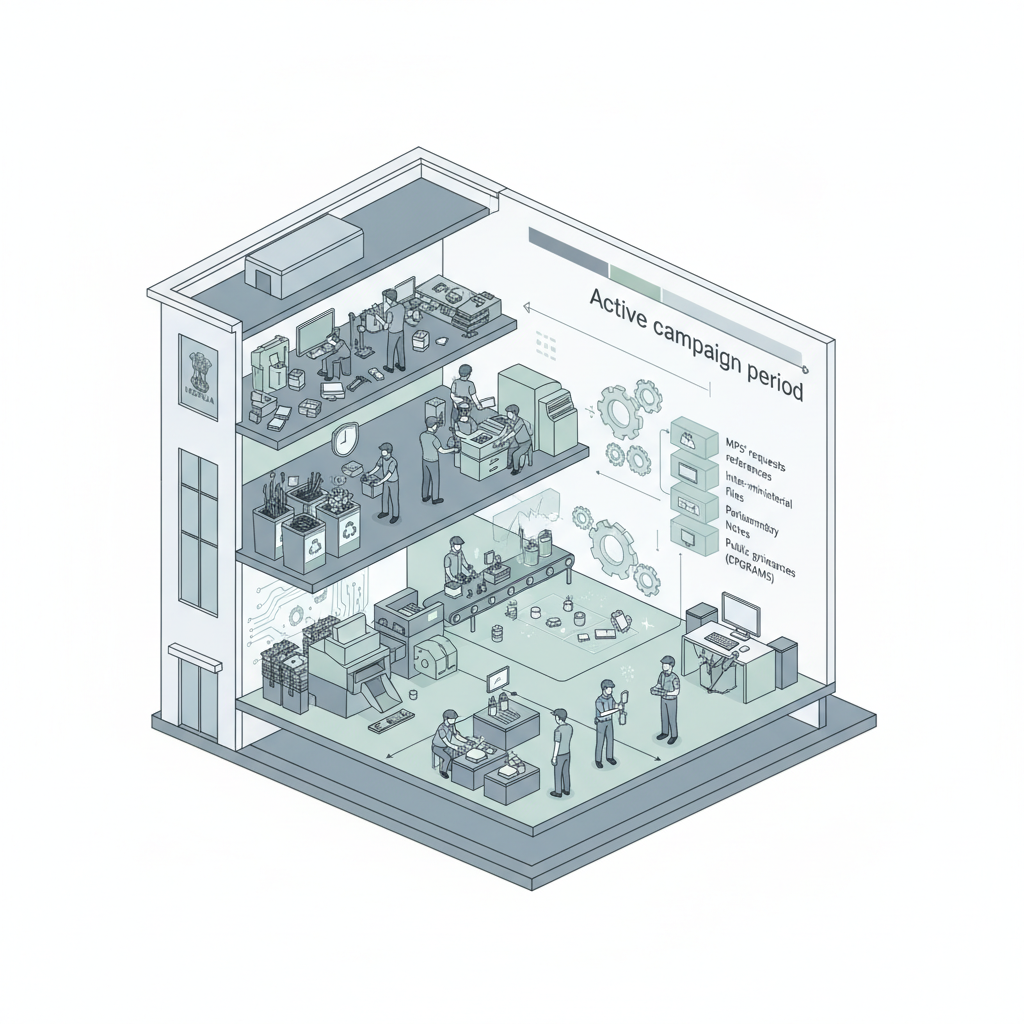
The Ministry of Housing and Urban Affairs (MoHUA) will actively participate in Special Campaign 6 from 2 October 2026 to 31 October 2026, with a renewed focus on institutionalising cleanliness in government offices and reducing pendency of cases. The campaign, conducted in two phases, will prioritise the effective collection, segregation, and disposal of e-waste in alignment with the E-Waste (Management) Rules, 2022, while also addressing pending references from MPs, state governments, inter-ministerial correspondences, parliamentary assurances, PMO references, and public grievances lodged via CPGRAMS.
Background
- Special Campaigns are time-bound, mission-mode initiatives launched by the Government of India to reduce pendency in government offices and improve service delivery.
- The E-Waste (Management) Rules, 2022, were notified under the Environment (Protection) Act, 1986, to regulate the generation, collection, storage, transport, treatment, and disposal of e-waste in India.
- CPGRAMS (Centralised Public Grievance Redress and Monitoring System) is an online platform for citizens to lodge grievances against government departments and track their redressal status.
- The Swachh Bharat Mission (Urban) aims to achieve clean and sustainable urban environments through community participation and institutional reforms.
- The Ministry of Housing and Urban Affairs oversees urban development, housing, and urban poverty alleviation, including the implementation of flagship schemes like AMRUT and Smart Cities Mission.
What is Special Campaign 6?
- Special Campaign 6 is a government-wide initiative to institutionalise cleanliness in government offices and reduce pendency of cases, with a focus on service delivery improvement.
- The campaign is conducted in two phases: a preparation phase (15–30 September 2026) to sensitise stakeholders and a implementation phase (2–31 October 2026) for on-ground action.
- This year’s campaign places special emphasis on the effective collection, segregation, and disposal of e-waste, in strict compliance with the E-Waste (Management) Rules, 2022.
- The campaign aims to dispose of pending references from MPs, state governments, inter-ministerial correspondences, parliamentary assurances, PMO references, and public grievances lodged via CPGRAMS in a time-bound manner.
- The campaign will also focus on improving cleanliness and aesthetics in regional/field offices to enhance the public experience in government premises.
- Key organisations such as the Central Public Works Department (CPWD) and NBCC have pledged full cooperation in conducting external cleanliness drives, beautification of buildings, and raising awareness about e-waste management.
- The campaign aligns with the vision of Swachh Bharat Mission (Urban) to create clean, sustainable, and citizen-friendly urban environments.
- The initiative underscores the government’s commitment to transparency, accountability, and efficiency in public administration.
Key Features
| Feature | Significance |
|---|---|
| Duration: 2 Oct 2026 – 31 Oct 2026 | Ensures sustained administrative focus on sanitation and pendency reduction within a defined timeframe. |
| Two-stage structure: Preparation (15–30 Sep 2026) & Implementation (2–31 Oct 2026) | Facilitates systematic planning followed by rigorous execution, aligning with administrative best practices. |
| Focus on e-waste management under E-waste (Management) Rules, 2022 | Strengthens compliance with statutory obligations for hazardous waste handling in government offices. |
| Coverage of pending references: MPs, states, PMO, PG Portal (CPGRAMS) | Addresses citizen grievances and inter-governmental coordination gaps through structured redressal. |
| Emphasis on regional/field offices and external cleanliness | Extends Swachh Bharat Mission’s reach to service delivery points, improving public interface. |
Why it Matters
Administrative Governance
- Institutionalises cleanliness protocols in government offices, aligning with the Swachh Bharat Mission’s objectives.
- Demonstrates a structured, time-bound approach to reducing pendency in public administration.
- Enhances inter-departmental coordination through the resolution of references from MPs, states, and PMO.
Environmental Sustainability
- Prioritises e-waste segregation and disposal, reducing environmental hazards from hazardous electronic waste.
- Ensures adherence to E-waste (Management) Rules, 2022, reinforcing India’s commitment to sustainable waste management.
- Promotes awareness and compliance among government agencies, setting a precedent for private sector adoption.
Public Service Delivery
- Improves citizen experience by addressing grievances through CPGRAMS and other channels.
- Enhances the aesthetic and functional quality of government buildings and field offices.
- Strengthens transparency and accountability in public office operations.
Institutional Collaboration
- Leverages the support of CPWD, NBCC, and other PSUs to execute cleanliness and beautification drives.
- Fosters multi-agency cooperation for large-scale sanitation and waste management initiatives.
- Demonstrates the central government’s role in coordinating with state governments and local bodies.
Challenges
1. E-waste Collection & Segregation
- Limited awareness among government employees about e-waste hazards and disposal protocols.
- Inadequate infrastructure for safe storage and transportation of e-waste in many offices.
- Coordination gaps between procurement, maintenance, and waste management units.
- Risk of improper disposal leading to environmental contamination and legal non-compliance.
UPSC Link: Environmental Pollution: Issues and Solutions
2. Pendency in Grievance Redressal
- High volume of references from MPs, states, and citizens creates backlog in resolution.
- Lack of standardised tracking systems for inter-ministerial and inter-state correspondence.
- Delays in data sharing and response coordination between central and field offices.
- Resource constraints in dedicated grievance redressal cells.
UPSC Link: Governance: Challenges in Public Service Delivery
3. Regional Office Participation
- Geographical dispersion of field offices complicates uniform implementation of cleanliness drives.
- Limited local capacity for waste management and sanitation in remote or rural offices.
- Language barriers and logistical challenges in awareness campaigns.
- Monitoring and evaluation gaps in assessing field-level outcomes.
UPSC Link: Decentralisation and Local Governance
4. Compliance with E-waste Rules
- Inconsistent adherence to E-waste (Management) Rules, 2022 across government departments.
- Absence of dedicated e-waste collection centres in many offices.
- Lack of training programmes for staff on hazardous waste handling.
- Difficulty in tracking e-waste generation and disposal in real time.
UPSC Link: Environmental Legislation and Compliance
5. Public Perception and Trust
- Skepticism among citizens regarding the sustainability of such campaigns post-implementation.
- Perception of cleanliness drives as symbolic rather than systemic improvements.
- Need for continuous engagement to maintain momentum beyond the campaign period.
- Risk of backsliding into pre-campaign practices without institutional safeguards.
UPSC Link: Citizen-Centric Governance
Challenges — UPSC Perspective
| Issue | Concern |
|---|---|
| E-waste infrastructure | Insufficient storage, transportation, and disposal facilities in government offices. |
| Grievance backlog | Unresolved references from MPs, states, and citizens due to systemic delays. |
| Field office engagement | Low participation and compliance in remote or under-resourced regional offices. |
| Rule compliance gaps | Non-adherence to E-waste (Management) Rules, 2022 across departments. |
| Monitoring mechanisms | Lack of real-time tracking and evaluation tools for campaign outcomes. |
| Sustainability post-campaign | Risk of reverting to pre-campaign practices without institutional reinforcement. |
Way Forward
- Conduct mandatory training sessions for government employees on e-waste segregation, handling, and disposal under E-waste (Management) Rules, 2022.
- Establish dedicated e-waste collection centres in all regional and field offices, with partnerships with certified recyclers.
- Develop a centralised dashboard for tracking pendency in grievance redressal, integrating CPGRAMS with departmental systems.
- Launch region-specific cleanliness drives, involving local authorities and community groups for sustained impact.
- Institutionalise quarterly audits of government offices to assess compliance with sanitation and e-waste norms.
- Create a feedback mechanism for citizens to report lapses in cleanliness or waste management, ensuring transparency.
- Collaborate with educational institutions to conduct awareness campaigns on e-waste hazards and sustainable practices.
- Allocate dedicated budgets for sanitation and waste management in annual financial plans of ministries and PSUs.
UPSC Value Addition
Keywords for Mains Answer-Writing
Special Campaign 6 · Swachh Bharat Mission · E-waste (Management) Rules, 2022 · Government office sanitation · Pending grievances redressal · CPGRAMS · CPWD · NBCC · Institutional cleanliness · Public sector undertakings · Ministry of Housing and Urban Affairs · Parliamentary assurances
Concept Flow
Swachh Bharat Mission mandates cleanliness in government offices → Ministry of Housing and Urban Affairs initiates Special Campaign 6 → Focus on e-waste management under E-waste (Management) Rules, 2022 → Addresses pendency in grievances via CPGRAMS and inter-governmental references → Enhances public service delivery and citizen trust → Strengthens environmental sustainability and administrative efficiency.
Prelims Practice Questions
Q1. Consider the following statements regarding Special Campaign 6:
1. It is conducted annually by the Ministry of Housing and Urban Affairs.
2. The campaign includes a preparation phase from 15–30 September and an implementation phase from 2–31 October.
3. The primary focus of Special Campaign 6 is on e-waste management and disposal.
4. The campaign does not address pending grievances under CPGRAMS.
How many of the above statements are correct?
- Only one
- Only two
- Only three
- All
Answer: Only three — Statements 2 and 3 are correct. Statement 1 is incorrect as the campaign is not limited to the Ministry of Housing and Urban Affairs but involves all government offices. Statement 4 is incorrect as the campaign specifically aims to dispose of pending grievances under CPGRAMS.
Q2. Assertion (A): The E-waste (Management) Rules, 2022, mandate strict compliance for effective collection, segregation, and disposal of e-waste.
Reason (R): The rules are designed to institutionalise cleanliness in government offices and reduce pending matters.
Options:
A. Both A and R are true, and R is the correct explanation of A.
B. Both A and R are true, but R is not the correct explanation of A.
C. A is true, but R is false.
D. A is false, but R is true.
- A
- B
- C
- D
Answer: B — Both Assertion (A) and Reason (R) are true. The E-waste (Management) Rules, 2022, indeed mandate strict compliance for effective e-waste management, and the broader objective of Special Campaign 6 is to institutionalise cleanliness and reduce pending matters in government offices, making R the correct explanation of A.
Mains Practice Question
✍ The Special Campaign 6, launched by the Ministry of Housing and Urban Affairs, aims to institutionalise cleanliness in government offices and dispose of pending matters. Critically examine the significance of this campaign in the context of the Swachh Bharat Mission and the E-waste (Management) Rules, 2022. Also, discuss the challenges in ensuring effective implementation across diverse government offices. (15 Marks)
Approach: MODEL-ANSWER SKELETON:
1. Introduction (2 Marks):
– Briefly define Special Campaign 6, its objectives, and its alignment with the Swachh Bharat Mission.
– Mention the dual focus on institutional cleanliness and pending grievance redressal under CPGRAMS.
2. Significance of the Campaign (5 Marks):
– **Swachh Bharat Mission Linkage**: Explain how the campaign reinforces the broader national mission of cleanliness by targeting government offices, which serve as models for public spaces.
– **E-waste Management**: Discuss the role of the E-waste (Management) Rules, 2022, in mandating strict compliance for collection, segregation, and disposal of e-waste, and how the campaign ensures adherence.
– **Pending Grievances**: Highlight the importance of timely disposal of pending matters (e.g., parliamentary assurances, MP references, state government references) in improving public trust and administrative efficiency.
– **Institutional Cleanliness**: Emphasise the campaign’s focus on service-providing regional/field offices to enhance public experience and transparency.
3. Challenges in Implementation (5 Marks):
– **Diverse Office Structures**: Discuss the varying scales, resources, and operational capacities of government offices (e.g., CPWD, NBCC) that may hinder uniform implementation.
– **Awareness and Training**: Highlight the need for capacity-building among staff to ensure effective e-waste management and cleanliness protocols.
– **Monitoring and Accountability**: Address the challenges in real-time monitoring, grievance tracking, and ensuring accountability across multiple stakeholders.
– **Behavioural Resistance**: Mention potential resistance to change among employees accustomed to traditional practices.
4. Conclusion (3 Marks):
– Summarise the campaign’s role in enhancing governance efficiency and public trust.
– Suggest measures such as regular audits, incentives for compliance, and leveraging technology (e.g., digital grievance redressal systems) to overcome challenges.
– Conclude with a balanced view on the campaign’s potential to institutionalise cleanliness and reduce pendency if implemented rigorously.
Source: PIB (Press Information Bureau)
Generated by AanyaAi for educational purpose.
Related guides on our sites
- Best PSIR optional coaching for upsc
- Best PSIR optional teacher for upsc
- Best teacher of PSIR optional for upsc
- Best PSIR optional coaching in delhi for UPSC

- AI नियमों के लिए UN की पहल: क्या है वैश्विक दृष्टिकोण? - September 17, 2026
- UN’s AI Governance Push: Can Global Rules Prevent Existential Risks? - September 17, 2026
- अल्लाहाबाद हाईकोर्ट का बड़ा फैसला: धर्म और जीवनसाथी चुनने का अधिकार - September 17, 2026

No Comments