


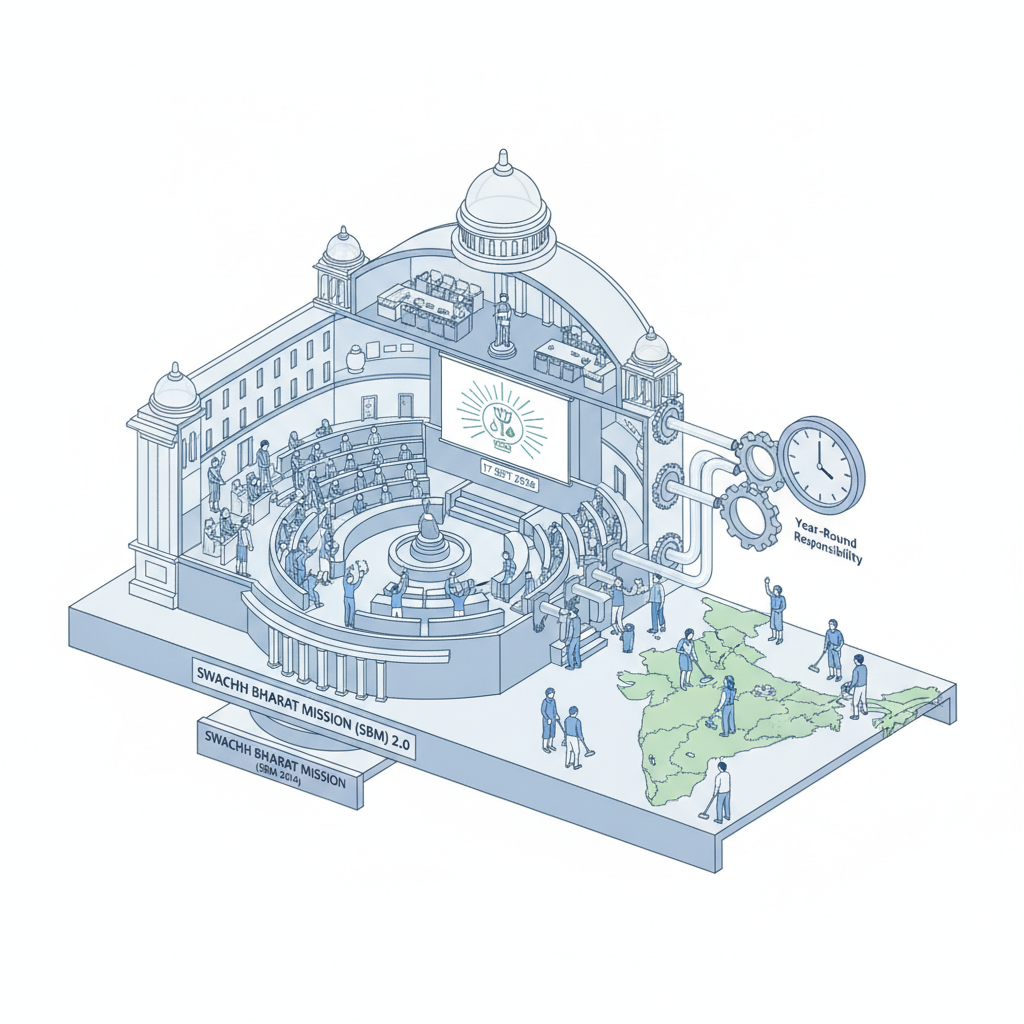
17 Sep Swachhata Hi Seva 2026: MoPA’s Role in Nationwide Cleanliness Drive
✎ Swachhata Hi Seva 2026 is a fortnight-long, government-led campaign (17 Sep–2 Oct 2026) under SBM 2.0 to institutionalise cleanliness as a year-round civic duty, culminating in a nationwide mass cleanliness drive on 1 October…
Subject Relevance — Where This Topic Fits
- GS Paper II — Governance, Constitution, Polity, Social Justice and International Relations (Role of Ministries in Public Awareness and Behavioural Change) | GS Paper III — Environment, Disaster Management and Sustainable Development Goals (SDG 6: Clean Water and Sanitation; SDG 11: Sustainable Cities and Communities)
- Prelims: Swachh Bharat Mission (SBM), Swachhata Hi Seva (SHS), SBM 2.0, Open Defecation Free (ODF) Plus, Solid Waste Management Rules 2016, Manual Scavengers Act 2013, Swachh Vidyalaya Abhiyan, SBM Urban 2.0, Jal Jeevan Mission, National Urban Sanitation Policy, Mahatma Gandhi National Rural Employment Guarantee Scheme (MGNREGS) convergence
- Essay: The Role of Collective Action in Nation-Building: Lessons from Swachh Bharat Mission, Sustainable Development and Citizen Participation: A Framework for Inclusive Governance
Quick Revision: Swachhata Hi Seva 2026 is a fortnight-long, government-led campaign (17 Sep–2 Oct 2026) under SBM 2.0 to institutionalise cleanliness as a year-round civic duty, culminating in a nationwide mass cleanliness drive on 1 October 2026.
Why is this in the news?
The Parliamentary Affairs Ministry (MoPA) actively participated in the nationwide launch of the Swachhata Hi Seva (SHS) Campaign 2026 on 17 September 2026, marking the beginning of a fortnight-long initiative aimed at reinforcing the Swachh Bharat vision through institutional participation, behavioural change, and citizen engagement. This campaign, running from 17 September to 2 October 2026, is coordinated across all central ministries and departments to institutionalise cleanliness as a year-round responsibility rather than a time-bound activity.
Background
- The Swachh Bharat Mission (SBM) was launched by the Government of India on 2 October 2014, with the objective of achieving universal sanitation coverage, eliminating open defecation, and improving solid waste management across rural and urban India.
- SBM 2.0 (2020–2025) expanded the mission’s scope to include ODF Plus status, faecal sludge management, plastic waste reduction, and behaviour change communication (BCC) to sustain sanitation gains.
- The Swachhata Hi Seva (SHS) campaign, first launched in 2017, is an annual mass mobilisation initiative under SBM to promote public participation in sanitation and cleanliness, aligning with the Mahatma Gandhi’s philosophy of cleanliness as a moral duty.
- The 2026 campaign is significant as it aims to consolidate gains while addressing emerging challenges such as plastic pollution, waste segregation, and behavioural inertia in urban and rural contexts.
- Institutional mechanisms like the Swachh Bharat Mission Cell in the Ministry of Jal Shakti provide the policy framework for sanitation governance in India.
- The campaign integrates with global commitments such as the Sustainable Development Goal (SDG) 6 (Clean Water and Sanitation) and SDG 11 (Sustainable Cities and Communities), reflecting India’s alignment with international sustainability agendas.
What is the Swachhata Hi Seva (SHS) Campaign 2026?
- The SHS Campaign 2026 is a government-led, mass mobilisation initiative under the Swachh Bharat Mission (SBM) 2.0, running from 17 September to 2 October 2026, to promote cleanliness, waste management, and civic responsibility across India.
- The campaign is structured as a fortnight of intensive activities, including daily institutional and community-level tasks such as office cleanliness drives, awareness programmes in schools, honoring sanitation workers (Safai Mitras), social media campaigns, and citizen participation programmes like tree plantation under the ‘Ek Ped Maa Ke Naam’ initiative.
- A key highlight is the nationwide ‘Ek Din, Ek Ghanta, Ek Saath’ (One Day, One Hour, Together) mass cleanliness drive on 1 October 2026, symbolising collective action for sanitation as a shared responsibility.
- The campaign emphasises the integration of cleanliness into daily institutional and personal routines, moving beyond symbolic gestures to sustained behavioural change, as articulated by MoPA Secretary Shri Nikunj Bihari Dhal in his address.
- Institutional participation is mandated across all central ministries, state governments, and local bodies, with the Parliamentary Affairs Ministry (MoPA) serving as a model for inter-ministerial coordination and public engagement.
- The campaign leverages digital platforms (e.g., social media, government portals) to amplify reach, track progress, and encourage citizen feedback, aligning with the Digital India initiative.
- Thematic focus areas include plastic waste reduction, source segregation of waste, faecal sludge management, and the promotion of ‘Swachhagrahis’ (community sanitation volunteers) as change agents in rural and urban areas.
- The campaign aligns with the Fundamental Duties (Article 51A(g)) that mandate citizens to protect and improve the natural environment, including sanitation and hygiene.
Key Features
| Feature | Significance |
|---|---|
| Nationwide launch of ‘Swachhata Hi Seva Abhiyan 2026’ | Demonstrates inter-ministerial coordination for a unified national sanitation drive under the Swachh Bharat Mission framework. |
| Daily activity plan (18 Sep–1 Oct 2026) | Ensures structured, sustained participation of officials, staff, and sanitation workers through time-bound, measurable tasks. |
| Collective oath-taking by MoPA Secretary | Symbolises leadership commitment and institutionalises behavioural change towards sanitation as a lifelong responsibility. |
| Citizen participation initiatives (school outreach, social media campaigns) | Enhances grassroots ownership and leverages digital platforms for mass behavioural transformation. |
| ‘Ek Ped Maa Ke Naam’ tree plantation drive | Integrates environmental stewardship with sanitation, reinforcing the link between cleanliness and ecological sustainability. |
| Nationwide shramdaan on 1 Oct 2026 (‘Ek Din, Ek Ghanta, Ek Saath’) | Institutionalises community-led sanitation work, aligning with the Mahatma Gandhi ethos of participatory governance. |
Why it Matters
Governance & Institutional
- Reinforces the role of ministries as nodal agencies in translating national missions into ground-level action through structured programmes.
- Demonstrates the integration of sanitation with other development priorities (e.g., environmental conservation, public health) within a single framework.
- Sets a precedent for inter-departmental collaboration in achieving Sustainable Development Goal 6 (Clean Water and Sanitation) and SDG 11 (Sustainable Cities).
Social & Behavioural
- Promotes a cultural shift from episodic cleanliness drives to year-round civic responsibility, aligning with the ‘Jan Andolan’ model of the Swachh Bharat Mission.
- Encourages dignity of labour by honouring sanitation workers and integrating their participation into official events.
- Leverages educational institutions and digital media to foster long-term behavioural change among youth and urban populations.
Environmental
- Links sanitation with afforestation, addressing the intersection of waste management and climate resilience under the National Action Plan on Climate Change.
- Promotes the concept of ‘green sanitation’ by integrating tree plantation with cleanliness drives, enhancing ecological balance.
Challenges
1. Sustaining Momentum Beyond Campaign Period
- Risk of reduced participation post-campaign due to lack of continuous engagement mechanisms.
- Need for institutional mechanisms to track and incentivise year-round sanitation efforts at the grassroots level.
UPSC Link: GS-II: Governance/GS-III: Environment
2. Behavioural Resistance to Cultural Change
- Deep-rooted habits of littering and open defecation in certain socio-economic segments may persist despite awareness campaigns.
- Overcoming apathy requires sustained motivational strategies and community-led monitoring systems.
UPSC Link: GS-IV: Ethics/GS-II: Social Justice
3. Resource Allocation and Infrastructure Gaps
- Limited availability of waste management infrastructure in rural and peri-urban areas may hinder effective implementation.
- Need for convergence with existing schemes like MGNREGS for community-based sanitation projects.
UPSC Link: GS-III: Infrastructure/GS-II: Rural Development
4. Digital Divide in Awareness Campaigns
- Urban-centric social media campaigns may exclude marginalised groups without access to digital platforms.
- Requirement for multi-modal outreach (e.g., radio, local leaders, street plays) to ensure inclusivity.
UPSC Link: GS-II: Social Justice/GS-IV: Ethics
5. Monitoring and Accountability Mechanisms
- Lack of real-time data on sanitation outcomes may impede evidence-based policy adjustments.
- Need for third-party audits and citizen feedback loops to ensure transparency and effectiveness.
UPSC Link: GS-II: Governance/GS-III: Environment
Challenges — UPSC Perspective
| Issue | Concern |
|---|---|
| Seasonal variations in participation | Climate conditions (e.g., monsoon) may disrupt outdoor activities, affecting engagement levels. |
| Language barriers in outreach | Multilingual content is essential for pan-India campaigns to reach diverse linguistic groups. |
| Inter-ministerial coordination fatigue | Sustaining enthusiasm across departments over multiple years requires structured incentives. |
| Corporate social responsibility (CSR) alignment | Lack of clear guidelines on CSR funding utilisation for sanitation initiatives. |
| Data privacy in digital campaigns | Ensuring compliance with data protection norms while collecting citizen feedback on sanitation. |
Government Initiatives — Must-Memorise for Prelims
- Swachh Bharat Mission (SBM) 2.0
Way Forward
- Institutionalise a quarterly ‘Swachhata Samiksha’ (sanitation review) mechanism at the district level to track progress under SBM 2.0.
- Develop a mobile application for real-time reporting of sanitation gaps, integrating it with the Swachh Bharat Mission portal.
- Expand the ‘Ek Ped Maa Ke Naam’ initiative to include urban forestry projects in collaboration with municipal corporations.
- Launch a ‘Swachhata Mitra’ programme to train local volunteers as sanitation champions in rural and urban areas.
- Converge SBM 2.0 with the Jal Jeevan Mission to address water-sanitation nexus at the household level.
- Introduce performance-linked incentives for ministries/departments based on sanitation outcomes in their jurisdictions.
- Strengthen school sanitation clubs under the ‘WASH in Schools’ initiative to embed hygiene education from an early age.
- Partner with civil society organisations to conduct periodic ‘Swachhata Raths’ (mobile awareness units) in remote areas.
UPSC Value Addition
Keywords for Mains Answer-Writing
Swachh Bharat Mission · Swachhata Hi Seva Abhiyan 2026 · Parliamentary Affairs Ministry · Public Participation in Sanitation · Citizen Responsibility · Collective Responsibility in Governance · Cleanliness Drives · Mass Awareness Campaigns · Shramdaan (Voluntary Labour) · Sustainable Sanitation Practices
Constitutional & Policy Linkages
- Directive Principles of State Policy (Article 48A) – Protection and improvement of environment and safeguarding of forests and wildlife.
- Fundamental Duty (Article 51A(g)) – Duty of every citizen to protect and improve the natural environment.
Concept Flow
Swachh Bharat Mission (SBM) 2.0 → National sanitation framework → Inter-ministerial coordination → Campaign-based implementation (Swachhata Hi Seva 2026) → Daily activity plan → Collective participation → Behavioural change → Sustainable sanitation culture. → Leadership commitment (oath-taking) → Institutionalisation of responsibility → Structured engagement (schools, social media, shramdaan) → Grassroots ownership → Long-term civic responsibility. → Sanitation drives → Waste management infrastructure → Environmental degradation → Afforestation (‘Ek Ped Maa Ke Naam’) → Ecological balance → Climate resilience. → Citizen awareness → Digital campaigns → Inclusivity challenges → Multi-modal outreach → Behavioural transformation. → Resource allocation → Infrastructure gaps → Convergence with MGNREGS → Community-led projects → Sustainable outcomes.
Prelims Practice Questions
Q1. Consider the following statements regarding the Swachhata Hi Seva Abhiyan 2026:
1. The campaign is launched by the Ministry of Parliamentary Affairs.
2. It is a nationwide initiative to promote cleanliness and citizen participation.
3. The campaign includes activities such as tree plantation under the ‘One Tree for Mother’ initiative.
4. The campaign is limited to urban areas only.
How many of the above statements are correct?
- Only one
- Only two
- Only three
- All four
Answer: Only three — Statements 1, 2, and 3 are correct as per the PIB release. Statement 4 is incorrect because the campaign is countrywide and includes rural and urban areas.
Q2. Assertion (A): The Swachhata Hi Seva Abhiyan 2026 emphasizes the year-round responsibility of citizens towards cleanliness.
Reason (R): The campaign includes daily activities and a nationwide shramdaan initiative on 1 October 2026.
Options:
A. Both A and R are true, and R is the correct explanation of A.
B. Both A and R are true, but R is not the correct explanation of A.
C. A is true, but R is false.
D. A is false, but R is true.
- A
- B
- C
- D
Answer: A — Both A and R are true, and R correctly explains A as the campaign’s design reflects the year-round commitment to cleanliness.
Q3. Match the following initiatives with their respective objectives under the Swachhata Hi Seva Abhiyan 2026:
Column I (Initiative) | Column II (Objective)
1. ‘One Day, One Hour, Together’ | a. Promoting tree plantation
2. ‘One Tree for Mother’ | b. Nationwide voluntary labour
3. Office cleanliness drives | c. Sensitizing school students
4. Awareness campaigns on social media | d. Maintaining office premises
Choose the correct match:
- 1-b, 2-a, 3-d, 4-c
- 1-a, 2-b, 3-c, 4-d
- 1-c, 2-d, 3-a, 4-b
- 1-d, 2-c, 3-b, 4-a
Answer: 1-b, 2-a, 3-d, 4-c — 1-b (Nationwide voluntary labour on 1 October), 2-a (‘One Tree for Mother’ initiative for tree plantation), 3-d (Office cleanliness drives), 4-c (Awareness campaigns for school students).
Mains Practice Question
✍ The Swachhata Hi Seva Abhiyan 2026 exemplifies the paradigm shift from episodic cleanliness drives to a sustained culture of collective responsibility for sanitation. Critically examine this statement with reference to the roles of government institutions, citizen participation, and institutional mechanisms for behavioural change. (15 Marks)
Approach: MODEL-ANSWER SKELETON:
1. **Introduction (2 Marks)**
– Define Swachhata Hi Seva Abhiyan 2026 and its alignment with Swachh Bharat Mission.
– State the paradigm shift: from campaign-based to institutionalised, year-round responsibility.
2. **Role of Government Institutions (4 Marks)**
– Ministry of Parliamentary Affairs as a nodal agency: leadership, inter-ministerial coordination, and symbolic participation (e.g., oath-taking by Secretary).
– Institutional mechanisms: daily activities, structured plans (18 Sep–1 Oct 2026), and nationwide shramdaan on 1 Oct 2026.
– Link to constitutional provisions: Article 51A(g) (Fundamental Duty) and Article 48A (Directive Principles of State Policy).
– Contrast with earlier episodic campaigns (e.g., Swachh Bharat Abhiyan 2014) and highlight institutionalisation.
3. **Citizen Participation and Behavioural Change (5 Marks)**
– Mechanisms for participation: office cleanliness drives, school sensitisation programmes, social media campaigns, and ‘One Tree for Mother’ initiative.
– Theoretical underpinnings: Ajzen’s Theory of Planned Behaviour (attitudes, subjective norms, perceived behavioural control) and collective efficacy (Bandura).
– Challenges: sustaining momentum post-campaign, urban-rural divide, and behavioural inertia.
– Case example: SBM Urban 2.0’s focus on ODF+ and ODF++ as institutionalised follow-ups.
4. **Institutional Mechanisms for Sustainability (3 Marks)**
– Role of Swachh Bharat Mission 2.0: convergence with Jal Jeevan Mission, SBM Urban 2.0, and SBM Grameen.
– Institutionalisation through SBM Urban 2.0’s focus on source segregation, waste processing, and behaviour change communication (BCC).
– Monitoring and evaluation: third-party audits, Swachh Survekshan rankings, and citizen feedback loops.
5. **Conclusion (1 Mark)**
– Reiterate the shift from episodic to institutionalised responsibility.
– Emphasise the need for multi-stakeholder collaboration (government, NGOs, private sector, citizens) for long-term impact.
Source: PIB (Press Information Bureau)
Generated by AanyaAi for educational purpose.
Related guides on our sites
- Current affairs for upsc 2026
- Best PSIR optional coaching for upsc
- Best PSIR optional teacher for upsc
- Best teacher of PSIR optional for upsc

- यूपीएससी के लिए सीएसआईआर साइक्विज: जानिए कैसे करें भागीदारी और लाभ उठाएं - September 21, 2026
- UPSC Alert: CSIR Science Quiz on My Bharat Portal for UPSC & State PCS 2026 - September 21, 2026
- एमएसएमई मंत्रालय ने शुरू किया विशेष अभियान 6.0: स्वच्छता और शिकायत निपटान पर जोर - September 21, 2026

No Comments