


17 Sep Punjab Ranks 16th in EV Adoption: NITI Aayog Report Insights for UPSC
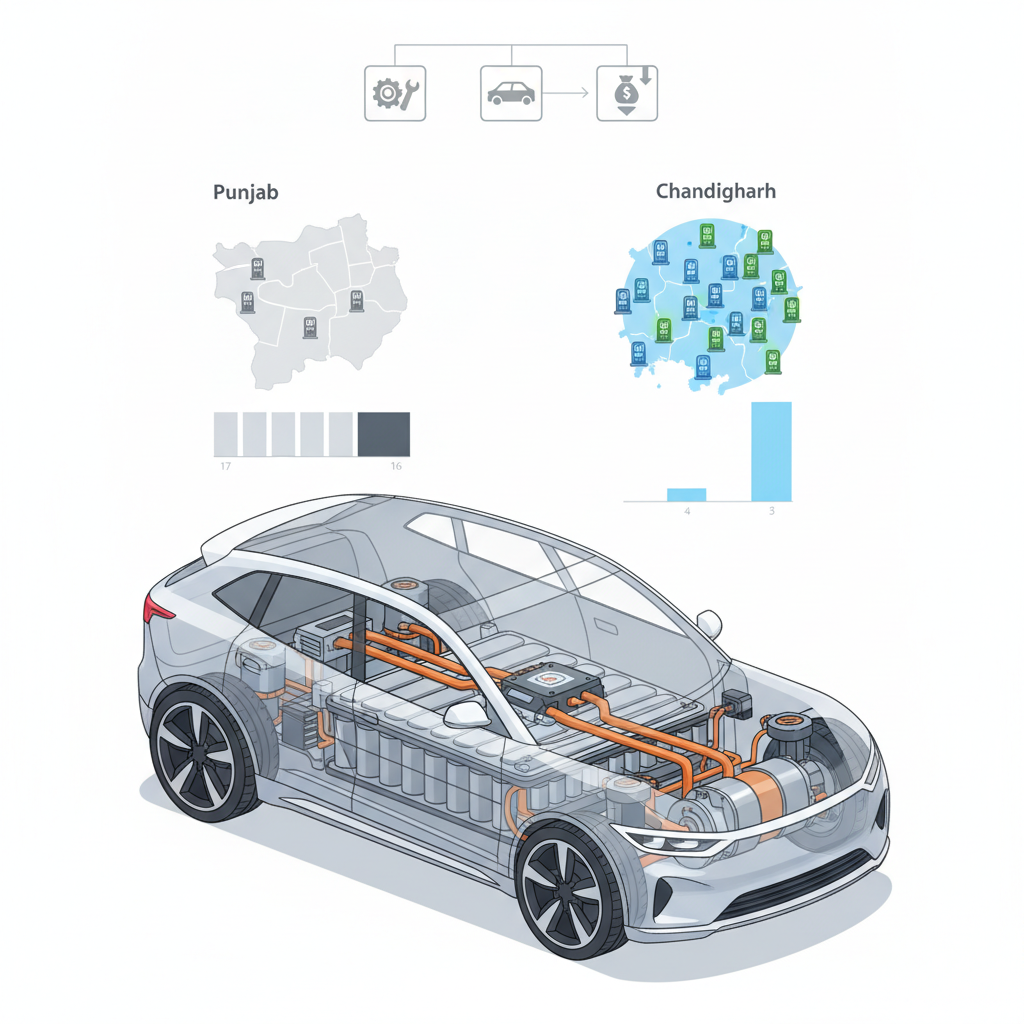
✎ The India Mobility Index 2025, released by NITI Aayog, has ranked Punjab 16th among 17 major states in electric vehicle (EV) adoption.
Subject Relevance — Where This Topic Fits
- GS Paper III — Environment, Climate Change and Disaster Management (Environmental Pollution and Degradation) | GS Paper III — Infrastructure (Energy, Transport) | GS Paper III — Science and Technology (Technology Missions and Innovations)
- Prelims: Electric Vehicle (EV), Battery Electric Vehicle (BEV), Charging Infrastructure, NITI Aayog, India Mobility Index, FAME-II Scheme, National Electric Mobility Mission Plan (NEMMP), Internal Combustion Engine (ICE) Vehicles, Vehicle Scrappage Policy, Permit Exemptions, Capital Subsidies
- Essay: Sustainable Mobility: Balancing Economic Growth and Environmental Stewardship in India, The Role of Public Policy in Accelerating Technological Adoption in Emerging Economies
Why is this in the news?
The India Mobility Index 2025, released by NITI Aayog, has ranked Punjab 16th among 17 major states in electric vehicle (EV) adoption. This underscores significant policy and infrastructure gaps in Punjab’s transition to cleaner mobility, despite state efforts. In contrast, Chandigarh has emerged as a leader, securing the 4th position nationally, highlighting the importance of targeted interventions and urban planning in accelerating EV adoption.
Background
- The Government of India launched the National Electric Mobility Mission Plan (NEMMP) 2020 to promote electric mobility, targeting 6-7 million electric vehicles on Indian roads by 2020. This was succeeded by the Faster Adoption and Manufacturing of Hybrid and Electric Vehicles (FAME-II) Scheme, which provided financial incentives for EV purchases and infrastructure development.
- Punjab’s EV policy, initially valid until February 2026, was extended to February 2027 to sustain incentives for EV purchases, scrappage of old vehicles, and infrastructure development.
- Chandigarh’s urban planning, compact geography, and proactive policy measures have enabled it to outperform larger states in EV adoption, serving as a model for other Union Territories and small states.
- The transition from Internal Combustion Engine (ICE) vehicles to EVs is critical for India’s commitments under the Paris Agreement, aiming to reduce vehicular emissions by 30-35% by 2030.
What is the India Mobility Index (IMI) 2025 and how does it evaluate EV adoption?
- The India Mobility Index (IMI) 2025 is a composite index developed by NITI Aayog to assess the preparedness and performance of Indian states and Union Territories (UTs) in adopting electric mobility solutions. It is designed to benchmark progress across critical dimensions: EV registrations (private and commercial), charging infrastructure availability, policy support and incentives, manufacturing ecosystem, and consumer awareness.
- Punjab’s overall score of 39 out of 100 places it significantly behind leaders like Maharashtra (78), Karnataka (73), and Tamil Nadu (61), reflecting systemic challenges in scaling EV adoption despite state-level incentives.
- The index highlights a critical disparity between private EV registrations (Punjab scored 49) and commercial EV registrations (Punjab scored 15), indicating a lack of business incentives or regulatory support for commercial fleets.
- Chandigarh’s score of 71 underscores the role of urban governance, compact city design, and targeted policy interventions in accelerating EV adoption. Its performance is attributed to high charging infrastructure density, streamlined approval processes, and public awareness campaigns.
- The IMI 2025 also evaluates the ratio of vehicles to charging stations, where Punjab scored 40, suggesting a need for accelerated deployment of public charging infrastructure to alleviate range anxiety among potential EV buyers.
- The index serves as a diagnostic tool for policymakers, enabling data-driven decision-making to identify gaps and prioritize interventions in states lagging behind in the EV transition.
- The findings of the IMI 2025 align with global best practices, where cities with dense public transport networks, integrated land-use planning, and supportive regulatory frameworks demonstrate higher EV adoption rates.
Key Features
| Feature | Significance |
|---|---|
| NITI Aayog’s India Mobility Index 2025 | A composite metric ranking Indian states and UTs on electric vehicle (EV) adoption, infrastructure, and policy readiness, enabling comparative assessment of progress. |
| Punjab’s composite score (39/100) | Reflects suboptimal performance across private EV registrations, commercial EV registrations, government efforts, and charging infrastructure density. |
| Chandigarh’s rank (4th with 71/100) | Demonstrates advanced EV ecosystem, policy support, and infrastructure development relative to larger states. |
| Government incentives under Punjab EV Policy | Extension of subsidy schemes and purchase incentives to accelerate EV adoption despite lagging infrastructure. |
Why it Matters
Economic
- EV adoption reduces long-term fuel import dependency, aligning with India’s energy security objectives under the National Electric Mobility Mission Plan (NEMMP).
- Accelerated EV transition can spur local manufacturing of batteries, charging equipment, and related components, enhancing industrial output in Punjab.
- Reduction in vehicular emissions contributes to Punjab’s compliance with the National Clean Air Programme (NCAP) targets.
Infrastructure Governance
- The disparity between Punjab’s government efforts (67/100) and charging infrastructure (40/100) highlights a governance gap in translating policy into tangible assets.
- Standardisation of charging infrastructure across urban and rural Punjab is critical for equitable access and grid resilience.
Environmental
- Transition to EVs in Punjab can mitigate particulate matter (PM2.5/PM10) emissions, particularly in urban centres like Ludhiana and Amritsar.
- Higher adoption of electric public transport (e.g., e-buses) can further reduce urban air pollution.
Challenges
1. Inadequate Charging Infrastructure
- Low charger-to-vehicle ratio (40/100 score) indicates insufficient public and private charging stations, deterring consumer confidence.
- Urban-rural divide in infrastructure deployment exacerbates accessibility issues for rural commuters.
UPSC Link: GS3: Infrastructure – Energy
2. Commercial EV Adoption Lag
- Commercial EV registrations score only 15/100, reflecting barriers such as higher upfront costs, limited financing options, and operational constraints for fleet operators.
UPSC Link: GS3: Transport – Logistics
3. Policy Implementation Gaps
- Despite extended EV policy (now valid until February 2027), slow disbursement of incentives and bureaucratic delays hinder uptake.
- Lack of integration between state EV policy and municipal urban planning frameworks.
UPSC Link: GS2: Governance – Policy Implementation
4. Consumer Awareness and Behavioural Barriers
- Limited public awareness of EV benefits, charging protocols, and total cost of ownership (TCO) compared to ICE vehicles.
- Perceived risks related to battery life, resale value, and after-sales service deter potential adopters.
UPSC Link: GS3: Consumer Behaviour
Challenges — UPSC Perspective
| Issue | Concern |
|---|---|
| Charging Infrastructure Density | Insufficient public and private charging stations, leading to range anxiety among consumers. |
| Commercial Fleet Transition | High costs and operational challenges discourage adoption by logistics and transport businesses. |
| Policy Disbursement Delays | Slow release of subsidies and incentives under the state EV policy undermines its effectiveness. |
| Urban-Rural Divide | Concentration of charging infrastructure in cities leaves rural areas underserved. |
| Consumer Skepticism | Lack of awareness about EV technology, maintenance, and long-term savings. |
Way Forward
- Strengthen public-private partnerships to accelerate deployment of fast-charging stations along national highways and urban hubs.
- Expand state-level financing schemes for commercial fleet operators to subsidise EV purchases and battery swapping infrastructure.
- Integrate EV charging infrastructure planning with urban development authorities to ensure grid compatibility and land-use efficiency.
- Launch targeted awareness campaigns highlighting total cost of ownership (TCO), environmental benefits, and government incentives.
- Establish a state-level EV adoption monitoring dashboard to track progress across districts and identify bottlenecks.
- Collaborate with NITI Aayog and Ministry of Heavy Industries to align Punjab’s EV policy with national frameworks like FAME-II and PLI schemes.
- Develop skill development programmes in partnership with technical institutions to build a local workforce for EV maintenance and charging infrastructure management.
UPSC Value Addition
Keywords for Mains Answer-Writing
Electric Mobility Policy · India Mobility Index 2025 · NITI Aayog EV adoption report · Charging infrastructure for EVs · State-wise EV adoption ranking · Subsidies for electric vehicles · EV incentives and scrappage policy · Commercial EV adoption · Government initiatives for EV transition · Sustainable transportation policy
Concept Flow
State-level EV policy formulation → Policy extension and incentives → Limited infrastructure deployment → Low consumer adoption → Poor India Mobility Index ranking. → Government effort score (67/100) → Policy intent → Incentive disbursement delays → Slow commercial adoption (15/100) → Infrastructure gap (40/100). → Urban-centric charging infrastructure → Rural exclusion → Skewed adoption patterns → Lower composite score (39/100). → NITI Aayog’s India Mobility Index → Comparative benchmarking → Identification of gaps → Recommendations for policy and infrastructure reforms. → EV policy extension (2027) → Sustained incentives → Gradual increase in registrations (e.g., 27,264 two-wheelers in 2025) → Long-term emission reduction.
Prelims Practice Questions
Q1. Consider the following statements regarding the India Mobility Index 2025 released by NITI Aayog:
1. Punjab ranks 16th among 17 large states in EV adoption.
2. Chandigarh is ranked 4th overall with 71 points.
3. The index evaluates only private EV registrations and excludes commercial EV registrations.
How many of the above statements are correct?
- Only one
- Only two
- All
- None
Answer: All — Statement 1 and 2 are correct as per the report. Statement 3 is incorrect because the index evaluates private EV registrations, commercial EV registrations, government efforts, and charging infrastructure.
Q2. Assertion (A): The India Mobility Index 2025 evaluates EV adoption based on four parameters: private EV registrations, commercial EV registrations, government efforts, and charging infrastructure.
Reason (R): NITI Aayog’s report highlights that Punjab needs to strengthen its charging infrastructure to improve its ranking.
- Both A and R are true, and R is the correct explanation of A
- Both A and R are true, but R is not the correct explanation of A
- A is true but R is false
- A is false but R is true
Answer: A is true but R is false — Assertion (A) is true as the index evaluates the four specified parameters. Reason (R) is also true but does not directly explain the assertion, as it focuses on Punjab’s specific need for infrastructure strengthening.
Q3. Match the following parameters evaluated in the India Mobility Index 2025 with their respective weightage in Punjab’s overall score:
Column I (Parameter) | Column II (Weightage in Punjab’s Score)
— | —
1. Private EV registrations | A. 49 points
2. Commercial EV registrations | B. 15 points
3. Government efforts | C. 67 points
4. Charging infrastructure | D. 40 points
- 1-A, 2-B, 3-C, 4-D
- 1-B, 2-A, 3-C, 4-D
- 1-A, 2-C, 3-B, 4-D
- 1-D, 2-B, 3-C, 4-A
Answer: 1-A, 2-B, 3-C, 4-D — The correct matching is: 1-A (Private EV registrations: 49 points), 2-B (Commercial EV registrations: 15 points), 3-C (Government efforts: 67 points), 4-D (Charging infrastructure: 40 points).
Mains Practice Question
✍ The India Mobility Index 2025, released by NITI Aayog, ranks states based on their adoption of electric vehicles (EVs) and the supporting ecosystem. In this context, critically examine the factors influencing EV adoption in Indian states, with particular reference to Punjab’s performance. Also, outline the policy recommendations suggested by NITI Aayog to enhance EV adoption across the country. (15 Marks)
Approach: MODEL-ANSWER SKELETON:
1. **Introduction (2 Marks)**
– Briefly define the India Mobility Index 2025 and its purpose.
– Mention Punjab’s ranking (16th among 17 large states) and Chandigarh’s performance (4th overall).
2. **Factors Influencing EV Adoption (6 Marks)**
– **Economic Factors**: Cost of EVs vs. conventional vehicles, availability of subsidies/incentives, and affordability.
– **Infrastructure**: Availability and accessibility of charging stations, battery swapping facilities, and grid capacity.
– **Policy Support**: State-level EV policies, scrappage incentives, and regulatory frameworks.
– **Consumer Awareness**: Public perception, familiarity with EV technology, and environmental consciousness.
– **Commercial Adoption**: Incentives for commercial fleets, permit relaxations, and operational cost savings.
– **Government Efforts**: State initiatives, public procurement of EVs, and awareness campaigns.
3. **Punjab’s Performance Analysis (4 Marks)**
– **Strengths**: Government efforts (67 points), private EV registrations (49 points).
– **Weaknesses**: Low commercial EV adoption (15 points), inadequate charging infrastructure (40 points).
– **Data**: Highlight the growth in two-wheeler and four-wheeler EV registrations but lag in commercial adoption.
4. **NITI Aayog’s Recommendations (3 Marks)**
– Incentives for scrapping old vehicles.
– Subsidies for charging infrastructure and reduced electricity tariffs for EV charging.
– Simplified approval processes for setting up charging stations.
– Skill development centers for EV technology.
5. **Conclusion (1 Mark)**
– Emphasize the need for a multi-stakeholder approach involving government, private sector, and consumers to accelerate EV adoption.
Source: amarujala.com
Punjab PCS (PPSC) — State PCS Practice
Prelims: As per the NITI Aayog report on electric vehicle adoption in India, which rank does Punjab hold among Indian states?
- 12th
- 14th
- 16th
- 18th
Answer: 16th — The NITI Aayog report ranked Punjab 16th in electric vehicle adoption among Indian states.
Mains: Analyze the key challenges faced by Punjab in promoting electric vehicles (EVs) despite its strong industrial and agricultural base. Suggest policy measures to accelerate EV adoption in the state, keeping in mind its unique socio-economic context.
Generated by AanyaAi for educational purpose.
Related guides on our sites
- Current affairs for upsc 2026
- Best PSIR optional coaching for upsc
- Best PSIR optional teacher for upsc
- Best teacher of PSIR optional for upsc

- यूएनजीए 2026: युद्ध, एआई और सुधार – दुनिया के नेता क्या करेंगे? (UPSC दृष्टिकोण) - September 22, 2026
- 40 दिन बाद भी संसद सत्र अनिर्णीत, महिला आरक्षण विधेयक पर सरकार की तैयारी - September 22, 2026
- Why Parliament Session Still Unprorogued After 40 Days? Women’s Quota Law Buzz Explained - September 22, 2026

No Comments