


22 Sep Why Parliament Session Still Unprorogued After 40 Days? Women’s Quota Law Buzz Explained
✎ Prorogation of Parliament, as per Article 85, is the formal termination of a session by the President on ministerial advice, distinct from adjournment, and may be strategically deferred to facilitate legislative amendments.
Subject Relevance — Where This Topic Fits
- GS Paper II — Parliament and State Legislatures — Structure, Functioning, Conduct of Business, Powers & Privileges and Issues Arising Out of These | GS Paper II — Constitutional Framework, Statutory, Regulatory and Various Quasi-Judicial Bodies
- Prelims: Prorogation of Parliament, Adjournment sine die, Women’s Reservation Bill, Constitutional provisions under Article 85, Lok Sabha and Rajya Sabha procedural rules, Delimitation Commission, Winter Session of Parliament
- Essay: The role of constitutional conventions in parliamentary governance, Balancing legislative efficiency and democratic accountability in parliamentary sessions
Quick Revision: Prorogation of Parliament, as per Article 85, is the formal termination of a session by the President on ministerial advice, distinct from adjournment, and may be strategically deferred to facilitate legislative amendments.
Why is this in the news?
The Monsoon Session of Parliament, adjourned sine die on 13 August 2026, remains unprorogued 40 days later, a procedural anomaly that has sparked speculation regarding the government’s legislative strategy. This delay is particularly significant in the context of ongoing discussions around the Women’s Reservation Bill, where procedural flexibility may be leveraged to introduce amendments or facilitate passage ahead of the 2029 Lok Sabha elections. The situation underscores the interplay between constitutional conventions, legislative timelines, and the procedural autonomy of Parliament.
Background
- The Constitution of India, under Article 85, empowers the President to prorogue the Houses of Parliament on the advice of the Union Council of Ministers, thereby formally concluding a session.
- Prorogation is distinct from adjournment; while adjournment terminates a sitting for a specified period, prorogation ends the session entirely, enabling the President to summon a new session at a later date.
- The last instance of an unprorogued session occurred in 2015, when the two Houses remained unprorogued for 28 days during the GST legislation process, highlighting the procedural flexibility within parliamentary practice.
- Concerns have been raised by southern states regarding potential reductions in their Lok Sabha representation under population-based delimitation, prompting discussions on a flat 50% seat expansion across all states and Union Territories to address these apprehensions.
What is Prorogation of Parliament and its Constitutional Framework?
- Prorogation is the formal termination of a session of Parliament by the President, acting on the advice of the Union Council of Ministers, as enshrined in Article 85 of the Constitution of India.
- Unlike adjournment, which suspends sittings temporarily, prorogation dissolves the session, enabling the President to summon a new session at a later date, thereby resetting the legislative agenda and procedural norms.
- The duration of an unprorogued session is a matter of parliamentary convention rather than constitutional prescription; historically, sessions have been prorogued within 3–4 days of adjournment sine die, though exceptions exist, as evidenced by the 2015 GST deliberations.
- Prorogation enables the government to strategically time legislative initiatives, particularly when seeking to introduce amendments or facilitate the passage of contentious bills without convening a fresh session.
- The absence of prorogation does not violate any constitutional provision but may raise questions about procedural transparency and the government’s legislative priorities, as observed in the current context.
Key Features
| Feature | Significance |
|---|---|
| Unprorogued Session | Prolonged adjournment sine die without formal prorogation allows the government to retain legislative flexibility, enabling potential introduction or amendment of bills without convening a fresh session. |
| Women’s Reservation Amendment | Proposed changes to the Women’s Reservation Act, 2023, aim to operationalise the 33% quota for women in Lok Sabha and State Legislative Assemblies, with adjustments to address representation concerns. |
| Delimitation Proposal | The government’s suggestion of a flat 50% seat expansion across all states and UTs seeks to mitigate opposition from southern states regarding population-based delimitation and representation loss. |
| Constitutional Provision (Article 85) | The President’s power to prorogue Parliament under Article 85(2)(a) is central to this scenario, as the executive’s inaction on prorogation maintains the session’s continuity. |
| Legislative Process Delay | The absence of prorogation beyond the customary 3-4 days post-adjournment sine die reflects deliberate procedural postponement, potentially to secure consensus or timing advantages for key legislation. |
Why it Matters
Constitutional and Procedural
- The prolonged unprorogued status of Parliament underscores the executive’s discretion in determining the duration of legislative sessions, subject to constitutional limits and conventions.
- Article 85(2)(a) of the Constitution empowers the President to prorogue the House on the government’s advice, highlighting the interplay between executive authority and legislative continuity.
- The absence of prorogation within the customary timeframe post-adjournment sine die may indicate strategic deliberation, particularly in the context of pending legislative priorities.
Representation and Governance
- The proposed amendment to the Women’s Reservation Act, 2023, seeks to enhance gender representation in legislatures, aligning with constitutional goals of inclusive governance and social justice.
- The flat 50% seat expansion proposal addresses concerns from southern states regarding potential under-representation due to population-based delimitation, ensuring equitable distribution of parliamentary seats.
- The delay in prorogation may reflect negotiations to balance regional representation interests with the implementation of affirmative action policies.
Institutional and Procedural
- The record 40-day unprorogued status of the Monsoon Session (as noted by the former Lok Sabha Secretary General) sets a precedent in parliamentary procedure, raising questions about the norms governing session durations.
- The government’s inaction on prorogation may be viewed as a procedural tactic to avoid the formal closure of a session, thereby retaining the option to introduce or amend legislation without reconvening.
Challenges
1. Regional Representation Concerns
- Southern states’ apprehensions regarding potential loss of Lok Sabha seats under population-based delimitation necessitate careful negotiation to ensure consensus on seat expansion proposals.
- The flat 50% seat expansion model may not fully address regional disparities, requiring further deliberation to balance demographic representation with political equity.
UPSC Link: GS-II: Federalism and Representation
2. Legislative Procedural Ambiguity
- The prolonged unprorogued status of Parliament raises procedural questions about the duration for which a session can remain adjourned sine die without formal prorogation, potentially straining constitutional conventions.
- The absence of a clear timeline for prorogation may lead to institutional ambiguity, affecting the predictability of legislative timelines and government accountability.
UPSC Link: GS-II: Parliament and State Legislatures
3. Consensus Building for Affirmative Action
- The Women’s Reservation Amendment requires broad political consensus to overcome opposition, particularly from parties representing regions with demographic concerns about seat redistribution.
- The government’s ability to secure legislative majority for the amendment hinges on addressing regional apprehensions, which may delay or dilute the proposed changes.
UPSC Link: GS-II: Social Justice and Empowerment
4. Constitutional Convention vs. Executive Discretion
- The prolonged unprorogued status tests the balance between executive discretion (Article 85) and established parliamentary conventions regarding session durations and prorogation timelines.
- Institutional stakeholders, including the Opposition and parliamentary committees, may scrutinise the government’s inaction to ensure adherence to democratic norms.
UPSC Link: GS-II: Constitutional Framework
Challenges — UPSC Perspective
| Issue | Concern |
|---|---|
| Regional Representation | Potential loss of Lok Sabha seats for southern states under population-based delimitation, risking political equity. |
| Legislative Continuity | Prolonged adjournment sine die without prorogation challenges conventional parliamentary timelines and procedural norms. |
| Consensus on Women’s Reservation | Opposition from regional parties may delay or derail the amendment, affecting implementation before the 2029 elections. |
| Executive-Legislative Balance | Government’s discretionary inaction on prorogation raises questions about the separation of powers and institutional accountability. |
| Procedural Precedent | The 40-day unprorogued status sets an unprecedented procedural precedent, potentially normalising deviations from established norms. |
Way Forward
- Convene a cross-party parliamentary committee to deliberate on the Women’s Reservation Amendment, ensuring representation from all regions, particularly southern states.
- Clarify the procedural norms governing the duration of adjournment sine die and the timeline for prorogation to prevent institutional ambiguity.
- Engage in structured negotiations with state governments to address concerns regarding seat expansion and delimitation, ensuring a consensus-based approach.
- Introduce a formal framework for amending the Women’s Reservation Act, 2023, incorporating safeguards to balance demographic representation with political equity.
- Publish a white paper outlining the government’s rationale for the flat 50% seat expansion proposal, addressing regional apprehensions through data-driven justification.
- Conduct pre-legislative consultations with civil society, women’s groups, and constitutional experts to refine the amendment and enhance its acceptability.
- Ensure timely prorogation of the session to uphold parliamentary conventions, while retaining the flexibility to introduce the amendment in a subsequent session if consensus is achieved.
UPSC Value Addition
Keywords for Mains Answer-Writing
Parliamentary sessions · Prorogation of Parliament · Women’s Reservation Act · Constitutional provisions on Parliament · Lok Sabha and Rajya Sabha procedures · Delimitation of constituencies · Parliamentary conventions · Winter Session of Parliament · Presidential power to summon and prorogue Parliament · Legislative process in India
Constitutional & Policy Linkages
- Article 85(2)(a): President’s power to prorogue Parliament on government’s advice.
Concept Flow
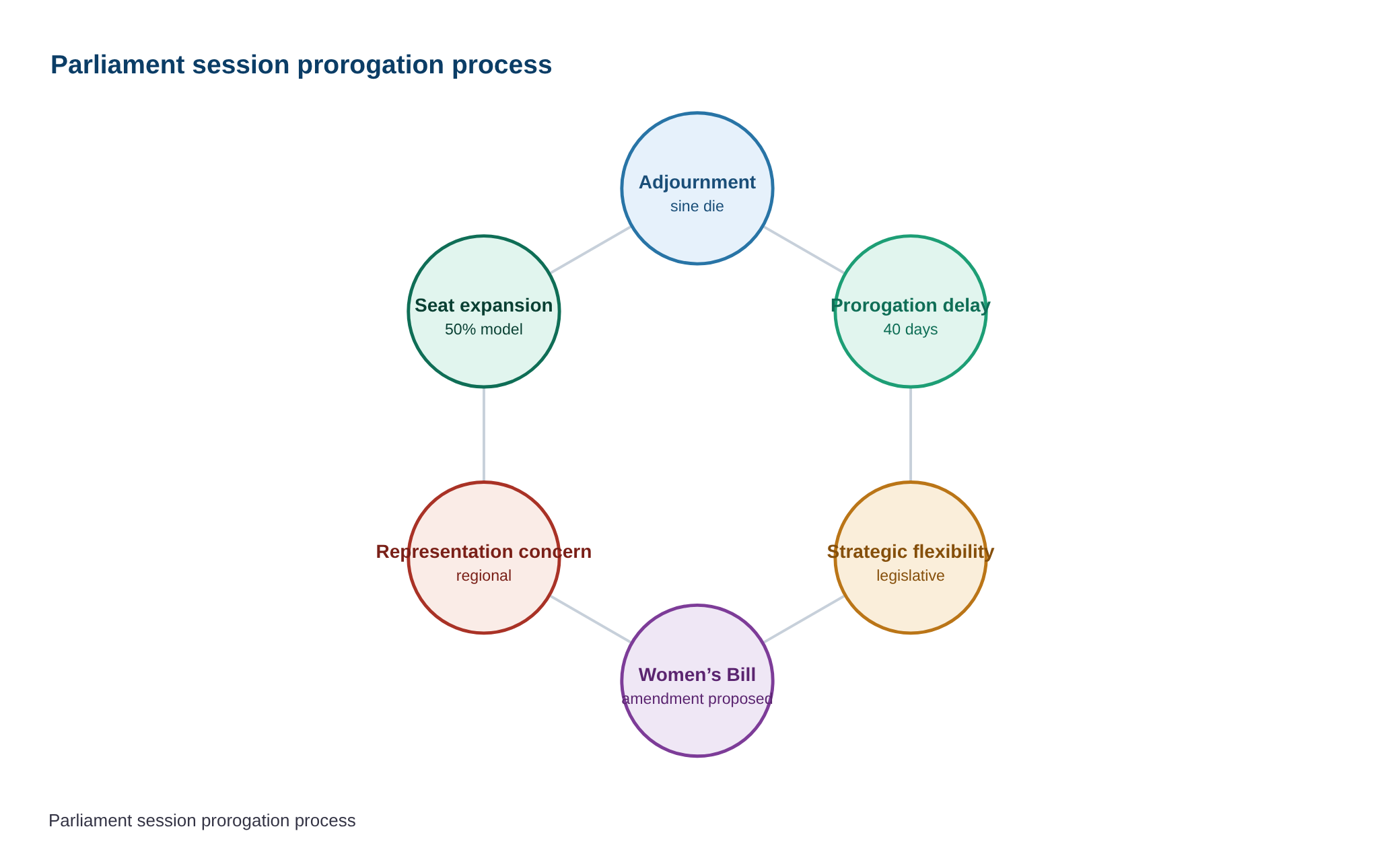
Adjournment sine die → Prorogation delay → Strategic legislative flexibility retained → Women’s Reservation Amendment proposed → Regional representation concerns raised → Seat expansion model introduced → Cross-party negotiations initiated → Consensus-building process begins.
Prelims Practice Questions
Q1. Consider the following statements regarding the prorogation of Parliament in India: 1. The President of India has the constitutional authority to prorogue the Parliament. 2. Prorogation terminates a session of Parliament but does not affect the bills pending before it. 3. The President can prorogue the Houses of Parliament only on the advice of the Council of Ministers. 4. The duration between the prorogation of one session and the commencement of the next is known as the ‘recess’. How many of the above statements are correct?
- Only one
- Only two
- Only three
- All four
Answer: All four — Statements 1, 3, and 4 are correct. Statement 2 is incorrect because prorogation does not terminate pending bills; they carry forward to the next session. The President prorogues Parliament on the advice of the Council of Ministers under Article 85(2) of the Constitution.
Q2. Assertion (A): The Women’s Reservation Act, 2023, mandates a 33% reservation for women in the Lok Sabha and State Legislative Assemblies. Reason (R): The Act provides for a rotational system of reservation to ensure fair representation across constituencies. (A) Both A and R are true, and R is the correct explanation of A. (B) Both A and R are true, but R is not the correct explanation of A. (C) A is true, but R is false. (D) A is false, but R is true.
- A
- B
- C
- D
Answer: D — Assertion (A) is true as the Women’s Reservation Act, 2023, does mandate a 33% reservation for women in the Lok Sabha and State Legislative Assemblies. Reason (R) is false because the Act does not provide for a rotational system of reservation; it is based on delimitation of constituencies.
Mains Practice Question
✍ The prolonged adjournment sine die of Parliament without formal prorogation raises constitutional and procedural concerns. Critically examine the significance of prorogation in the parliamentary calendar and its implications for legislative business, with reference to the Women’s Reservation Act, 2023. (15 Marks)
Approach: MODEL-ANSWER SKELETON:
1. **Constitutional Basis of Prorogation**: Define prorogation under Article 85(2) of the Constitution; differentiate between adjournment, prorogation, and dissolution. Cite the role of the President in prorogation on the advice of the Council of Ministers.
2. **Legislative Implications**: Explain how pending bills (e.g., Women’s Reservation Bill) are affected by prorogation; contrast with adjournment sine die. Highlight the continuity of parliamentary business across sessions.
3. **Parliamentary Conventions and Record**: Discuss the convention of prorogation within 3-4 days of adjournment sine die; cite the record of 40 days without prorogation as an exception (reference to former Lok Sabha Secretary-General P D T Achari’s observation).
4. **Women’s Reservation Act, 2023**: Outline the key provisions of the Act, including the 33% reservation for women in the Lok Sabha and State Legislative Assemblies. Explain the proposed amendments (e.g., flat 50% seat expansion) and the rationale behind them.
5. **Delimitation and Representation Concerns**: Discuss the concerns raised by southern states regarding population-based delimitation and the proposed flat expansion model to address these concerns.
6. **Balance of Views**: Present the government’s perspective (timing of legislation, consensus-building) and opposition concerns (representation, federalism). Conclude with the need for timely prorogation to maintain legislative efficiency and constitutional propriety.
Source: orissapost.com
Generated by AanyaAi for educational purpose.
Related guides on our sites
- Anthropology VS PSIR
- Best PSIR optional coaching
- Best PSIR optional coaching online
- Best coaching for law optional

- 40 दिन बाद भी संसद सत्र अनिर्णीत, महिला आरक्षण विधेयक पर सरकार की तैयारी - September 22, 2026
- Why Parliament Session Still Unprorogued After 40 Days? Women’s Quota Law Buzz Explained - September 22, 2026
- सुप्रीम कोर्ट ने कावेरी जल पुनर्वितरण याचिका खारिज की, जानें पूरा मामला - September 22, 2026

No Comments