


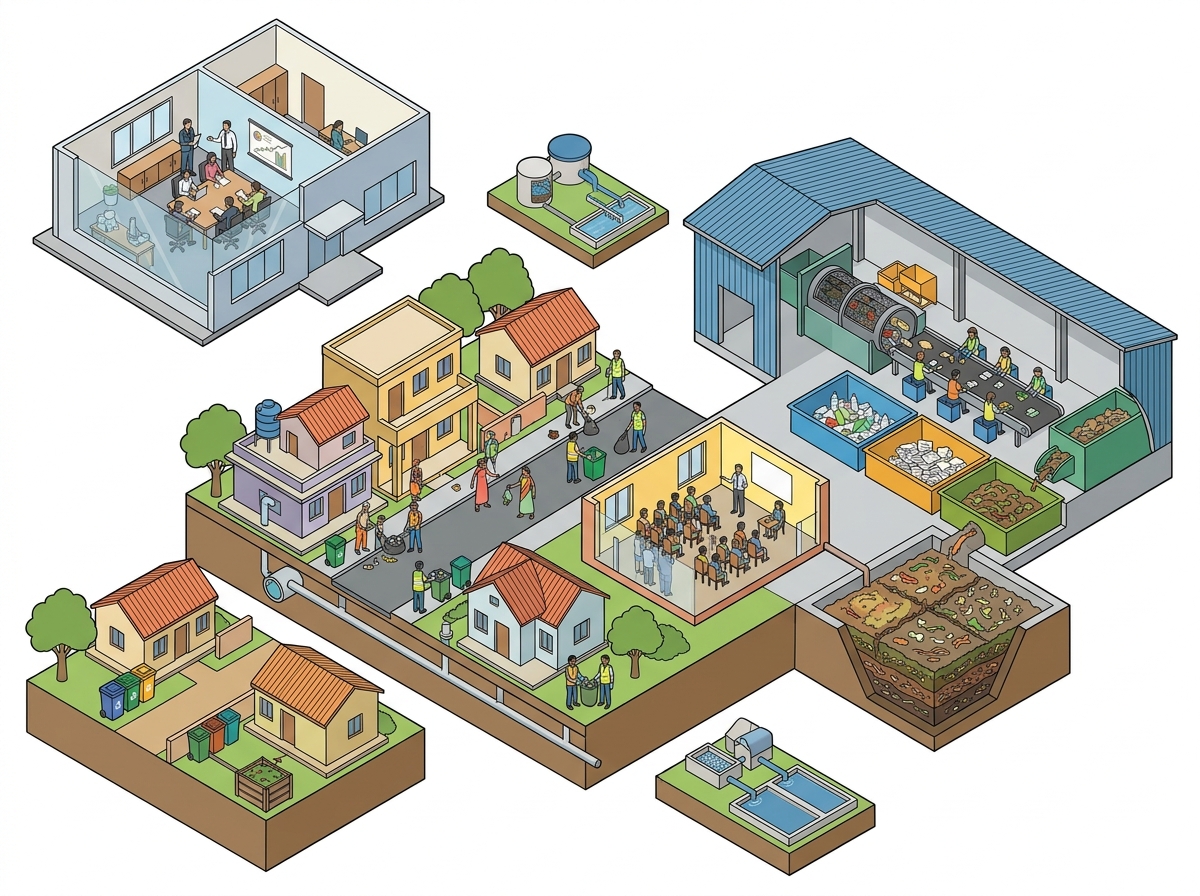
18 Sep DoLR launches ‘Swachhata Hi Seva’ campaign for collective cleanliness drive
✎ ‘Swachhata Hi Seva’ reframes cleanliness from an administrative duty to a civic responsibility, integrating waste minimisation, segregation at source, and circular economy practices into daily governance and personal conduct.
Subject Relevance — Where This Topic Fits
- GS Paper II — Governance, Transparency and Accountability | GS Paper III — Environment, Sustainable Development and Waste Management
- Prelims: Swachh Bharat Mission 2.0, Circular Economy, Plastic Waste Management Rules 2022, Solid Waste Management Rules 2016, Extended Producer Responsibility (EPR), Sustainable Development Goals (SDG 11, SDG 12), National Clean Air Programme (NCAP)
- Essay: The Role of Individual Responsibility in Nation-Building: A Case Study of Swachhata Abhiyan, Sustainable Development and Governance: Linking Policy to Public Participation
Quick Revision: ‘Swachhata Hi Seva’ reframes cleanliness from an administrative duty to a civic responsibility, integrating waste minimisation, segregation at source, and circular economy practices into daily governance and personal conduct.
Why is this in the news?
On 17 September 2026, the Department of Land Resources (DoLR) under the Ministry of Rural Development initiated the ‘Swachhata Hi Seva’ campaign, reaffirming its commitment to cleanliness, responsible waste management, and a culture of public service. This initiative is noteworthy as it frames cleanliness not merely as an administrative task but as a collective civic duty, integrating behavioural change at the individual, community, and institutional levels. The campaign aligns with national policies on waste management and sustainable development, particularly in the context of India’s ongoing efforts to achieve cleaner cities and villages under the Swachh Bharat Mission 2.0.
Background
- The Swachh Bharat Mission (SBM), launched in 2014, aimed to achieve universal sanitation and cleanliness by 2 October 2019, with a subsequent phase (SBM 2.0) focusing on sustainability, behaviour change, and solid waste management.
- India generates approximately 150,000 tonnes of municipal solid waste daily, with only about 75-80% collected and a fraction processed or recycled, highlighting the urgency of effective waste management systems.
- The Solid Waste Management Rules, 2016, mandate segregation at source, decentralised processing, and extended producer responsibility (EPR) for plastic waste, reflecting a shift from end-of-pipe solutions to upstream waste reduction.
- India’s commitment to the Sustainable Development Goals (SDGs), particularly SDG 11 (Sustainable Cities and Communities) and SDG 12 (Responsible Consumption and Production), underscores the need for integrated approaches to waste management and civic engagement.
- The National Clean Air Programme (NCAP, launched in 2019, addresses air pollution through multi-sectoral strategies, including waste management, as part of broader environmental governance.
What is the ‘Swachhata Hi Seva’ initiative?
- The ‘Swachhata Hi Seva’ campaign, launched by the Department of Land Resources (DoLR) on 17 September 2026, is a governance-driven initiative to promote cleanliness, responsible waste management, and civic responsibility among government employees and the public.
- The initiative frames cleanliness as a collective responsibility, emphasising that every individual—regardless of role—must contribute to maintaining clean environments in workplaces, residential areas, and public spaces.
- It encourages behavioural change by discouraging littering, promoting waste segregation at source, and advocating for the reuse, repair, recycling, or responsible disposal of waste, thereby aligning with circular economy principles.
- The campaign highlights the importance of responsible management of plastic waste and electronic waste (e-waste), urging employees to adopt sustainable practices such as avoiding single-use plastics and supporting recycling systems.
- It promotes the concept of ‘waste minimisation’—reducing waste generation at the individual and community levels—as a key strategy for long-term environmental sustainability.
- The initiative includes practical steps such as identifying unused items in homes and offices, exploring repair or reuse options, and ensuring proper disposal through authorised channels, thereby reducing landfill burden.
- It seeks to institutionalise a culture of civic duty by encouraging government employees to set an example in their workplaces and communities, thereby fostering broader societal behavioural change.
- The campaign underscores the link between cleanliness and public service, positioning waste management not as a standalone task but as an integral component of good governance and sustainable development.
Key Features
| Feature | Significance |
|---|---|
| Collective Responsibility Framework | Emphasises shared accountability for sanitation beyond individual duty, aligning with constitutional directive principles of State policy (Article 48A) and fundamental duties (Article 51A(g)). |
| Waste Segregation & Circular Economy Promotion | Encourages identification of reusable, repairable, recyclable, or responsibly disposable items, fostering sustainable consumption patterns in line with the Swachh Bharat Mission 2.0 objectives. |
| Plastic & E-Waste Management Focus | Highlights responsible handling of non-biodegradable waste streams, addressing environmental degradation and aligning with the Plastic Waste Management Rules, 2016 and E-Waste (Management) Rules, 2022. |
| Behavioral Change Campaign | Targets reduction in littering tendencies through institutional and community-level habit formation, integrating principles of social norm transformation. |
| Institutional Role Model Approach | Mandates proactive participation by government officials and staff, institutionalising cleanliness as a cultural norm within governance structures. |
Why it Matters
Governance & Institutional Efficiency
- Demonstrates institutional commitment to public service by embedding sanitation as a core administrative function, enhancing workplace productivity and civic trust.
- Promotes transparency in waste management practices within government facilities, setting benchmarks for private sector and civil society adoption.
- Strengthens inter-departmental coordination for sanitation initiatives, aligning with the ‘Whole of Government’ approach under the Sustainable Development Goals (SDG 17).
Environmental Sustainability
- Advances circular economy principles by prioritising waste reduction, reuse, and recycling, reducing pressure on landfills and natural resources.
- Addresses critical environmental challenges posed by plastic pollution and electronic waste, contributing to climate resilience and biodiversity conservation.
- Supports India’s Nationally Determined Contributions (NDCs) under the Paris Agreement by reducing land-based waste disposal emissions.
Social & Behavioral Transformation
- Fosters a culture of civic responsibility, where individuals internalise sanitation as a personal and collective duty, reducing public expenditure on waste management.
- Encourages inter-generational habit formation, particularly among youth, through institutional role modelling and community engagement.
- Enhances public health outcomes by minimising vector-borne diseases linked to improper waste disposal.
Economic Implications
- Generates secondary economic benefits through waste-to-wealth initiatives, such as recycling industries and job creation in the green economy sector.
- Reduces long-term healthcare costs associated with sanitation-related diseases, thereby improving workforce productivity.
- Supports the ‘Make in India’ initiative by promoting domestic recycling and waste management technologies.
Challenges
1. Behavioral Resistance to Change
- Deep-rooted cultural practices of littering and waste segregation avoidance may persist despite institutional campaigns.
- Lack of immediate incentives for individuals to adopt sustainable waste management habits could hinder long-term participation.
- Psychological barriers, such as the ‘not-in-my-backyard’ syndrome, may limit community-level cooperation.
UPSC Link: GS-II: Social Empowerment
2. Infrastructural Gaps in Waste Management
- Inadequate segregation facilities at source in many urban and rural areas may impede effective implementation of the campaign.
- Limited availability of recycling and composting infrastructure in tier-2 and tier-3 cities could constrain circular economy practices.
- Logistical challenges in transporting segregated waste to processing centres may reduce the feasibility of the initiative.
UPSC Link: GS-III: Environment & Disaster Management
3. Regulatory Enforcement Challenges
- Weak implementation of existing waste management rules (e.g., Plastic Waste Management Rules, 2016) due to limited monitoring and penalties.
- Inconsistent enforcement across states and union territories may create disparities in outcomes.
- Jurisdictional overlaps between municipal, state, and central authorities could lead to coordination failures.
UPSC Link: GS-II: Governance
4. Financial Sustainability Concerns
- High initial costs for setting up waste segregation and recycling infrastructure may deter participation from smaller municipalities.
- Dependence on public funding for campaign sustainability risks discontinuation during fiscal constraints.
- Limited private sector investment in waste management due to perceived low profitability.
UPSC Link: GS-III: Economic Development
5. Awareness & Education Deficits
- Low public awareness about the health and environmental impacts of improper waste disposal may reduce campaign effectiveness.
- Inadequate training for municipal staff and waste collectors on segregation and handling techniques.
- Language and cultural barriers in rural areas may hinder the dissemination of key messages.
UPSC Link: GS-II: Social Justice
Challenges — UPSC Perspective
| Issue | Concern |
|---|---|
| Cultural Littering Norms | Deep-seated habits of indiscriminate waste disposal persist despite campaigns. |
| Infrastructural Deficits | Insufficient segregation and processing facilities limit practical implementation. |
| Regulatory Gaps | Weak enforcement of existing waste management laws undermines compliance. |
| Financial Constraints | High capital and operational costs deter sustainable scaling of initiatives. |
| Awareness Disparities | Unequal education levels and language barriers reduce message penetration. |
| Inter-Agency Coordination Failures | Jurisdictional overlaps and bureaucratic silos impede unified action. |
Way Forward
- Conduct district-wise audits of existing waste management infrastructure to identify gaps in segregation, collection, and processing facilities.
- Launch targeted behaviour change communication campaigns in regional languages, leveraging local influencers and school networks.
- Establish public-private partnerships (PPPs) to mobilise investment in recycling and composting infrastructure, with viability gap funding.
- Incentivise households and institutions through recognition programmes (e.g., star ratings) for exemplary waste management practices.
- Integrate the campaign with existing Swachh Bharat Mission 2.0 components, such as ODF+ and ODF++ protocols, for synergy.
- Develop a national-level waste management dashboard to track progress, ensuring transparency and accountability.
- Strengthen inter-state coordination mechanisms to harmonise enforcement of waste management rules and reduce regulatory fragmentation.
- Introduce mandatory training modules on waste segregation and circular economy practices for municipal staff and government employees.
UPSC Value Addition
Keywords for Mains Answer-Writing
Swachhata Hi Seva campaign · collective responsibility in sanitation · responsible waste management · circular economy principles · plastic waste management · e-waste management · individual responsibility in public hygiene · sustainable habits for cleanliness · Department of Land Resources (DOLR) · Ministry of Rural Development · solid waste management · community participation in sanitation
Constitutional & Policy Linkages
- Article 48A (Directive Principles of State Policy) – Protection and improvement of environment and safeguarding of forests and wildlife.
- Article 51A(g) (Fundamental Duties) – Duty of every citizen to protect and improve the natural environment.
Concept Flow
Institutional Commitment to Sanitation → ‘Swachhata Hi Seva’ Campaign Launch → Collective Responsibility Framework Adoption → Individual & Community Habit Formation → Waste Segregation & Circular Economy Practices → Environmental Degradation Mitigation → Public Health & Economic Benefits → Sustainable Development Goals Alignment
Prelims Practice Questions
Q1. Consider the following statements regarding the ‘Swachhata Hi Seva’ campaign launched by the Department of Land Resources (DOLR):
1. The campaign emphasizes individual responsibility in maintaining cleanliness at personal and community levels.
2. It focuses exclusively on office premises and does not extend to residential or community spaces.
3. The initiative promotes the principles of a circular economy by encouraging reuse, repair, and recycling of waste.
4. The campaign addresses only plastic waste and does not cover electronic waste (e-waste).
How many of the above statements are correct?
- Only one
- Only two
- Only three
- All
Answer: Only three — Statements 1 and 3 are correct as the campaign underscores individual and community responsibility in sanitation and promotes circular economy principles. Statements 2 and 4 are incorrect because the campaign extends beyond office premises to residential and community spaces, and it addresses both plastic waste and e-waste.
Q2. Assertion (A): The ‘Swachhata Hi Seva’ campaign by the Department of Land Resources (DOLR) is designed to foster a culture of responsible waste management and collective hygiene.
Reason (R): The campaign explicitly encourages employees to adopt sustainable habits such as minimizing waste generation and ensuring proper disposal of plastic and electronic waste.
In the context of the above two statements, which one of the following is correct?
- Both A and R are true, and R is the correct explanation of A.
- Both A and R are true, but R is not the correct explanation of A.
- A is true, but R is false.
- A is false, but R is true.
Answer: Both A and R are true, and R is the correct explanation of A. — Both the Assertion (A) and Reason (R) are true, and R correctly explains A. The campaign’s objective is to foster responsible waste management and collective hygiene, which is achieved through sustainable habits like minimizing waste and proper disposal of plastic and e-waste.
Q3. Match the following initiatives with their respective objectives:
Column I
A. Swachhata Hi Seva campaign
B. Solid Waste Management Rules, 2016
C. E-waste (Management) Rules, 2022
D. Plastic Waste Management Rules, 2016
Column II
1. Framework for the management of plastic waste in India
2. Promotes collective responsibility in sanitation and hygiene
3. Regulates the disposal and recycling of electronic waste
4. Provides guidelines for the management of solid waste, including biodegradable and non-biodegradable waste
Select the correct match:
- A-2, B-4, C-3, D-1
- A-1, B-2, C-3, D-4
- A-3, B-1, C-4, D-2
- A-4, B-3, C-2, D-1
Answer: A-2, B-4, C-3, D-1 — The correct match is: A-2 (Swachhata Hi Seva campaign promotes collective responsibility in sanitation), B-4 (Solid Waste Management Rules, 2016 provides guidelines for solid waste management), C-3 (E-waste (Management) Rules, 2022 regulates electronic waste), and D-1 (Plastic Waste Management Rules, 2016 frames plastic waste management).
Mains Practice Question
✍ The ‘Swachhata Hi Seva’ campaign, launched by the Department of Land Resources (DOLR), reaffirms sanitation as a collective responsibility rather than an individual or institutional obligation alone. In this context, critically examine the constitutional and statutory framework governing sanitation and waste management in India. Also, analyze the role of citizen participation in ensuring the success of such campaigns. (15 Marks)
Approach: MODEL-ANSWER SKELETON:
1. **Constitutional and Statutory Framework**:
– **Directive Principles of State Policy (DPSP)**: Article 48A (protection and improvement of environment) and Article 51A(g) (fundamental duty to protect and improve the natural environment).
– **Statutory Provisions**:
– **Solid Waste Management Rules, 2016**: Framework for segregation, storage, transportation, processing, and disposal of solid waste.
– **Plastic Waste Management Rules, 2016**: Provisions for phasing out single-use plastics and promoting recycling.
– **E-waste (Management) Rules, 2022**: Regulations for environmentally sound management of e-waste.
– **Swachh Bharat Mission (SBM)**: A flagship program aimed at achieving universal sanitation and cleanliness.
– **Institutional Mechanisms**: Role of local bodies (Municipal Corporations, Panchayati Raj Institutions) under the 74th and 73rd Constitutional Amendments.
2. **Role of Citizen Participation**:
– **Individual Responsibility**: The campaign aligns with Article 51A(g) by encouraging citizens to adopt sustainable habits (e.g., minimizing waste, proper disposal).
– **Community Engagement**: Success hinges on participatory models (e.g., Swachhagrahis under SBM, community-led initiatives).
– **Challenges**: Lack of awareness, behavioral resistance, and inadequate infrastructure can hinder participation.
3. **Critical Analysis**:
– **Strengths**: The campaign leverages behavioral change, which is critical for long-term sustainability.
– **Weaknesses**: Top-down approaches may lack grassroots ownership; enforcement of rules remains a challenge.
– **Way Forward**: Strengthening local governance, enhancing public awareness, and integrating informal sector workers (e.g., waste pickers) into formal systems.
4. **Conclusion**:
– Reiterate the importance of constitutional duties and statutory frameworks in enabling such campaigns.
– Emphasize the need for a multi-stakeholder approach (government, citizens, private sector) for sustainable sanitation.
Source: PIB (Press Information Bureau)
Generated by AanyaAi for educational purpose.
Related guides on our sites
- Best PSIR optional coaching for upsc
- Best PSIR optional teacher for upsc
- Best teacher of PSIR optional for upsc
- Best PSIR optional coaching in delhi for UPSC

- नवीनतम: Nvidia ने AI एजेंटों को नियंत्रित करने के लिए नया सुरक्षा टूल लॉन्च किया - September 29, 2026
- Anthropic Warns AI Could Pose Existential Risks in IPO Filing - September 29, 2026
- भारत-अमेरिका संबंधों में सीमापार आतंकवाद की चिंता क्यों है महत्वपूर्ण? जानिए क्या बोले एस. जयशंकर - September 29, 2026

No Comments