


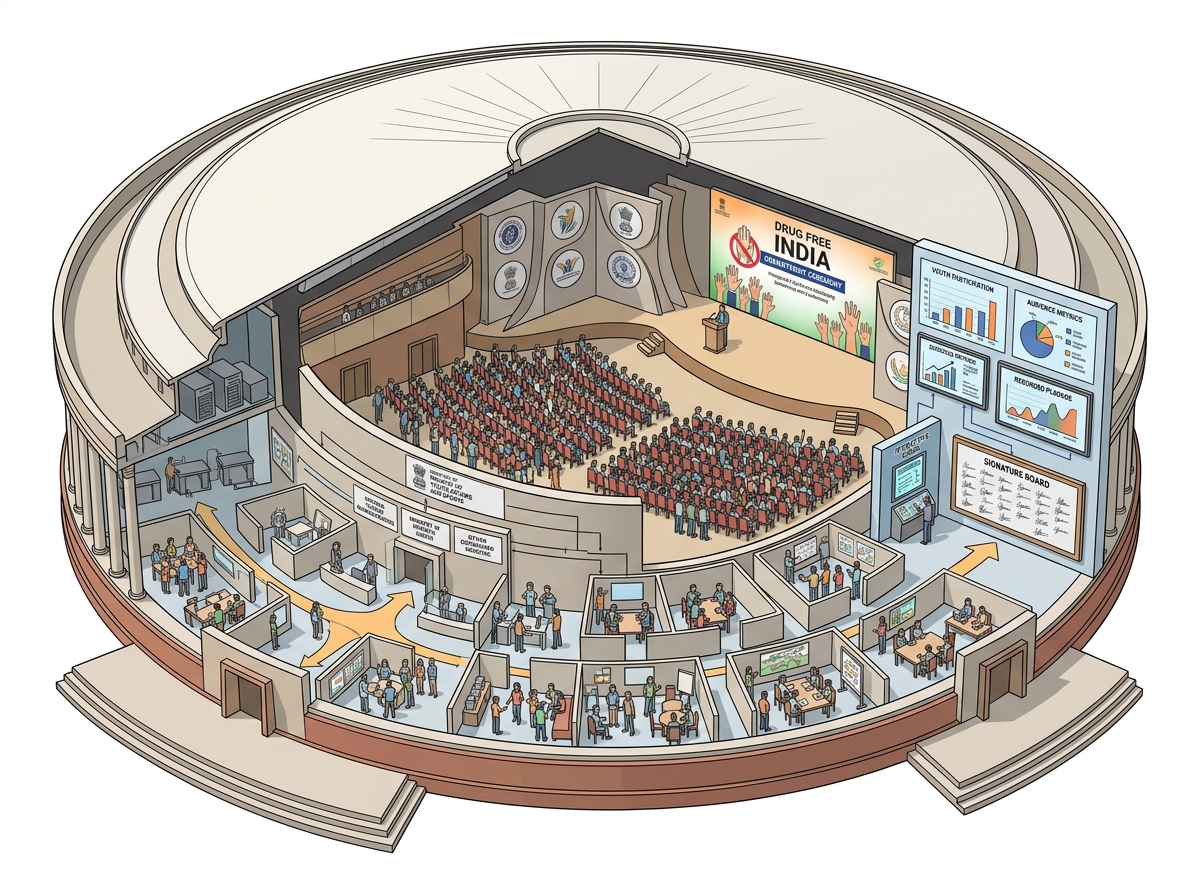
18 Sep 100-Week Drug-Free Youth Campaign: National Pledge Ceremony on 18 Sept 2026
✎ The 100-week 'Nasha Mukt Yuva Abhiyan' is a Ministry of Youth Affairs and Sports-led, multi-stakeholder campaign to prevent substance abuse among youth through awareness, health promotion, life skills education, and community…
Subject Relevance — Where This Topic Fits
- GS Paper II — Governance, Government Policies and Interventions for Development in various sectors | GS Paper IV — Ethics and Human Interface: Role of Youth in Society, Social Responsibility
- Prelims: Narcotic Drugs and Psychotropic Substances (NDPS) Act, 1985, National Service Scheme (NSS), Mera Yuva Bharat (MY Bharat), Yuva Swachhta Kendra, Community Mobilisation, Youth Empowerment, Substance Abuse Prevention, Life Skills Education
- Essay: Role of youth in nation-building: Challenges and opportunities, Public health interventions and community participation in social transformation
Quick Revision: The 100-week ‘Nasha Mukt Yuva Abhiyan’ is a Ministry of Youth Affairs and Sports-led, multi-stakeholder campaign to prevent substance abuse among youth through awareness, health promotion, life skills education, and community mobilisation, anchored by NSS and MY Bharat.
Why is this in the news?
The Union Ministry of Youth Affairs and Sports, through the Department of Youth Affairs, in collaboration with the National Service Scheme (NSS) and Mera Yuva Bharat (MY Bharat), is launching a nationwide youth pledge and signature campaign titled ‘Rashtriya Sankalp Samaroh’ on 18 September 2026, marking the beginning of the 100-week ‘Nasha Mukt Yuva Abhiyan’ aimed at fostering a collective commitment among youth towards a drug-free India as part of the vision of ‘Viksit Bharat’. This initiative builds on the participation of over 30,200 locations, 2.5 crore viewers, and 1 crore pledges recorded during its initial phase.
Background
- The Government of India has consistently emphasised the importance of youth participation in national development through programmes such as the National Youth Policy (2014) and the establishment of Mera Yuva Bharat (MY Bharat) as a technology-driven platform for youth development and community engagement.
- The National Service Scheme (NSS), operational since 1969 under the Ministry of Youth Affairs and Sports, is a flagship programme for community service and youth empowerment, engaging over 3.8 million student volunteers across 47,000 institutions in India.
- Substance abuse among youth remains a critical public health challenge in India, with studies indicating rising trends in alcohol, tobacco, and drug use, particularly in urban and semi-urban areas, necessitating multi-stakeholder interventions.
- The NDPS Act, 1985, provides the legal framework for controlling and regulating narcotic drugs and psychotropic substances in India, with provisions for prevention, treatment, and rehabilitation of substance users.
- The ‘Viksit Bharat’ vision, articulated in the Union Budget 2024-25, underscores the role of youth as catalysts for socio-economic transformation, requiring holistic development including health, fitness, and life skills.
- Collaborations with spiritual organisations, NGOs, industry associations, and university bodies reflect a multi-sectoral approach to address substance abuse through awareness, prevention, and rehabilitation.
What is the 100-Week ‘Nasha Mukt Yuva Abhiyan’?
- A structured, 100-week national campaign launched on 18 September 2026 to foster a drug-free youth population as part of the ‘Viksit Bharat’ vision, anchored by the Ministry of Youth Affairs and Sports.
- The campaign is structured around four pillars: Prevention (awareness and education), Protection (safety measures), Rehabilitation (support systems), and Leadership (youth-led initiatives).
- The campaign employs a phased approach with a 12-week activity calendar from September to December 2026, divided into thematic phases: ‘Mera Swasthya, Mera Abhiman’ (My Health, My Pride), ‘Fit Yuva, Vyasan-Mukt Yuva’ (Fit Youth, Addiction-Free Youth), and ‘Jeevan Kaushal Maha’ (Life Skills Month).
- The ‘Rashtriya Sankalp Samaroh’ is a collective youth pledge and signature campaign, organised on 18 September 2026 by NSS in 300 educational institutions and on 20 September 2026 by MY Bharat in 485 units, to reinforce youth commitment to a drug-free society.
- Activities under the campaign include health check-ups, BMI camps, wellness sessions, yoga, traditional sports, mini-marathons, cyclothons, sports leagues, decision-making workshops, problem-solving activities, street plays, and youth-led discussions to promote awareness and behavioural change.
- The campaign leverages NSS volunteers (3.8 million across 47,000 institutions) and MY Bharat units (485 designated units) for grassroots mobilisation, ensuring wide reach and participation across states and union territories.
- Monitoring and documentation of activities will be undertaken through photography, video recordings, participation data, and key highlights to ensure transparency and accountability in implementation.
- The initiative aligns with global frameworks such as the Sustainable Development Goals (SDG 3: Good Health and Well-being) and the WHO’s Global Strategy to Reduce the Harmful Use of Alcohol, emphasising youth-centric public health interventions.
Key Features
| Feature | Significance |
|---|---|
| National Youth Pledge and Signature Campaign (‘Rashtriya Sankalp Samaroh’) | Mobilises collective commitment among youth through mass participation in a structured, time-bound pledge ceremony, reinforcing social accountability for substance-free behaviour. |
| 100-Week Structured Programme (September–December 2026) | Ensures sustained engagement through a 12-week phased calendar with thematic modules, enabling long-term habit formation and institutional integration. |
| Multi-Stakeholder Partnership Model | Leverages NSS, MY Bharat, educational institutions, NGOs, spiritual organisations, and industry to create a unified ecosystem for prevention and rehabilitation. |
| Thematic Phases: ‘Mera Swasthya, Mera Abhiman’, ‘Fit Yuva, Vyasan-Mukt Yuva’, ‘Jeevan Kaushal Mahina’ | Aligns health, fitness, and life-skills interventions with measurable outcomes, integrating physical, mental, and social well-being components. |
| Documentation and Monitoring Framework | Uses IEC materials, branding, and digital reporting (photos, videos, participation data) to track outreach and ensure transparency in implementation across districts. |
Why it Matters
Public Health
- Addresses the dual burden of substance abuse and lifestyle diseases by combining prevention, awareness, and wellness activities, targeting the demographic dividend (15–35 years).
- Integrates mental health promotion through yoga, meditation, and life-skills workshops, aligning with WHO’s call for holistic youth health strategies.
- Leverages community-based platforms (NSS, MY Bharat) to reach underserved and rural youth, reducing urban-rural disparities in health access.
Social and Behavioural Change
- Uses mass pledge ceremonies and peer-led activities to normalise abstinence from substances, shifting social norms through collective action.
- Encourages youth leadership in designing and delivering campaigns, fostering ownership and sustainability of health behaviours.
- Combines symbolic acts (pledges) with tangible activities (health camps, sports leagues) to reinforce commitment and track progress.
Institutional Capacity Building
- Strengthens NSS and MY Bharat as delivery mechanisms for public health interventions, enhancing their role in grassroots governance and youth mobilisation.
- Promotes inter-sectoral coordination among ministries (Youth Affairs, Health, Education), standardising protocols for youth-centric programmes.
- Builds a cadre of trained youth volunteers who can sustain awareness and peer-support networks beyond the 100-week campaign.
Demographic Dividend Utilisation
- Targets the 15–35 age cohort, the most vulnerable to substance abuse and lifestyle disorders, ensuring early intervention to prevent long-term health and economic costs.
- Aligns with India’s commitment to achieving SDG 3.5 (substance abuse reduction) and SDG 3.4 (non-communicable disease prevention).
- Leverages youth energy through sports, cultural, and volunteer activities, channeling it into productive and health-promoting pursuits.
Challenges
1. Sustaining Long-Term Engagement
- Risk of campaign fatigue due to its 100-week duration, requiring periodic refreshers, incentives, and visible impact metrics to maintain momentum.
- Need for continuous motivation strategies, including recognition systems (certificates, badges) and gamification to sustain participation.
UPSC Link: GS-II, Social Justice
2. Equitable Reach Across Geographies
- Ensuring uniform implementation in remote, tribal, and conflict-affected regions where access to NSS/MY Bharat units is limited.
- Addressing language and cultural barriers in IEC materials to resonate with diverse youth populations across states.
UPSC Link: GS-II, Governance
3. Convergence with Existing Health Programmes
- Avoiding duplication with Ayushman Bharat, National Tobacco Control Programme, or Fit India Movement while ensuring synergy for maximum impact.
- Coordinating with state health departments to integrate campaign activities with existing health screening and rehabilitation services.
UPSC Link: GS-II, Health
4. Monitoring and Evaluation Rigor
- Developing robust MIS systems to track participation, behavioural changes, and health outcomes beyond self-reported data.
- Ensuring third-party audits or independent evaluations to validate the campaign’s effectiveness and identify gaps.
UPSC Link: GS-IV, Ethics
5. Addressing Root Causes of Substance Abuse
- Tackling socio-economic determinants (unemployment, peer pressure, family dysfunction) through life-skills training and livelihood linkages.
- Incorporating mental health screening and referral systems to address co-occurring disorders (e.g., depression, anxiety).
UPSC Link: GS-II, Social Justice
Challenges — UPSC Perspective
| Issue | Concern |
|---|---|
| Limited Awareness in Rural Areas | Low penetration of NSS/MY Bharat units in remote districts may exclude a significant youth population from the campaign. |
| Stigma Around Substance Abuse | Cultural taboos may deter youth from openly participating in pledge ceremonies or seeking help, undermining the campaign’s reach. |
| Resource Constraints | Dependence on volunteer-driven models may lead to uneven execution quality across states and districts. |
| Data Privacy and Consent | Collecting participation data and health metrics requires strict adherence to data protection norms, especially for minors. |
| Integration with School/College Curricula | Ensuring the campaign’s activities are embedded in formal education systems to institutionalise its impact. |
Government Initiatives — Must-Memorise for Prelims
- National Service Scheme (NSS)
- Mera Yuva Bharat (MY Bharat)
- Fit India Movement
- National Tobacco Control Programme (NTCP)
- Ayushman Bharat – Health and Wellness Centres
Way Forward
- Establish a dedicated inter-ministerial task force to oversee convergence with existing health and youth programmes, ensuring no duplication and maximum synergy.
- Develop a digital dashboard to monitor real-time participation, health outcomes, and feedback, enabling data-driven course corrections.
- Incorporate livelihood linkages in the campaign, such as skill training and entrepreneurship modules, to address socio-economic root causes of substance abuse.
- Strengthen community-based monitoring through local youth councils and parent-teacher associations to ensure grassroots accountability.
- Launch a peer-mentorship programme where trained NSS/MY Bharat volunteers guide new participants, fostering sustained engagement.
- Integrate the campaign’s themes into school and college curricula, such as life-skills education and physical fitness modules.
- Conduct periodic impact assessments using third-party agencies to evaluate behavioural changes and health improvements among participants.
- Expand the reach of NSS/MY Bharat units in tribal, remote, and conflict-affected regions through targeted outreach and resource allocation.
UPSC Value Addition
Keywords for Mains Answer-Writing
Nasha Mukt Bharat Abhiyan · National Service Scheme (NSS) · Mera Yuva Bharat (MY Bharat) · Yuva Swasthya · Substance abuse prevention · Community-driven youth engagement · Life skills education · Youth-led initiatives · National pledge campaigns · Holistic health interventions · Preventive healthcare · Youth empowerment · Public health governance · Inter-ministerial collaboration
Constitutional & Policy Linkages
- Directive Principles of State Policy (Article 39(e), 47) – State’s duty to improve public health and protect youth from exploitation.
- Fundamental Duty (Article 51A(e)) – Duty of every citizen to promote harmony and the spirit of common brotherhood.
Concept Flow
Substance abuse among youth → Public health crisis → Government launches ‘Nasha Mukt Yuva Abhiyaan’ → Mobilises youth via NSS/MY Bharat → Structured 100-week campaign with thematic phases → Combines prevention, wellness, and life-skills → Collective pledge and peer-led activities → Behavioural change and social norm shift → Long-term health and socio-economic benefits for India’s demographic dividend
Prelims Practice Questions
Q1. Consider the following statements regarding the ‘Nasha Mukt Bharat Abhiyan’:
1. The campaign is structured around four pillars: Prevention, Security, Recovery, and Leadership.
2. The initiative is implemented solely by the Ministry of Health and Family Welfare.
3. The ‘National Sankalp Samaroh’ is a collective oath-taking ceremony to be conducted across educational institutions and MY Bharat units.
How many of the above statements are correct?
- Only one
- Only two
- All three
- None
Answer: Only two — Statement 1 is correct as the campaign is structured around four pillars. Statement 2 is incorrect because the campaign involves multiple stakeholders including the Ministry of Youth Affairs and Sports, NSS, and MY Bharat. Statement 3 is correct as the National Sankalp Samaroh involves oath-taking ceremonies.
Q2. Assertion (A): The ‘Nasha Mukt Bharat Abhiyan’ aims to foster community-driven youth participation in substance abuse prevention.
Reason (R): The campaign includes structured activities such as health camps, yoga sessions, and youth-led discussions to raise awareness.
Options:
A. Both A and R are true, and R is the correct explanation of A.
B. Both A and R are true, but R is not the correct explanation of A.
C. A is true, but R is false.
D. A is false, but R is true.
- A
- B
- C
- D
Answer: A — Assertion (A) is true as the campaign aims to engage youth in substance abuse prevention through community participation. Reason (R) is also true and directly explains how the campaign achieves this aim through structured activities.
Q3. Match the following columns related to the ‘Nasha Mukt Bharat Abhiyan’:
Column I (Pillar of the Campaign) | Column II (Description)
1. Prevention | A. Focuses on early intervention and awareness programs
2. Security | B. Emphasizes the role of law enforcement and safety measures
3. Recovery | C. Aims at rehabilitation and reintegration of affected individuals
4. Leadership | D. Encourages youth to take ownership and lead initiatives
Options:
A. 1-A, 2-B, 3-C, 4-D
B. 1-B, 2-A, 3-D, 4-C
C. 1-C, 2-D, 3-A, 4-B
D. 1-D, 2-C, 3-B, 4-A
- A
- B
- C
- D
Answer: A — 1-A (Prevention focuses on early intervention), 2-B (Security involves law enforcement), 3-C (Recovery aims at rehabilitation), 4-D (Leadership encourages youth ownership).
Mains Practice Question
✍ The ‘Nasha Mukt Bharat Abhiyan’ represents a multi-dimensional approach to substance abuse prevention among youth. Critically examine its four-pillar framework—Prevention, Security, Recovery, and Leadership—within the broader context of public health governance in India. Also, assess how the integration of institutions like the National Service Scheme (NSS) and Mera Yuva Bharat (MY Bharat) enhances the campaign’s reach and effectiveness. (15 Marks)
Approach: MODEL-ANSWER SKELETON:
1. Introduction (2 marks):
– Define substance abuse as a public health challenge in India, citing WHO/NFHS data on prevalence among youth.
– Contextualize the ‘Nasha Mukt Bharat Abhiyan’ as a flagship initiative under the Ministry of Youth Affairs and Sports, launched in August 2026.
2. Four-Pillar Framework (6 marks):
– Prevention: Discuss awareness campaigns, school/college interventions, and IEC (Information, Education, Communication) materials. Cite examples like ‘National Sankalp Samaroh’ and thematic activities (nukkad natak, slogan writing).
– Security: Highlight the role of law enforcement agencies (e.g., Narcotics Control Bureau) in interdiction and supply reduction. Reference the Narcotic Drugs and Psychotropic Substances (NDPS) Act, 1985.
– Recovery: Explain rehabilitation programs, helplines (e.g., ‘Toll-Free Helpline 14446’), and partnerships with NGOs like the National Institute of Social Defence.
– Leadership: Emphasize youth-led initiatives, MY Bharat volunteers, and NSS-driven community engagement. Discuss the ‘100 Weeks’ calendar and structured activities (yoga, health camps, sports leagues).
3. Institutional Integration (4 marks):
– NSS: Role in mobilizing 300+ educational institutions, organizing events, and documenting participation. Cite the NSS’s statutory framework under the Ministry of Youth Affairs and Sports.
– MY Bharat: Discuss its mandate to engage 485+ units, including district offices and youth hostels, in weekly activities. Highlight its alignment with the National Youth Policy 2021.
– Inter-ministerial collaboration: Mention partnerships with the Ministry of Health and Family Welfare (for health camps), Ministry of Home Affairs (for security), and NGOs (for recovery programs).
4. Challenges and Way Forward (3 marks):
– Critique: Limited reach in rural areas, stigma associated with substance abuse, and sustainability of youth engagement.
– Suggestions: Strengthen grassroots participation, leverage digital platforms (e.g., ‘Sankalp App’), and integrate with existing schemes like Ayushman Bharat for holistic health coverage.
– Conclude with the campaign’s potential to foster a ‘Healthy India’ by 2047, aligning with the ‘Viksit Bharat’ vision.
Source: PIB (Press Information Bureau)
Generated by AanyaAi for educational purpose.
Related guides on our sites
- Best PSIR optional coaching for upsc
- Best PSIR optional teacher for upsc
- Best teacher of PSIR optional for upsc
- Best PSIR optional coaching in delhi for UPSC

- यूक्रेन को EU से 3.3 अरब यूरो का रक्षा अनुदान: जानिए UPSC के लिए महत्वपूर्ण बिंदु - September 19, 2026
- Ukraine Receives €3.3 Billion EU Defence Fund: UPSC & PCS Security Analysis - September 19, 2026
- मत्स्यपालन विभाग का विशेष अभियान 6.0: स्वच्छता एवं सुशासन की नई पहल - September 19, 2026

No Comments