


18 Sep Why Fiscal Autonomy for Local Bodies Matters for UPSC & State PCS
✎ The State Finance Commission (SFC), constituted under the 73rd and 74th Constitutional Amendment Acts, 1992, is tasked with reviewing the financial position of local bodies and recommending measures to enhance their fiscal…
Subject Relevance — Where This Topic Fits
- GS Paper II — Polity and Governance (Constitutional and Statutory Bodies, Federalism) | GS Paper III — Economy (Fiscal Federalism, Local Governance Finances)
- Prelims: State Finance Commission (SFC), 74th Constitutional Amendment Act, 1992, Devolution of Funds, Own Sources of Revenue (OSR), Property Tax, Professional Tax, User Charges, GIS-based Tax Collection, 50% Reservation for Women in Panchayats, Fiscal Autonomy, Decentralisation, Bureaucratic Accountability, Devolution of Powers
- Essay: Decentralisation as a Pillar of Democratic Governance: Balancing Autonomy and Accountability, Fiscal Federalism and Local Governance: The Case for Empowered Local Bodies
Quick Revision: The State Finance Commission (SFC), constituted under the 73rd and 74th Constitutional Amendment Acts, 1992, is tasked with reviewing the financial position of local bodies and recommending measures to enhance their fiscal autonomy and resource base, though its recommendations are advisory and not binding on State governments.
Why is this in the news?
The Chairman of the Tamil Nadu State Finance Commission (SSFC) highlighted the critical need for granting greater fiscal autonomy and authority to local bodies during a national seminar on strengthening local governance and finances. The remarks underscore persistent challenges in the devolution of financial resources and functional autonomy to local governments, despite constitutional provisions mandating decentralisation. The discussion also brought to the fore systemic issues such as low revenue generation from local sources, bureaucratic overreach, and the underutilisation of constitutional provisions for women’s representation in local governance.
Background
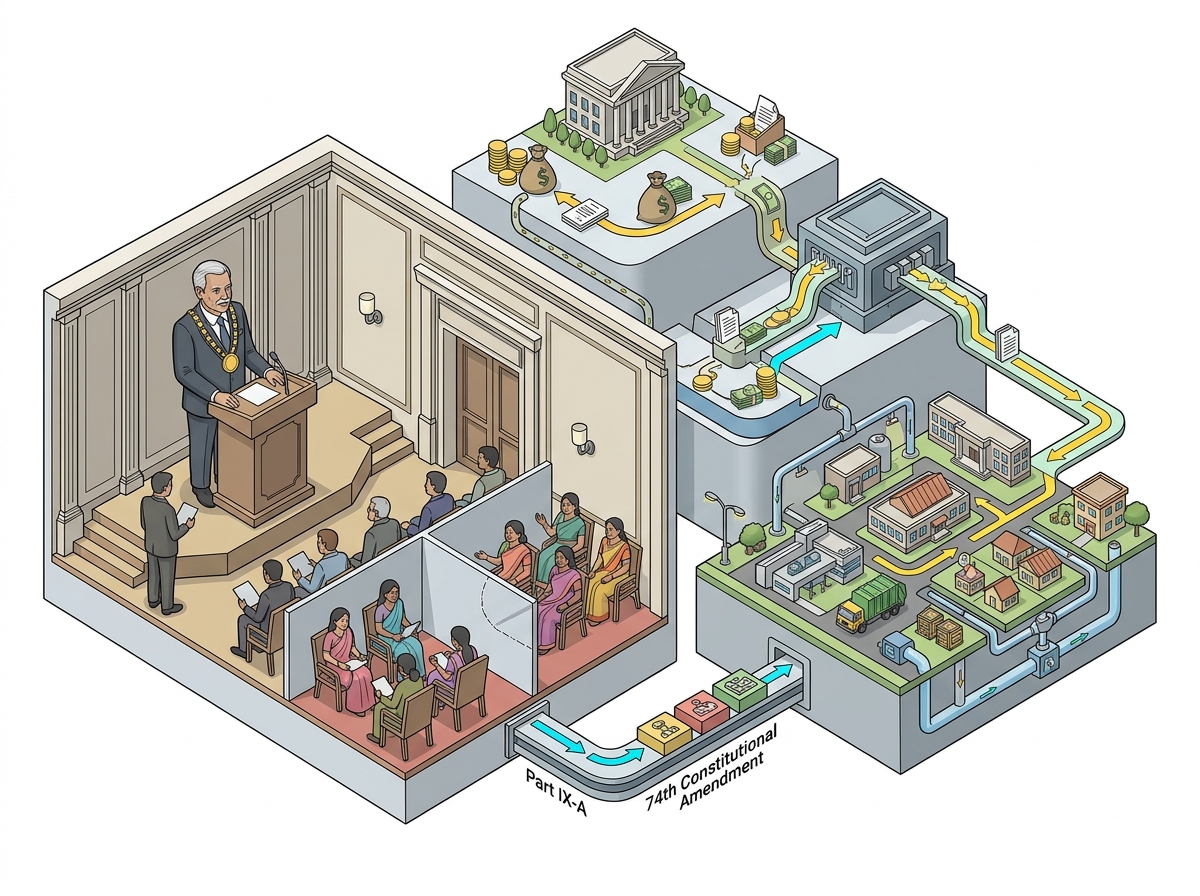
- The 74th Constitutional Amendment Act, 1992, introduced Part IX-A to the Constitution, mandating the establishment of urban local bodies (ULBs) with a view to decentralise governance and empower local institutions.
- The Act directs State governments to constitute State Finance Commissions (SFCs) every five years to review the financial position of local bodies and recommend measures for improving their financial status, including devolution of funds and assignment of taxes.
- Despite constitutional provisions, local bodies continue to rely heavily on transfers from the Union and State governments, with own sources of revenue (OSR) contributing minimally to their budgets.
- The OECD average for property tax collection is approximately 1.1% of GDP, whereas in India, it stands at a mere 0.2%, indicating significant underutilisation of local revenue potential.
- Issues such as bureaucratic control, lack of clarity in functional domains, and inadequate devolution of powers persist, constraining the autonomy of local governments.
- Tamil Nadu’s initiative, the Tamil Nadu Village Empowerment, Transformation and Rejuvenation Initiative (TN-VETRI), reflects a state-level effort to empower rural local bodies, though challenges in implementation remain.
What is the State Finance Commission (SFC)?
- The State Finance Commission (SFC) is a statutory body constituted by State governments under the provisions of the 73rd and 74th Constitutional Amendment Acts, 1992.
- Its primary function is to review the financial position of local bodies (both urban and rural) and recommend measures to improve their financial status, including the devolution of funds and assignment of taxes.
- The SFC is required to be constituted every five years, though the frequency may vary slightly across States based on their respective legislations.
- The recommendations of the SFC are advisory in nature and not binding on the State government, though they serve as a critical input for policy formulation and fiscal devolution.
- The SFC assesses the revenue and expenditure needs of local bodies, evaluates the adequacy of transfers from the State and Union governments, and suggests reforms to enhance local revenue generation.
- The SFC also examines the utilisation of funds by local bodies and may recommend measures to improve financial accountability and transparency.
- The recommendations of the SFC are typically submitted to the State government, which may accept or reject them in whole or in part, subject to legislative scrutiny.
- The SFC plays a pivotal role in bridging the gap between constitutional provisions for decentralisation and their practical implementation at the grassroots level.
Key Features
| Feature | Significance |
|---|---|
| Fiscal autonomy for local bodies | Enhances their ability to plan and execute development projects without dependency on higher tiers of government. |
| Own Sources of Revenue (OSR) | Reduces reliance on transfers and enables sustainable local financing for services like solid waste management and property tax collection. |
| GIS-based tax collection | Improves efficiency and transparency in revenue generation through spatial mapping of taxable assets. |
| 50% reservation for women in local bodies | Promotes gender-inclusive governance but requires safeguards against informal power usurpation by spouses. |
| Devolution of funds (e.g., TN-VETRI) | Strengthens grassroots empowerment by transferring resources directly to rural local governments for targeted interventions. |
Why it Matters
Constitutional and Governance
- The call for fiscal autonomy aligns with the 73rd and 74th Constitutional Amendments (1992), which mandate decentralisation but remain under-implemented due to resource constraints.
- Local self-government is a constitutional promise; fiscal empowerment converts it into a functional reality, enhancing democratic accountability.
- Empowering elected representatives over bureaucratic control ensures responsiveness to local needs and reduces top-down interference.
Economic and Fiscal
- Low OSR (1–8% in India vs. 1.1% of GDP in OECD) indicates untapped revenue potential, particularly in property tax, which can fund urban and rural infrastructure.
- Predictable and adequate fiscal resources enable local bodies to invest in critical services like sanitation, transport, and primary healthcare.
- Increased devolution (e.g., Tamil Nadu’s proposal to raise devolution from 10% to 12%) can reduce vertical fiscal imbalances and improve service delivery efficiency.
Social and Inclusive Development
- Strengthening women’s representation in local governance addresses gender gaps but requires institutional support to prevent proxy control by non-elected actors.
- Revenue augmentation through user charges (e.g., parking fees, solid waste management) can improve service quality while promoting cost-sharing with beneficiaries.
Challenges
1. Limited Own Revenue Generation
- Over-reliance on transfers from Union and State governments creates dependency and reduces local autonomy in decision-making.
- Low property tax collection (0.2% of GDP vs. 1.1% in OECD) reflects weak enforcement, outdated valuation systems, and public resistance to taxation.
- Narrow tax bases in rural areas constrain revenue diversification beyond traditional sources like land revenue.
UPSC Link: 73rd/74th Amendments – Fiscal Decentralisation
2. Bureaucratic Overreach and Lack of Accountability
- Local bodies often operate under bureaucratic control, undermining elected representatives’ authority and reducing responsiveness to citizens.
- Absence of clear functional demarcation between local governments and line departments leads to duplication and inefficiency.
- Weak institutional capacity at the grassroots level hampers effective utilisation of devolved funds and revenue collection.
UPSC Link: Role of Bureaucracy in Panchayati Raj
3. Gender Representation and Informal Power Structures
- Despite constitutional reservations, spouses of elected women representatives often exercise informal control, diluting the intended benefits of gender inclusion.
- Lack of awareness and training for women representatives exacerbates their marginalisation in decision-making processes.
UPSC Link: 50% Reservation for Women in Local Bodies
4. Technological and Administrative Gaps
- Absence of GIS-based tax mapping systems limits the efficiency and transparency of revenue collection, particularly for property and professional taxes.
- Weak data systems hinder the assessment of local resource potential and the design of targeted tax policies.
UPSC Link: Digital Governance in Local Bodies
Challenges — UPSC Perspective
| Issue | Concern |
|---|---|
| Low OSR | Insufficient local revenue generation to fund basic services and infrastructure. |
| Bureaucratic dominance | Elected representatives lack autonomy, reducing accountability to citizens. |
| Gender proxy control | Informal usurpation of roles by spouses undermines women’s representation. |
| Weak tax enforcement | Poor collection of property and professional taxes due to outdated systems and public resistance. |
| Functional ambiguity | Overlapping roles between local bodies and line departments cause inefficiency. |
Government Initiatives — Must-Memorise for Prelims
- Tamil Nadu Village Empowerment, Transformation and Rejuvenation Initiative (TN-VETRI)
Way Forward
- Enact statutory provisions to guarantee a minimum share of devolved funds (e.g., 12%) to local bodies, indexed to inflation or revenue growth.
- Modernise property tax systems using GIS mapping and digital valuation to improve coverage and compliance.
- Strengthen capacity-building programs for elected representatives, particularly women, to enhance their decision-making role.
- Establish clear functional mandates for local bodies, delineating their responsibilities vis-à-vis line departments to avoid duplication.
- Introduce performance-based grants to incentivise efficient revenue collection and service delivery at the local level.
- Promote user charges for services like solid waste management and parking to diversify revenue streams while ensuring affordability.
- Conduct periodic audits of local body finances to ensure transparency and accountability in fund utilisation.
UPSC Value Addition
Keywords for Mains Answer-Writing
State Finance Commissions · fiscal decentralisation · local self-government · Constitution of India Part IX · 74th Constitutional Amendment Act · own sources of revenue for local bodies · property tax collection · financial autonomy of Panchayats and Municipalities · devolution of funds to local governments · GIS-based tax administration · OECD standards for property tax · empowerment of elected women representatives · bureaucratic accountability in local governance · Tamil Nadu Village Empowerment, Transformation and Rejuvenation Initiative (TN-VETRI) · financial accountability and predictability for local bodies
Constitutional & Policy Linkages
- Article 243G – Functions of Panchayats
- Article 243W – Functions of Municipalities
- 73rd and 74th Constitutional Amendments – Decentralisation Framework
- Article 243I – Constitution of State Finance Commissions
Concept Flow
Constitutional mandate for decentralisation (73rd/74th Amendments) -> Limited fiscal autonomy for local bodies due to reliance on transfers -> Weak revenue generation (low OSR) -> Inefficient service delivery and infrastructure gaps -> Call for greater fiscal autonomy and authority -> Modernisation of tax systems (GIS, user charges) -> Strengthened local governance and inclusive development.
Prelims Practice Questions
Q1. Consider the following statements regarding the State Finance Commissions (SFCs) in India:
1. The State Finance Commissions are constitutional bodies mandated under Article 243-I of the Constitution of India.
2. The primary function of the SFCs is to recommend the principles governing the distribution of net proceeds of taxes between the State and the Panchayats and Municipalities.
3. The recommendations of the SFCs are binding on the State governments and must be implemented within six months of submission.
How many of the above statements are correct?
- Only one
- Only two
- All three
- None
Answer: Only two — Statement 1 is correct as SFCs are constitutional bodies under Article 243-I. Statement 2 is correct as their primary role is to recommend principles for tax distribution. Statement 3 is incorrect as the recommendations of SFCs are advisory and not binding on the State governments.
Q2. Assertion (A): The 74th Constitutional Amendment Act, 1992, provides for the establishment of Municipalities with elected representatives and devolution of powers and responsibilities to them.
Reason (R): The 74th Amendment Act mandates that Municipalities shall be constituted for every town and city, and their functions include urban planning, regulation of land use, and public health and sanitation.
In the context of the above Assertion and Reason, select the correct code:
- Both A and R are true, and R is the correct explanation of A
- Both A and R are true, but R is not the correct explanation of A
- A is true, but R is false
- A is false, but R is true
Answer: Both A and R are true, but R is not the correct explanation of A — Assertion (A) is true as the 74th Amendment Act provides for the establishment of Municipalities and devolution of powers. Reason (R) is also true and correctly explains the functions assigned to Municipalities under the Act.
Q3. Match the following pairs related to local governance in India:
Column I
A. Article 243-I
B. Article 243-Y
C. Article 243-W
D. 73rd Constitutional Amendment Act
Column II
1. Provisions for Municipalities
2. Constitution of State Finance Commissions
3. Provisions for Panchayats
4. Functions of Municipalities
Which of the following is the correct matching?
- A-3, B-4, C-1, D-2; A-2, B-1, C-4, D-3; A-1, B-2, C-3, D-4; A-4, B-3, C-2, D-1
- answer_ixs_pairing_indices_are_1_based_so_answer_0_for_first_option_etc.
Answer: A-3, B-4, C-1, D-2; A-2, B-1, C-4, D-3; A-1, B-2, C-3, D-4; A-4, B-3, C-2, D-1 — Correct matching: A-2 (Article 243-I pertains to State Finance Commissions), B-4 (Article 243-Y pertains to Finance Commissions for Municipalities), C-1 (Article 243-W pertains to functions of Municipalities), D-3 (73rd Amendment Act pertains to Panchayats).
Mains Practice Question
✍ The Constitution of India envisages a robust framework for fiscal decentralisation through the 73rd and 74th Constitutional Amendments. However, local bodies continue to face significant challenges in exercising meaningful fiscal autonomy. Critically examine the structural and institutional barriers to fiscal decentralisation in India, with particular reference to the role of State Finance Commissions and the need for predictable financial resources. (15 Marks)
Approach: MODEL-ANSWER SKELETON:
1. **Constitutional Framework for Fiscal Decentralisation** (2 points):
– Articles 243-I (SFCs) and 243-Y (Finance Commissions for Municipalities) mandate devolution of funds and functions to local bodies.
– 73rd and 74th Amendments (1992) provide for 3-tier Panchayati Raj and Municipal governance with elected representatives.
2. **Structural Barriers** (4 points):
– **Over-centralisation**: Excessive dependence on State/Union transfers (e.g., Finance Commission devolution, Centrally Sponsored Schemes) undermines local autonomy.
– **Limited Own Revenue Sources (OSR)**: Property tax collection in India is ~0.2% of GDP vs. ~1.1% in OECD countries; reliance on ad-hoc grants.
– **Functional Ambiguity**: Overlapping functions between State agencies and local bodies (e.g., sanitation, urban planning) lead to conflicts.
– **Bureaucratic Resistance**: Lack of accountability of bureaucrats to local representatives; informal capture by spouses of elected women representatives (despite 50% reservation).
3. **Institutional Challenges** (4 points):
– **State Finance Commissions (SFCs)**: Recommendations are advisory; no binding mechanism for implementation; delays in constituting SFCs.
– **Predictability of Funds**: Devolution lacks multi-year budgeting; funds are often tied to specific schemes, limiting flexibility.
– **Capacity Deficits**: Weak institutional capacity in local bodies for GIS-based tax administration, user charges, and solid waste management.
– **Gendered Barriers**: Informal usurpation of roles by male relatives of elected women representatives despite constitutional reservations.
4. **Contemporary Initiatives and Way Forward** (3 points):
– **Tamil Nadu’s TN-VETRI**: A State-led initiative for rural empowerment, but its success hinges on devolving fiscal authority.
– **Reforms Needed**:
– Mandate binding recommendations for SFCs with time-bound implementation.
– Expand OSR by rationalising property tax (e.g., GIS mapping, periodic reassessment) and levying user charges (e.g., parking, waste management).
– Strengthen local capacity through training and digital tools (e.g., GIS-based tax collection).
– Ensure gender-sensitive governance by empowering elected women representatives.
5. **Conclusion** (2 points):
– Fiscal decentralisation remains a ‘Constitutional promise’ rather than a ‘lived reality’ due to structural and institutional constraints.
– A shift toward predictable, flexible, and locally generated funds is essential to realise the vision of self-governing local bodies as envisaged in the Constitution.
Source: The Hindu
Generated by AanyaAi for educational purpose.
Related guides on our sites
- Best PSIR optional coaching for upsc
- Best economics optional coaching for upsc
- Best PSIR optional teacher for upsc
- Best teacher of PSIR optional for upsc


No Comments