


18 Sep Mumbai Monsoon 2026: Human Activity Drove 86 of 92 Days of Extreme Weather
✎ The Climate Shift Index (CSI) quantifies human influence on daily weather anomalies, with Mumbai’s 2026 monsoon recording CSI levels of 4–5, indicating severe anthropogenic contribution to extreme heat and rainfall events.
Subject Relevance — Where This Topic Fits
- GS Paper III — Environment and Disaster Management | GS Paper III — Urbanisation and Related Issues
- Prelims: Climate Shift Index (CSI), Urban Heat Island (UHI) Effect, Greenhouse Gas (GHG) Emissions, El Niño-Southern Oscillation (ENSO), Mumbai Metropolitan Region (MMR), Climate Central, Sea Level Rise Vulnerability
- Essay: Climate Change and Urban Governance: Balancing Development and Environmental Sustainability, The Role of Scientific Evidence in Shaping Public Policy for Climate Resilience
Quick Revision: The Climate Shift Index (CSI) quantifies human influence on daily weather anomalies, with Mumbai’s 2026 monsoon recording CSI levels of 4–5, indicating severe anthropogenic contribution to extreme heat and rainfall events.
Why is this in the news?
A recent study by Climate Central, utilising the Climate Shift Index (CSI), has quantified the anthropogenic influence on Mumbai’s monsoon weather patterns during the 2026 season. The findings indicate that human activities, including vehicular emissions and industrial practices, exacerbated extreme heat and rainfall events in Mumbai and the Mumbai Metropolitan Region (MMR), with 86 of 92 monsoon days exhibiting measurable human-driven climate impacts. This underscores the urgent need for evidence-based urban climate adaptation strategies in India’s financial capital.
Background
- The Mumbai Metropolitan Region (MMR) is India’s most densely urbanised and economically significant coastal zone, housing over 20 million inhabitants and critical infrastructure.
- Monsoon variability in Mumbai has historically been influenced by natural phenomena such as the El Niño-Southern Oscillation (ENSO), which modulates sea surface temperatures in the Pacific Ocean and, in turn, Indian monsoon rainfall patterns.
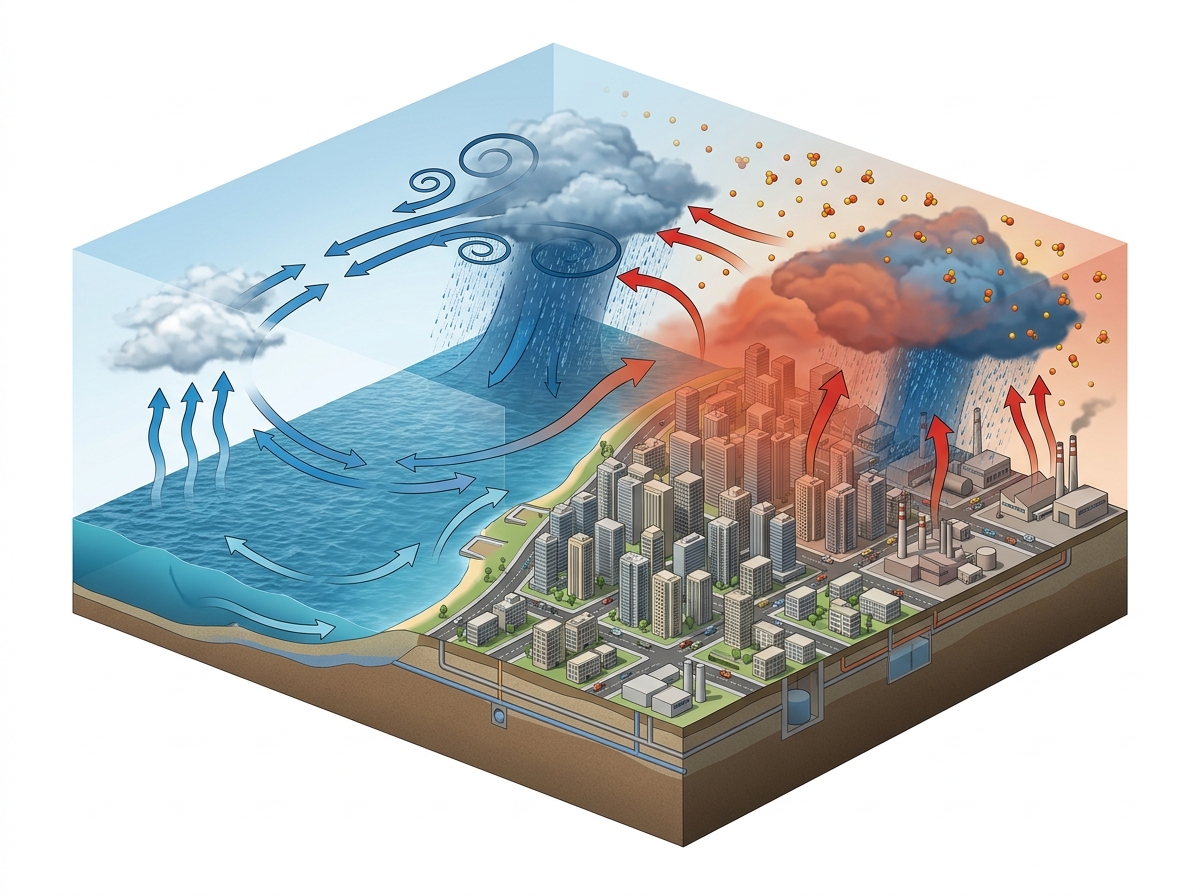
- Urbanisation in MMR has led to the formation of the Urban Heat Island (UHI) effect, wherein built-up areas retain heat more efficiently than surrounding rural regions, altering local microclimates.
- The Intergovernmental Panel on Climate Change (IPCC) Sixth Assessment Report (2021–2023) highlights that urban areas are disproportionately vulnerable to climate change due to high population densities, economic concentration, and infrastructure exposure.
- Climate Central’s Climate Shift Index (CSI) is a peer-reviewed metric designed to attribute daily temperature and precipitation anomalies to anthropogenic climate change, providing a quantitative measure of human influence on weather events.
- The United Nations’ report on global sea-level rise identifies Mumbai as one of the world’s most exposed megacities to coastal flooding, with projections of 0.5–1 metre rise by 2100 under high-emission scenarios.
Understanding Anthropogenic Climate Influence on Mumbai’s Monsoon: Key Concepts and Mechanisms
- **Climate Shift Index (CSI):**** A metric developed by Climate Central to quantify the likelihood that a given day’s temperature or precipitation anomaly is attributable to human-induced climate change. CSI values range from 0 (no human influence) to 5 (extreme human influence), with Mumbai recording average CSI levels of 4–5 during the 2026 monsoon, indicating severe anthropogenic contribution.
- **Urban Heat Island (UHI) Effect:**** A phenomenon where urban areas experience higher temperatures than their rural surroundings due to reduced evapotranspiration, heat retention by concrete and asphalt, and anthropogenic heat emissions from vehicles, industries, and buildings.
- **Greenhouse Gas (GHG) Emissions:**** Human activities, including vehicular traffic, industrial operations, and energy consumption, emit GHGs such as carbon dioxide (CO₂) and methane (CH₄), which enhance the greenhouse effect and contribute to global warming.
- **El Niño-Southern Oscillation (ENSO):**** A natural climate phenomenon characterised by periodic warming (El Niño) or cooling (La Niña) of sea surface temperatures in the central and eastern Pacific Ocean. While ENSO influences large-scale monsoon patterns, its effects are now superimposed on a background of anthropogenic warming, amplifying extreme weather events in regions like Mumbai.
- **Anthropogenic Aerosols:**** Fine particulate matter (PM₂.₅ and PM₁₀) from vehicular exhaust, industrial emissions, and construction activities can alter cloud formation and rainfall patterns.
- **Sea Level Rise and Coastal Vulnerability:**** Mumbai’s low-lying coastal geography increases its susceptibility to flooding.
- **Climate Adaptation in Urban Governance:**** The study’s findings necessitate integrated urban climate policies, including green infrastructure (e.g., urban forests, permeable pavements), emissions reduction strategies (e.g., public transport electrification), and disaster risk reduction measures (e.g., flood-resilient urban design) to enhance Mumbai’s resilience.
Key Features
| Feature | Significance |
|---|---|
| Climate Shift Index (CSI) | A quantitative metric used to attribute daily temperature anomalies to human-induced climate change, with levels 4-5 indicating severe anthropogenic influence. |
| Mumbai Metropolitan Region (MMR) coverage | Expands the analysis beyond Mumbai and Navi Mumbai to include Thane, Dombivali, Kalyan, Pimpri, and Shivaji Nagar, demonstrating regional climate vulnerability. |
| Monsoon temperature anomalies | Mumbai recorded deficit rainfall in June and August 2026 but surpassed average monsoon quota in July, with temperatures elevated due to combined El Niño and anthropogenic factors. |
| Greenhouse Gas (GHG) emissions | Vehicle and industrial emissions are identified as primary contributors to localised heat islands and altered rainfall patterns in urban clusters. |
| Regional disparity in rainfall distribution | Uneven monsoon distribution across Indian states, exacerbated by El Niño, highlights systemic climate variability linked to global warming. |
Why it Matters
Environmental Governance
- Urban climate resilience requires integrated monitoring of anthropogenic heat sources and rainfall anomalies.
- Local governance must align with national climate action plans (e.g., National Action Plan on Climate Change) to mitigate urban heat island effects.
- MMR’s vulnerability underscores the need for regional cooperation in climate adaptation strategies.
Scientific Research
- Attribution studies using CSI provide empirical evidence for policy interventions in urban planning and emissions control.
- Long-term climate datasets are essential for distinguishing natural variability (e.g., El Niño) from anthropogenic trends.
- Collaboration between international (Climate Central) and national agencies enhances climate data reliability.
Urban Planning
- Heat-resilient infrastructure (e.g., cool roofs, green spaces) must be prioritised in MMR’s developmental plans.
- Flood management systems need redesign to account for altered monsoon patterns and extreme rainfall events.
- Public health systems must adapt to increased heat stress during monsoon months.
Economic Implications
- Agricultural productivity in Maharashtra may face disruptions due to erratic monsoon patterns, impacting food security.
- Tourism and real estate sectors in Mumbai could face long-term risks from rising temperatures and sea levels.
- Insurance and financial sectors may reassess risk models for urban infrastructure in high-vulnerability zones.
Challenges
1. Urban Heat Island Effect
- Intensified by anthropogenic emissions, leading to prolonged heat stress during monsoon.
- Disproportionately affects vulnerable populations (e.g., informal settlements, outdoor workers).
UPSC Link: GS-III: Climate Change
2. Altered Monsoon Patterns
- Increased frequency of deficit rainfall followed by extreme bursts, disrupting water resource management.
- Agricultural planning and water storage strategies require recalibration.
UPSC Link: GS-I: Monsoon Variability
3. Regional Climate Disparities
- MMR faces higher anthropogenic influence compared to other Indian cities, necessitating targeted interventions.
- Lack of uniform climate data across districts hampers policy precision.
UPSC Link: GS-III: Urbanisation
4. Infrastructure Resilience
- Existing drainage systems are inadequate for extreme rainfall events, increasing urban flooding risks.
- Heat-sensitive materials in urban construction degrade faster, raising maintenance costs.
UPSC Link: GS-III: Disaster Management
5. Policy Implementation Gaps
- National climate action plans often lack granularity for urban micro-climates.
- Inter-state coordination in MMR is weak, delaying climate adaptation measures.
UPSC Link: GS-II: Governance
6. Public Health Risks
- Heat-related illnesses (e.g., heatstroke, dehydration) surge during prolonged high-temperature periods.
- Vector-borne diseases (e.g., dengue) may expand due to altered rainfall patterns.
UPSC Link: GS-II: Health
Challenges — UPSC Perspective
| Issue | Concern |
|---|---|
| Anthropogenic Emissions | Escalating local temperatures and altering rainfall patterns in MMR. |
| El Niño Influence | Amplifies natural climate variability, compounding anthropogenic effects. |
| Urbanisation Pressure | Concentrates heat and emissions, exacerbating climate vulnerabilities. |
| Data Gaps | Insufficient granular climate data for district-level policy formulation. |
| Institutional Fragmentation | Lack of coordination between municipal, state, and national agencies. |
| Infrastructure Deficits | Inadequate systems to handle extreme weather events. |
Way Forward
- Strengthen urban climate monitoring networks with real-time data integration for MMR districts.
- Integrate climate-resilient design principles into urban planning (e.g., green roofs, permeable pavements).
- Enhance inter-agency coordination for monsoon preparedness and heatwave management in MMR.
- Promote low-carbon public transport and industrial emission controls in high-density urban zones.
- Develop district-specific climate adaptation plans with inputs from meteorological and health authorities.
- Invest in flood-resilient infrastructure and decentralised water storage systems.
- Conduct public awareness campaigns on heat safety and sustainable urban practices.
- Collaborate with international agencies for advanced climate modelling and attribution studies.
UPSC Value Addition
Keywords for Mains Answer-Writing
Climate Change and Extreme Weather Events · Anthropogenic Influence on Monsoon Patterns · Urban Heat Island Effect · Greenhouse Gas Emissions and Local Climatic Variations · Climate Shift Index (CSI) · Mumbai Metropolitan Region (MMR) Climate Vulnerability · El Niño-Southern Oscillation (ENSO) and Monsoon Disruptions · Urbanisation and Microclimatic Alterations · Climate Central Study on Indian Cities · Regional Climate Anomalies in Maharashtra
Concept Flow
Anthropogenic GHG emissions → Urban heat island formation → Elevated daytime temperatures (CSI levels 4-5) → Altered monsoon dynamics (deficit/excess rainfall) → Increased vulnerability of urban infrastructure and public health → Need for adaptive governance and infrastructure reforms.
Prelims Practice Questions
Q1. Consider the following statements regarding the Climate Shift Index (CSI) used in the study on Mumbai’s climate:
1. The CSI measures the impact of climate change on daily temperatures.
2. A CSI level of 4 or 5 indicates a severe impact of climate change.
3. The CSI is calculated solely based on natural climate variability.
How many of the above statements are correct?
- Only one
- Only two
- All
- None
Answer: Only two — Statements 1 and 2 are correct as the CSI is designed to quantify the influence of climate change on daily temperatures, with levels 4 and 5 indicating severe impacts. Statement 3 is incorrect because the CSI isolates human-induced factors from natural variability.
Q2. Assertion (A): The El Niño-Southern Oscillation (ENSO) is a primary driver of monsoon variability in India.
Reason (R): ENSO influences sea surface temperatures in the central and eastern Pacific Ocean, which in turn affects atmospheric circulation patterns over the Indian subcontinent.
Options:
A. Both A and R are true, and R is the correct explanation of A.
B. Both A and R are true, but R is not the correct explanation of A.
C. A is true, but R is false.
D. A is false, but R is true.
Answer: ? — Both the assertion and reason are correct, and the reason accurately explains the assertion. ENSO’s warming of Pacific waters disrupts monsoon patterns by altering global atmospheric circulation.
Q3. Match the following cities with the number of days in the 2026 monsoon season when human activity significantly influenced local weather patterns as per the study:
Column I (City) | Column II (Days affected)
— | —
A. Mumbai | 1. 76
B. Thane | 2. 79
C. Kalyan | 3. 81
D. Pimpri | 4. 86
- A-4, B-3, C-2, D-1
- A-4, B-1, C-2, D-3
- A-3, B-4, C-1, D-2
- A-2, B-3, C-4, D-1
Answer: A-4, B-3, C-2, D-1 — Mumbai (86 days), Thane (81 days), Kalyan (79 days), and Pimpri (76 days) are correctly matched with their respective days of human-induced weather influence.
Mains Practice Question
✍ The intensification of extreme heat and rainfall events in urban India during the monsoon season is increasingly attributed to anthropogenic factors. Critically analyse the interplay between climate change, urbanisation, and local weather anomalies in the context of the Mumbai Metropolitan Region (MMR). Also, discuss the policy implications for climate-resilient urban planning. (15 Marks)
Approach: MODEL-ANSWER SKELETON:
1. **Introduction (2 marks)**: Define anthropogenic climate change and its urban manifestations; cite the Climate Central study and CSI methodology.
2. **Mechanisms of Urban Climate Alteration (4 marks)**:
– Urban Heat Island Effect: impervious surfaces, reduced evapotranspiration, and heat retention.
– Greenhouse Gas Emissions: vehicular and industrial sources in MMR.
– El Niño-Southern Oscillation (ENSO) amplification: interaction with anthropogenic warming.
3. **Empirical Evidence from MMR (3 marks)**:
– Data on extreme heat days (28 in Mumbai/Navi Mumbai) and rainfall anomalies (deficit in June/August 2026).
– CSI levels 4-5 indicating severe human influence.
4. **Policy Implications (4 marks)**:
– Urban greening and heat action plans (e.g., Mumbai’s Cool Roofs Initiative).
– Decarbonisation of transport and industry (National Clean Air Programme targets).
– Integration of climate risk assessments in MMR’s Development Plan 2034.
5. **Conclusion (2 marks)**: Emphasise the need for multi-scalar governance (local, state, and national) and community participation in climate adaptation.
Source: The Indian Express
Maharashtra PCS (MPSC) — State PCS Practice
Prelims: Which of the following human activities has significantly contributed to the altered monsoon patterns and increased flooding in Mumbai in recent years?
- A. Expansion of mangrove forests along the coastline
- B. Rapid urbanization and concretization of natural drainage systems
- C. Decrease in vehicular emissions due to public transport initiatives
- D. Implementation of strict industrial pollution control measures
Answer: B. Rapid urbanization and concretization of natural drainage systems — Rapid urbanization and concretization have disrupted natural water absorption and drainage, exacerbating flooding during monsoon.
Mains: Analyze the role of unplanned urban expansion and loss of natural water bodies in altering Mumbai’s microclimate and monsoon-related disasters. Suggest policy measures to mitigate these effects, with a focus on Maharashtra’s climate resilience framework.
Generated by AanyaAi for educational purpose.
Related guides on our sites
- Current affairs for upsc 2026
- How to prepare for GS paper 1 for UPSC CSE mains exam
- Best UPSC coaching for IFOS exam
- Best geography optional coaching

- Mumbai Monsoon 2026: Human Activity Drove 86 of 92 Days of Extreme Weather - September 18, 2026
- ईरान में नागरिकों पर अत्याचार: संयुक्त राष्ट्र के तथ्यान्वेषण मिशन की रिपोर्ट - September 18, 2026
- UN Report: Iran’s Crimes Against Humanity & US War Crimes Exposed - September 18, 2026

No Comments