


18 Sep UPSC Alert: Postal Dept Launches Swachhata Abhiyan 6 for E-Waste & Pending Cases
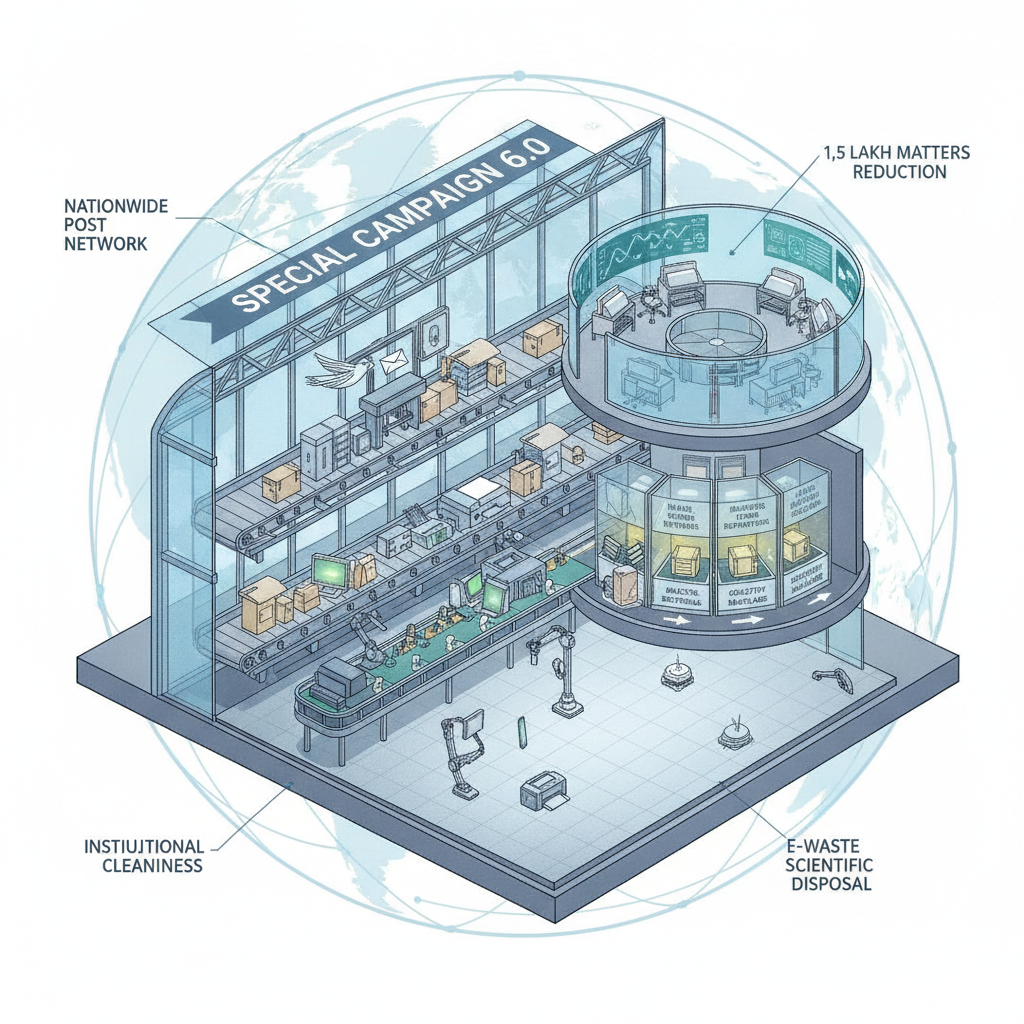
✎ Special Campaign 6.0 of the Department of Posts institutionalises cleanliness, reduces pendency, and enforces scientific e-waste management under the E-waste (Management) Rules, 2022, leveraging the postal network’s scale for…
Subject Relevance — Where This Topic Fits
- GS Paper II — Governance, Transparency and Accountability | GS Paper III — Environment and Sustainable Development
- Prelims: E-waste (Management) Rules, 2022, Swachh Bharat Mission (Urban & Rural), Government e-Marketplace (GeM), Digital India, Sustainable Development Goals (SDG 11, 12)
- Essay: Governance reforms for sustainable public service delivery, Balancing technological advancement with environmental sustainability in public institutions
Quick Revision: Special Campaign 6.0 of the Department of Posts institutionalises cleanliness, reduces pendency, and enforces scientific e-waste management under the E-waste (Management) Rules, 2022, leveraging the postal network’s scale for sustainable governance.
Why is this in the news?
The Department of Posts, Ministry of Communications, Government of India, has announced Special Campaign 6.0 to institutionalise cleanliness, reduce pending matters, and scientifically manage electronic waste (e-waste) across its nationwide postal network. This initiative builds on the outcomes of Special Campaign 5.0, which achieved significant milestones in cleanliness drives and citizen grievance redressal, and aligns with national priorities for environmental sustainability and efficient public service delivery.
Background
- The Department of Posts operates one of the world’s largest postal networks, with over 1.5 lakh post offices, serving as a critical public service infrastructure.
- E-waste management has emerged as a global challenge, with India generating approximately 1.6 million tonnes of e-waste annually (as per Central Pollution Control Board estimates), necessitating robust institutional mechanisms for collection, segregation, and disposal.
- The E-waste (Management) Rules, 2022, mandate Extended Producer Responsibility (EPR) for producers, importers, and brand owners, requiring them to ensure environmentally sound management of e-waste through authorised channels.
- Special Campaigns have been a governance reform initiative since 2021, focusing on reducing pendency, improving record management, and enhancing cleanliness in government offices.
- The postal network’s scale and reach make it uniquely positioned to contribute to national e-waste management efforts through systematic collection and disposal mechanisms.
- Sustainable Development Goals (SDGs), particularly SDG 11 (Sustainable Cities and Communities) and SDG 12 (Responsible Consumption and Production), underscore the need for institutionalising waste management practices in public institutions.
What is Special Campaign 6.0 of the Department of Posts?
- A nation-wide governance reform initiative launched by the Department of Posts, Ministry of Communications, to institutionalise cleanliness, reduce pendency of matters, and scientifically manage e-waste in its offices and establishments.
- The campaign spans two phases: a preparation phase (15–30 September 2026) and an implementation phase (2–31 October 2026), ensuring systematic planning and execution.
- The preparation phase focuses on identifying pending matters, purging obsolete records, assessing redundant materials, cataloguing e-waste, and setting measurable targets for cleanliness and waste management.
- A key objective is the scientific management of e-waste, including effective collection, segregation, and disposal in compliance with the E-waste (Management) Rules, 2022 and its amendments.
- Postal circles will conduct preliminary assessments of old electronic and IT equipment, ensuring their segregation and disposal through authorised channels such as recyclers, refurbishers, or manufacturers as per EPR norms.
- The campaign mandates the establishment of designated collection centres within post offices and postal establishments, along with capacity-building initiatives to sensitise staff on safe e-waste handling practices.
- Records of e-waste collection and disposal will be maintained to ensure transparency and accountability in the process.
- The initiative builds on the achievements of Special Campaign 5.0, which organised 6,000 ‘Post Choupals’ (community outreach events), cleaned 130,000 campaign sites, planted over 5,600 trees, and resolved over one lakh public grievances and 1,000 CPGRAMS appeals.
Key Features
| Feature | Significance |
|---|---|
| Institutionalisation of Cleanliness | Ensures sustained hygiene practices within the postal network, aligning with the broader Swachh Bharat Mission objectives. |
| Reduction of Pending Cases | Streamlines record management and disposal of obsolete files, enhancing administrative efficiency. |
| Scientific E-Waste Management | Mandates systematic collection, segregation, and disposal of e-waste in compliance with E-Waste (Management) Rules, 2022. |
| Two-Phase Implementation | Preparation phase (15–30 Sep 2026) focuses on assessment, while the implementation phase (2–31 Oct 2026) executes corrective actions. |
| Awareness Generation | Conducts training sessions for staff on safe e-waste handling and disposal protocols. |
Why it Matters
Administrative Efficiency
- Reduces bureaucratic backlog by digitising and disposing of redundant records.
- Enhances transparency through documented e-waste disposal chains.
- Improves citizen experience by ensuring cleaner and more functional postal offices.
Environmental Sustainability
- Promotes circular economy principles via authorised e-waste recycling and refurbishment.
- Minimises hazardous waste leakage into landfills through regulated disposal mechanisms.
- Supports India’s commitment to Sustainable Development Goals (SDG 12: Responsible Consumption and Production).
Institutional Capacity Building
- Strengthens institutional frameworks for long-term cleanliness and waste management.
- Establishes standard operating procedures (SOPs) for future campaigns.
- Fosters a culture of accountability and continuous improvement within government offices.
Challenges
1. Regulatory Compliance
- Ensuring strict adherence to E-Waste (Management) Rules, 2022, across diverse postal circles.
- Coordinating with multiple stakeholders (manufacturers, recyclers, refurbishers) for seamless e-waste disposal.
UPSC Link: Environmental Pollution: Legal Framework
2. Logistical Bottlenecks
- Managing the transportation and segregation of e-waste from remote postal offices.
- Overcoming infrastructure gaps in rural and semi-urban areas for authorised disposal.
UPSC Link: Logistics and Supply Chain Management
3. Resource Allocation
- Balancing manpower and financial resources for simultaneous cleanliness and e-waste initiatives.
- Training staff in new protocols without disrupting core postal operations.
UPSC Link: Public Administration: Challenges
4. Awareness and Behavioural Change
- Overcoming resistance to change among employees accustomed to traditional record-keeping.
- Ensuring public participation in e-waste segregation at post office premises.
UPSC Link: Social Behaviour and Governance
5. Monitoring and Evaluation
- Developing robust metrics to measure the success of cleanliness and e-waste reduction.
- Avoiding superficial compliance without tangible improvements in operational efficiency.
UPSC Link: Governance: Performance Measurement
Challenges — UPSC Perspective
| Issue | Concern |
|---|---|
| Regulatory Fragmentation | Diverse state-level rules may conflict with centralised e-waste management protocols. |
| Technological Obsolescence | Rapidly outdated IT equipment in postal offices complicates e-waste classification. |
| Stakeholder Coordination | Lack of unified platforms for tracking e-waste from collection to disposal. |
| Public Participation | Low awareness among citizens about e-waste segregation in public spaces. |
| Data Security Risks | Ensuring sensitive data erasure from discarded electronic devices. |
Government Initiatives — Must-Memorise for Prelims
- E-Waste (Management) Rules, 2022
Way Forward
- Establish dedicated e-waste collection centres in all postal circles with real-time tracking systems.
- Conduct periodic audits of record management systems to prevent accumulation of obsolete files.
- Integrate AI-driven tools for predictive maintenance of IT infrastructure to reduce premature e-waste generation.
- Launch multi-lingual awareness campaigns targeting postal staff and the public on e-waste hazards.
- Develop public-private partnerships with certified recyclers to ensure cost-effective and compliant disposal.
- Incorporate cleanliness and waste management metrics into performance appraisals of postal officers.
- Pilot digital record-keeping in high-volume post offices to streamline file disposal processes.
UPSC Value Addition
Keywords for Mains Answer-Writing
E-waste Management Rules 2022 · Special Campaign 6 · Government e-waste disposal · Institutionalizing cleanliness in postal network · Scientific disposal of e-waste · Circular economy in government offices · E-governance infrastructure sustainability · Administrative reforms in postal services · Extended Producer Responsibility (EPR) · Sustainable Development Goals (SDG) 12 · Record management in public offices · Government waste management policies · Digital India waste management · Public sector sustainability initiatives
Concept Flow
Government offices generate obsolete records and e-waste as part of routine operations. → Special Campaign 6 identifies and categorises pending cases and e-waste through assessment phase. → Corrective actions are implemented, including disposal of records and authorised e-waste processing. → Institutional frameworks (SOPs, training) are strengthened for long-term sustainability. → Improved operational efficiency and environmental compliance enhance citizen experience. → Lessons from Special Campaign 5.0 inform the scalability and refinement of Campaign 6.0.
Prelims Practice Questions
Q1. Consider the following statements regarding the E-waste (Management) Rules, 2022:
1. These rules mandate the establishment of a formal mechanism for the collection, segregation, and disposal of e-waste by producers.
2. The rules apply exclusively to electronic equipment used in government offices.
3. The rules require producers to ensure environmentally sound management of e-waste through authorized channels.
4. The rules exempt small and medium enterprises from compliance with e-waste management provisions.
How many of the above statements are correct?
- Only one
- Only two
- Only three
- All four
Answer: Only three — Statements 1 and 3 are correct as the E-waste (Management) Rules, 2022 mandate producers to establish a formal mechanism for e-waste management and ensure environmentally sound disposal. Statements 2 and 4 are incorrect as the rules apply broadly to all producers and do not exempt small and medium enterprises.
Q2. Assertion (A): The Special Campaign 6 launched by the Department of Posts focuses on institutionalizing cleanliness and reducing pending cases in government offices.
Reason (R): The campaign includes a preparatory phase for identifying pending cases, obsolete records, and e-waste, followed by an implementation phase for scientific disposal.
In the context of the above two statements, which one of the following is correct?
- Both A and R are true, and R is the correct explanation of A
- Both A and R are true, but R is not the correct explanation of A
- A is true, but R is false
- A is false, but R is true
Answer: Both A and R are true, and R is the correct explanation of A — Both Assertion (A) and Reason (R) are true, and Reason (R) correctly explains Assertion (A). The campaign’s dual-phase structure—preparatory and implementation—directly addresses institutional cleanliness and pending cases, including e-waste management.
Q3. Match the following initiatives with their respective objectives:
Column I (Initiative) | Column II (Objective)
———————————————–|———————————————–
A. Special Campaign 6 | 1. Strengthening record management in public offices
B. E-waste (Management) Rules, 2022 | 2. Mandating scientific disposal of e-waste
C. Digital India initiative | 3. Promoting digital literacy and infrastructure
D. Swachh Bharat Mission | 4. Ensuring cleanliness and hygiene in public spaces
Select the correct match:
- A-1, B-2, C-3, D-4
- A-2, B-1, C-4, D-3
- A-4, B-3, C-2, D-1
- A-3, B-4, C-1, D-2
Answer: A-1, B-2, C-3, D-4 — The correct match is: A (Special Campaign 6) with 1 (Strengthening record management), B (E-waste Rules, 2022) with 2 (Mandating scientific disposal), C (Digital India) with 3 (Promoting digital literacy), and D (Swachh Bharat Mission) with 4 (Ensuring cleanliness).
Mains Practice Question
✍ The Department of Posts has launched Special Campaign 6 to institutionalise cleanliness, reduce pendency, and promote scientific e-waste management in its offices. Critically examine the significance of such administrative reforms in the context of India’s broader sustainability and governance objectives. (15 Marks)
Approach: MODEL-ANSWER SKELETON:
1. **Context and Objectives of Special Campaign 6**:
– Brief outline of the campaign’s two-phase structure (preparatory: 15–30 Sep 2026; implementation: 2–31 Oct 2026).
– Key focus areas: pendency reduction, record management, and scientific e-waste disposal under the E-waste (Management) Rules, 2022.
2. **Administrative Reforms and Governance**:
– **Institutionalising Cleanliness**: Link to Swachh Bharat Mission (2014) and SDG 12 (Responsible Consumption and Production).
– **Pendency Reduction**: Highlight the importance of reducing backlog in public offices for efficiency and citizen trust (cite the Right to Service Acts and the 3rd ARC recommendations).
– **E-waste Management**: Discuss the role of Extended Producer Responsibility (EPR) under the E-waste Rules, 2022, and the need for a circular economy in government operations.
3. **Sustainability and Circular Economy**:
– Explain how the campaign aligns with India’s commitments under the Paris Agreement and the National Resource Efficiency Policy (2019).
– Discuss the potential for replicating such reforms in other government departments to promote sustainable public procurement (cite the Government e-Marketplace (GeM) and the Green Procurement Policy).
4. **Challenges and Limitations**:
– **Implementation Gaps**: Cite past instances of similar campaigns (e.g., Special Campaign 5.0) where outcomes were mixed due to lack of sustained monitoring.
– **Resource Constraints**: Highlight the need for adequate funding, training, and technology for e-waste segregation and disposal.
– **Behavioral Change**: Emphasise the role of awareness campaigns and capacity-building among postal staff.
5. **Way Forward**:
– Propose measures such as integrating digital tools (e.g., AI for pendency tracking) and incentivising departments for compliance.
– Stress the need for third-party audits and public disclosure of progress to ensure accountability.
6. **Conclusion**:
– Summarise the campaign’s potential to set a precedent for other ministries/departments in balancing administrative efficiency with environmental sustainability.
Source: PIB (Press Information Bureau)
Generated by AanyaAi for educational purpose.
Related guides on our sites
- Best PSIR optional coaching for upsc
- Best PSIR optional teacher for upsc
- Best teacher of PSIR optional for upsc
- Best PSIR optional coaching in delhi for UPSC

- तमिलनाडु की आर्थिक क्षमता बढ़ाने के लिए केर्नी रिपोर्ट के प्रमुख सुझाव - September 18, 2026
- Kearney Report: Tamil Nadu’s Fiscal Gap Can Be Bridged Without New Taxes or Loans - September 18, 2026
- ईरान ने होर्मुज जलडमरूमध्य में तेल टैंकर पर हमला बोला: जानिए पूरा घटनाक्रम - September 18, 2026

No Comments