


18 Sep Kearney Report: Tamil Nadu’s Fiscal Gap Can Be Bridged Without New Taxes or Loans
✎ Tamil Nadu’s fiscal capacity can be significantly enhanced by improving GST compliance, revising and enforcing guideline values for stamp duty, optimising excise revenue, and ensuring disciplined capital project execution…
Subject Relevance — Where This Topic Fits
- GS Paper II — Functions and Responsibilities of the Union and the States, Issues and Challenges Pertaining to the Federal Structure | GS Paper III — Indian Economy and Issues Relating to Planning, Mobilisation of Resources, Growth, Development and Employment
- Prelims: Fiscal capacity, Revenue deficit, GST-to-GSDP ratio, Guideline value, Stamp duty, Excise revenue, Debt-GSDP ratio, Capital project readiness
- Essay: Fiscal federalism and the challenges of resource mobilisation in Indian States, Balancing growth, welfare, and fiscal prudence: Lessons from Tamil Nadu
Quick Revision: Tamil Nadu’s fiscal capacity can be significantly enhanced by improving GST compliance, revising and enforcing guideline values for stamp duty, optimising excise revenue, and ensuring disciplined capital project execution, thereby reducing the revenue deficit without additional borrowing or taxation.
Why is this in the news?
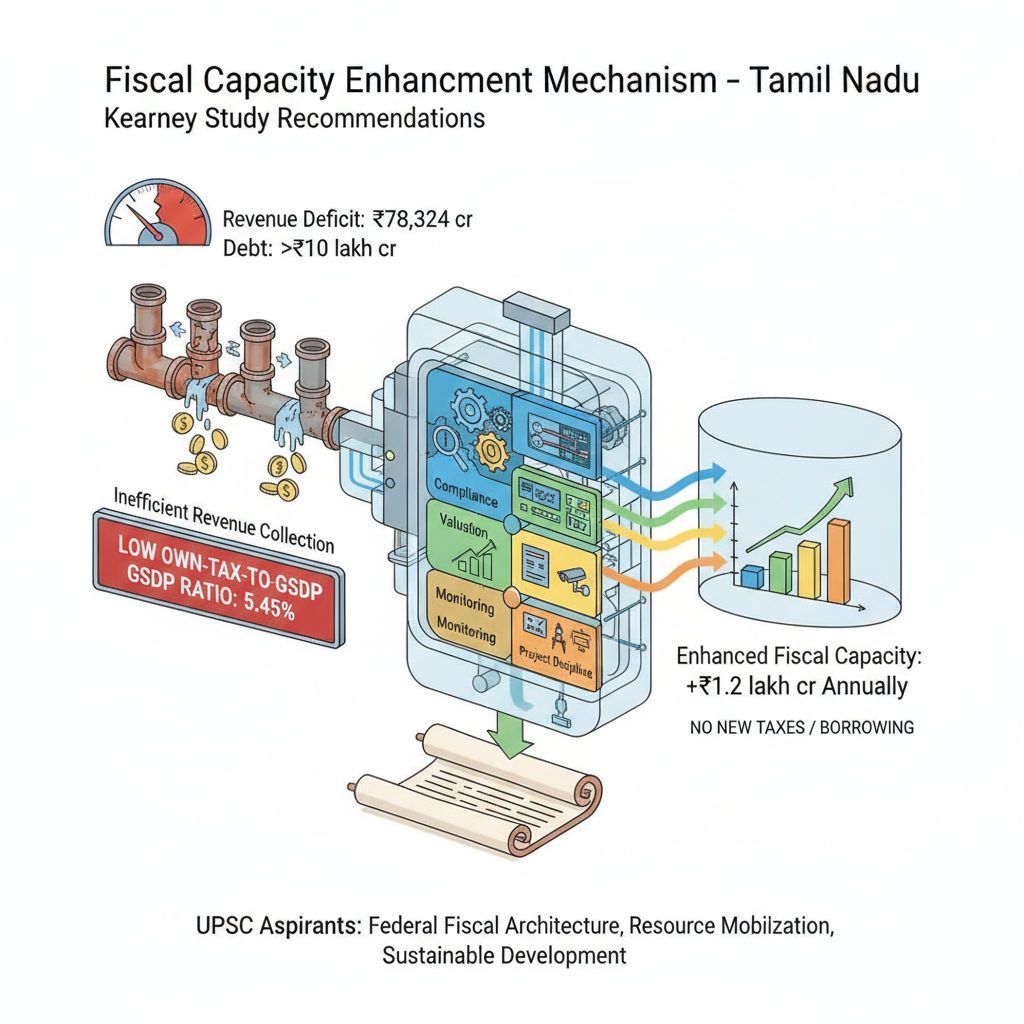
A recent study by Kearney has highlighted Tamil Nadu’s suboptimal fiscal performance, characterised by a revenue deficit of ₹78,324 crore, debt exceeding ₹10 lakh crore, and a low own-tax-to-GSDP ratio of 5.45%. The report underscores that the State’s primary challenge is not excessive borrowing but inefficient revenue collection and expenditure management. It proposes structural reforms to enhance fiscal capacity by ₹1.2 lakh crore annually without additional taxation or borrowing, focusing on compliance, valuation, monitoring, and project discipline. This analysis is critical for UPSC aspirants as it intersects with federal fiscal architecture, resource mobilisation, and sustainable development.
Background
- Tamil Nadu, one of India’s largest economies, has witnessed a 309% increase in debt over the past decade, as highlighted by the Comptroller and Auditor General (CAG), leading to repayment pressures and constrained fiscal space.
- Tamil Nadu’s guideline values for stamp duty and registration charges were last revised in 2017, with the next revision implemented in July 2024 following a granular ‘composite value’ system post a Madras High Court ruling against across-the-board increases in January 2024.
- The State’s excise revenue remains underleveraged, with limited availability of premium and semi-premium alcohol products and suboptimal excise rate differentiation.
- The Kearney report aligns with broader debates on fiscal federalism, where States grapple with balancing developmental expenditure with fiscal prudence under constrained revenue mobilisation frameworks.
What is Fiscal Capacity and Why Does It Matter for Tamil Nadu?
- Fiscal capacity refers to a State’s ability to mobilise revenue efficiently and allocate resources for developmental expenditure without resorting to unsustainable borrowing or taxation.
- Tamil Nadu’s fiscal capacity is constrained by structural inefficiencies in tax administration, including low GST realisation, outdated guideline values, and weak excise revenue management, despite its large consumption base.
- The State’s revenue deficit (₹78,324 crore) and debt burden (₹10+ lakh crore) reflect a mismatch between expenditure commitments and revenue generation, necessitating reforms in compliance and expenditure prioritisation.
- Efficient fiscal capacity enables States to invest in critical infrastructure, human development, and competitiveness, which are essential for long-term economic growth and welfare delivery.
- The Kearney report identifies four key levers to enhance fiscal capacity: (1) improving GST compliance and broadening the tax base, (2) revising and enforcing guideline values for stamp duty and registration, (3) optimising excise revenue through product differentiation and rate structuring, and (4) disciplined capital project execution with clear accountability.
- Fiscal capacity is intricately linked to the State’s debt-GSDP ratio, which the report suggests should be maintained at 23% for sustainability, below the current levels.
- Reforms in revenue administration, such as periodic guideline value revisions and data-driven enforcement, can stabilise stamp duty collections and reduce leakages in registration processes.
- The study emphasises that enhancing fiscal capacity does not require new taxes or additional borrowing but relies on better utilisation of existing revenue streams through administrative and structural reforms.
Key Features
| Feature | Significance |
|---|---|
| Revenue Deficit (₹78,324 crore) | Indicates the gap between revenue receipts and revenue expenditure, highlighting inefficiencies in tax collection and expenditure management. |
| Outstanding Debt (>₹10 lakh crore) | Reflects accumulated liabilities, necessitating fiscal discipline to maintain debt sustainability and avoid repayment pressures. |
| Own-Tax-to-GSDP Ratio (5.45%) | Demonstrates the State’s limited tax mobilisation capacity relative to its economic output, constraining developmental expenditure. |
| GST-to-GSDP Ratio (Lowest among peers) | Signals underperformance in GST compliance and enforcement, leaving potential revenue untapped. |
| Guideline Value System (2002-2024) | Aims to standardise property valuation for stamp duty; recent reforms (2024) seek to address judicial constraints and improve revenue realisation. |
Why it Matters
Fiscal Governance
- The study underscores the primacy of fiscal efficiency over borrowing limits, advocating structural reforms in tax administration and expenditure prioritisation.
- Tamil Nadu’s debt trajectory (309% increase over a decade) necessitates a balance between developmental investment and fiscal prudence to avoid debt traps.
- Revenue mobilisation gaps, particularly in GST and stamp duties, constrain the State’s ability to fund infrastructure and human development without recourse to debt.
Economic Competitiveness
- Weak GST realisation relative to peers (Maharashtra, Gujarat, Karnataka) suggests inefficiencies in formalising economic activity, impacting competitiveness.
- Opportunities exist to enhance excise revenue through premium alcohol categories, aligning with demand elasticity and revenue maximisation.
- Improved fiscal capacity can fund high-impact sectors (e.g., logistics, manufacturing) critical for Tamil Nadu’s next phase of growth.
Institutional Reforms
- Periodic revision of guideline values, coupled with granular geographic data, can stabilise stamp-duty collections and reduce arbitrage.
- Linking departmental accountability to delivery (e.g., GST compliance targets, grant drawdown) ensures measurable outcomes in revenue administration.
- Enforcement against under-valuation in property transactions is as critical as policy revisions to sustain revenue streams.
Challenges
1. Revenue Mobilisation Deficit
- Low GST-to-GSDP ratio (5.45% own-tax) indicates systemic underperformance in tax compliance and administration.
- Stamp duty collections are constrained by outdated guideline values and judicial interventions, necessitating data-driven reforms.
- Excise revenue potential remains underexploited due to restrictive availability of premium alcohol categories.
UPSC Link: GS-III: Fiscal Policy and Taxation
2. Debt Sustainability
- Outstanding debt exceeding ₹10 lakh crore raises concerns about repayment capacity and fiscal space for future borrowings.
- CAG reports highlight the 309% debt increase over a decade, underscoring the need for fiscal consolidation.
- Sustainable debt-GSDP ratio (23%) serves as a benchmark to guide borrowing limits and expenditure prioritisation.
UPSC Link: GS-III: Public Finance and Debt Management
3. Expenditure Inefficiency
- Revenue deficit (₹78,324 crore) reflects inefficiencies in expenditure management, necessitating sharper prioritisation and project discipline.
- Capital project readiness and procurement competition are critical to avoid cost overruns and delays in infrastructure development.
- Grant drawdown inefficiencies limit the utilisation of central funds, reducing fiscal leverage.
UPSC Link: GS-II: Centre-State Financial Relations
4. Institutional Constraints
- Judicial interventions (e.g., Madras High Court striking down across-the-board guideline value hikes) complicate revenue administration.
- Lack of periodic, data-driven revisions in property valuation systems undermines revenue stability.
- Weak enforcement mechanisms (e.g., registration-below-guideline-value referrals) perpetuate leakages.
UPSC Link: GS-II: Constitutional and Statutory Bodies
Challenges — UPSC Perspective
| Issue | Concern |
|---|---|
| GST Compliance Gap | Systemic underperformance in tax collection relative to economic activity, leading to revenue leakage. |
| Stamp Duty Valuation Lag | Outdated guideline values and judicial constraints reduce revenue potential from property transactions. |
| Excise Revenue Underutilisation | Restricted availability of premium alcohol categories limits excise revenue maximisation. |
| Grant Drawdown Delays | Inefficiencies in utilising central grants constrain fiscal leverage and developmental funding. |
| Debt Accumulation Pressure | Rapid debt growth (309% over a decade) risks fiscal sustainability and repayment burdens. |
Way Forward
- Establish first-year targets for GST compliance, linked to departmental accountability and measurable outcomes.
- Revise guideline values using granular geographic data and actual transaction records to stabilise stamp-duty collections.
- Enhance excise revenue by expanding the availability of premium and semi-premium alcohol categories with differential tax rates.
- Strengthen enforcement against under-valuation in property transactions through consistent referral mechanisms.
- Prioritise capital project readiness by improving procurement competition and project discipline to avoid cost overruns.
- Leverage central grants more efficiently through streamlined drawdown processes and faster utilisation.
- Adopt a sustainable debt-GSDP ratio (23%) as a guiding benchmark for future borrowings and expenditure planning.
- Integrate real-time monitoring systems for revenue collections to identify leakages and improve compliance.
UPSC Value Addition
Keywords for Mains Answer-Writing
Tamil Nadu fiscal capacity · State finances and GST compliance · Public expenditure management · Tax buoyancy and compliance · Stamp duty and guideline value reforms · Excise revenue optimisation · Debt-GSDP ratio sustainability · Fiscal federalism in India · Revenue administration reforms · Infrastructure financing mechanisms · Sub-national fiscal policy · Economic governance and efficiency
Constitutional & Policy Linkages
- Article 268: Division of taxation powers between Union and States (GST framework).
- Article 280: Role of Finance Commission in fiscal transfers to States.
- Article 293: Borrowing powers of States and Centre-State financial relations.
Concept Flow
Low GST compliance → Revenue leakage → Fiscal capacity constraints → Reduced developmental expenditure → Slower economic growth. → Outdated stamp duty valuation → Arbitrage opportunities → Revenue instability → Reduced infrastructure funding. → Inefficient excise policy → Underutilised revenue potential → Limited fiscal space → Higher debt reliance. → Judicial constraints on revenue policy → Policy rigidity → Revenue shortfalls → Fiscal imbalances. → Weak enforcement mechanisms → Persistent leakages → Revenue deficit → Debt accumulation pressure. → Delayed grant utilisation → Reduced fiscal leverage → Constrained welfare spending → Growth slowdown.
Prelims Practice Questions
Q1. Consider the following statements regarding Tamil Nadu’s fiscal position as per the Kearney report:
1. Tamil Nadu’s own-tax-to-GSDP ratio is lower than that of Maharashtra, Gujarat, and Karnataka.
2. The report recommends linking departmental accountability to delivery of fiscal targets.
3. The report suggests that Tamil Nadu’s debt-GSDP ratio of 23% is unsustainable.
How many of the above statements are correct?
- Only one
- Only two
- Only three
- None
Answer: Only two — Statement 1 is correct: Tamil Nadu’s own-tax-to-GSDP ratio is 5.45%, which is lower than Maharashtra, Gujarat, and Karnataka. Statement 2 is correct: the report explicitly recommends linking departmental accountability to delivery of fiscal targets. Statement 3 is incorrect: the report states that a sustainable debt-GSDP ratio for Tamil Nadu is 23%, implying sustainability at this level.
Q2. Assertion (A): Tamil Nadu’s core fiscal challenge is not excessive borrowing but inefficient revenue collection and expenditure.
Reason (R): The Kearney report highlights that Tamil Nadu can add over ₹1.2 lakh crore annually to its fiscal capacity through better compliance, valuation, monitoring, and project discipline without new taxes or additional borrowing.
- Both A and R are true, and R is the correct explanation of A
- Both A and R are true, but R is NOT the correct explanation of A
- A is true, but R is false
- A is false, but R is true
Answer: Both A and R are true, and R is the correct explanation of A — Both Assertion (A) and Reason (R) are true. The report explicitly states that Tamil Nadu’s fiscal challenge is inefficient revenue collection and expenditure, not excessive borrowing. Reason (R) correctly explains why efficient collection and expenditure can enhance fiscal capacity without new taxes or borrowing.
Q3. Match the following revenue streams of Tamil Nadu with the recommended reform measures suggested by the Kearney report:
Revenue Stream Recommended Reform Measure
A. Goods and Services Tax (GST) collections 1. Periodic revision of guideline values with finer geographic granularity
B. Stamp duty and registration charges 2. Wider availability of premium and semi-premium alcohol products
C. Excise revenue 3. Fixing first-year compliance targets for GST
D. Mining royalties and receipts 4. Mining reconciliation and reconciliation of receipts
Select the correct match:
- A-3, B-1, C-2, D-4
- A-1, B-3, C-2, D-4
- A-4, B-2, C-1, D-3
- A-2, B-4, C-3, D-1
Answer: A-3, B-1, C-2, D-4 — The correct matches are: A (GST collections) with 3 (fixing first-year compliance targets for GST), B (Stamp duty and registration charges) with 1 (periodic revision of guideline values with finer geographic granularity), C (Excise revenue) with 2 (wider availability of premium and semi-premium alcohol products), and D (Mining royalties and receipts) with 4 (mining reconciliation and reconciliation of receipts).
Mains Practice Question
✍ ‘The efficiency of revenue collection and the discipline of public expenditure are the twin pillars that determine a State’s fiscal capacity.’ Critically examine this statement with reference to the fiscal challenges faced by Tamil Nadu as highlighted in the Kearney report. Also, outline the key recommendations proposed to enhance Tamil Nadu’s fiscal capacity without resorting to additional taxation or borrowing. (15 Marks)
Approach: MODEL-ANSWER SKELETON:
1. **Introduction (2 marks)**
– Define fiscal capacity and its significance for sub-national governments in India’s federal structure.
– Highlight Tamil Nadu’s fiscal position: revenue deficit (₹78,324 crore), debt (>₹10 lakh crore), and own-tax-to-GSDP ratio (5.45%).
– State the central thesis: efficiency in revenue collection and expenditure discipline are critical to fiscal capacity.
2. **Efficiency in Revenue Collection (4 marks)**
– **GST Compliance**: Tamil Nadu’s GST-to-GSDP ratio is the lowest among comparable States (Maharashtra, Gujarat, Karnataka). Recommendations include fixing first-year compliance targets and tightening enforcement against leakages.
– **Stamp Duty and Registration Charges**: Periodic revision of guideline values (last revised in 2024) with finer geographic granularity and use of actual transaction data to sustain a steadier stamp-duty-to-GSDP ratio.
– **Excise Revenue**: Wider availability of premium and semi-premium alcohol products paired with higher excise rates for these categories.
– **Mining Royalties**: Mining reconciliation and reconciliation of receipts to plug leakages.
– **Grants-in-Aid**: Ensuring timely drawdown of central grants through better monitoring and accountability.
3. **Discipline in Public Expenditure (4 marks)**
– **Prioritisation and Project Readiness**: Sharper prioritisation of expenditure and disciplined execution of capital projects to avoid cost overruns and delays.
– **Procurement Competition**: Enhancing competition in procurement to improve efficiency and reduce waste.
– **Departmental Accountability**: Linking departmental accountability to delivery of fiscal targets to ensure performance.
– **Capital Expenditure Discipline**: Ensuring project readiness to unlock fiscal capacity without additional borrowing.
4. **Kearney Report’s Quantitative Impact (2 marks)**
– The report estimates that narrowing the efficiency gap can add over ₹1.2 lakh crore annually to Tamil Nadu’s fiscal capacity without new taxes or borrowing.
5. **Challenges and Constraints (2 marks)**
– **Legal Constraints**: Madras High Court’s 2024 ruling striking down across-the-board increases in guideline values; transition to a composite value system.
– **Political Economy**: Balancing fiscal prudence with growth and welfare imperatives.
– **Institutional Capacity**: Need for robust monitoring and enforcement mechanisms.
6. **Conclusion (1 mark)**
– Summarise the argument: Efficiency in revenue collection and discipline in expenditure are indispensable for sustainable fiscal capacity.
– Emphasise that the recommendations, if implemented, can restore Tamil Nadu’s capacity to invest in infrastructure, human development, and competitiveness.
Source: The Hindu
Tamil Nadu PCS (TNPSC) — State PCS Practice
Prelims: According to the Kearney study on improving Tamil Nadu’s fiscal capacity, which of the following measures is NOT recommended to enhance the state’s revenue generation?
- A. Expanding the tax base by bringing more economic activities under the GST framework
- B. Increasing the state’s borrowing limits to fund infrastructure projects
- C. Leveraging digital technologies to improve tax compliance and reduce evasion
- D. Strengthening public-private partnerships (PPPs) to attract investments in key sectors
Answer: B. Increasing the state’s borrowing limits to fund infrastructure projects — The Kearney study emphasizes revenue enhancement through tax base expansion, digital compliance, and PPPs but does not recommend increasing borrowing limits as a fiscal capacity measure.
Mains: Discuss the key recommendations of the Kearney study to improve Tamil Nadu’s fiscal capacity, with a focus on governance reforms and economic strategies. (150 words)
Generated by AanyaAi for educational purpose.
Related guides on our sites
- Best economics optional coaching for upsc
- Best economics optional teacher for upsc
- How to prepare for GS paper 1 for UPSC CSE mains exam
- Best UPSC coaching for IFOS exam

- Kearney Report: Tamil Nadu’s Fiscal Gap Can Be Bridged Without New Taxes or Loans - September 18, 2026
- ईरान ने होर्मुज जलडमरूमध्य में तेल टैंकर पर हमला बोला: जानिए पूरा घटनाक्रम - September 18, 2026
- Iran Strikes Togo-Flagged Oil Tanker in Strait of Hormuz: UPSC Geography Analysis - September 18, 2026

No Comments